
 Worksheets
Quiz on Heat Engines
Total questions: 76
Worksheet time: 38mins
Which of the following is an example of an external combustion engine?
Steam engine
Rotary gas turbine
Wankel engine
SI engine
What is the working medium in an external combustion engine?
Air
Steam
Petrol
Diesel
What is the primary function of a heat engine?
To convert mechanical energy into heat energy
To convert heat energy into mechanical energy
To store heat energy for later use
To generate electricity directly from heat energy
In an internal combustion engine, where does the combustion of fuel take place?
Outside the engine
Inside the engine cylinder
In the boiler
In the crankshaft
What type of ignition system is used in a compression ignition engine?
Spark ignition
Injector type ignition
Carburetor type ignition
Rotary ignition
What type of combustion occurs in a spark ignition engine?
Constant pressure combustion
Constant volume combustion
Variable pressure combustion
Variable volume combustion
Which type of engine uses propane, butane, or methane gases as fuel?
Diesel engine
Petrol engine
Gas engine
Steam engine
How many revolutions of the crankshaft are required to complete a cycle in a four-stroke cycle engine?
One revolution
Two revolutions
Three revolutions
Four revolutions
What is the temperature range of compressed air in a compression ignition engine before fuel is sprayed?
500-600°C
700-900°C
300-400°C
1000-1200°C
Which part of the internal combustion engine confines the expanding gases and forms the combustion space?
Cylinder block
Cylinder head
Cylinder
Piston
What is the function of the cylinder liner or sleeve in an internal combustion engine?
To transmit power to the crankshaft
To provide a lining for the cylinder block
To compress the air-fuel mixture
To connect the piston to the connecting rod
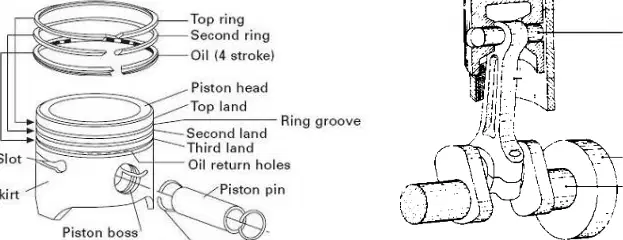
What is the primary function of the piston ring in an engine?
To form a gas-tight combustion chamber for all positions of the piston.
To transmit the heat away from the piston to the cylinder walls.
To join the connecting rod to the piston.
To control the distribution of lubrication oil in the cylinder and piston.
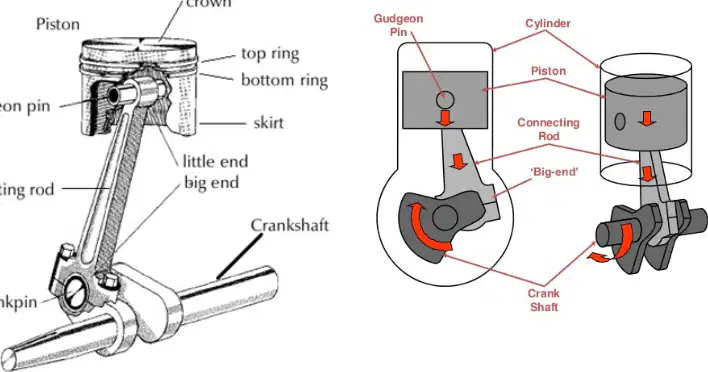
What material is commonly used to make connecting rods due to its strength and durability?
Aluminum and its alloys.
Cast iron.
Drop forged steel.
Pressed steel alloy.
Which type of piston ring prevents leakage of gases from the cylinder and increases compression pressure?
Oil ring.
Compression ring.
Snap ring.
Top ring.
What is the function of the oil ring in an engine?
To control the cylinder lubrication.
To transmit heat away from the piston to the cylinder walls.
To control the distribution of lubrication oil in the cylinder and piston.
To form a gas-tight combustion chamber.
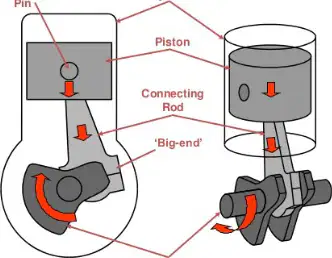
What is the purpose of the piston pin in an engine?
To join the connecting rod to the piston.
To transmit the power of combustion to the crankshaft.
To reduce contact area between the cylinder wall and piston wall.
To form a gas-tight combustion chamber.
What is the main function of the crankshaft in an engine?
To store energy during power strokes
To convert reciprocating motion into rotary motion
To raise and lower inlet and exhaust valves
To control the timing of ignition
Which material is commonly used to make the flywheel?
Aluminum
Cast iron
Steel
Copper
What is the purpose of the crankcase in an engine?
To store energy during idle strokes
To provide a reservoir for lubricating oil
To control the timing of ignition
To convert reciprocating motion into rotary motion
What is the speed of the camshaft in a four-stroke engine compared to the crankshaft?
Equal speed
Half the speed
Twice the speed
One-fourth the speed
What is the function of the timing gear in an engine?
To store energy during power strokes
To control the timing of ignition and valve opening
To raise and lower inlet and exhaust valves
To provide a reservoir for lubricating oil
What is the stroke-bore ratio for tractor engines typically?
1.0
1.25
1.45
2.0
What is the function of the inlet manifold in an engine?
To allow exhaust gases to exit the cylinder
To allow air or air-fuel mixture to enter the cylinder
To control the timing of ignition
To store energy during idle strokes
What is the function of the exhaust manifold in an engine?
To allow air-fuel mixture to enter the cylinder
To allow exhaust gases to exit the cylinder
To control the timing of ignition
To store energy during idle strokes
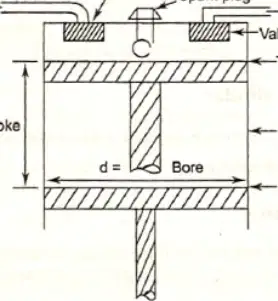
What is the term used to describe the volume displaced by one stroke of the piston in an engine?
Compression ratio
Swept volume
Brake horse power
Indicated horse power
What is the position of the piston called when it is at the top of its stroke?
Bottom dead centre (BDC)
Top dead centre (TDC)
Compression stroke
Power stroke
What is the ratio of the volume of the cylinder at the beginning of the compression stroke to the volume at the end of the compression stroke called?
Swept volume
Compression ratio
Brake horse power
Indicated horse power
What is the S.I. unit of power?
Horse power
Joule
Watt
Kilogram
Which of the following is the power delivered by the engine at the end of the crankshaft?
Indicated horse power (IHP)
Brake horse power (BHP)
Swept volume
Compression ratio
In a four-stroke cycle engine, which event occurs during the first stroke of the piston?
Compression stroke
Power stroke
Suction stroke
Exhaust stroke
How many revolutions of the crankshaft are required to complete the four events in a four-stroke cycle engine?
One revolution
Two revolutions
Three revolutions
Four revolutions
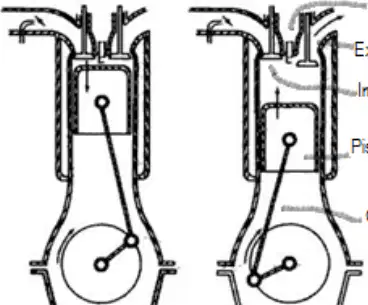
What happens during the suction stroke in an engine?
The piston moves upward, compressing the air-fuel mixture.
The piston moves downward, drawing air or air-fuel mixture into the cylinder.
The piston moves downward, expelling exhaust gases.
The piston moves upward, generating high pressure in the cylinder.
Which valve remains closed during the suction stroke?
Inlet valve
Exhaust valve
Both valves
Spark plug valve
What is the primary function of the compression stroke in an engine?
To expel exhaust gases from the cylinder.
To ignite the air-fuel mixture using a spark plug.
To compress the charge taken into the cylinder by the upward movement of the piston.
To generate mechanical work by rotating the crankshaft.
What causes the piston to move downward during the power stroke?
The opening of the exhaust valve.
The ignition of fuel, generating high pressure in the cylinder.
The compression of air-fuel mixture.
The upward movement of the connecting rod.

What happens during the exhaust stroke in an engine?
The piston moves upward, expelling burnt gases through the exhaust valve.
The piston moves downward, drawing air into the cylinder.
The piston moves upward, compressing the air-fuel mixture.
The piston moves downward, generating mechanical work.
What is the main difference between a two-stroke cycle engine and a four-stroke cycle engine in terms of the sequence of events?
A two-stroke cycle engine completes the sequence of events in two strokes, while a four-stroke cycle engine completes them in four strokes.
A two-stroke cycle engine uses valves, while a four-stroke cycle engine uses ports.
A two-stroke cycle engine has a crankcase that is not airtight, while a four-stroke cycle engine has an airtight crankcase.
A two-stroke cycle engine does not have a power stroke, while a four-stroke cycle engine has one.
What happens during the upward stroke of the piston in a two-stroke cycle engine?
The piston uncovers the exhaust port and transfer port.
The piston compresses the air-fuel mixture and ignites it with a spark plug.
The piston traps the air-fuel mixture and compresses it.
The piston burns the fuel and releases exhaust gases.
Which of the following is an advantage of a CI engine over an SI engine?
The CI engine requires warming up before switching from part load to full load.
The CI engine has a higher expansion ratio, resulting in less heat loss to cylinder walls.
The CI engine has a single carburetor for fuel distribution.
The CI engine has a higher fire risk due to the ignition system.
Why is the reliability of a CI engine higher than that of an SI engine?
The CI engine uses a single carburetor system.
The CI engine has a separate fuel injector for each cylinder.
The CI engine requires warming up before operation.
The CI engine has a higher fire risk due to the ignition system.
What is the primary reason for the minimized fire risk in a CI engine compared to an SI engine?
The CI engine uses diesel fuel, which is less flammable than petrol.
The CI engine has an ignition system that prevents fire risks.
The CI engine does not use a spark plug for ignition.
The CI engine has a cooling system that reduces fire risks.
What is one advantage of a two-stroke cycle engine over a four-stroke cycle engine?
It gives one working stroke for every two revolutions of the crankshaft.
It requires a heavier flywheel due to uniform turning moment.
It gives one working stroke for each revolution of the crankshaft.
It has a more complex valve mechanism.
Why is the mechanical efficiency of a two-stroke engine higher than that of a four-stroke engine?
It has a more complex camshaft and rocker mechanism.
It has fewer oscillations.
It lacks components like camshaft, rockers, and valves.
It requires more spare parts.
Which of the following is a disadvantage of a two-stroke cycle engine?
It requires fewer spare parts.
It consumes more lubricating oil due to greater wear and tear.
It is lighter in weight for the same power and speed.
It is more compact and requires less space.
What is the primary reason for poor thermal efficiency in a two-stroke engine?
The ports remain closed during the upward stroke.
The scavenging process is inefficient, leading to charge dilution.
It uses a separate lubrication system.
It has a higher compression ratio than a four-stroke engine.
What are the two types of conventional ignition systems mentioned in the text?
Battery Ignition System and Spark Ignition System.
Magneto Ignition System and Diesel Ignition System.
Battery or Coil Ignition System and Magneto Ignition System.
Spark Ignition System and Compression Ignition System.
Which type of ignition system is commonly used in 2-wheelers like Pulsar, Kinetic Honda, and Honda Activa?
Battery ignition system
Magneto ignition system
Capacitor discharge ignition system
Electronic ignition system
What is the main principle on which conventional ignition systems work?
Electromagnetic induction
Thermodynamic expansion
Chemical reaction
Mechanical compression
In a battery ignition system, what is the typical voltage supplied by the battery?
3 V or 6 V
6 V or 12 V
24 V or 48 V
1.5 V or 3 V
What is the approximate number of turns in the primary winding of the battery ignition system?
100-150 turns
200-300 turns
500-600 turns
1000-1500 turns
What is the voltage range generated in the secondary winding of the battery ignition system?
1000-5000 volts
5000-10000 volts
28000-30000 volts
40000-50000 volts
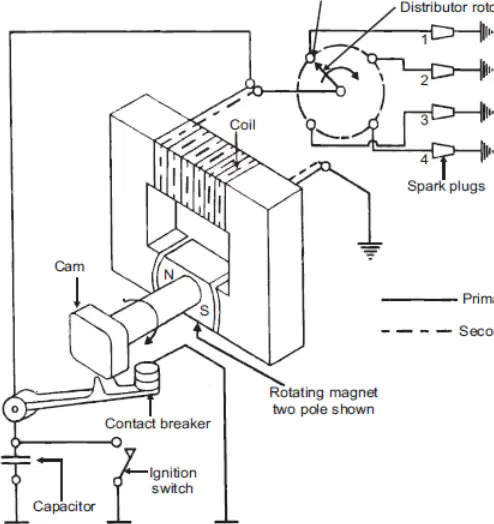
What is the primary function of the distributor rotor in an ignition system?
To produce high voltage current.
To rotate and supply high voltage current to the spark plug based on the engine firing order.
To ignite the combustion products directly.
To control the speed of the engine.
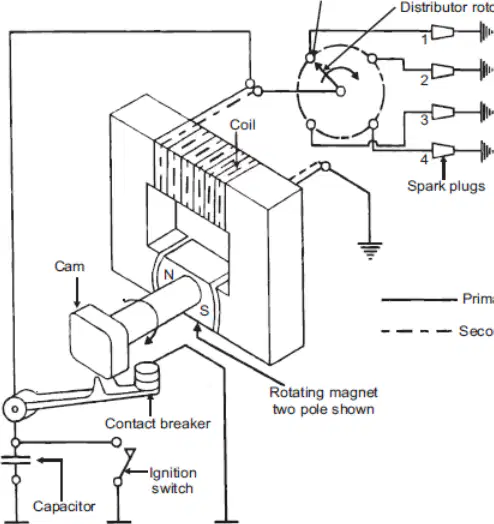
Which component in the magneto ignition system produces the required current for the primary winding?
Battery.
Magneto.
Capacitor.
Distributor rotor.
What is one key difference between battery ignition and magneto ignition systems?
Battery ignition requires a magneto, while magneto ignition does not.
Battery ignition is compact, while magneto ignition occupies more space.
Battery ignition requires a battery, while magneto ignition does not.
Battery ignition produces current for the primary circuit, while magneto ignition does not.
What is a disadvantage of conventional ignition systems?
They require frequent battery maintenance.
They are compact and occupy less space.
They do not produce sparks at low speeds.
They are prone to arcing and pitting of contact breaker points.
Which type of vehicle commonly uses magneto ignition systems?
Cars and buses.
Motorcycles and scooters.
Trucks and heavy machinery.
Airplanes and helicopters.
Which of the following is an advantage of the electronic ignition system?
Moving parts are present, requiring maintenance.
Spark plug life increases by 50%.
Combustion efficiency is lower compared to conventional systems.
Contact breaker parts are prone to arcing.
What is the main function of the tank capacitor in the capacitance discharge ignition system?
To store high voltage for spark generation.
To regulate the engine firing order.
To control the current in the SCR.
To step up the voltage to 12 volts.
Which type of electronic ignition system uses a Silicon Controlled Rectifier (SCR)?
Transistorized system.
Piezo-electric ignition system.
Capacitance discharge ignition system.
The Texaco ignition system.
What voltage range is typically used to charge the tank capacitor in the capacitance discharge ignition system?
6-12 volts.
250-350 volts.
12-24 volts.
100-200 volts.
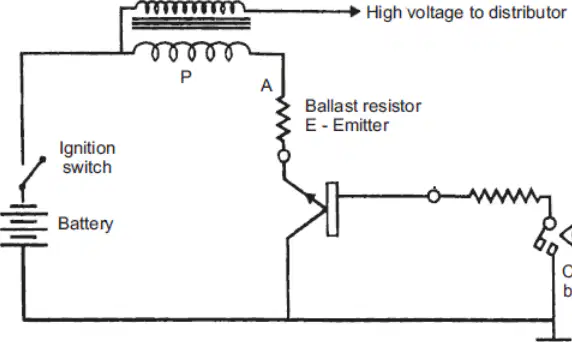
What is one advantage of the Transistorized Assisted Contact (TAC) Ignition System?
The voltage rise-time at the spark plug is reduced.
The low breaker-current ensures longer life.
Mechanical breaker points are not necessary for timing the spark.
The cost of the ignition system is reduced.
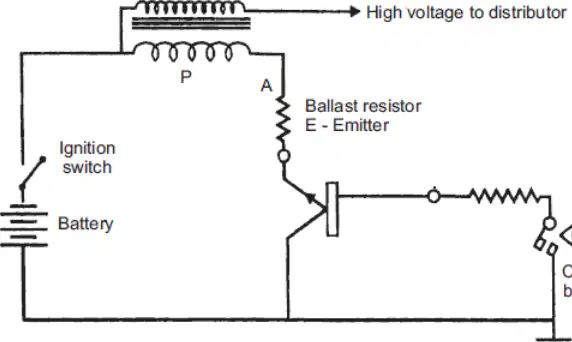
What is one disadvantage of the TAC Ignition System?
The cost of the ignition system is increased.
The smaller gap and lighter point assembly increase dwell time.
The low primary inductance reduces primary current drop-off at high speeds.
The system eliminates the need for mechanical breaker points.
Why have piezo-electric ignition systems not been widely adopted?
They produce insufficient voltage.
They require high mechanical loading of the order of 500 kV.
They are unable to control spark duration.
They are incompatible with single-cylinder engines.
What is the primary purpose of the Texaco Ignition System?
To reduce the cost of ignition systems.
To provide stable ignition at high air-fuel ratios.
To eliminate the need for exhaust gas recirculation systems.
To increase the voltage rise-time at the spark plug.
What component in the mechanical type fuel transfer pump ensures the proper direction of fuel flow?
The eccentric mounted on the camshaft.
The spring-loaded flexible diaphragm.
The spring-loaded valves in the inlet and outlet.
The rocker arm actuated by the eccentric.
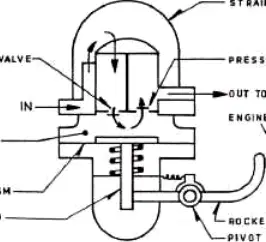
What is the primary function of the diaphragm in a mechanical fuel pump?
To create a vacuum for fuel intake.
To regulate the flow of air into the pump chamber.
To compress the fuel for delivery.
To control the rocker arm movement.
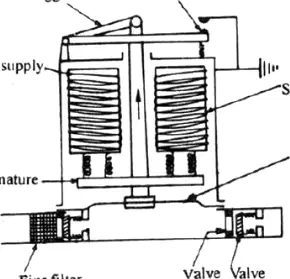
Which component in an electromagnetic fuel pump is responsible for inducing the intake stroke?
Solenoid.
Rocker arm.
Diaphragm spring.
Delivery valve.
What is one of the functions of a carburetor?
To atomize petrol for mixing with air.
To compress air for combustion.
To regulate the temperature of the engine.
To control the speed of the vehicle.
What happens when the toggle switch in an electromagnetic fuel pump makes contact?
The solenoid releases the armature, and fuel is delivered.
The diaphragm creates a vacuum for fuel intake.
The rocker arm moves to open the delivery valve.
The fuel is atomized for combustion.
Which of the following is NOT a function of a carburetor?
Maintaining a constant fuel supply for vaporization.
Preparing a homogeneous mixture of air and vaporized petrol.
Compressing air for combustion.
Atomizing petrol for mixing with air.
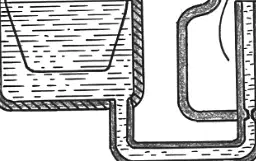
What is the primary function of the float chamber in a simple carburetor?
To mix air and fuel precisely
To maintain the fuel at a constant level
To increase the velocity of the air stream
To control the power of the engine
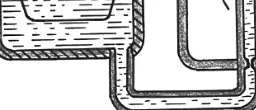
What happens when the fuel level in the float chamber sinks below the normal level?
The needle valve closes, stopping fuel inflow
The float goes up, opening the needle valve
The float goes down, opening the needle valve
The venturi increases the air velocity
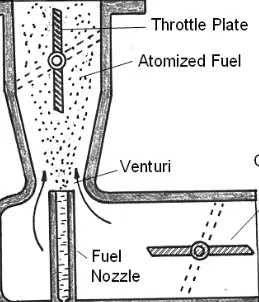
What is the role of the venturi in the mixing chamber of a simple carburetor?
To control the power of the engine
To increase the velocity of the air stream and atomize fuel
To maintain the fuel level in the float chamber
To meter the amount of fuel supplied
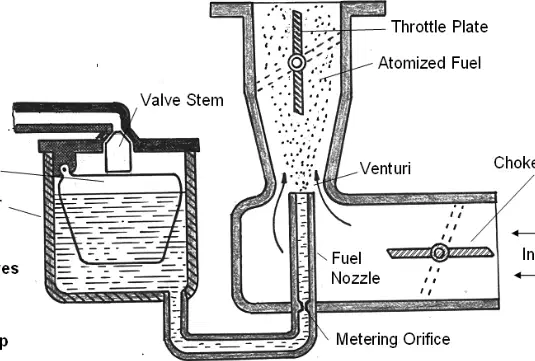
Which component of the carburetor determines the amount of air-fuel mixture passed to the engine?
Venturi
Float chamber
Throttle
Jet tube
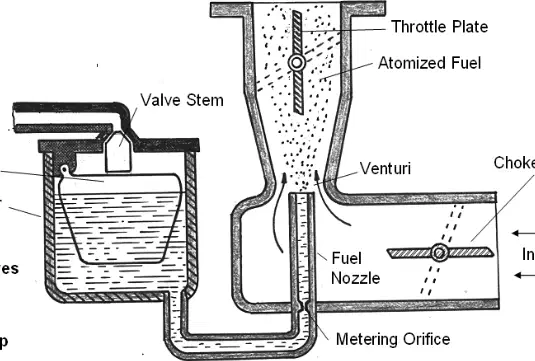
What is the function of the jet tube in a simple carburetor?
To mix air and fuel precisely
To meter the amount of fuel supplied
To control the power of the engine
To increase the velocity of the air stream
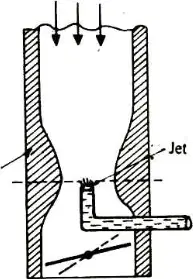
Which type of mixing chamber is the most commonly used according to the provided material?
Upward draught mixing chamber
Horizontal draught mixing chamber
Down draught mixing chamber
Vertical draught mixing chamber

