
 Worksheets
Pharmaceutical Pharmacology 1 – Prelims Lecture
Total questions: 60
Worksheet time: 30mins
Study stating that use of drug treatment is to: cure disease, delay disease progression, alleviate signs and/or symptoms of the disease
Pharmacogenetics
Pharmacoepidemiology
Pharmacotherapy
Pharmacoeconomics
Study of the use cost-effectiveness of drug treatments
Pharmacogenetics
Pharmacoepidemiology
Pharmacotherapy
Pharmacoeconomics
The science of substances used to prevent, diagnose, and treat disease.
Pharmacology
Medical Pharmacology
Toxicology
Toxinology
The study of substances that interact with living systems through chemical process by binding to regulatory molecules and activating or inhibiting normal body processes.
Pharmacology
Medical Pharmacology
Toxicology
Toxinology
Type of Drug Class that once present, can alter the biochemical and physiologic activities of the cell.
Functional Modifiers
Replenishers
Diagnostic Agents
Chemotherapeutic Agents
Dobutamine which is an α – receptor agonist is a type of ________.
Functional Modifiers
Replenishers
Diagnostic Agents
Chemotherapeutic Agents
What type of Thyroid Hormone is used commercially as a replenisher to alleviate hypothyroidism.
Thyroid 3
Thyroid 4
Levo-thyroid 4
Dextro-thyroid 4
Antibiotics is a type of ________.
Functional Modifiers
Replenishers
Diagnostic Agents
Chemotherapeutic Agents
Effect of Drugs in the Body
Pharmacodynamics
Pharmacokinetics
Pharmacotherapeutics
Fate and Disposition - LADME
Pharmacodynamics
Pharmacokinetics
Pharmacotherapeutics
Study of preparing and dispensing drugs
Posology
Pharmacy
Pharmaceutics
Pharmacology
Study of poison usually produced by plant or animal
Pharmacology
Medical Pharmacology
Toxicology
Toxinology
Filipinos are considered as _______, hence they experience _____ as SE of INH
Rapid Acetylators; Hepatotoxicity
Slow Acetylators; Hepatotoxicity
Rapid Acetylators; Peripheral Neuropathy
Slow Acetylators; Peripheral Neuropathy
Refers to a drug that have almost exclusively harmful effects.
Toxin
Side Effect
Poison
Adverse Effect
Toxin from pufferfish
Tetrodotoxin
Saxitoxin
Aflatoxin
Toxin from shellfish
Saxitoxin
Aflatoxin
Tetrodotoxin
Toxin from molds of peanuts
Aflatoxin
Saxitoxin
Tetrodotoxin
An odorless, tasteless, colorless, nonirritating gas formed by hydrocarbon combustion which decreases the oxygen-carrying capacity of the blood leading to ______.
Nitrogen; Cyanosis
Carbon Dioxide; Dehydration
Carbon Monoxide; Cyanosis
Nitrogen; Dehydration
Antiparasitic drug that leads to worm segmentation
Metronidazole
Pyrantel Pamoate
Niacinamide
Niclosamide
A farmer was rushed to the ER because he had burns and irritations due to poison ivy exposure. That area is related to study his case?
Pharmacoepidemiology
Toxinology
Lipophilicity, Degree of Ionization, and Molecular weight are examples of _____.
Physico-Chemical Properties
Pharmacokinetic Properties
Pharmacodynamic Properties
The intensity and quality of effect.
Physico-Chemical Properties
Pharmacokinetic Properties
Pharmacodynamic Properties
First proposed that drug actions were mediated by chemical receptors.
Florey and Chain
Pelletier and Caventou
Dioscorides and Erlich
Langley and Erlich
Refers to any molecule which attaches selectively to particular receptors or sites. CHOOSE THE BEST ANSWER.
Receptor
Ligand
Neurotransmitters
Hormones
It is the component of a cell or organism that interacts with a drug and initiates the chain of events leading to drug’s observed effects.
Receptor
Ligand
Neurotransmitters
Hormones
In the lock and key concept, the lock serves as the _______, while the key serves as the _______.
Substrate and Ligand
Receptor and Substrate
Ligand and Receptor
Capacity of a drug to form the complex with its receptor.
Intrinsic Activity
Agonist
Antagonist
Affinity
The ability of a drug to trigger the pharmacological response after making the drug-receptor complex.
Intrinsic Activity
Agonist
Antagonist
Affinity
Activates a receptor to produce a submaximal effect.
Full Agonist
Partial Agonist
Inverse Agonist
Antagonist
Has an intrinsic activity of less than zero.
Full Agonist
Partial Agonist
Inverse Agonist
Has both high affinity and high intrinsic activity.
Full Agonist
Partial Agonist
Inverse Agonist
Antagonist
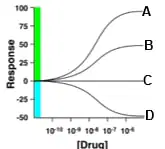
C is a type of ________ ligand. Refer to the graph showing response versus drug concentration with curves labeled A, B, C, and D; curve C is a flat line indicating no change in response.
Full Agonist
Partial Agonist
Inverse Agonist
Antagonist
A patient was rushed to the ER because her symptoms of schizophrenia were not alleviated even after taking her medicines. The pharmacist checked the patient medication profile and found she was taking Phenylephrine and Aripiprazole at the same time. Phenylephrine has an activation ability of 1 while Aripiprazole has an activation ability of more than 0 but less than 1. Which among the drugs is a Full Agonist?
Phenylephrine
Aripiprazole
A patient was rushed to the ER because her symptoms of schizophrenia were not alleviated even after taking her medicines. The pharmacist checked the patient medication profile and found she was taking Phenylephrine and Aripiprazole at the same time. Phenylephrine has an activation ability of 1 while Aripiprazole has an activation ability of more than 0 but less than 1. Which among the drugs is a Partial Agonist?
Phenylephrine
Aripiprazole
A patient was rushed to the ER because her symptoms of schizophrenia were not alleviated even after taking her medicines. The pharmacist checked the patient medication profile and found she was taking Phenylephrine and Aripiprazole at the same time. Phenylephrine has an activation ability of 1 while Aripiprazole has an activation ability of more than 0 but less than 1. Which among the drugs have a mixed agonist–antagonist action?
Phenylephrine
Aripiprazole
A patient was rushed to the ER because her symptoms of schizophrenia were not alleviated even after taking her medicines. The pharmacist checked the patient medication profile and found she was taking Phenylephrine and Aripiprazole at the same time. Phenylephrine has an activation ability of 1 while Aripiprazole has an activation ability of more than 0 but less than 1. Which among the drugs have higher binding activity?
Phenylephrine
Aripiprazole
A patient was rushed to the ER because her symptoms of schizophrenia were not alleviated even after taking her medicines. The pharmacist checked the patient medication profile and found she was taking Phenylephrine and Aripiprazole at the same time. Phenylephrine has an activation ability of 1 while Aripiprazole has an activation ability of more than 0 but less than 1. Which drug will not be able to bind at the α-receptor and not be able to elicit its effects?
Phenylephrine
Aripiprazole
MOA antagonism where two ligands act on different targets producing opposite effects.
Receptor Antagonism
Pharmacological Antagonism
Functional Antagonism
MOA antagonism where two ligands act on the same targets producing opposite effects.
Receptor antagonism
Pharmacological antagonism
Functional antagonism
Both A and B
Antagonism based on duration of interaction where weak forces are formed such as Van der Waals and hydrogen bonding.
Irreversible
Reversible
Antagonism based on duration of interaction where strong forces are formed such as covalent bonds.
Irreversible
Reversible
Case scenario: Histamine is an autacoid responsible for stimulating acid secretion by binding to histamine receptors found in the parietal cells of the stomach. Omeprazole is a drug responsible for inhibiting acid secretion by binding to proton pump receptors found in parietal cells of the stomach. What is the type of antagonism shown in the scenario?
Pharmacologic antagonism
Physiologic antagonism
Reversible antagonism
Irreversible antagonism
Case scenario: Histamine is an autacoid responsible for stimulating acid secretion by binding to histamine receptors found in the parietal cells of the stomach. Omeprazole is a drug responsible for inhibiting acid secretion by binding to proton pump receptors found in parietal cells of the stomach. What will happen if the two drugs are taken together by the patient?
No effect will happen
Increase in effect
Decrease in effect
Case scenario: Ropinirole is a dopamine receptor agonist used as a first-line treatment for restless legs syndrome. Haloperidol is a dopamine receptor antagonist used for schizophrenia. What is the type of antagonism shown in the scenario?
Pharmacologic antagonism
Physiologic antagonism
Reversible antagonism
Irreversible antagonism
Case scenario: A patient was rushed to the ER due to malathion ingestion and inhalation. Malathion is a pesticide which inhibits acetylcholinesterase, the enzyme responsible for the degradation of acetylcholine. If the incident happened within 24 hours, atropine is given. If the poisoning happened after 24 hours, pralidoxime is given. Pralidoxime is given when the antagonism’s duration of action is ________.
Pharmacologic antagonism
Physiologic antagonism
Reversible antagonism
Irreversible antagonism
Case scenario: A patient was rushed to the ER due to malathion ingestion and inhalation. Malathion is a pesticide which inhibits acetylcholinesterase, the enzyme responsible for the degradation of acetylcholine. If the incident happened within 24 hours, atropine is given. If the poisoning happened after 24 hours, pralidoxime is given. Atropine is given when the antagonism’s duration of action is ________.
Pharmacologic antagonism
Physiologic antagonism
Reversible antagonism
Irreversible antagonism
It is usually the desired effect that leads to its therapeutic use. Which combination best describes this effect?
Side effect
Adverse effect
Secondary effect
Primary effect
It is the unintended effect.
Side effect
Adverse effect
Secondary effect
All of the above
Alter cell function by drug–receptor interactions.
Structural non‑specific
Structural specific
Alter the cell environment by physical or chemical processes.
Structural non‑specific
Structural specific
Type of regulatory protein that conduct changes in ion channels.
Receptors
Carrier molecules
Voltage‑gated ion channels
Enzymes
Lidocaine is a local anesthetic blocking sodium channels. What is its effect on VGIC?
(+) Depolarization
Excitatory
(−) Hyperpolarization
Relaxation
Minoxidil is an arterial vasodilator acting on potassium channels through activation. What is its effect on VGIC?
(+) Depolarization
Excitatory
(−) Hyperpolarization
Relaxation
NAP, NCX, and PPI are ______ type of regulatory proteins.
Receptors
Carrier molecules
Voltage‑gated ion channels
Enzymes
Case scenario: A patient experiencing heart failure was given digoxin. After a few minutes, the contraction of the patient’s heart stabilized. How will digoxin alleviate heart failure?
Inhibit NCX; decrease calcium
Inhibit NCX; increase calcium
Inhibit NAP; increase calcium → contraction
Inhibit NAP; decrease calcium
Case scenario: A patient experiencing heart failure was given digoxin. After a few minutes, the contraction of the patient’s heart stabilized. What effect does digoxin give?
(+) Inotropy → contraction
(+) Chronotropy
(+) Dromotropy
All are proton pump inhibitors, EXCEPT.
Esomeprazole
Aripiprazole
Omeprazole
Pantoprazole
Biological catalysts that hasten catalytic reactions.
Receptors
Carrier molecules
Voltage‑gated ion channels
Enzymes
Moclobemide is a ______ selective inhibitor. That is why it is given to ______.
MAO B; Parkinson’s disease
MAO B; Major depression
MAO A; Major depression
MAO A; Parkinson’s disease
Selegiline is a ______ selective inhibitor. That is why it is given to ______.
MAO B; Parkinson’s disease
MAO B; Major depression
MAO A; Major depression
MAO A; Parkinson’s disease

