
Font size
 Worksheets
PHYSICS | Kinematics
Total questions: 99
Worksheet time: 17hrs 30mins
what is the speed of an object at rest?
0.0 m/s
1.0 m/s
9.81 m/s
-9.81 m/s2
Acceleration is
displacement
the rate of change of displacement
velocity
the rate of change of velocity
Velocity is (select all that apply)
speed with a direction
a vector
rate of change of displacement
rate of change of acceleration
Displacement is (select all that apply)
how far an object is from where it started
how far an object has traveled
a scalar
a vector
distance is (select all that apply)
a scalar
how far an object moves is all of its travels
always positive
how far an object is from where it started
A shopping cart given an initial velocity of 2.0 m/s undergoes a constant acceleration of 3.0 m/s2. What is the magnitude of the cart's displacement after the first 4.0 s of its motion?
10.0 m
55 m
32 m
80.0 m
A curious kitten pushes a ball of yarn at rest with its nose displacing the ball of yarn 15.4 cm in 3.00 s. What is the acceleration of the ball of yarn?
4.38 cm/s2
3.42 cm/s2
46.2 cm/s2
18.4 cm/s2
A rock is thrown straight upward with an initial velocity of 24.5 m/s where the downward acceleration due to gravity is -9.81 m/s2. What is the rock’s displacement after 1.00 s?
9.81 m
19.6 m
24.5 m
29.4 m
Human reaction time is usually about 0.20 s. If your lab partner holds a ruler between your finger and thumb and releases it without warning, how far can you expect the ruler to fall before you catch it?
4.0 cm
9.8 cm
16.0 cm
19.6 cm
A runner moves 40 m to the right and then 10 m to the left. What is the runner’s displacement after the two moves?
30 m to the right
40 m to the right
50 m
30 m
What is the standard SI unit for acceleration?
m/s
m/s 2
m
s
What is the standard SI unit for distance?
m/s
m/s 2
m
s
select all of the properties that are scalars
distance
time
temperature
speed
displacement
Select all of the properties that are vectors
acceleration
time
velocity
displacement
a vector is a quantity with
magnitude and direction
magnitude or direction
magnitude only
direction only
In one-dimensional motion, the average speed of an object that moves from one place to another and then back to its original place has which of the following properties?
It is positive.
It is negative.
It is zero.
It can be positive, negative, or zero.
It isn't zero
A cheetah can run at approximately 100 km/hr and a gazelle at 80.0 km/hr. If both animals are running at full speed, with the gazelle 70.0 m ahead, how long before the cheetah catches its prey?
12.6 s
25.2 s
6.30 s
10.7 s
6.30 s d. 10.7 s e. 20.3 s
An automobile driver puts on the brakes and decelerates from 30.0 m/s to zero in 10.0 s. What distance does the car travel?
150 m
196 m
336 m
392 m
421 m
A rock, released at rest from the top of a tower, hits the ground after 1.5 s. What is the speed of the rock as it hits the ground? (g = 9.8 m/s2 and air resistance is negligible)
15 m/s
20 m/s
31 m/s
39 m/s
40 m/s
A trucker drives with an average velocity of 27 m/s towards the east on a perfectly straight highway. What will the trucker's displacement be after 2 minutes?
97 m; east
190 m; east
1600 m; east
3200 m; east
What is the definition of "One-Dimension" in the context of motion?
An object or motion that can be specified with a single coordinate and occurs along a straight line or single axis.
Objects or motion that can be described using two spatial dimensions.
The study of motion using words, numbers, graphs, and equations.
Motion that occurs in three-dimensional space.
Which of the following best describes "Two-Dimension" in the context of motion?
Objects or motion that can be described using two spatial dimensions, typically length and width, and that exist on a flat plane.
Motion that occurs along a single axis, such as left or right.
The study of motion using graphs and equations.
Motion that occurs in a three-dimensional space.
What does "Kinematics" study?
The study of motion using words, numbers, graphs, and equations.
The study of forces acting on objects.
The study of energy transformations.
The study of objects in three-dimensional space.
Which of the following best defines a scalar quantity?
A quantity that has both a magnitude and a direction.
A quantity that has only a magnitude (number or value).
A vector quantity that refers to how far your ending point is from your starting point.
A scalar quantity that refers to how much ground an object has covered during its motion.
What is the key difference between a scalar and a vector quantity?
Scalars have only magnitude, while vectors have both magnitude and direction.
Scalars have direction, while vectors have only magnitude.
Scalars and vectors both have only magnitude.
Scalars and vectors both have only direction.
Which of the following is an example of a scalar quantity?
Displacement
Distance
Velocity
Acceleration
What does displacement measure in physics?
The total ground covered by an object during its motion.
A scalar quantity that refers to the total distance traveled.
A vector quantity that refers to how far your ending point is from your starting point.
A quantity that has only magnitude.
Which of the following is true about distance?
It is a vector quantity that measures the shortest path between two points.
It is a scalar quantity that refers to how much ground an object has covered during its motion.
It is a vector quantity that refers to the direction of motion.
It is a scalar quantity that measures the displacement of an object.
What is the ratio of distance and time, which is always positive, called?
Velocity
Speed
Instantaneous Velocity
Average Velocity
Which term refers to the ratio of displacement and time, and can be positive or negative?
Speed
Instantaneous Velocity
Velocity
Average Velocity
What is the speed at any given instant in time called?
Average Velocity
Velocity
Instantaneous Velocity
Speed
What is the total displacement covered over the total time referred to as?
Speed
Instantaneous Velocity
Velocity
Average Velocity
What is the SI unit of time?
Meter (m)
Second (s)
Kilogram (kg)
Minute (min)
What is the SI unit of speed or velocity?
Meter (m)
Second (s)
Meter per second (m/s)
Kilometer per hour (km/h)
How is acceleration defined?
The distance covered by an object
The change in the object's motion
The time taken for an object to stop
The force applied to an object
What is the SI unit of acceleration?
Meter per second (m/s)
Meter per second squared (m/s²)
Kilometer per hour squared (km/h²)
Newton (N)
What is the SI unit for Distance/Displacement?
meter (m)
second (s)
kilogram (kg)
newton (N)
What does the symbol Δ (delta) represent in physics?
The sum of two quantities
The change or difference between two values of a quantity
The product of two values
The average of two values
What does Δv represent in physics?
Change in velocity
Final velocity
Initial velocity
Average velocity
What does the symbol vf represent in physics?
Initial velocity
Final velocity
Average velocity
Change in velocity
What does the symbol "v₀" represent in physics?
Final velocity
Initial velocity
Acceleration
Change in displacement
What does the symbol "Δt" represent?
Change in displacement
Change in time
Acceleration
Initial velocity
What does the symbol "Δx" represent in physics?
Change in displacement
Change in time
Acceleration
Initial velocity
What does the symbol "a" represent in physics?
Initial velocity
Change in time
Acceleration
Change in displacement
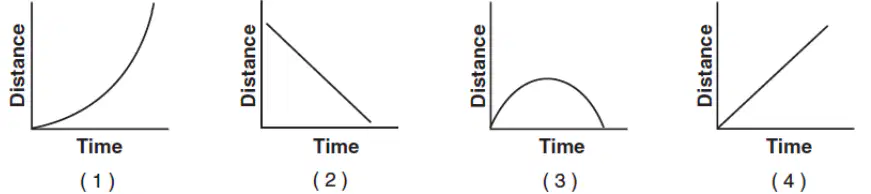
A cart travels with a constant, nonzero acceleration along a straight line.
Which graph best represents the relationship between the distance the cart travels and the time of travel?
Graph 1
Graph 2
Graph 3
Graph 4
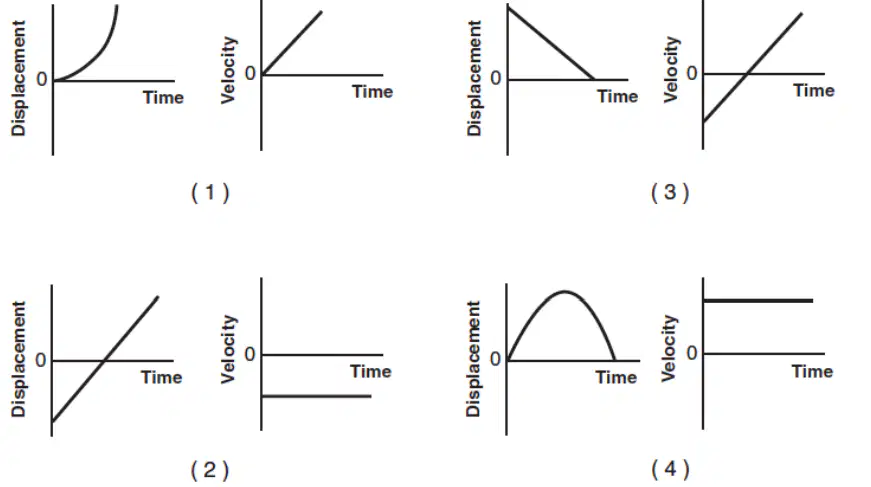
Which pair of graphs represents the same motion of an object?
Graph Set 1
Graph Set 2
Graph Set 3
Graph Set 4
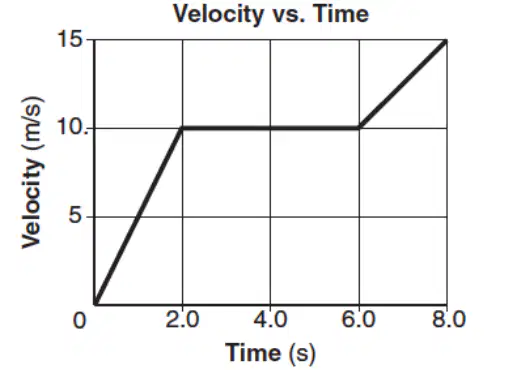
The graph to the left represents the velocity of an object traveling in a straight line as a function of time.
Determine the magnitude of the total displacement of the object at the end of the first 6 seconds.
20 m
50 m
60 m
65 m
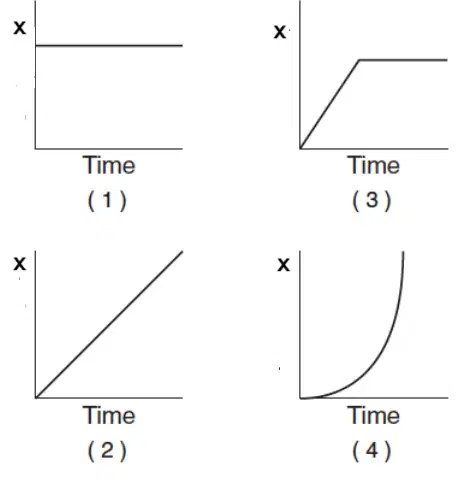
Which graph best represents the motion of a car uniformly accelerating down a ramp?
Graph 1
Graph 2
Graph 3
Graph 4
A truck traveling at 75 km/hr north is a description of a:
Scalar quantity
Vector quantity
Both
Neither
A truck is traveling down the highway at 65 mi/hr.
Scalar quantity
Vector quantity
Both
Neither

On the position vs. time graph, what is the object doing from t = 4 s to t = 6 s?
At rest
Speeding up
Slowing down
On the position vs. time graph, what is the object doing from t = 7 s to t = 9 s?
moving backward.
speeding up
moving forward
slowing down
During which time interval does the object have the greatest speed?
t = 6\,\text{s} \text{ to } t = 9\,\text{s}
t = 1\,\text{s} \text{ to } t = 4\,\text{s}
t = 4\,\text{s} \text{ to } t = 6\,\text{s}

On the displacement vs. time graph, what is the object doing between t = 5 s and t = 10 s?
moving backward
speeding up
slowing down
moving forward
How would you find the velocity of the object from this graph?
area under the curve
slope of the line
read the value on the y-axis
cannot be determined from this graph
What is the velocity of the object between t = 0 and t = 5 s?
0.8 m/s
0.6 m/s
0.5 m/s
0.9 m/s

How would you calculate the displacement of the object from the graph?
area under the curve
slope of the line
read the value on the x-axis
cannot be determined from this graph
What is the displacement of the object from t = 0 min to t = 10 min?
300 m
30 m
6 m
600 m
From t = 15 min to t = 30 min, the object is (slowing down / speeding up) because its velocity is (+ / -) and its acceleration is (+ / -).
slowing down, +v, -a
speeding up, +v, -a
slowing down, -v, -a
slowing down, -v, +a
From t = 30 min to t = 40 min, the object is (slowing down / speeding up) because its velocity is (+ / -) and its acceleration is (+ / -).
speeding up, -v, -a
slowing down, -v, -a
speeding up, +v, -a
slowing down, -v, +a

In graph (i), the acceleration is ( + / - / 0 ) and the object is ____.
+ / moving with constant acceleration
- / moving with constant acceleration
+ / moving with increasing acceleration
- / moving with decreasing acceleration
In graph (ii), the acceleration is ( + / - / 0 ) and the object is ____.
- / moving with constant acceleration
+ / moving with constant acceleration
- / moving with increasing acceleration
+ / moving with 0 acceleration
In graph (iii), the acceleration is (+ / - / 0) and the object is ____.
0 / moving with constant velocity
+ / moving with increasing acceleration
- / moving with constant acceleration
+ / moving with constant acceleration

In graph 1, the velocity is ( + / - / 0 ) and the object is ____.
+ / moving with constant velocity.
- / moving with constant velocity.
+ / moving with 0 velocity.
+ / moving with increasing velocity.

On the position vs. time graph, what is this object doing?
Moving to the right; slowing down to a rest.
Moving to the right; speeding up.
Moving to the left; slowing down to a rest.
Moving to the right; moving with a constant speed.

On the position vs. time graph, what is the object doing?
Moving to the left with increasing speed.
Moving to the left with decreasing speed.
Moving to the left with a constant speed.
Moving to the right with a constant speed.

On the velocity vs. time graph, what is this object doing?
Speeding up to the left with a constant acceleration.
Speeding up to the right with a constant acceleration.
Slowing down to the left with a constant acceleration.
Slowing down to the right with a constant acceleration.

Who had the greatest average speed after 100 seconds?
Mike
Katelyn
Alex
They had the same average speed

What is happening at point C?
Stationary
Accelerating
Fast steady speed; moving away from the starting position
Slower steady speed; moving away from the starting position

What is happening at D?
Stationary
Accelerating
Fast, steady speed; moving away from the starting position
Slower, steady speed; moving away from the starting position
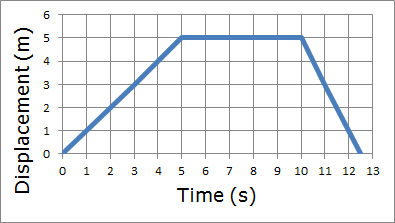
According to the graph, how far does the person travel in the first 5 seconds?
2 m
10 m
0 m
5 m
Which two measurements are necessary to calculate average velocity?
Final velocity and time
Acceleration and final velocity
Acceleration and displacement
Displacement and time
What is the equation to calculate average speed?
average speed = total distance / total time
average speed = total time / total distance
average speed = total time × total distance
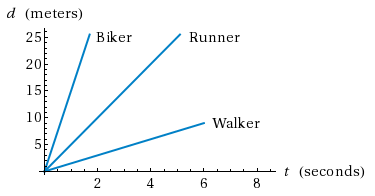
Which person moved the fastest in 3 seconds?
Biker
Runner
Walker
They are all moving equally

At what point in time does this person turn around?
3 seconds
5 seconds
10 seconds
25 seconds

Which graph shows the greatest positive velocity?
A
B
C
D

Which graph represents zero acceleration (constant velocity)?
A
B
C
D

Which graph represents the greatest acceleration?
A
B
C
D
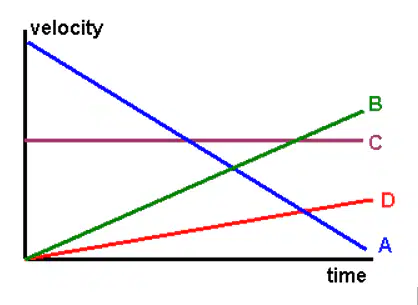
Which line represents constant acceleration?
A
B and D
Only C
A, B, and D
Vector quantities need both a magnitude and a _____.
distance
displacement
direction
velocity
Which of the following groups of graphs could represent the position, velocity, and acceleration of a moving object as functions of time?
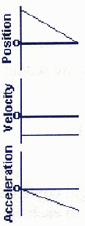
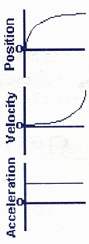
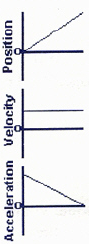
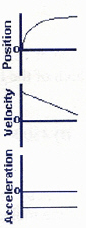

What does the graph represent?
no motion
constant velocity
increasing velocity
decreasing velocity
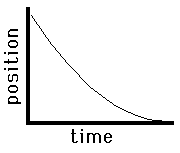
Describe the motion shown in the graph:
Slow to fast; Negative direction
Fast to slow; Negative direction
Fast to slow; Positive direction
Slow to fast; Positive direction

In section 5 of the velocity-time graph, the object is
speeding up while moving in the positive direction
slowing down while moving in the positive direction
speeding up while moving in the negative direction
slowing down while moving in the negative direction

The figure above shows the velocity v and acceleration a vectors for a ball thrown into the air. (Ignore air resistance)
Which of the following could be the velocity and acceleration vectors when the ball is at the highest point in its path?

9


When an object falls freely in the absence of air resistance, what happens?
It accelerates at a constant rate until it hits the ground.
It accelerates at a non-constant rate until it hits the ground.
It accelerates at a constant rate until it reaches terminal velocity.
It accelerates at a non-constant rate until it reaches terminal velocity.
Which of the following statements applies to the motion of a ball rising and then falling in free fall?
I. The ball has constant acceleration as it moves upward.
II. The ball has constant acceleration at the top of its path.
III. The ball has constant acceleration as it moves downward.
I only
III only
I and III
I, II, and III
Which would hit the ground first if dropped from the same height in the absence of air resistance—a feather or a hammer?
the feather
the hammer
They would hit the ground at the same time.
They would be suspended (floating) in air.
A free-falling object falls under the influence of:
An object in a state of free fall is:
under the force of gravity only.
under the force of air resistance.
experiencing a net force.
under the force of gravity and air resistance.

Which of these dot diagrams represents a free-falling object dropped from rest?
A
B
C
D

If two rocks of different sizes and masses are dropped from the same height, which one will hit the ground first?
larger rock
smaller rock
both will reach the ground at the same time
Which would fall with greater acceleration in a vacuum (no air resistance): a leaf or a stone?
the leaf
the stone
They would accelerate at the same rate.
It is difficult to determine without more information.
What does it mean for something to be in free fall?
Its motion is only affected by gravity.
Its downward motion is only affected by gravity.
Its upward motion is only affected by gravity.
Its motion is not affected by gravity.

Which of the following is true about the direction of the ball’s velocity and acceleration between A and B?
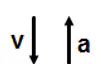
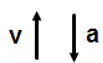
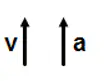

Which of the following is true about the direction of the ball’s velocity and acceleration between B and C?
Considering the diagram to the left, what is true about the direction of the acceleration due to gravity?
always acts in the upward direction and is constant
acts upward at a constant rate, then at point B, there is no acceleration, then acts downward at a constant rate
always acts downward at a constant rate

