
NEW
Font size
 Worksheets
Introduction to Antihypertensive Agents and Diuretics
Total questions: 30
Worksheet time: 15mins
A 58-year-old with stage 2 hypertension and diabetic nephropathy needs long-term outcome benefit. Which change best aligns with evidence for ACE inhibitors?
Switch to atenolol to lower heart failure admissions
Start lisinopril to reduce renal disease progression
Add loop diuretic to normalize cardiac output immediately
Use thiazide only to reverse end-organ damage quickly
After initiating a thiazide, which patient scenario should prompt adding a loop diuretic instead of simply increasing the thiazide dose?
Blood pressure falls 10 mm Hg after six weeks
Serum potassium slightly low but asymptomatic
Mild essential hypertension responsive to 25 mg dose
Glomerular filtration rate less than 30 mL per minute
A patient on hydrochlorothiazide 25 mg daily has persistent hypertension and normal renal function. Which adjustment is most reasonable before adding a second class?
Increase thiazide dose toward 50 mg for effect
Stop thiazide due to reduced cardiac output
Switch to loop diuretic as more natriuretic
Add beta-blocker to correct vascular resistance
Which adverse effect pattern most requires counseling when starting a thiazide in a patient with gout and borderline glucose intolerance?
Acute kidney injury from potent vasoconstriction
Bradycardia with worsened heart block risk
Hyperuricemia and impaired glucose tolerance risk
Life-threatening hyperkalemia within 24 hours
You are asked to justify ACE inhibitor selection for an older patient with isolated systolic hypertension and high cardiovascular risk. Which rationale best reflects mechanism and outcomes?
Stimulates sympathetic tone, maintaining diastolic pressure
Blocks angiotensin II formation, lowering resistance and protecting kidneys
Directly dilates veins only, rapidly normalizing cardiac output
Inhibits aldosterone receptors, eliminating sodium within hours
A clinician expects diuretics to lower blood pressure primarily by which time-dependent sequence?
Late sodium retention raising stroke volume
Sustained cardiac output reduction causing hypotension
Immediate neurogenic dilation without natriuresis
Early volume loss then decreased peripheral resistance
A patient with severe hypertension on multiple sodium-retaining agents needs additional control. Which diuretic strategy is most appropriate?
Add loop diuretic targeting the loop of Henle
Stop all diuretics to prevent magnesium loss
Use low-dose thiazide monotherapy indefinitely
Start ACE inhibitor only for rapid natriuresis
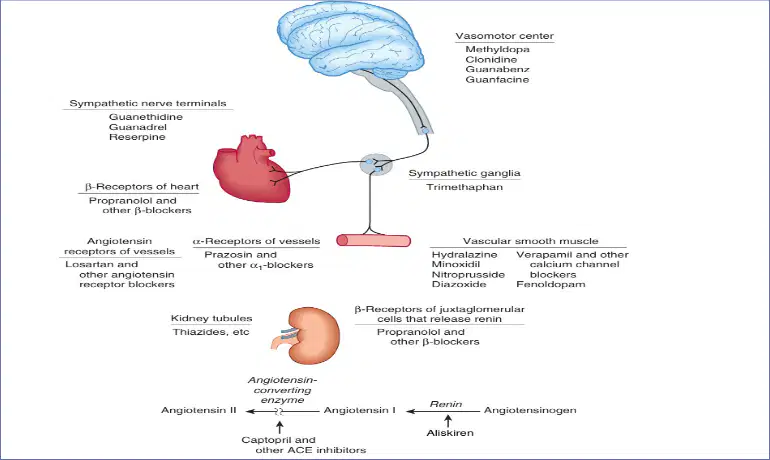
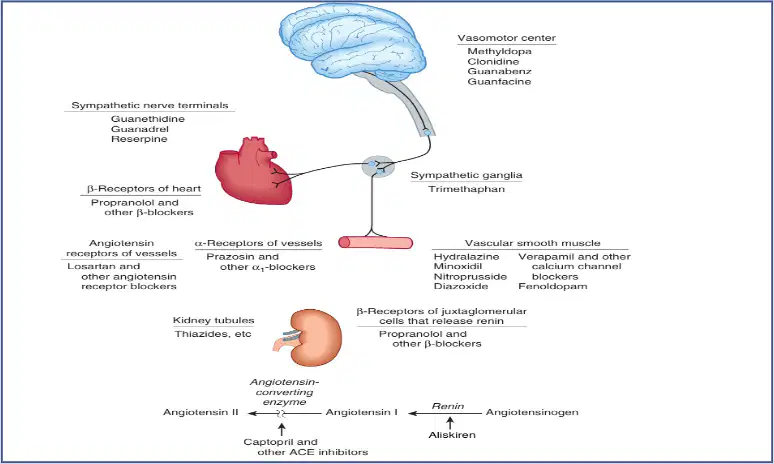
Interpret the diagram of antihypertensive drug targets: choosing a drug to reduce arteriolar resistance while sparing heart rate, which class directly blocks angiotensin II receptors on vessels?
Verapamil and other calcium channel blockers
Losartan and other angiotensin receptor blockers
Propranolol and other beta-receptor blockers
Prazosin and other alpha1-receptor blockers
A patient with pregnancy-related hypertension needs a central agent. Which choice best balances mechanism and safety for this scenario?
Methyldopa stimulating central alpha adrenoceptors
Guanabenz blocking peripheral alpha-1 adrenoceptors
Guanfacine acting as beta-2 partial agonist only
Clonidine activating imidazoline receptor predominantly
Two drugs are being compared: one lowers heart rate and cardiac output more than the other due to sensitizing brainstem vasomotor centers to baroreflex inhibition. Which drug has this profile?
Clonidine with greater cardiac output reduction
Methyldopa with stronger chronotropic effect
Guanabenz with minimal baroreflex impact
Guanfacine with predominant beta blockade
A patient on methyldopa develops sedation at therapy onset and later shows a positive Coombs test after months. What is the most appropriate clinical decision?
Switch to clonidine abruptly without taper
Add tricyclic antidepressant to offset sedation
Increase dose to overcome tolerance
Consider discontinuation due to hemolytic risk
Which scenario most likely reflects clonidine pharmacokinetics and dosing strategy for smooth control?
Administer once weekly oral pulses
Use twice-daily oral dosing or a patch
Give intravenous boluses at bedtime
Use sublingual tablets only during crises
A patient taking clonidine and a tricyclic antidepressant has rising blood pressure. What mechanism best explains the interaction?
Tricyclics block alpha adrenoceptor–mediated antihypertensive effect
Tricyclics increase clonidine bioavailability via CYP inhibition
Tricyclics enhance imidazoline receptor stimulation
Tricyclics potentiate baroreflex inhibition synergistically
After missing two doses of high-dose clonidine taken for months, a patient presents with severe headache, tachycardia, and sweating. What is the best immediate management principle?
Reinstate clonidine and taper gradually
Stop clonidine permanently and observe
Add tricyclic antidepressant urgently
Switch immediately to methyldopa without overlap
Which hemodynamic change is most characteristic when arterial pressure falls with clonidine therapy?
Marked postural hypotension due to venous pooling
Decreased renal vascular resistance with maintained blood flow
Reduced supine pressure with frequent syncope
Increased cardiac output with tachycardia
A clinician must choose between methyldopa and clonidine for a patient prone to depression. Which plan minimizes risk based on drug profiles?
Prefer clonidine because it elevates mood
Start clonidine and stop if sedation occurs
Use methyldopa only with TCA co-therapy
Avoid clonidine due to depression risk
A patient on guanethidine develops severe postural hypotension after starting a tricyclic antidepressant. Which reasoning best explains the blood pressure change?
Antidepressant enhances norepinephrine vesicular storage
Antidepressant blocks guanethidine neuronal uptake mechanism
Antidepressant increases renal sodium and water retention
Antidepressant stimulates peripheral beta-2 adrenoceptors
A man taking high-dose guanethidine reports retrograde ejaculation and diarrhea. Which mechanism links both adverse effects?
Alpha-1 receptor blockade in the bladder neck
Direct muscarinic receptor agonism by guanethidine
Parasympathetic predominance on smooth muscle activity
Local anesthetic effect on pelvic autonomic nerves
Reserpine is avoided in a patient with a history of major depression and peptic ulcer. What integrates the risks in this case?
Direct cholinergic agonism provoking dysphoria and ulcers
Dopamine D2 stimulation increasing stress and acid output
Peripheral beta-2 blockade causing anxiety and acid reflux
Central monoamine depletion worsening mood and gastric secretion
A patient on long-term propranolol wants to stop abruptly. Using pathophysiology, what consequence is most concerning?
Persistent bradycardia due to residual beta blockade
Pulmonary edema from sudden sodium retention
Rebound angina from beta-adrenoceptor supersensitivity
Acute hypertension from alpha-1 receptor upregulation
During exercise testing, a patient on propranolol shows reduced heart rate rise. Why does this occur?
Enhanced vagal tone via muscarinic receptor agonism
Inhibited renin-angiotensin signaling in the lungs
Blocked beta-1 response to catecholamines during exertion
Reduced preload from alpha-1 vasodilation at muscles
You must choose a beta blocker for a hypertensive patient with mild asthma. Which option applies reasoning about receptor selectivity and dose?
Metoprolol at cautious doses for relative beta-1 selectivity
Propranolol at standard doses despite bronchospasm risk
Nadolol because nonselective agents spare the bronchi
Pindolol because partial agonists reduce airway tone
A patient with ischemic heart disease has low renin hypertension. What property of propranolol still supports its use?
Cardiac output reduction lowering myocardial oxygen demand
Peripheral beta-2 blockade improving skeletal blood flow
Direct diuretic action decreasing intravascular volume
Alpha-1 antagonism reducing systemic vascular resistance
Clinic protocol prefers once-daily dosing for adherence. Between metoprolol and atenolol, which reasoning favors atenolol for hypertension?
Higher lipid solubility ensures sustained CNS presence
Greater intrinsic sympathomimetic activity extends coverage
Longer half-life and renal excretion allow once-daily use
Stronger beta-2 blockade provides longer antihypertensive
A patient with reduced renal function needs a long-acting beta-1 blocker. Which option requires dose reduction to avoid accumulation?
Propranolol due to high first-pass extraction
Metoprolol due to extensive CYP2D6 metabolism
Carvedilol due to biliary excretion pathways
Nadolol due to renal elimination and long half-life
You are preparing for a hypertensive emergency in pheochromocytoma. Which agent’s mixed alpha and beta blockade is most logical?
Labetalol providing combined alpha-beta antagonism
Atenolol providing selective beta-1 antagonism
Esmolol providing ultra–short beta-1 blockade
Nebivolol releasing nitric oxide for vasodilation
A patient with heart failure and hypertension needs mortality benefit. Which beta blocker choice is most evidence-based?
Nadolol weekly dosing reverses systolic failure
Pindolol titration prevents remodeling effectively
Acebutolol daily reduces sudden death risk
Carvedilol twice daily improves survival outcomes
In a perioperative setting, you need tight, moment-to-moment beta-1 control. Which dosing strategy is most appropriate?
Esmolol IV infusion with short half-life titration
Atenolol oral loading with extended-release form
Metoprolol IM bolus every 6 hours as needed
Nadolol oral dose with delayed onset kinetics
A clinician selects nebivolol for a patient with hypertension and endothelial dysfunction. What rationale supports this choice?
Intrinsic sympathomimetic activity raising heart rate slightly
Beta-1 selectivity with nitric oxide–mediated vasodilation
Nonselective blockade increasing skeletal vasoconstriction
Alpha-1 antagonism predominating over beta blockade
A patient with bradyarrhythmia requires a beta blocker for angina. Using pharmacology, which agent should be avoided due to partial agonist effects?
Bisoprolol because long half-life quickens sinus rate
Atenolol because selectivity increases pacemaker rate
Pindolol because agonist activity may worsen rate
Metoprolol because CYP2D6 enhances automaticity

