
 Worksheets
Units 9-10 World History
Total questions: 105
Worksheet time: 53mins

Which option best explains why Western merchants sought Asian markets during the 1800s?
To end all trade with the Americas and Africa
To avoid competition in European home markets entirely
To buy high-value luxury goods like silks and spices
To spread European languages across all Asian ports
Which raw materials were prime targets of Western industrial demand in Asia?
Cotton for American plantations
Rubber for tires and machinery
Oil for fuel and industry
Coal for steam power
Wheat for European bakeries
Which development reflects colonial expansion as a motivation for accessing Asia?
Ending resource extraction to protect forests
Replacing industrialization with cottage industries
Establishing European-controlled settlements and administrations
Closing all Asian ports to foreign ships

Which combination best captures both economic and political drivers behind Western interest in Asia?
Charitable aid programs and language education
Profits from luxury goods and control through colonies
Religious pilgrimages and artistic exchanges
Isolationist policies and reduced maritime trade
Which tactic did European merchants primarily use to open Chinese markets in the 1800s?
Diplomatic cultural exchanges with gifts
Selling addiction products like opium
Building railways to boost local trade
Funding Chinese naval modernization
What was a direct outcome of the opium trade in China during the 1830s?
Qing officials legalized all narcotics nationwide
China formed an equal trade partnership with Britain
European demand for Chinese tea collapsed
Over twelve million became addicted to opium

Which conflict forced China to accept unequal trade terms with Western powers?
Opium Wars
Crimean War
Boxer Uprising
Taiping Rebellion
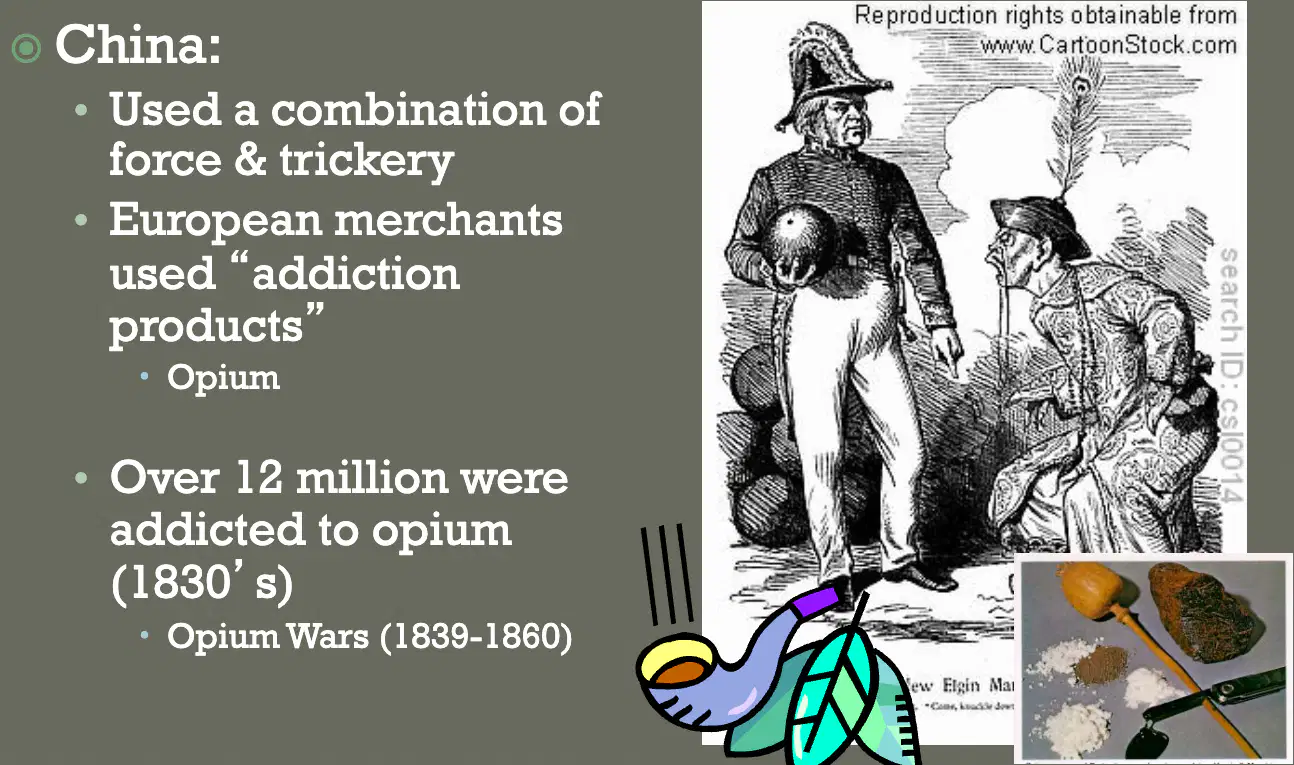
Which combination best describes Western methods for entering Chinese markets?
Force in warfare and naval pressure
Addiction products like opium
Trickery through unequal treaties
Cultural assimilation and missionary schools
In 1853, who led the first successful mission that compelled Japan to open ports to the United States?
Captain Alfred Mahan
Admiral Horatio Nelson
Commodore Matthew Perry
General Charles Gordon
Which description best explains how Western nations initially accessed Japanese markets in the 1850s?
Through joint scientific expeditions and fairs
By sheer military force and gunboat diplomacy
With long-term cultural exchange programs
Via free trade zones requested by daimyo
After Perry’s mission, how did other Western countries approach Japan?
They negotiated only humanitarian agreements
They followed his example and forced entry
They focused solely on missionary activities
They avoided involvement to respect isolationism

Which pair correctly matches country and Western strategy used to gain access in the 1800s?
China — scientific alliances and scholarships
Japan — voluntary commercial partnerships
China — opium trade and military coercion
Japan — isolation strengthened by treaties
Which statement best summarizes imperialism in East Asia during the mid-1800s?
Local governments directed mutually beneficial trade
Asian states initiated colonization of Europe
Western powers relied on peaceful cultural exchange
Military pressure and unequal treaties expanded access
Which reform effort in China aimed at rapid modernization and lasted only a short period?
Self-Strengthening Movement nationwide overhaul
Hundred Days of Reform in China
Taiping Reforms under Hong Xiuquan
Late Qing Restoration long campaign
Which country is associated with Western-style modernization as a response to imperialism?
China during the Qing court
Japan through Meiji changes
Korea under Joseon rulers
Siam led by Rama III

Which group in China sought to expel foreigners and was linked to an uprising around 1898–1901?
Imperial Maritime Customs
Society of the Harmonious Fists
Heavenly Kingdom Reformers
Eight-Nation Alliance Council
Which statements describe armed resistance rather than reform?
Hundred Days of Reform modernized institutions
The Boxer Rebellion occurred 1898–1901
Society of the Harmonious Fists targeted foreigners
Western-style modernization transformed Japan
What are two contrasting strategies Asian leaders used in response to imperialism?
Religious isolation and tribute revival
Colonial alliances and protectorates
Mercantilist tariffs and monopolies
Internal reforms and armed resistance
Which pair best explains why Britain was interested in India during the 1800s?
Establishing democracy and cultural exchange
Alliance building with Indian princely states
Missionary work and naval base expansion
Access to raw materials and large consumers
What role did the British East India Company initially play in India before direct government rule?
It operated India as a corporate power
It served only as a shipping broker
It managed British colonies in Africa
It functioned as a religious mission
Which statement best describes the consumer market that attracted Britain to India?
A vast population near 300 million
A small elite market of nobles
A primarily rural market with no trade
A market closed to foreign goods
Which change followed the period of Company control in India?
The British government took direct control
India gained immediate independence
Control shifted to local Indian assemblies
France gained influence over governance
Who were the Sepoys in mid-19th century India?
Indian soldiers in the British army
British officers stationed in Delhi
French mercenaries hired in Bengal
Local princes opposing taxation
Which issue most directly triggered the Sepoy Rebellion of 1857?
Forced conscription into Europe
A ban on traditional festivals
A new land revenue settlement
Greased seals on gun cartridges
Which outcomes followed the suppression of the Sepoy Rebellion?
Abolition of the East India Company
Deepened divisions between Hindus and Muslims
Stronger direct rule by the British government
Immediate withdrawal of British troops
Which statement best evaluates why the rebellion failed to expel the British?
Seaports were blockaded by Indian navies
Rebel forces lacked unity across communities
Rural populations universally supported rebels
British lacked military technology advantages
Which combination best captures both economic and political effects of British rule highlighted here?
Resource extraction and centralized governance
Agricultural decline and immediate autonomy
Free trade for Indian industries alone
Neutral administration without economic aims
During the Scramble for Africa, what best describes the main objective of European powers between the 1880s and 1914?
Uniting Africa into one independent federation
Withdrawing from overseas colonies to cut costs
Building equal partnerships with African kingdoms
Racing to claim as much African land as possible
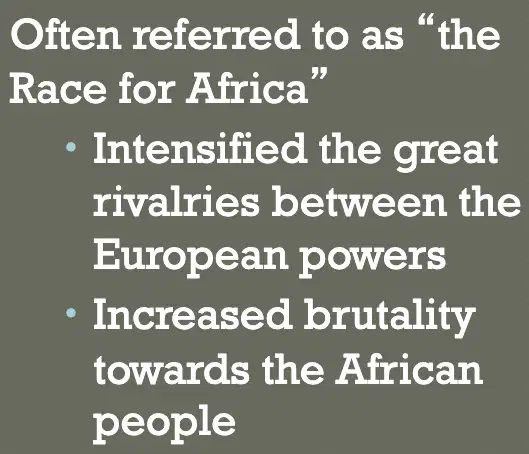
Which nickname captured the competitive nature of European expansion into Africa in the late 19th century?
The Race for Africa
The New Silk Road
The Partition of Europe
The Great Migration
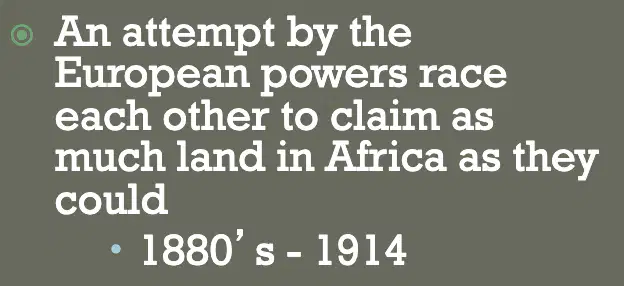
Which timeline most closely matches the Scramble for Africa?
From the 1880s to 1914
From 1918 to 1939
From 1700 to 1750
From 1450 to 1600
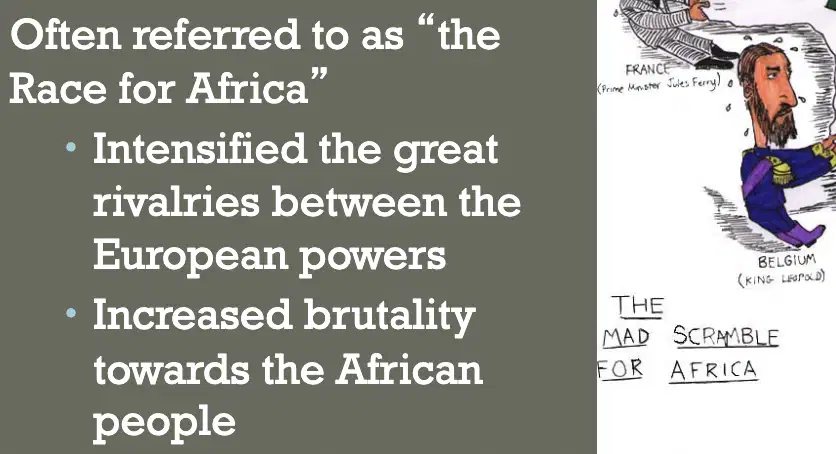
What was one consequence of the 'Race for Africa' among European states?
Formation of a unified European empire in Africa
Decline of European interest in overseas trade
Rapid African industrial leadership worldwide
Intensified rivalries between European powers

Which change most increased the feasibility of long-term European presence in Africa during imperialism?
Medical advances against African diseases
Fading European interest in raw materials
Loss of naval power among Europeans
Abandonment of steam transportation entirely

Which pair lists primary economic motivations for colonizing Africa?
Markets and raw materials
Tourism and sports leagues
Land for European prisons
Religious offices and cathedrals
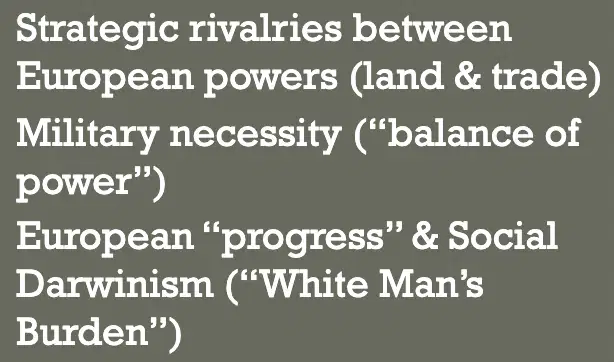
Which factor reflects strategic competition that pushed European expansion in Africa?
Rivalries for land and trade routes
Cooperation to limit resource extraction
Shared plans for African self-rule
Isolationism and closed European borders
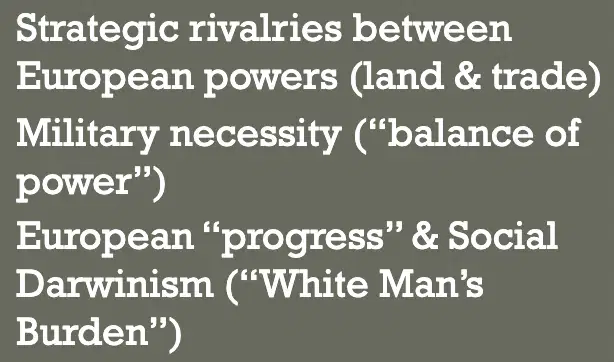
Which idea was often used to justify imperial rule as a civilizing mission?
Social Darwinism and the 'White Man's Burden'
Romantic nationalism and folk cultures
Republicanism and popular sovereignty
Mercantilism and isolationist tariffs

Which statement distinguishes indirect imperialism from direct imperialism?
Indirect used local leaders; direct used European administrators
Indirect banned trade; direct promoted all free trade
Indirect required assimilation; direct protected all cultures
Indirect abolished classes; direct created caste systems
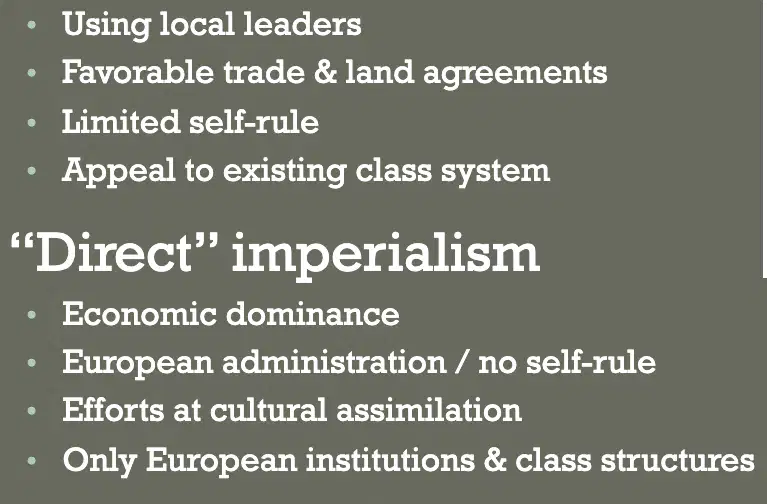
Which policy would most likely occur under indirect imperialism?
Banning traditional authorities entirely
Allowing limited self-rule through local elites
Replacing all courts with European judges
Mandating European language instruction only
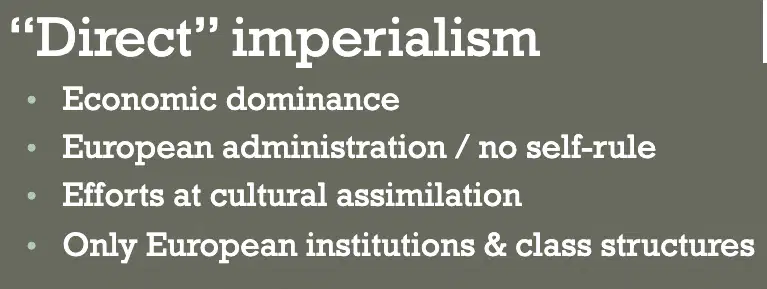
Under direct imperialism, which feature was typical of governance?
Power-sharing constitutions with Africans
Autonomy for local chiefs over taxation
European administration with no self-rule
Protection of all indigenous institutions
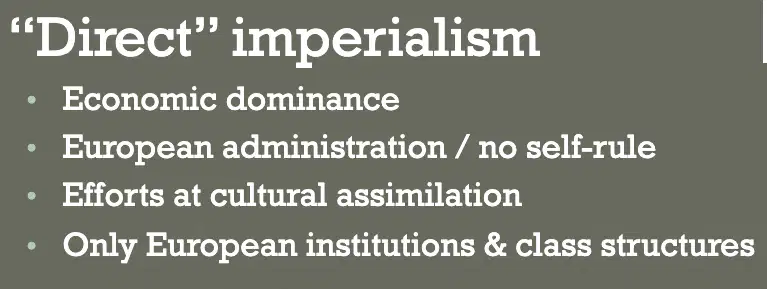
Which approach best represents cultural policy under direct imperialism?
Transfer of European citizens back to Europe
Complete isolation of colonies from Europe
State-funded preservation of every local custom
Efforts to assimilate colonized peoples culturally

Which combination correctly matches method with practice?
Direct: economic dominance by metropole
Indirect: European-only institutions everywhere
Direct: using local leaders as intermediaries
Indirect: appeal to existing class systems
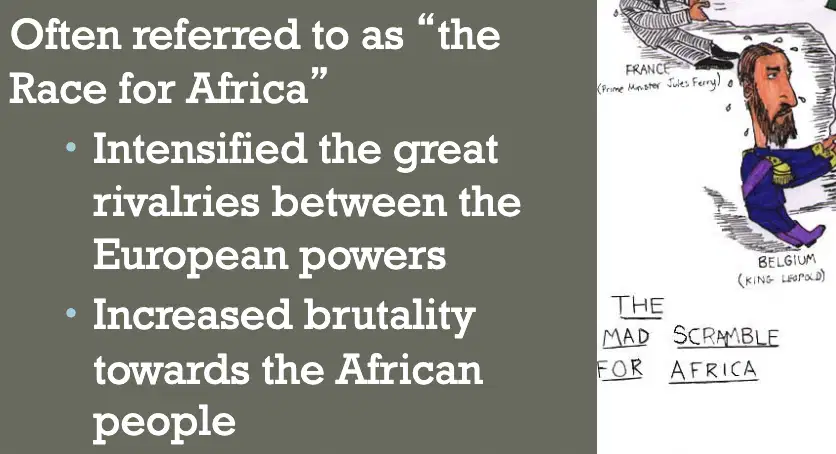
What outcome for Africans is associated with the Scramble for Africa?
Increased brutality toward African communities
Universal prosperity under African leadership
Elimination of European military presence
Immediate continent-wide political independence
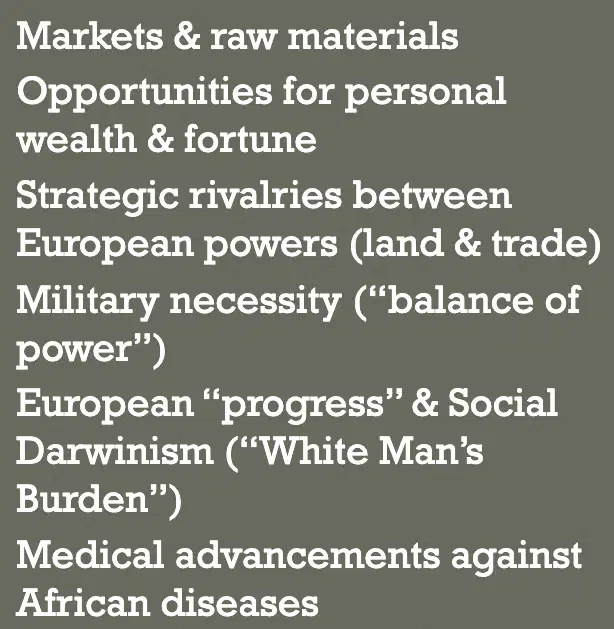
Which set lists several drivers of European interest in Africa during imperialism?
Desire to end all trade and exploration
Military balance-of-power considerations
Personal fortunes and wealth opportunities
Markets for goods and access to raw materials
Which statement best describes the Congo Free State during King Leopold II’s rule?
A personal colony exploiting rubber, ivory, and minerals
An independent African kingdom trading freely with Europe
A Belgian democracy promoting African political representation
A protectorate focused on missionary education programs
In what years did the Congo Free State operate as Leopold II’s colony before annexation by Belgium?
1960 to 1975
1914 to 1945
1830 to 1862
1885 to 1908
Which factor led to international outcry against the Congo Free State?
Allied support for African nationalist leaders
Religious persecution of European settlers
High tariffs blocking European merchants
Documented atrocities against native peoples
French Algeria was viewed by France primarily as which of the following?
A remote penal colony for convicts
A protectorate ruled by local emirs
A temporary military occupation zone
An adopted province within France
Which time span and resource pairing matches French Algeria?
1885–1908 and rubber ivory minerals
1830–1962 and Mediterranean trade prestige
1870–1918 and gold diamond mining
1910–1954 and Atlantic plantation economy
Which statements are true about resistance and outcomes in Algeria?
The colony had little interest for settlers
A major revolt eventually led to independence
French rule ended without any accusations
Algerians resisted intermittently until 1945
Which colonial administration was run as a front company before annexation by its European parliament?
German Southwest Africa under settlers
The Gold Coast under British investors
French Algeria under Napoleon III
The Congo Free State under Leopold II
Which pair correctly links colony and primary motive emphasized in the case studies?
Algeria—mining rainforest rubber and ivory
Congo Free State—establishing Mediterranean naval bases
Algeria—search for Central African river routes
Congo Free State—extraction of rubber and ivory
Which comparison best captures a key difference between the two case studies?
Congo centered on resource extraction; Algeria on settler colonization
Both were independent African states recognized by Europe
Both were short protectorates with minimal European settlement
Algeria focused on ivory monopolies; Congo on sea trade
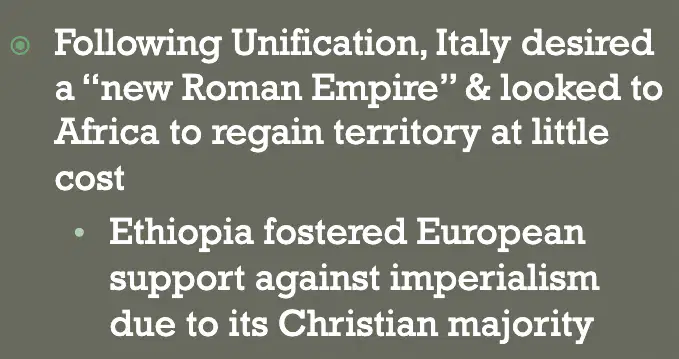
Which statement best explains why Ethiopia remained largely uncolonized during the Scramble for Africa?
It was protected by deserts and mountains only
It secured European sympathy as a Christian kingdom
It lacked resources attractive to European states
It was already ruled by another European power
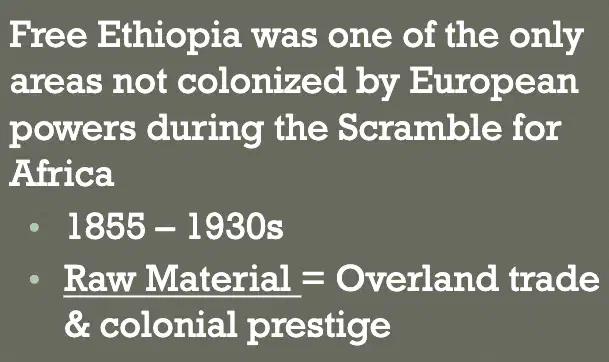
During which approximate period did Ethiopia maintain its independence from European colonization in this case study?
1600s to 1700s
1855 to 1930s
2000s to 2020s
1940s to 1960s
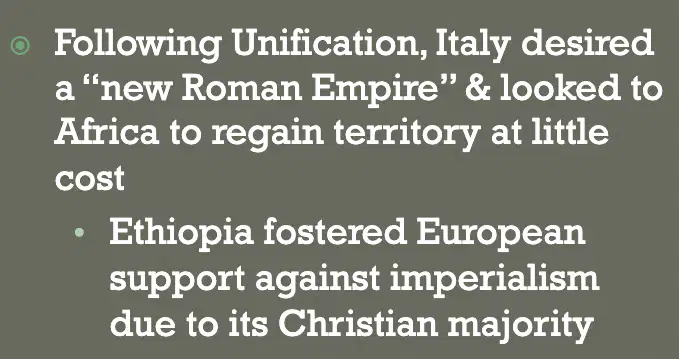
What motivated post-unification Italy to target Africa, particularly Ethiopia?
Avoiding involvement in European power politics
Converting the region to Islam for influence
Creating alliances with Portugal for trade routes
Building a new Roman Empire image at low cost
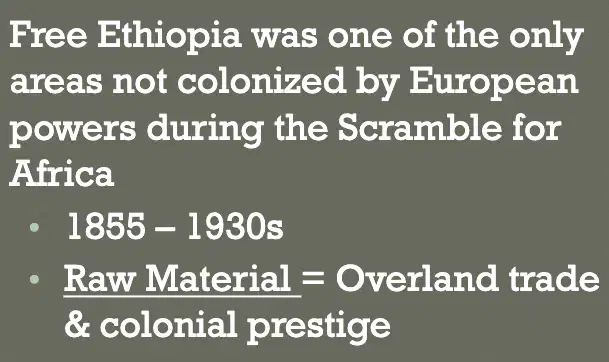
In the context of Ethiopia, what did 'Raw Material' primarily mean in the lesson?
Naval bases and oil drilling sites
Gold mines and rubber plantations
Overland trade and colonial prestige
Industrial labor and railway hubs
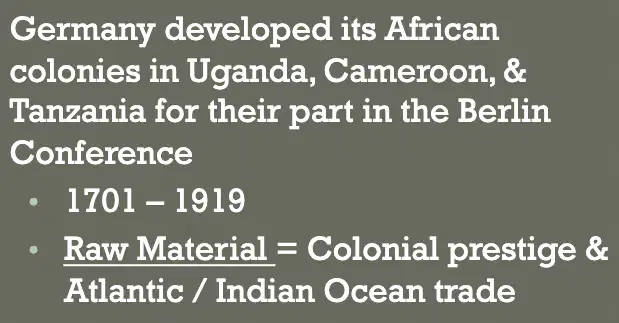
Germany’s African colonies in Uganda, Cameroon, and Tanzania were tied to what international event?
The Congress of Vienna outcomes
The Berlin Conference agreements
The Treaty of Versailles negotiations
The Potsdam Conference plans
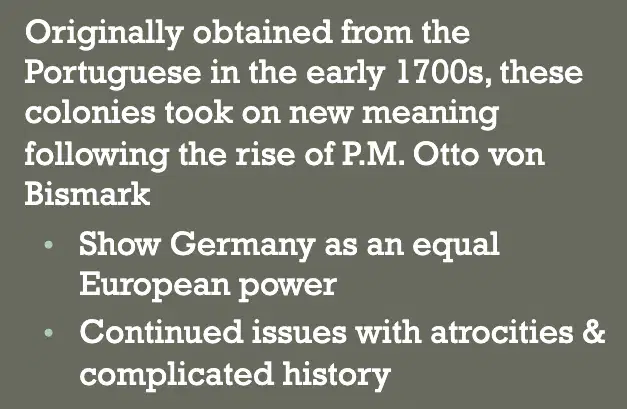
Select all reasons Germany pursued African colonies in the late 1800s and early 1900s.
To exit Atlantic and Indian Ocean trade entirely
To display equal status among European powers
To gain colonial prestige in global politics
To return territories to Portuguese administration
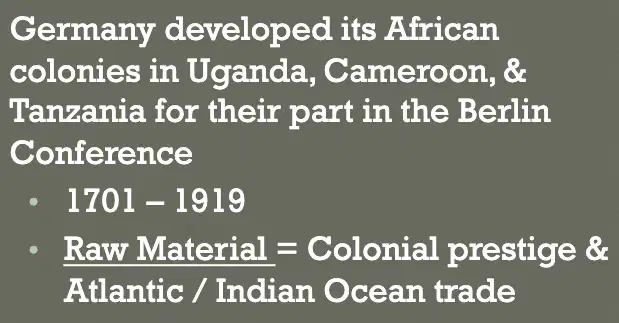
What time span best matches Germany’s formal control of its listed African colonies in this lesson?
1700 to 1750
1701 to 1919
1919 to 1945
1960 to 1990
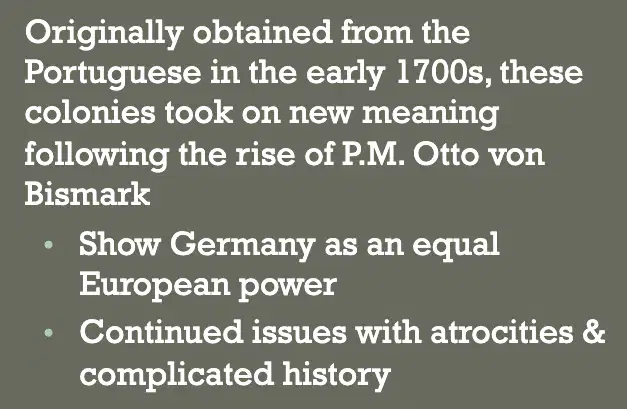
How did Otto von Bismarck’s rise affect the meaning of Germany’s African colonies?
They became private ventures without oversight
They symbolized Germany’s place among great powers
They shifted to spreading religious missions only
They were abandoned due to domestic revolts
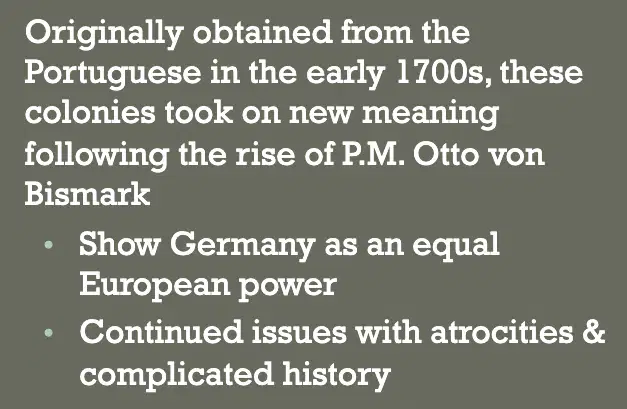
Which ongoing issue is associated with Germany’s colonial history in Africa, as highlighted in the lesson?
Peaceful transitions with no resistance
Universal admiration from European rivals
Continued issues with atrocities and complexity
Complete economic isolation of colonies
During which period did British control in South Africa described here primarily last?
1950s to 1990s
1790s to 1948
1400s to 1600s
1600s to 1750s
Which motive best explains why Britain valued South Africa as an imperial possession?
Strategic location and raw minerals
Abundant forests for ship timber
Large market for British textiles
Religious conversion opportunities
Who first established a colony in what became South Africa before British dominance?
French settlers from Normandy
Dutch settlers in the 1600s
Portuguese traders in 1500s
Spanish colonists in 1700s
Which event helped shift control in South Africa from the Dutch to the British?
World War I treaties
Seven Years’ War armistice
Napoleonic Wars aftermath
Scramble for Africa summit
Which policy name was used for the system of racial separation in South Africa?
Pass Laws
Apartheid
Caste Order
Jim Crow
How long was apartheid-related separation enforced according to the material?
Over one hundred years
Just under fifty years
About two decades total
Roughly five hundred years
Which group was politically favored under apartheid-era separation?
Mixed-race farm laborers
Indian merchant families
White minority settlers
Black majority communities
Which statement best describes apartheid after South Africa became independent in the 1900s?
It turned into British military rule
It was replaced with equal voting rights
It continued to be enforced by the state
It was immediately abolished nationwide
Which of the following are reasons Britain and settlers sought South Africa?
Mineral resources like gold and diamonds
Vast fertile farmland for settlement
Strategic sea routes around the Cape
Dense rainforest rubber supplies
When did the Boer Wars take place?
1914 to 1918
1939 to 1945
1770s to 1783
1880s to 1902
Who were the Boers in the South African context?
Dutch-descended settlers in Africa
Indigenous Zulu confederations
Portuguese naval explorers
British soldiers stationed abroad
What initial aim motivated the Boers’ revolts that became the Boer Wars?
Access to Atlantic slave markets
Religious conversion protections
Equal rights and cultural respect
Annexation by the German Empire
Which outcome did the Boer Wars eventually seek beyond early grievances?
Negotiated trade monopolies
Union with French colonies
War for independence from Britain
Expansion into East Africa
Which pair correctly matches a flag with its side in the Boer Wars image?
Orange white blue stripes – British forces
Green white black tricolor – Boer side
Union Jack design – Boer commandos
Orange white blue stripes – Boer side
Which development is associated with British rule strengthening racial divisions in South Africa?
Abolition of pass documents
Union with India’s administration
Institutionalization of segregation policies
Creation of the Suez Canal
During which years did the Philippine–American War primarily take place?
1904 to 1907
1914 to 1918
1899 to 1902
1896 to 1898
Which parties were the main combatants in the Philippine–American War?
Spain and the United States
The United States and Filipino natives
Britain and the Philippines
Japan and the Philippines
Why was the conflict described as an imperialistic war?
It involved the United States expanding control overseas
It aimed to spread democracy worldwide
It centered on European colonial rivalries
It focused on defending Philippine independence
What broader issue did the war raise about the United States in the Pacific?
Questions about naval technology progress
Questions about intentions and methods used
Questions about internal migration patterns
Questions about trade tariffs only
How did the United States initially view the Philippines during the Spanish–American War?
As a neutral trading partner
As a secondary front to tie enemy forces
As a training ground for recruits
As a permanent colony first
What was one tactical purpose of opening a 'second front' in the Philippines?
To negotiate immediate independence
To recruit Filipino laborers
To tie up enemy troops and naval ships
To establish gold mining camps
After the Spanish–American War, how did US strategic thinking about the Philippines change?
It decided on immediate full independence
It saw the islands as an overseas empire
It saw the islands as unnecessary territory
It planned to sell the islands to Britain
Which naval consideration encouraged US interest in the Philippines after 1898?
Submarine repair hubs concept
Exclusive fishing zones enforcement
Coaling stations for extended naval reach
Icebreaking ports for Arctic routes
Which statement best describes Emilio Aguinaldo's early role?
A British diplomat mediating peace
A Spanish colonial governor loyalist
A local leader who became a revolutionary
A US military officer stationed in Manila
Which organization did Emilio Aguinaldo help establish?
The Katipunan resistance group
The Manila Naval Council
The Filipino Commonwealth Party
La Solidaridad League
What time span corresponds to Emilio Aguinaldo’s lifetime?
1848 to 1910
1869 to 1964
1885 to 1945
1901 to 1980
Against whom did Aguinaldo help lead Filipino resistance before exile?
British merchant companies
Japanese occupation forces
Spanish colonial authorities
American volunteer regiments
What event facilitated Aguinaldo’s return to the Philippines from exile?
The outbreak of World War I
The Spanish–American War with US support
The signing of the Treaty of Paris 1763
The annexation of Hawaii by Britain
Which combination accurately links conflict and purpose: Spanish–American War and Philippine–American War?
Philippine–American War: US expansion into Pacific
Spanish–American War: open second front in Asia
Spanish–American War: defeat Spain in Caribbean
Philippine–American War: Filipino alliance with Spain
Which themes best capture why the Philippine–American War is historically significant?
Resolution of European land disputes
Growth of Filipino nationalist leadership
Emergence of naval logistics like coaling
Debates over US imperialism in Pacific
Which event most directly set the stage for the Philippine–American War in 1899?
German intervention creating an international protectorate
Treaty of Paris transferring Philippines to the US
Spanish reconquest restoring colonial administration
British mediation establishing shared sovereignty
What did the United States pay Spain under the 1898 Treaty of Paris for the Philippines?
$200 million in war damages
$20 million in compensation
$2 million in indemnities
$50 million in reparations
Which action asserted Filipino nationhood soon after Spain’s defeat in 1898?
Aguinaldo declared Filipino independence
European powers guaranteed Philippine neutrality
US Congress recognized Filipino autonomy
Spain appointed a Filipino governor-general
Which statement best describes the initial US political approach to the Philippines after 1898?
Held a plebiscite to choose political status
Negotiated joint administration with Filipino leaders
Recognized the First Philippine Republic’s sovereignty
Ignored Aguinaldo’s government and installed colonial rule
Which combination accurately matches leaders and actions that escalated tensions?
McKinley backed colonial governance; Aguinaldo pursued independence
McKinley ceded the islands to Spain; Aguinaldo accepted rule
McKinley sought immediate independence; Aguinaldo urged annexation
McKinley requested neutrality; Aguinaldo supported protectorate
Which tactics became central to Filipino resistance once open battles proved costly?
Guerrilla warfare against US forces
Naval blockades of US coasts
Trench warfare with set-piece battles
Aerial bombardment of US positions
Which US military response aimed to counter guerrilla warfare in the Philippines?
Demobilization to reduce local tensions
Small-unit patrols and civic-military measures
Massive set-piece battles and sieges
Exclusive reliance on naval bombardment
Select all developments that contributed to the war’s conclusion.
Transition from conventional to guerrilla fighting
Capture of Emilio Aguinaldo in 1901
Spanish return to Manila in 1902
US establishment of colonial administration
Which outcome followed the capture of Aguinaldo during the conflict?
US forces withdrew immediately from the islands
Filipino resistance weakened and fragmented
International coalition occupied the archipelago
Spain resumed control of key provinces
Which statement best explains why the Treaty of Paris was controversial among Filipinos?
It preserved Spanish colonial institutions
It created a joint US–Filipino parliament
It guaranteed independence within five years
It transferred sovereignty without Filipino consent
Identify a common misconception about the start of the Philippine–American War.
US installed a colonial government in the islands
US recognized Filipino independence from the outset
Spain sold the Philippines to the US for money
Aguinaldo declared independence after Spain’s defeat
Which pair correctly links a document and its year?
Treaty of Paris — 1896
Treaty of Paris — 1903
Treaty of Paris — 1898
Treaty of Paris — 1901
What best describes US troop reactions during the conflict as guerrilla war intensified?
Requested Spanish mediation to end hostilities
Adopted counterinsurgency and consolidation policies
Relied solely on naval blockades and tariffs
Shifted to full demobilization and withdrawal
Which sequence best outlines the conflict’s trajectory?
Aguinaldo captured, treaty signed, war erupts, independence declared, annexation halted
Guerrilla phase, treaty signed, independence declared, war erupts, Spain returns
Treaty signed, independence declared, war erupts, guerrilla phase, Aguinaldo captured
War erupts, Spain returns, independence declared, guerrilla phase, treaty rejected
Which governance change occurred under President William McKinley in the Philippines after 1898?
Establishment of a European protectorate council
Recognition of a Filipino-led independent republic
Installation of a US colonial administration with troops
Return of civil authority to Spanish officials

