
Font size
 Worksheets
Electricity Quiz
Total questions: 99
Worksheet time: 50mins
Which phenomenon is commonly observed when we take off synthetic clothes or a sweater, especially in dry weather?
Magnetic attraction
Electric discharge
Chemical reaction
Sound emission
What is a common example of electric discharge seen in nature?
Earthquake
Lightning during thunderstorms
Rainfall
Solar eclipse
Why do we sometimes experience a shock when opening a car door or holding an iron bar after sliding from our seat?
Due to magnetic fields
Due to discharge of electric charges accumulated by rubbing insulating surfaces
Due to heat transfer accumulated by rubbing insulating surfaces-magnetic fields and chemical reaction
Due to chemical reaction
What does the term "static" refer to in the context of electricity?
Anything that moves rapidly
Anything that does not move or change with time
Anything that emits light that produces sound
Anything that produces sound
What does electrostatics deal with?
The study of moving charges
The study of forces, fields, and potentials arising from static charges
The study of chemical reactions magnetic fields moving charges and potentials
The study of magnetic fields
Who is credited with the discovery that amber rubbed with wool or silk cloth attracts light objects?
Aristotle
Thales of Miletus
Archimedes
Socrates
The name "electricity" is derived from which language?
Latin
Greek
French
Arabic
What happens when two glass rods rubbed with wool or silk cloth are brought close to each other?
They attract each other
They repel each other
They remain neutral
They produce light
What is the term used to describe the property that differentiates the two kinds of charges?
Conductivity
Polarity
Magnetism
Density
According to Benjamin Franklin, what is the charge on a glass rod or silk termed as?
Negative
Neutral
Positive
Electrified
What is the result when a glass rod rubbed with silk is brought in contact with the silk again?
They attract each other
They repel each other
They no longer attract or repel each other
They produce heat repel each other attract each other
Which statement best describes the behavior of like and unlike charges?
Like charges attract and unlike charges repel
Like charges repel and unlike charges attract
Both like and unlike charges repel
Both like and unlike charges attract
What is meant by an object being electrically neutral?
It has only positive charge
It has only negative charge
It possesses no electric charge
It is electrified
Why do objects like glass or plastic rods acquire an electric charge when rubbed?
Due to heating
Due to electrification
Due to magnetization
Due to cooling
What conclusion can be drawn when charged bodies are brought in contact and neutralize each other's effect?
They become more electrified
They become electrically neutral
They start attracting other objects
They produce light
What is the purpose of a gold-leaf electroscope?
To measure temperature
To detect charge on a body
To measure mass
To detect magnetic fields
Which of the following statements about electric charge is correct?
Electric charge is created during rubbing
Electric charge is destroyed during rubbing
No new charge is created in the process of rubbing
Electric charge is only present in metals destroyed during rubbing
What happens when a glass rod is rubbed with silk?
The rod loses electrons and becomes positively charged
The rod gains electrons and becomes negatively charged
The silk loses electrons and becomes positively charged
The rod becomes neutral
Which of the following is a conductor?
Glass
Plastic
Metal
Wood
What is the main difference between conductors and insulators?
Conductors have tightly bound electrons, insulators have free electrons
Conductors allow electricity to pass through easily, insulators do not
Insulators allow electricity to pass through easily, conductors do not
Both conductors and insulators allow electricity to pass through easily
Why does a nylon or plastic comb get electrified on combing hair or on rubbing, but a metal article does not?
Metals are insulators
Metals have free electrons that distribute charge over the surface
Plastics are conductors
Nylon is a semiconductor
What is a semiconductor?
A material that allows electricity to pass through very easily
A material that does not allow electricity to pass through at all
A material that offers resistance to the movement of charges intermediate between conductors and insulators
A material that is always positively charged does not allow electricity to pass through at all to pass through very easily
Which of the following statements best describes a point charge?
A charge that is distributed over a large area.
A charge that is always negative.
A charge whose size is very small compared to the distance between charged bodies.
A charge that cannot be measured. charge that is always negative.charge that is always negative.
What is the principle of additivity of charges?
Charges can only be added if they are positive.
The total charge of a system is the algebraic sum of all individual charges.
Charges must be multiplied to find the total charge.
Only negative charges contribute to the total charge.
If a system contains five charges: +1, +2, -3, +4, and -5 (in arbitrary units), what is the total charge of the system?
+15
-1
+1
-5
Which property of electric charge states that the total charge of an isolated system remains unchanged?
Additivity of charge
Conservation of charge
Point charge property
Mass-charge equivalence
When two bodies are rubbed together, what happens to the charges?
Both bodies lose charge.
One body gains charge and the other loses charge.
Both bodies gain charge.
No transfer of charge occurs.
Why is it not possible to create or destroy net charge carried by any isolated system?
Because charges are always positive.
Because the total charge of an isolated system is always conserved.
Because charges can only be transferred, not created or destroyed.
Because charges have no magnitude.
What is the difference between mass and charge as described in the text?
Mass can be positive or negative, but charge is always positive.
Mass has direction, but charge does not.
Mass is always positive, but charge can be either positive or negative.
Mass is a vector, but charge is a scalar.
Which of the following equations correctly represents the quantisation of electric charge?
q = ne
q = n/e
q = e/n
q = n + e
What is the value of the basic unit of charge (e) in the SI system?
1.602192 × 10⁻¹⁹ C
1.602192 × 10¹⁹ C
1.602192 × 10⁻¹⁸ C
1.602192 × 10⁻²⁰ C
In the SI system, what is the unit of electric charge called?
Ampere
Coulomb
Volt
Ohm
If a body contains n₁ electrons and n₂ protons, what is the total amount of charge on the body?
n₁ × e + n₂ × e
n₂ × e + n₁ × (-e) = (n₂ - n₁) e
n₁ × n₂ × e
n₁ + n₂ × e
Why does the charge on any body appear to be continuous at the macroscopic level?
Because the step size of charge is very large
Because the step size of charge is very small
Because charge is not quantised
Because electrons and protons do not exist
Who experimentally demonstrated the quantisation of charge in 1912?
Faraday
Millikan
Newton
Einstein
Which physical law first suggested the quantisation of charge?
Law of Electrolysis
Law of Gravitation
Law of Reflection
Law of Refraction
How many electrons are there in a charge of -1C?
About 6 × 10¹⁸
About 6 × 10¹⁶
About 6 × 10²⁰
About 6 × 10¹⁴
Which of the following is a smaller unit of charge commonly used in electrostatics?
1 mC
1 μC
1 kC
1 nC
What is the charge on an electron by convention?
+e
-e
0
+2e
What is the value of the electronic charge (e)?
1.6 × 10^-19 C
1.6 × 10^-16 C
1.6 × 10^-12 C
1.6 × 10^{-9} C
Approximately how many electrons are contained in a cubic piece of copper of side 1 cm?
2.5×1024
2.5×10²⁰
2.5×10¹⁸
2.5×10¹²
How long would it take to collect a charge of 1coulomb if 109electrons move out of a body every second?
198 years
10 years
1 year
1000 years
If the mass of one cup of water is 250 g, how many molecules of water are present in the cup?
(250/18)×6.02×1023
18250×6.02×1020
18250×6.02×1018
18250×6.02×1012
According to Coulomb’s law, the force between two point charges varies:
Inversely as the square of the distance between the charges
Directly as the square of the distance between the charges
Inversely as the distance between the charges
Directly as the distance between the charges
What is the total charge (in coulombs) of all the positive or negative charges in a cup of water weighing 250 g?
1.34 × 10^7 C
1.34 × 10^5 C
1.34 × 10^3 C
1.34 × 10^9 C
Why can the quantisation of charge be ignored at the macroscopic level?
Because the charges involved are enormous compared to the magnitude of charge e
Because the charges involved are very small
Because the charges are always continuous
Because the charges cannot be counted
What does Coulomb’s law state about the force between two point charges?
It is directly proportional to the product of the magnitudes of the charges and inversely proportional to the square of the distance between them
It is directly proportional to the sum of the charges and inversely proportional to the distance between them
It is inversely proportional to the product of the charges and directly proportional to the square of the distance between them
It is directly proportional to the difference of the charges and inversely proportional to the cube of the distance between them
Which law describes the force between two point charges in vacuum?
Coulomb's Law
Newton's Law
Ohm's Law
Faraday's Law
What device did Coulomb use to measure the force between charged metallic spheres?
Torsion balance
Spring scale
Barometer
Voltmeter
According to Coulomb's law, what happens to the force between two charges as the distance between them increases?
The force decreases
The force increases
The force remains constant
The force becomes zero
What is the value of the constant k in SI units for Coulomb's law?
9 × 10⁹ Nm²/C²
6.67 × 10⁻¹¹ Nm²/kg²
3 × 10⁸ m/s
1.6 × 10⁻¹⁹ C
Who was Charles Augustin de Coulomb and what was his significant contribution to physics?
A French physicist who formulated the law of electric force between charges
An English chemist who discovered oxygen
An Italian mathematician who invented calculus
A German astronomer who discovered Neptune
If two charges of 1 C each are placed 1 meter apart in vacuum, what is the magnitude of the force between them according to Coulomb's law?
9 × 10⁹ N
1 N
6.67 × 10⁻¹¹ N
3 × 10⁸ N
Why is the value of k in Coulomb's law considered arbitrary?
It can be chosen as any positive value to define the unit of charge
It depends on the mass of the objects
It is always zero
It is determined by the temperature
Which physical constant is called the permittivity of free space?
ε₀
k
r
q
What is the value of ε₀ (the permittivity of free space) in SI units?
8.854 × 10⁻¹² C² N⁻¹ m⁻²
9 × 10⁹ N
1.602 × 10⁻¹⁹ C
6.022 × 10²³ mol⁻¹
According to Coulomb's law, what is the formula for the force between two point charges q₁ and q₂ separated by a distance r?
F = (1 / 4πε₀) * (q₁q₂ / r²)
F = m * a
F = q * E
F = G * (m₁m₂ / r²)
If two charges q₁ and q₂ are of the same sign, what is the direction of the force F₂₁ on q₂ due to q₁?
Along r̂₂₁, which denotes repulsion
Along r̂₁₂, which denotes attraction
Perpendicular to r̂₂₁
Zero force
What is the vector leading from charge 1 to charge 2 denoted by?
r₂₁ = r₂ - r₁
r₁₂ = r₁ - r₂
r₁ + r₂
r₁ × r₂
Which equation expresses Coulomb’s force law between two point charges q₁ and q₂ located at r₁ and r₂, respectively, in vector form?
F₂₁ = (1 / 4πε₀) * (q₁q₂ / r₂₁²) * r̂₂₁
F = m * a
F = q * E
F = G * (m₁m₂ / r²)
If q₁ and q₂ are of opposite signs, what does the direction of F₂₁ indicate?
Attraction, as expected for unlike charges
Repulsion, as expected for like charges
No force
Perpendicular force
Why do we not need to write separate equations for the forces between like and unlike charges in Coulomb’s law?
Equation (1.3) takes care of both cases
The force is always attractive
The force is always repulsive
The charges must be equal
Given the position vectors r₁ and r₂ for charges q₁ and q₂, how is the unit vector r̂₂₁ defined?
r̂₂₁ = (r₂₁) / |r₂₁|
r̂₂₁ = (r₁₂) / |r₁₂|
r̂₂₁ = r₁ + r₂
r̂₂₁ = r₁ × r₂
Which law states that the force between two charges is inversely proportional to the square of the distance between them?
Coulomb's Law
Newton's Law of Motion
Ohm's Law
Faraday's Law
According to Coulomb's law, what is the mathematical expression for the force F12 between two charges q1 and q2 separated by a distance r12?
F12 = (1 / 4πε₀) * (q1q2 / r12²)
F12 = q1q2 / r12
F12 = q1 + q2 / r12²
F12 = (1 / 4πε₀) * (q1 + q2 / r12)
What does the negative sign in the electric force equation between an electron and a proton indicate?
The force is attractive
The force is repulsive
The force is zero
The force is infinite
What is the ratio of the magnitudes of electric force to gravitational force between an electron and a proton at a distance of 1 Å?
2.4 × 10³⁹
1.3 × 10³⁶
230
1.9 × 10⁻³⁴
Which force is stronger between two protons inside a nucleus, the electric force or the gravitational force?
Electric force
Gravitational force
Both are equal
Cannot be determined
What is the approximate value of the electric force between two protons inside a nucleus (distance ~ 10⁻¹⁵ m)?
230 N
1.9 × 10⁻³⁴ N
2.4 × 10³⁹ N
1.3 × 10³⁶ N
What is the approximate value of the gravitational force between two protons inside a nucleus (distance ~ 10⁻¹⁵ m)?
1.9 × 10⁻³⁴ N
230 N
2.4 × 10³⁹ N
1.3 × 10³⁶ N
Why does the situation get complicated when charges are placed in matter or the intervening space has matter?
Due to the presence of charged constituents of matter
Because the charges disappear
Because the force becomes zero
Because the charges become equal
Which of the following best describes the difference in nature between the gravitational force and the Coulomb force between two protons?
Gravitational force is attractive, Coulomb force is repulsive
Both forces are attractive
Gravitational force is repulsive, Coulomb force is attractive
Both forces are repulsive
What is the magnitude of the electric force exerted by a proton on an electron, given by the formula |F| = (1 / 4πε₀) * (e² / r²)?
2.3 × 10⁻⁸ N
8.987 × 10⁹ N
1.6 × 10⁻¹⁹ N
9.11 × 10⁻³¹ N
Using Newton's second law of motion, what is the acceleration that an electron will undergo when acted upon by a force of 2.3 × 10⁻⁸ N?
2.5 × 10²² m/s²
1.4 × 10¹⁹ m/s²
9.8 m/s²
3.0 × 10⁸ m/s²
What conclusion can be drawn about the effect of gravitational field on the motion of an electron under the action of Coulomb force due to a proton?
The effect of gravitational field is negligible.
The effect of gravitational field is dominant.
The effect of gravitational field is equal to the Coulomb force.
The effect of gravitational field is stronger than the Coulomb force.
What is the value for acceleration of a proton under the action of Coulomb force due to an electron?
1.4 × 10¹⁹ m/s²
2.5 × 10²² m/s²
9.8 m/s²
8.987 × 10⁹ m/s²
A charged metallic sphere A is suspended by a nylon thread. Another charged metallic sphere B is held by an insulating thread. What is the distance between spheres A and B?
10 cm
5 cm
15 cm
20 cm
In Figure 1.4(c), what is the distance between spheres A and B?
5 cm
10 cm
15 cm
20 cm
According to Coulomb's law, what is the formula for the magnitude of the electrostatic force between two point charges q and q' separated by a distance r?
F = (qq') / (4πε₀r²)
F = (qq') / (r)
F = (qq') / (4πε₀r)
F = (qq') / (r²)
When two identical but uncharged spheres touch a charged sphere, how is the charge distributed among them?
Each sphere gets the full charge
Each sphere gets half the charge
Each sphere gets one-third of the charge
Each sphere gets no charge
What is the principle called that states the individual forces on a charge are unaffected by the presence of other charges?
Principle of conservation
Principle of superposition
Principle of distribution
Principle of addition
If the separation between two charged spheres is halved, what happens to the magnitude of the electrostatic force between them?
It is doubled
It is halved
It becomes four times greater
It remains the same
How is the net force on a charge due to several other charges determined?
By multiplying the individual forces
By taking the vector sum of all individual forces
By subtracting the smallest force from the largest
By dividing the total charge by the number of charges
Which law is used to calculate the force between two point charges?
Coulomb's law
Newton's law
Ohm's law
Faraday's law
According to the principle of superposition, how is the total force on a charge in a system of multiple charges determined?
By adding the forces due to each charge vectorially
By multiplying the forces due to each charge
By subtracting the forces due to each charge
By dividing the forces due to each charge
What is the formula for the force on charge $q_1$ due to charge $q_2$ in terms of Coulomb's law?
4πϵ01r122q1q2r^12
$q_1 + q_2$
r12q1q2
4πϵ01r12q1q2
What does the principle of superposition state in the context of electrostatics?
The force on a charge is unaffected by the presence of other charges
The force on a charge is doubled in the presence of other charges
The force on a charge is halved in the presence of other charges
The force on a charge is always zero in the presence of other charges
In an equilateral triangle of side $l$, what is the length of the perpendicular from a vertex to the opposite side?
23l
2l
$l$
$2l$
What is the distance from a vertex to the centroid in an equilateral triangle of side $l$?
32AD=31l
2l
$l$
23l
If three equal charges are placed at the vertices of an equilateral triangle, what is the force on a fourth charge placed at the centroid?
The force is the vector sum of the forces due to each vertex charge
The force is zero
The force is the arithmetic mean of the forces due to each vertex charge
The force is the product of the forces due to each vertex charge
What is the magnitude of the force of attraction or repulsion between each pair of charges placed at the vertices of an equilateral triangle?
4πϵ0l2q2
4πϵ0l22q2
2πϵ0l2q2
8πϵ0l2q2
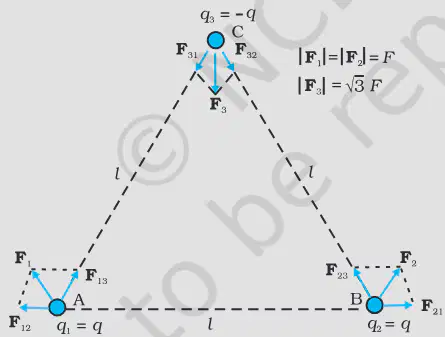
If three charges \(q, q, -q\) are placed at the vertices of an equilateral triangle, what is the direction of the total force on charge \(q\) at vertex A?
Along BC
Along AB
Along AC
Perpendicular to the triangle
According to the parallelogram law, what is the total force on charge \(q\) at vertex A due to the other two charges?
F_1 = F \hat{r}_1
F_1 = 2F \hat{r}_1
F_1 = F \hat{r}_2
F_1 = 0
What is the value of the resultant force on charge Q if the system of three charges is rotated through 60° about O?
The resultant force remains zero
The resultant force doubles
The resultant force becomes negative
The resultant force is halved
Which law is used to determine the total force on a charge when multiple forces are acting on it in the context of electric charges at the vertices of a triangle?
Parallelogram law
Newton's law
Coulomb's law
Ohm's law
Which physical quantity is produced by a point charge Q everywhere in its surrounding?
Magnetic field
Gravitational field
Electric field
Thermal field
What is the formula for the electric field E(r) produced by a point charge Q at a distance r?
E(r) = Q / r
E(r) = 1 / (4πε₀) * Q / r² * r̂
E(r) = Q * r²
E(r) = 4πε₀ * Q / r
What does the unit vector r̂ represent in the context of electric field?
The direction from the charge Q to the origin
The direction from the origin to the point r
The magnitude of the electric field
The position of the charge Q
According to the material, what is the effect of a charge incorporated in the existence of?
Gravitational field
Electric field
Magnetic field
Thermal field

