
Font size
 Worksheets
After Christmas review
Total questions: 67
Worksheet time: 50mins
What is the oxidation number on the nitrogen in NO?
0
-1
-2
+2
Which of the following has an oxidation number of zero on the chlorine atom?
NaCl
Cl2
Cl-
ClO3-
What is reduced in the reaction below?
Na + PbCl2 → Pb + NaCl
Na
Pb
Na+1
Pb2+
Oxidation is the _________ of electrons.
loss
gain
sharing
transfer
Mg → Mg2+ + 2e–
What is the oxidation number of iodine in KIO3?
0
-1
+5
+1
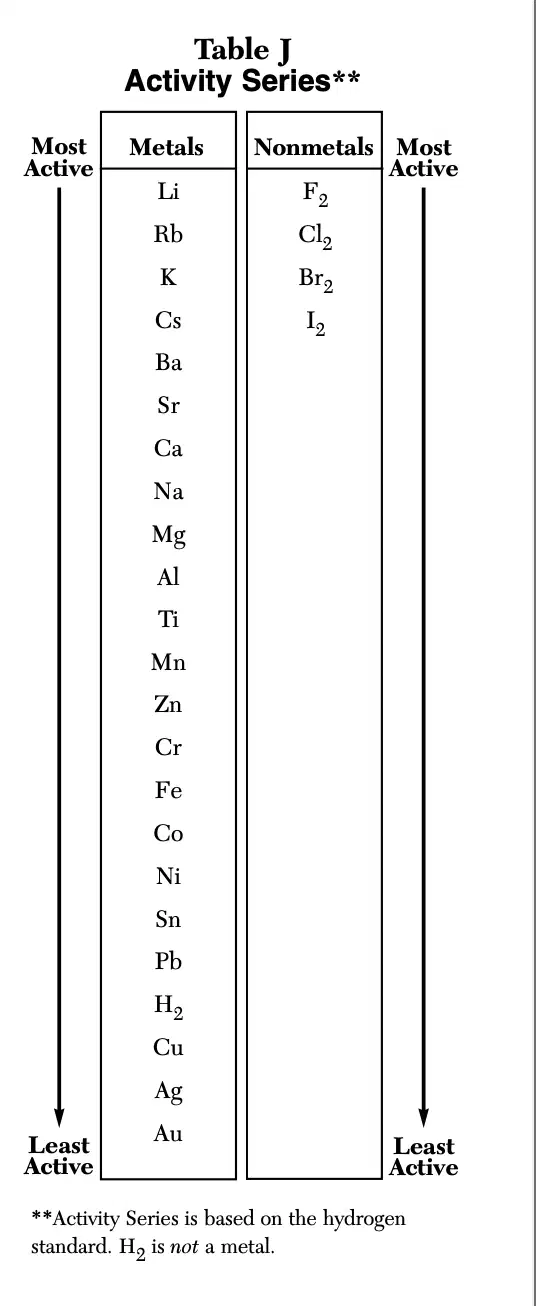
Which metal is most easily oxidized?
Co
Ag
Cu
Mg
What is a half-reaction of this equation, Na + Cl --> NaCl ?
Cl + e- --> Cl-
Cl - e- --> Cl-
Na --> Na + e-
Na° + Cl°--> Na+1Cl-1




Because electrons were emitted from a negative charge and attracted to a positive charge, it was understood that electrons have a ___ charge.
neutral
postive
negative
unknown
In summary, Thomson's CRT experiment revealed that:
A. electrons have mass & a negative charge
B. there are subatomic particles that make up an atom
C. atoms exist
D. both A & B are correct
E. A, B & C are correct

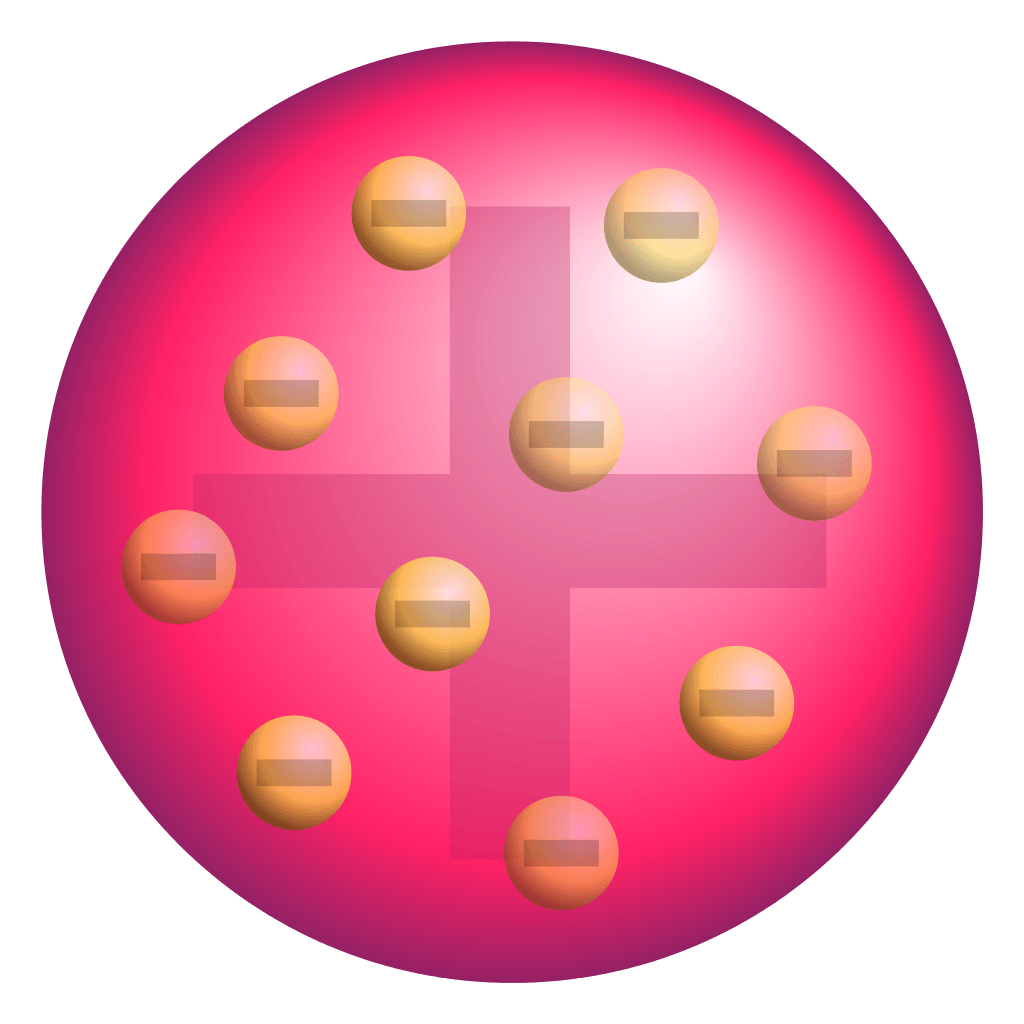
What was the major contribution of J.J. Thomson's model of the atom?
Introduction of electrons
Discovery of protons
Explanation of isotopes
There are two different charges near each other they will...
Attract
Repel
Become the same
All of the above
Mrs. Jensen rubbed two balloons with a piece of wool. What will happen when the balloons are brought near each other?
The balloons will repel each other.
The balloons will attract each other.
The balloons will become positively (+) charged.
The balloons will pop.
What is static electricity caused by?
A balance of power
A balance of positive and negative charges
An imbalance of positive and negative charges
An imbalance of protons and neutrons

Two objects with LIKE elecrical charges will
attract each other
even out in the end
repel each other
cause a spark

Shiny (luster) and good conductors of electricity:
Nonmetal
Lightning
Metal
Semi-metal

List 4 properties of metals
conducts electricity, reacts with acid, malleable, shiny
does not conduct electricity, reacts with acid, malleable, shiny
conducts electricity, does not react with acid, malleable, shiny
conducts electricity, reacts with acid, lusterous, shiny
Which of the following are properties of nonmetals?
brittle
dull
conducts electricity
does not react with acid
reacts with acid
What type of element is in group 16 period 4?
metal
nonmetal
metalloid
noble gas
none of these are correct
Name the element that is a metalloid in period 3.
Aluminum
Silicon
Phosphorus
Scandium
Germanium
Which of the following elements would have properties similar to beryllium?
Mg
Na
Ti
Sr
C
A substance was found to conduct electricity, is malleable, is dull, and did not react with acid. What type of element is this?
metal
transition metal
metalloid
nonmetal
alkali metal
An element is shiny, conducts electricity, reacts with acid and is malleable. Where can it be found?
Group 15 period 2
Group 14 period 4
Group 13 period 4
Group 16 period 6
Where would an element that is dull, does not react with acid, is brittle, and does not conduct belong on the periodic table?
Period 3 group 16
Period 4 group 2
Period 4 group 14
Period 2 group 18
What are the vertical columns on the periodic table called?
Divisions
Friends
Groups
Periods
What are the horizontal rows on the periodic table called?
Periods
Groups
Families
Divisions
Most of the elements in the periodic table are classified as?
Metalloids
Nonmetals
Transition Metals
Metals
NaB
Polar Covalent
Ionic
Network
Metallic
Nonpolar Covalent
NaCl
Polar Covalent
Ionic
Network
Metallic
Nonpolar Covalent
FeCs
Polar Covalent
Ionic
Network
Metallic
Nonpolar Covalent
What type of bond is present in H2O?
Network
Ionic
Polar Covalent
Metallic
Nonpolar Covalent
What type of bond is present in Cu?
Polar Covalent
Ionic
Metallic
Nonpolar Covalent
Network
The 3 types of chemical bonds are ________, ________, and ______. (Choose 3)
ionic
valence
covalent
metallic
atomic
A bond between two nonmetal atoms is a __________ bond.
ionic
nuclear
metallic
covalent
Which compound has high melting point?
Ionic
Covalent

What happens when two oppositely charged ions are pushed together?
they will repel (move apart)
they will be attracted to each other (move together)
Which of the following is true about Ionic Bonds? (select ALL TRUE options)
High melting point
Low melting point
Can dissolve in water
Cannot dissolve in water
Can conduct electricity

Is this molecule polar or non-polar?
Polar
Non-polar

Is this molecule polar or non-polar?
Non-polar
Polar

Is this molecule polar or non-polar?
Polar
Non-polar

Look at this covalent molecule as a whole. What type of molecule is it? (Is it symmetrical?)
Polar
Nonpolar
Ionic
Electricity passes through a conductor because
The voltage is up high enough on a power pack/battery
Of the bound outer electrons which don't move from atom to atom
Of the free outer electrons which move from atom to atom
The nuclei are negatively charged meaning their movement through a wire generates current
When different materials are rubbed together, electrons can be
destroyed and broken down
transferred from one material to the other
transformed into a different atomic particle
combined to form a different element

