
 Worksheets
F4 DSE Book 1C Exercises
Total questions: 86
Worksheet time: 43mins
Name
Class
Date
1.
1. Which of the following metals is/are found as a free element in nature?
(1) Gold
(2) Copper
(3) Platinum
a)
A. (1) only
b)
B. (2) only
c)
C. (1) and (3) only
d)
D. (2) and (3) only
2.
2. Which of the following is the major compound present in haematite?
a)
A. FeO
b)
B. Fe₂O₃
c)
C. Fe₃O₄
d)
D. FeCl₂
3.
3. Which of the following methods is commonly used for extracting mercury from mercury(II) oxide?
a)
A. Heating mercury(II) oxide strongly
b)
B. Heating mercury(II) oxide with carbon
c)
C. Heating mercury(II) oxide with carbon monoxide
d)
D. Electrolysis of the molten mercury(II) oxide
4.
4. X, Y and Z are three different metals. X exists as a free element in nature. Z can be extracted from its ore by heating with coke. Y can be obtained by electrolysis of its molten ore. Which of the following correctly shows the discovery sequence of these metals (the first metal being discovered is put first)?
a)
A. Z, Y, X
b)
B. X, Z, Y
c)
C. Z, X, Y
d)
D. X, Y, Z
5.
5. Which of the following are problems associated with metal recycling?
(1) Separating metal wastes from other wastes is difficult.
(2) The cost of sorting and transporting metal wastes is high.
(3) The cost of melting and purifying of used metals is high.
a)
A. (1) and (2) only
b)
B. (1) and (3) only
c)
C. (2) and (3) only
d)
D. (1), (2) and (3)
6.
1. Which of the following processes would produce oxygen?
a)
A. Heating silver oxide
b)
B. Heating copper(II) oxide
c)
C. Heating sodium oxide with carbon
d)
D. Heating iron(III) oxide with carbon monoxide
7.
2. Which of the following processes would produce a metal?
a)
A. Heating zinc oxide strongly
b)
B. Heating aluminium oxide with carbon
c)
C. Electrolysis of solid sodium chloride
d)
D. Heating iron(III) oxide with carbon monoxide
8.
1. W, X, Y and Z are four different metals. Below is some information about them.
• W exists as a free element in nature.
• X does not react with cold water but reacts with steam.
• Y reacts explosively with dilute acids.
• The oxide of Z is reduced to Z by heating in air.
Which of the following correctly shows the four metals in order of decreasing reactivity?
a)
A. Y, X, W, Z
b)
B. Y, X, Z, W
c)
C. W, X, Z, Y
d)
D. W, Z, X, Y
9.
1. Copyright © Scottish Qualifications Authority National 5 2017 May Section 1 Q8
(Refer to Textbook 1C, Chapter 12, Exam practice, Q1)
a)
A
b)
B
c)
C
d)
D
10.
2. Which of the following statements about 36 g of pure water is/are correct?
(Relative atomic masses: H = 1.0, O = 16.0, Avogadro constant = 6.02 × 10²³ mol⁻¹)
(1) It contains 4 mol of hydrogen atoms.
(2) It contains 3 × 6.02 × 10²³ of atoms.
(3) It contains 3 × 6.02 × 10²³ of molecules.
a)
A. (1) only
b)
B. (2) only
c)
C. (1) and (3) only
d)
D. (2) and (3) only
11.
1. Which of the following metals may corrode after they are exposed to air for a very long time?
(1) Iron
(2) Copper
(3) Silver
a)
A. (1) and (2) only
b)
B. (1) and (3) only
c)
C. (2) and (3) only
d)
D. (1), (2) and (3)
12.
1. Which of the following statements about rusting is/are correct?
(1) Fe²⁺(aq) is produced during rusting.
(2) Rusting occurs for all reactive metals.
(3) One of the possible formulae of rust is Fe₂O₃ • 2H₂O(s).
a)
A. (1) only
b)
B. (2) only
c)
C. (1) and (3) only
d)
D. (2) and (3) only
13.
Which of these metals is the easiest to be extracted from its ore?
a)
A. P
b)
B. Q
c)
C. R
d)
D. S
14.
2. In an experiment, a small piece of potassium is added to a trough of water. Which of the following statements is/are correct description(s) of the experimental result(s)?
(1) A gas is produced.
(2) The metal burns with a golden yellow flame.
(3) The temperature of water rises.
a)
A. (1) only
b)
B. (2) only
c)
C. (1) and (3) only
d)
D. (2) and (3) only
15.
3. Element G can be obtained by heating its oxide with carbon. G does not react with dilute hydrochloric acid. Which of the following might G be?
a)
A. Copper
b)
B. Iron
c)
C. Magnesium
d)
D. Zinc
16.
Which of the following correctly represents the metals in order of decreasing reactivity?
a)
A. X, Y, W, Z
b)
B. X, W, Y, Z
c)
C. Z, Y, W, X
d)
D. Z, W, Y, X
17.
5. 28.0 g of nitrogen has the same number of atoms as
(Relative atomic masses: H = 1.0, N = 14.0, O = 16.0, Cl = 35.5, Ar = 40.0)
a)
A. 2.0 g of hydrogen.
b)
B. 18.0 g of oxygen.
c)
C. 34.0 g of chlorine.
d)
D. 40.0 g of argon.
18.
6. 0.4 mol of a substance has a mass of 36 g. What is the molar mass, in g mol⁻¹, of this substance?
a)
A. 9.0
b)
B. 14.4
c)
C. 40.0
d)
D. 90.0
19.
7. A sample of 3.91 g of hydrated nickel(II) sulphate (NiSO₄ • xH₂O) was heated to remove all the water of crystallization. The mass of the residue was 2.29 g. What is the value of x?
(Relative atomic masses: H = 1.0, O = 16.0, S = 32.1, Ni = 58.7)
a)
A. 3
b)
B. 4
c)
C. 5
d)
D. 6
20.
★★ 8. Metal M forms two oxides: X and Y. Heating separately 4.707 g of X and 4.234 g of Y with excess carbon give the same mass of M, 3.760 g. If the formula of X is MO, the formula of Y is
(Relative atomic mass: O = 16.0)
a)
A. M₂O.
b)
B. M₂O₃.
c)
C. MO₂.
d)
D. MO₃.
21.
9. Consider the following reaction:
2Al(s) + Cr₂O₃(s) → Al₂O₃(s) + 2Cr(s)
1.00 g of aluminium is heated with 4.00 g of chromium(III) oxide. 1.75 g of chromium is obtained. What is the percentage yield of the reaction?
(Relative atomic masses: O = 16.0, Al = 27.0, Cr = 52.0)
a)
A. 25.4%
b)
B. 45.5%
c)
C. 64.0%
d)
D. 91.0%
22.
★★ 10. 4.86 g of a Group II metal T reacts with excess chlorine to form 19.06 g of a chloride with formula TCl₂. Which of the following may T be?
(Relative atomic mass: Cl = 35.5)
a)
A. Barium
b)
B. Calcium
c)
C. Magnesium
d)
D. Strontium
23.
★ 11. HKDSE 2014 Paper 1A Q19
(Refer to Textbook 1C, Part exercise, Q11)
a)
A
b)
B
c)
C
d)
D
24.
★ 12. Which of the following statements concerning iron and magnesium is correct?
a)
A. Iron corrodes more readily than magnesium.
b)
B. Iron is malleable but magnesium is not.
c)
C. Both iron and magnesium can form more than one type of ion in their compounds.
d)
D. The abundance of iron is higher than that of magnesium in the Earth’s crust.
25.
★★ 2. HKDSE 2015 Paper 1A Q7
(Refer to Textbook 1C, Chapter 13, Exam practice, Q2)
a)
A
b)
B
c)
C
d)
D
26.
Which of the following methods is the most suitable for protecting the crash barrier from rusting?
a)
A. Oiling
b)
B. Alloying
c)
C. Tin-plating
d)
D. Galvanizing
27.
1. Which of the following statements concerning the extraction of metals is INCORRECT?
a)
A. Heating silver oxide gives silver and oxygen.
b)
B. It is easier to extract lead than to extract aluminium from their oxides.
c)
C. Gold can be obtained from its ore by panning.
d)
D. Heating magnesium oxide with carbon gives magnesium and carbon dioxide.
28.
2. Which of the following statements concerning calcium is correct?
a)
A. Calcium burns with a brick-red flame when it is added to cold water.
b)
B. Calcium reacts with water, forming calcium hydroxide and hydrogen.
c)
C. Calcium reacts with dilute hydrochloric acid, giving calcium chloride and water.
d)
D. Calcium is a transition metal.
29.
3. P, Q and R are three different metals. P exists as free element in nature. Q reacts with steam but not with cold water. R can be obtained by heating its oxide alone. Which of the following shows these metals in order of increasing reactivity?
a)
A. P, Q, R
b)
B. P, R, Q
c)
C. R, P, Q
d)
D. R, Q, P
30.

4. Consider the following chemical equation:
xCu(s) + yHNO₃(aq) → xCu(NO₃)₂(aq) + 2NO(g) + 4H₂O(𝓁)
Which of the following combinations is correct?
a)
A
b)
B
c)
C
d)
D
31.
5. X, Y, and Z are three different metals. When placed into a solution of copper(II) sulphate, X and Z dissolve but Y does not. X is extracted from its molten ore by electrolysis. The ore of Z can be reduced by heating it with carbon. Which of the following shows the three metals in order of decreasing reactivity?
a)
A. X, Y, Z
b)
B. X, Z, Y
c)
C. Y, X, Z
d)
D. Z, Y, X
32.
6. How many moles of ethene (C₂H₄) contains n hydrogen atoms?
(L represents the Avogadro constant.)
a)
A.L/n
b)
B. n/L
c)
C. 4n/L
d)
D. n/4L
33.
7. What is the mass of the water of crystallization in 5.0 g of copper(II) sulphate-5-water?
(Relative atomic masses: H = 1.0, O = 16.0, S = 32.1, Cu = 63.5)
a)
A. 9.0 g
b)
B. 0.9 g
c)
C. 1.8 g
d)
D. 3.6 g
34.
8. When 3.0 g of magnesium is added to excess sulphuric acid, how many grams of magnesium sulphate would be produced?
(Relative atomic masses: O = 16.0, Mg = 24.3, S = 32.1)
a)
A. 4.0
b)
B. 11.9
c)
C. 14.9
d)
D. 30.0
35.
9. Which of the following statements concerning anodization of an aluminium object is/are correct?
(1) The anodization process is carried out in dilute sulphuric acid.
(2) The mass of the aluminium object decreases after anodization.
(3) The aluminium object is connected to the positive terminal of the power supply.
a)
A. (1) only
b)
B. (2) only
c)
C. (1) and (3) only
d)
D. (2) and (3) only
36.
10. Three iron nails were treated as described below and then placed in three Petri dishes with a rust indicator. Which of the following iron nails would NOT rust?
(1) Iron nail coated with grease
(2) Iron nail wrapped with a tin wire
(3) Iron nail washed with soap and rinsed
a)
A. (1) only
b)
B. (2) only
c)
C. (1) and (3) only
d)
D. (2) and (3) only
37.
11. Consider the following statements and choose the best answer:
1st statement
Lithium is the most reactive metal among the Group I elements.
2nd statement
Lithium atoms lose electrons to form positive ions most readily among the Group I elements.
a)
A. Both statements are true and the 2nd statement is a correct explanation of the 1st statement.
b)
B. Both statements are true but the 2nd statement is NOT a correct explanation of the 1st statement.
c)
C. The 1st statement is false but the 2nd statement is true.
d)
D. Both statements are false.
38.
4. HKDSE 2016 Paper 1A Q5
(Refer to Textbook 1C, Chapter 13, Exam practice, Q4)
a)
A
b)
B
c)
C
d)
D
39.
★ 5. Which of the following statements concerning cathodic protection is/are correct?
(1) The iron object should be connected to the negative terminal of the power supply.
(2) A magnesium rod should be connected to the positive terminal of the power supply.
(3) An a.c. power supply is used in cathodic protection.
a)
A. (1) only
b)
B. (2) only
c)
C. (1) and (3) only
d)
D. (2) and (3) only
40.
6. HKDSE 2020 Paper 1A Q8
(Refer to Textbook 1C, Chapter 13, Exam practice, Q6)
a)
A
b)
B
c)
C
d)
D
41.
★★ 7. HKDSE 2017 Paper 1A Q13
(Refer to Textbook 1C, Chapter 13, Exam practice, Q7)
a)
A
b)
B
c)
C
d)
D
42.
8. HKDSE 2021 Paper 1A Q18
(Refer to Textbook 1C, Chapter 13, Exam practice, Q8)
a)
A
b)
B
c)
C
d)
D
43.
2. An iron nail is put in a test tube containing tap water. Which of the following substances, after being added to the water, would speed up the corrosion of the nail?
(1) Acid
(2) Sugar
(3) Salt
a)
A. (1) and (2) only
b)
B. (1) and (3) only
c)
C. (2) and (3) only
d)
D. (1), (2) and (3)
44.
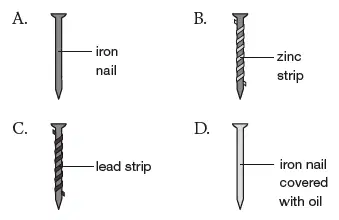
3. In which of the following cases would the iron nail rust fastest?
a)
A
b)
B
c)
C
d)
D
45.

4. In which of the following set-ups would the iron nail rust most slowly?
a)
A
b)
B
c)
C
d)
D
46.

5. Which of the following combinations about corrosion prevention methods of metal objects is correct?
a)
A
b)
B
c)
C
d)
D
47.

6. Which of the following set-ups can be used for anodizing aluminium objects?
a)
A
b)
B
c)
C
d)
D
48.
7. Consider the following statements and choose the best answer:
1st statement
An iron nail does not rust in a test tube of distilled water.
2nd statement
Distilled water does not contain dissolved oxygen.
a)
A. Both statements are true and the 2nd statement is a correct explanation of the 1st statement.
b)
B. Both statements are true but the 2nd statement is NOT a correct explanation of the 1st statement.
c)
C. The 1st statement is false but the 2nd statement is true.
d)
D. Both statements are false.
49.
★★ 3. If 2 g of helium contains y molecules, how many molecules are present in 38 g of fluorine?
(Relative atomic masses: He = 4.0, F = 19.0)
a)
A. (1/2)y
b)
B. y
c)
C. 2y
d)
D. 4y
50.
★★ 4. HKDSE 2018 Paper 1A Q4
(Refer to Textbook 1C, Chapter 12, Exam practice, Q4)
a)
A
b)
B
c)
C
d)
D
51.
5. OCR A Level Chemistry A 2017 Jun H432/01 Q4
(Refer to Textbook 1C, Chapter 12, Exam practice, Q5)
a)
A
b)
B
c)
C
d)
D
52.
★ 6. How many grams of iron can be extracted from 100 g of iron ore that contains 70% by mass of Fe₂O₃? (Assume that the impurities do not contain iron.)
(Relative atomic masses: O = 16.0, Fe = 55.8)
a)
A. 12.3 g
b)
B. 24.5 g
c)
C. 48.9 g
d)
D. 97.8 g
53.
7. HKDSE 2020 Paper 1A Q3
(Refer to Textbook 1C, Chapter 12, Exam practice, Q7)
a)
A
b)
B
c)
C
d)
D
54.
★ 8. Hydrated salt X • nH₂O contains 62.9% of water by mass. Given that the molar mass of X is 106.0 g mol⁻¹, what is the value of n?
(Relative atomic masses: H = 1.0, O = 16.0)
a)
A. 2
b)
B. 5
c)
C. 6
d)
D. 10
55.
9. HKDSE 2021 Paper 1A Q19
(Refer to Textbook 1C, Chapter 12, Exam practice, Q9)
a)
A
b)
B
c)
C
d)
D
56.
10. The relative atomic mass of metal X is 40.1. 8.42 g of an oxide of X contains 2.40 g of oxygen. What is the mole ratio of X to oxygen in the oxide?
(Relative atomic mass: O = 16.0)
a)
A. 1 : 1
b)
B. 1 : 2
c)
C. 2 : 1
d)
D. 1 : 3
57.
11. OCR A Level Chemistry A 2017 Jun H432/01 Paper 1 Q7
(Refer to Textbook 1C, Chapter 12, Exam practice, Q11)
a)
A
b)
B
c)
C
d)
D
58.
12. OCR A Level Chemistry A 2020 Nov H432/01 Q3
(Refer to Textbook 1C, Chapter 12, Exam practice, Q12)
a)
A
b)
B
c)
C
d)
D
59.
★★ 13. HKDSE 2014 Paper 1A Q4
(Refer to Textbook 1C, Chapter 12, Exam practice, Q13)
a)
A
b)
B
c)
C
d)
D
60.
★★★ 14. Zinc chloride has the formula ZnCl₂. Which of the following statements about zinc chloride is correct?
(Relative atomic masses: Cl = 35.5, Zn = 65.4)
a)
A. 1 mol of zinc atoms has been combined with 2 mol of chlorine molecules.
b)
B. 1 g of zinc has been combined with 2 g of chlorine.
c)
C. It contains a higher percentage by mass of chlorine than zinc.
d)
D. Its molar mass is 130.4 g mol⁻¹.
61.
★★★ 15. When 0.1 mol of an element Y is heated in air, there is an increase in mass of 2.4 g. Assume that Y reacts only with the oxygen in air and the reaction is complete. Which of the following elements might Y be?
(Relative atomic masses: C = 12.0, O = 16.0, Al = 27.0, K = 39.1, Ca = 40.1)
a)
A. Carbon
b)
B. Aluminium
c)
C. Potassium
d)
D. Calcium
62.
1. Which of the following substances contains the least number of ions?
a)
A. 1 mol of silver sulphide, Ag₂S
b)
B. 1 mol of copper(II) dichromate, CuCr₂O₇
c)
C. 1 mol of aluminium sulphate, Al₂(SO₄)₃
d)
D. 1 mol of magnesium nitrate, Mg(NO₃)₂
63.
2. One mole of oxygen and one mole of nitrogen have the same
(1) mass.
(2) number of atoms.
(3) number of molecules.
a)
A. (1) only
b)
B. (2) only
c)
C. (1) and (3) only
d)
D. (2) and (3) only
64.
Which of the following is the empirical formula of nandrolone?
a)
A. C₉H₁₃O
b)
B. C₁₈H₂₆O₂
c)
C. C₉H₂₆O₂
d)
D. C₁₈H₁₃O
65.
4. Which of the following is the molar mass of nandrolone?
(Relative atomic masses: H = 1.0, C = 12.0, O = 16.0)
a)
A. 137.0 g mol⁻¹
b)
B. 166.0 g mol⁻¹
c)
C. 245.0 g mol⁻¹
d)
D. 274.0 g mol⁻¹
66.
5. An oxide of metal X contains 83.0% of X. What is the formula of the oxide?
(Relative atomic masses: O = 16.0, X = 39.1)
a)
A. XO₂
b)
B. X₂O
c)
C. X₂O₃
d)
D. X₃O₂
67.
6. In an experiment, 4.40 g of a sample of ZnSO₄ • xH₂O was heated and 2.47 g of anhydrous ZnSO₄ was obtained. What is the value of x?
(Relative atomic masses: H = 1.0, O = 16.0, S = 32.1, Zn = 65.4)
a)
A. 2
b)
B. 5
c)
C. 7
d)
D. 10
68.
7. Calcium carbonate decomposes on heating to give calcium oxide and carbon dioxide.
CaCO₃(s) → CaO(s) + CO₂(g)
What would be the theoretical mass of calcium oxide produced when 10.01 g of calcium carbonate decomposes completely by heat?
(Relative atomic masses: C = 12.0, O = 16.0, Ca = 40.1)
a)
A. 4.84 g
b)
B. 5.61 g
c)
C. 7.21 g
d)
D. 9.62 g
69.
8. If 4.31 g of calcium oxide is finally obtained, what is the percentage yield of the reaction?
a)
A. 44.8%
b)
B. 59.8%
c)
C. 76.8%
d)
D. 89.0%
70.
2. Which of the following equations is/are balanced?
(1) 2PbS + 3O₂ → 2PbO + 2SO₂
(2) MgCO₃ + 2HCl → MgCl₂ + CO₂ + 2H₂O
(3) Zn(NO₃)₂ + 2NaOH → Zn(OH)₂ + 2NaNO₃
a)
A. (1) only
b)
B. (2) only
c)
C. (1) and (3) only
d)
D. (2) and (3) only
71.
3. Metal X is between zinc and copper in the metal reactivity series. It can be deduced that
a)
A. X can displace zinc from zinc oxide.
b)
B. zinc can displace X from the oxide of X.
c)
C. X can displace both zinc and copper from their oxides.
d)
D. copper can displace X from the oxide of X.
72.
★★ 4. X, Y and Z are three different metals. X can be obtained by heating its oxide with carbon but not by heating with Y. Z cannot be obtained by heating its oxide with either X or Y. Which of the following correctly shows the metals in order of decreasing reactivity?
a)
A. Z, X, Y
b)
B. Z, Y, X
c)
C. X, Y, Z
d)
D. X, Z, Y
73.
5. Dilute hydrochloric acid reacts with calcium oxide according to the following chemical equation:
2HCl(aq) + CaO(s) → CaCl₂(aq) + H₂O(𝓁)
Which of the following correctly shows the ionic equation of the reaction?
a)
A. 2H⁺(aq) + 2Cl⁻(aq) + CaO(s) → Ca²⁺(aq) + 2Cl⁻(aq) + H₂O(𝓁)
b)
B. 2H⁺(aq) + CaO(s) → Ca²⁺(aq) + H₂O(𝓁)
c)
C. 2H⁺(aq) + O²⁻(aq) → H₂O(𝓁)
d)
D. H⁺(aq) + OH⁻(aq) → H₂O(𝓁)
74.

★ 6. The extraction of titanium from its ore consists of two steps. The first step can be represented by the following equation:
TiO₂(s) + wCl₂(g) + xC(s) → yTiCl₄(𝓁) + zCO(g)
Which of the following combinations is correct?
a)
A
b)
B
c)
C
d)
D
75.
★★ 7. HKDSE 2017 Paper 1A Q15
(Refer to Textbook 1C, Chapter 11, Exam practice, Q7)
a)
A
b)
B
c)
C
d)
D
76.
8. HKDSE 2020 Paper 1A Q15
(Refer to Textbook 1C, Chapter 11, Exam practice, Q8)
a)
A
b)
B
c)
C
d)
D
77.
9. HKDSE 2021 Paper 1A Q4
(Refer to Textbook 1C, Chapter 11, Exam practice, Q9)
a)
A
b)
B
c)
C
d)
D
78.

Which of the following combinations is correct?
a)
A
b)
B
c)
C
d)
D
79.
2. Which of the following metals reacts with dilute acids and steam, but NOT with cold water?
a)
A. Potassium
b)
B. Calcium
c)
C. Copper
d)
D. Magnesium
80.
3. Which of the following experiments would produce a colourless gas?
(1) Mixing sodium with water
(2) Heating iron with steam
(3) Mixing copper with dilute hydrochloric acid
a)
A. (1) and (2) only
b)
B. (1) and (3) only
c)
C. (2) and (3) only
d)
D. (1), (2) and (3)
81.
4. In which of the following metals do the atoms lose electrons most readily?
a)
A. Calcium
b)
B. Aluminium
c)
C. Iron
d)
D. Copper
82.
5. Which of the following correctly shows the chemical equation for the reaction between potassium and water?
a)
A. K(s) + 2H₂O(𝓁) → K(OH)₂(aq) + H₂(g)
b)
B. K(s) + H₂O(𝓁) → KO(s) + H₂(g)
c)
C. 2K(s) + H₂O(𝓁) → K₂O(s) + H₂(g)
d)
D. 2K(s) + 2H₂O(𝓁) → 2KOH(aq) + H₂(g)
83.
Which of the following correctly shows the three metals in order of decreasing reactivity?
a)
A. X, Y, W
b)
B. X, W, Y
c)
C. W, Y, X
d)
D. Y, X, W
84.
7. P, Q and R are three different metals. P exists as a free element in nature. Q reacts with steam but not with cold water. When placed in an aqueous solution of a compound of R, Q dissolves but P does not. Which of the following shows these metals in order of increasing reactivity?
a)
A. P, Q, R
b)
B. P, R, Q
c)
C. R, P, Q
d)
D. R, Q, P
85.
8. Consider the following chemical equation:
AgNO₃(aq) + NaCl(aq) → AgCl(s) + NaNO₃(aq)
Which of the following are the spectator ions of this reaction?
a)
A. Ag⁺(aq) and Cl⁻(aq)
b)
B. Na⁺(aq) and NO₃⁻(aq)
c)
C. Ag⁺(aq) and NO₃⁻(aq)
d)
D. Na⁺(aq) and Cl⁻(aq)
86.
★ 3. HKDSE 2018 Paper 1A Q3
(Refer to Textbook 1C, Chapter 10, Exam practice, Q3)
a)
A
b)
B
c)
C
d)
D
100 %

