
 Worksheets
Weather Review
Total questions: 113
Worksheet time: 2hrs 40mins
What is weather?
The amount of moisture in the air
The number of clouds in the sky
The speed of the wind
The state of the atmosphere at any particular time.
What are the characteristics of a high-pressure system?
Wind and rain
Humidity and thunder
Extremely hot temperatures
Clear skies and sun
If the air is only holding one-third as much moisture as it can possibly hold, what is the relative humidity? (a) percent
What will happen if the relative humidity is 100 percent, and the temperature begins falling?
It will start to rain
The air will be sticky and uncomfortable
The temperature will rise
The barometric pressure will rise
Someone who studies the weather.
(a)
What kind of weather would you expect in a low pressure system?
Warm temperatures
Cool temperatures
Clear conditions
Cloudy/rainy conditions

The amount of water vapor present in the air is called (a) .
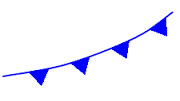
What symbol is this?
(a)
Weather is driven by ______
Rotation of the Earth on its axis
Uneven heating of Earth's surface
Revolution of the Earth around the sun
The moon's Gravity
What type of heat transfer drives weather in the atmosphere?
(a)
Convection happens when _______
Warm fluids rise and cold fluids sink
Warm fluids sink and cold fluids rise
Heat moves through touch
High Pressure usually brings what kind of weather?
(a)
On a cold, cloudy day, the local weather forecaster predicts that a high-pressure system will be moving into the area in the next 24 hours. Which weather conditions will this system most likely bring to the area?
(a)
Michael observes the air pressure daily. Over the last couple of days the air pressure has been dropping. What weather will Michael most likely observe as a result?
Increasingly clear skies and more wind
Increasingly clear skies and dry weather
increasingly cloudy skies and possible storms
Wind always moves from areas of _____ pressure to areas of _____ pressure.
Low, Low
High, High
Low, High
High, Low
Which statement correctly defines wind?
Wind is the movement of air from an area of low pressure to an area of high pressure
Wind is the movement of air to a colder area in the atmosphere.
Wind is the movement of air from an area of high pressure to an area of low pressure.
Wind is the movement of air pushed around and bouncing off Earth's surface.

What type of front is this
(a)

What is symbol C (the 3rd from the top)?
(a)
What is 4th symbol?
(a)
When I cold front is approaching, what happens
warm air is pushing under cold air causing humid weather and lower temperatures
warm air is pushing under cold air causing humid weather and higher temperatures
warm air rises, cools, and causes rain and thunderstorms
cold air is pushed over warm air causing rain and thunderstorms
Why does a hurricane slow down when it hits land?
The wind stops it
It stops raining
It loses its energy source
The air is different
Located at the leading edge of a temperature drop off. Bring heavy thunderstorms, rain, and hail. Cool, fair weather is likely to follow.
(a)
Located at the leading edge of a warm air mass. Brings gentle rain or light snow, followed by warmer, milder weather.
(a)

This is the symbol for a...
(a)

The map below shows a high pressure system. The lines on the map represent areas of equal atmospheric pressure, measured in millibars. The difference in atmospheric pressure between Point X and Point Y causes
(a)

Storms with high winds and heavy rain that form over warm ocean waters are called (a)

When do tornadoes form?
when warm, humid air collides with cold, dry air
when cold, humid air collides with warm, dry air
when cold air rises through warm air
when the air cools rapidly and forms storm clouds

How does the Fujita scale measure a tornado's intensity?
by analyzing the damage the tornado has done & matching that to wind speeds
by only looking at the wind speed
by looking at the number of buildings the tornado destroys
by analyzing the wind speeds and width of the tornado

Near which two cities are the low pressure systems located?
Seattle & San Francisco
Chicago & Seattle
Dallas & Houston
Chicago & Nashville

Near which city is the high pressure system located?
(a)

Which two cities are most likely to experience clear, dry weather?
Seattle & San Francisco
Chicago & Minneapolis
Chicago & Nashville
Dallas & Houston
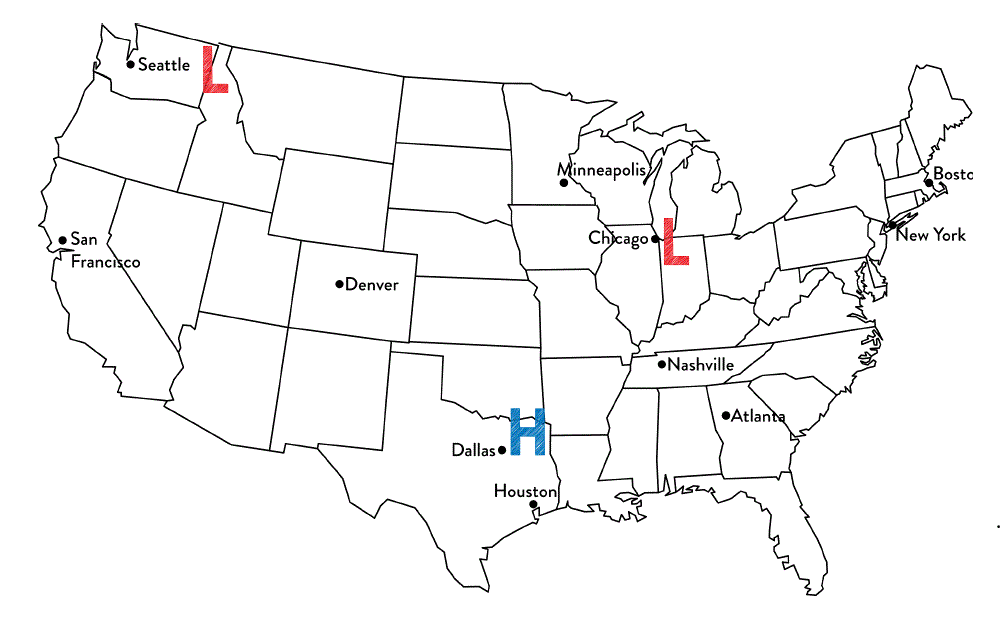
Tim said that Chicago is most likely to experience rainy weather. Jennifer thinks that Dallas is most likely to experience rainy weather.
Which student is correct?
Tim because Chicago is the closest to a low pressure system and they produce precipitation.
Jennifer because high pressure systems produce precipitation
Both students are correct because all systems produce precipitation
Neither of the students are correct because the cities are not close enough to the system.

When this symbol is present on a weather map, it represents
a cold air mass has taken over a warm air mass
a warm air mass has taken over a cold air mass
a cold air mass and warm air mass meet but neither have enough force to move each other
two cold fronts have collided and a warm air mass is pushing it upwards

Which location is most likely experiencing warmer temperatures and higher humidity?
Location A
Location B
Location C
Location D

(a)

heavier, sinking air
high pressure
low pressure

tornado
extreme high pressure
extreme low pressure

humid air
high pressure
low pressure

Look at the weather map. What type of air front is heading toward San Francisco?
Cold front
Warm front
Stationary front
Occluded front

What does this symbol indicate?
(a)
What is the Coriolis effect?
The Coriolis effect is the result of gravitational forces between celestial bodies.
The Coriolis effect is the phenomenon of ocean currents caused by the rotation of the Earth.
The Coriolis effect is the apparent deflection of moving objects caused by the rotation of the Earth.
The Coriolis effect is the change in temperature due to the rotation of the Earth.
What are the causes of the Coriolis effect?
Gravitational pull of the Moon.
Tectonic plate movement.
Solar radiation.
Rotation of the Earth on its axis
In which hemisphere does the Coriolis effect deflect moving objects to the right?
Western Hemisphere
Eastern Hemisphere
Northern Hemisphere
Southern Hemisphere

The rotation of the Earth causes winds to bend due to the...
(a)

What causes differences in air pressure around the Earth?
Warm air rises at the equator and cold air sinks at the poles.
Warm air sinks at the equator and cold air rises at the poles.
Warm air rises at the equator and cold air rises at the poles.
Cold air rises at the equator and warm air sinks at the poles.

Globally, air moves in convection cells about every ___ of latitude, producing pressure belts.
10 degrees
20 degrees
30 degrees
40 degrees

The air molecules, warmed by earth’s surface, rise because they are ____________________. After the air molecules cool, they sink. This is an example of _____________________.
more dense, conduction
less dense, convection
less dense, radiation
more dense, insulation

What are winds that blow steadily, from specific directions, over long distances?
(a)

Due to the Jet Stream and Westerlies, in which direction do most weather systems travel across the United States?
east to west
west to east
north to west
north to south
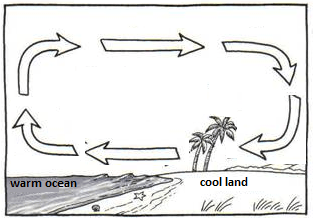
Global winds that occur between 0 and 30 degrees latitude are called
(a)
Global winds that flow from the southwest in the Northern hemisphere and northwest in the Southern hemisphere are called (a) .
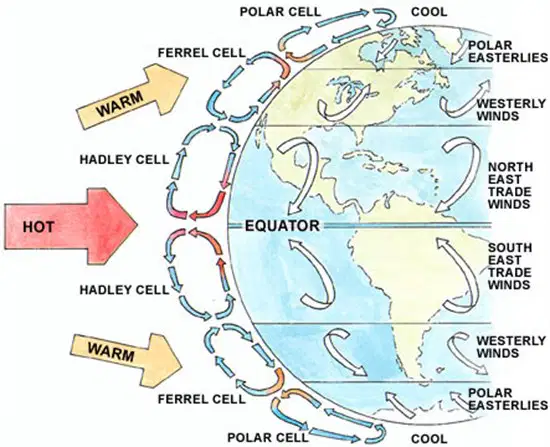
Global winds that flow from 90 to 60 degrees latitude are called (a) .

Type of heat transfer: Curling Iron
(a)

Type of heat transfer: Boiling Water
(a)

Type of heat transfer: Mantle
(a)

Type of heat transfer: Microwaving Food
(a)

Type of heat transfer: Heat Lamps
(a)
What type of air would a continental polar air mass bring?
Warm and humid
Warm and dry
Cold and humid
Cold and dry
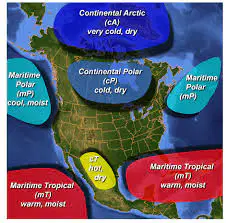
What type of air mass is associated with warm and humid air?
(a)
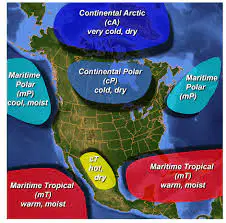
What type of air mass is associated with cold and humid air?
(a)
What type of instrument measures the humidity in the air?
hygrometer
barometer
anemometer
rain gauge
Sling Psychrometer
Which instrument tells you the direction from which the wind is blowing?
(a)

What is satellite used for and in what units?
surface and atmospheric temperatures
precipitation and humidity levels
cloud patterns and movements
All the above

This weather instrument is a...
(a)

An instrument used to measure HUMIDITY; the moisture in the air
(a)

An instrument that measures the DIRECTION from which the WIND is blowing
(a)

An instrument used to measure WIND SPEED
(a)

Water vapor enters the atmosphere by what process?
(a)

Why is the Equator warmest?
Because it receives indirect sunlight
Because it receives the most direct sunlight

What is it called when the atmosphere traps heat?
(a)
Which of the following is a greenhouse gas?
oxygen
carbon dioxide
nitrogen
neon

At the poles cold air __________________________.
rises
sinks
sinks and causes low pressure
causes snow

Why don't the rays from the sun reach every part of the Earth evenly? pgraph 4
because the Earth is tilted more than 23 degrees
because the equator is bigger than the rest of the Earth
because the oceans block the sun from the land
because the poles are so cold

Which of the following is characteristic of Air Mass A?
hot and dry
hot and wet
cold and dry
cold and wet
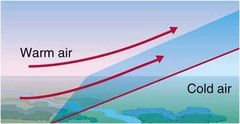
Which type of front is displayed?
(a)

Which type of front is displayed?
(a)
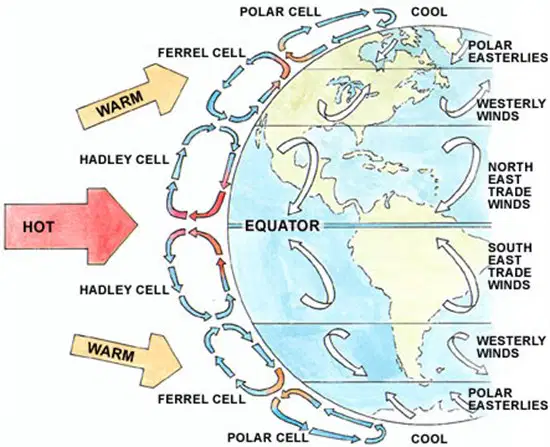
The tropical winds running from 0 to 30 degrees latitude are called:
(a)
Warm, rising air at the Equator forms a calm, weak wind called the:
(a)

Which electromagnetic wave has the longest wavelengths and the lowest frequencies?
(a)

Sunscreen protects from sunburns caused by what electromagnetic wave?
Infrared
Gamma
Ultraviolet
Visible Light

The human eye is only capable of seeing which electromagnetic wave?
(a)

Which form of matter has a definite shape like this picture?
(a)

Which form of matter fills the space like it has in the balloon?
(a)

The drops of water that appear on the outside of a glass of cold juice on a warm day are an example of?
(a)

Our (a) is the layer of gases that surrounds our planet.
Which of the following is NOT a greenhouse gas?
Carbon dioxide
Methane
Water vapor
nitrogen
1. Certain gases in the atmosphere – water vapor, carbon dioxide, methane and nitrous oxide – help maintain the Earth’s temperatures and climate. These are called: (a) .

Earth receives its energy from the sun in the form of ____________________ radiation and the Earth releases the heat it received in the form of ________________ radiation
Gamma and Radio
Visible and Ultraviolet
Longwave and Shortwave
Shortwave and Longwave
*When solar energy hits the earth*
it can be either reflected or absorbed by the atmosphere and/or the surface
it is all absorbed by the atmosphere and the surface
it is mostly reflected by the atmosphere and the surface
it cannot affect processes that occur on earth

Describe what scientists mean when they say Earth’s energy budget.
We should spend way more money on taking care of Earth.
The balance between the energy humans consume and the pollution humans emit.
The balance between the energy that Earth receives from the sun and the energy that Earth re-emits/reflects back.
The balance between the energy coming in from the sun and the energy that humans need to survive.

The greenhouse effect is caused by
more heat arriving at the earth from the sun than the earth emits out into space
the earth releasing more heat at night than it receives during the day
certain gases in the atmosphere that are trapping heat released by the earth.
the varying difference in the distance we are from the sun throughout the year.
*What percentage of solar radiation is absorbed by the atmosphere and clouds?*
5%
20%
30%
50%
Which naturally occurring greenhouse gas is the most abundant in our atmosphere?
CFCs
carbon dioxide
water vapor
methane
Albedo can best be described as...
the temperature increase or decrease of a surface.
the amount of solar radiation absorbed by a surface
the amount of solar radiation reflected by a surface
the amount of solar radiation that doesn't contact a surface
(a) describes how much energy is required to raise an object's temperature.

