
 Worksheets
6.Nucleic acids and Protein synthesis
Total questions: 117
Worksheet time: 2hrs 25mins
What is the genetic molecule?
(a)
What is the DNA's aim?
What ability does DNA have?
What are Chromosomes made of?
(a)
What are the individual sections in DNA?
(a)
Facts about the genetic molecule we need to know:
Chromosomes are made from DNA strands, these strands have individual sections called genes
Genes are composed of many tiny DNA molecules, each one acting like a single letter in an instruction manual that the cell can read out of order
Ability to be copied over and over again, so it can be found in daughter cell nuclei
The two strands of DNA are identical copies of each other, so that if one strand gets damaged there is backup
Aim to store information about cell behaviour and how to construct them
What does de abbreviation of DNA stand for?
(a)
What does de abbreviation of RNA stand for?
(a)
What are nucleic acids?
(a)
What type of macromolecule are DNA and RNA?
What are the subunits of Nucleic acids?
(a)
Name given to polymers of nucleotides:
(a)
How many components form nucleotides?
What are the 3 components of nucleotides?
(a)
What nitrogen-containing base substitutes Thymine in RNA?
(a)
What are the 3 nitrogen-containing bases in DNA?
(a)
How many carbons does a pentose sugar have?
What pentose sugar do nucleotides have in DNA?
(a)
What pentose sugar do nucleotides have in DNA?
(a)
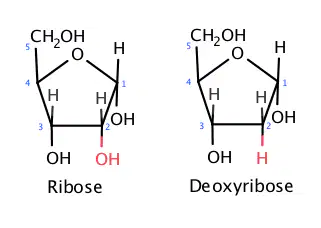
What is the structural difference between the pentose sugars ribose and deoxyribose?
What are the two components that form Adenosine?
Polysaccharide and four phosphate groups
Purine base and Glycoprotein
Carbohydrate and Nucleic acid
Monosaccharide and a nitrogenous base
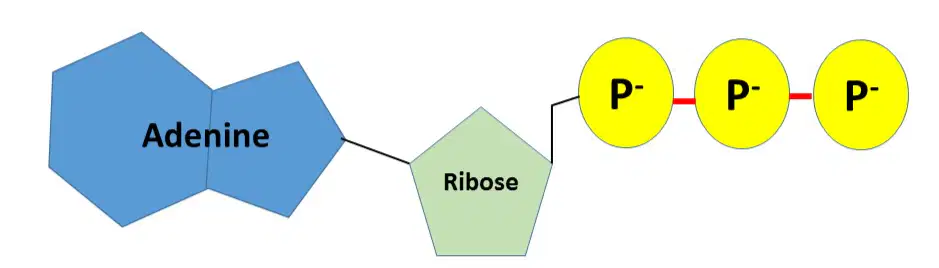
what 2 components form ATP?
(a)
What type of nitrogenous base are Guanine(G) and Adenine(A)?
(a)
What type of nitrogenous base are Thymine(T) and Cytosine(C)?
(a)
What is ADP composed by?
Ribose and adenine (Adenosine) and three phosphate groups
Ribose and adenine (Adenosine) and two phosphate groups.
Ribose and adenine (Adenosine) and one phosphate group.
What is AMP composed by?
Ribose and adenine (Adenosine) and three phosphate groups
Ribose and adenine (Adenosine) and two phosphate groups.
Ribose and adenine (Adenosine) and one phosphate group.
ATP's structure is similar to a (a) structure
Facts about Dinucleotides:
It is a polynucleotide
Joined by a condensation reaction
Covalent sugar-phosphate bonds link the 2 nucleotides
Phosphodiester bonds link the 2 nucleotides
Formed by 2 nucleotides
What two covalent bonds refer to the same bond with the same function: linking nucleotides together?
sugar-phosphate bonds
Facts about Condensation reaction:
Also called dehydration synthesis
Creates covalent bonds
What is a polynucleotide?
Where are the polynucleotides (DNA/RNA) made in?
(a)
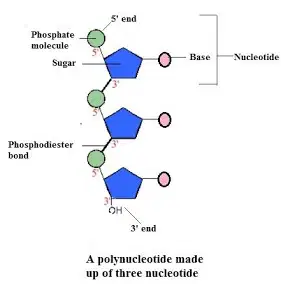
Facts about the phosphate links in polynucleotides:
Links are established through covalent bonds between proteins.
The phosphate link starts in the 5th carbon
Links are created by ionic bonds between phosphates
The last phosphate link ends in the 3rd Carbon
Which process can be repeated millions of times to create long, unbranching strand of nucleotides?
1. Condensation reactions that link nucleotides with phosphodiester bonds, releasing water
1. Hydrolisis reactions that links nitrogen-containing bases with phosphodiester bonds, producing a water molecule
2. The reaction is catalyzed by DNA polymerase (5'→3'), using a template strand
2. The reaction is catalyzed by Topoisomerase (3'→5'), using a copy strand
What makes the sugar-phosphate backbone of polynucleotides?
How many hydrogen bonds are there between Adenine (A) and Thymine (T)
(a)
How many hydrogen bonds are there between Guanine (G) and Cytosine (C)
(a)
What shape does DNA have?
(a)
How many base pairs for their to be a turn in DNA?
(a)
In what processes are hydrogen bonds broken?
Transcription
Replication
Translation
Protein synthesis
In which process are phosphodiester bonds formed?
Protein synthesis
Translation
Transcription
Replication
What process: DNA → DNA
(a)
DNA→RNA (mRNA)
(a)
RNA (mRNA)→ Polypeptide
(a)
Polypeptide → Functional protein
(a)
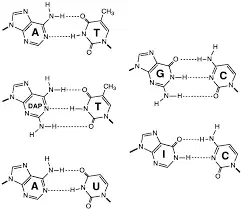
How many rings do purines and pyrimidines have and together?
(a)
How many polynucleotide strands make RNA?
(a)
First step of Replication? (shape/bonds/result)
What happens after "the DNA strand is unwinded and the hydrogen bonds between bases are broken resulting into 2 strands" in the Replication process?
What is the 'Copying process' in replication dna?
DNA polymerase attaches to the 2 strands and adds a complementary base at a time, joined by hydrogen bonds to its complementary base
The translation of DNA into proteins.
The repair of copied DNA strands.
Part of DNA replication
Producing RNA out DNA
In what strand does DNA polymerase copy 5'→3'
(a)
In what strand does DNA polymerase copy 3'→5'
(a)
Where does 5'→'3 travel towards in replication?
Towards the origin
Towards the unwinding enzyme
Opposite to the unwinding enzyme
Where does 3'→'5 travel towards in replication?
Towards the origin
Towards the unwinding enzyme
Opposite to the unwinding enzyme
In what does the bottom parent strand result in after the copying process
(a)
In what does the top parent strand result in after the copying process
(a)
What does the 3'→5' copying direction mean?
What are the fragments copied in the lagging strand called?
(a)
What enzyme unwinds the DNA strand?
(a)
Which enzyme breaks hydrogen bonds?
(a)
What does DNA ligase do?
How is the backbone formed to finish the replication process?
What enzyme finishes the Replication processs?
(a)
What are all the reactions in the body done by?
(a)
DNA codes for
(a)
DNA controls which (a) are made
If DNA controls protein production what does it also control?
(a)
What is the primary structure of proteins?
(a)
What does the primary structure of proteins determine?
What is a sequence of bases in DNA?
(a)
Where are proteins made?
(a)
When a cell makes a protein, the _______ __ _____ in DNA codes for the exact order in which ______ _____ join
(a)
What does a gene code for?
(a)
What is another name for a triplet code
(a)
What is a triplet code/codon?
(a)
What does a sequence of 3 bases (codon) code for?
(a)
What are both Upper and Lower strands in Replication?
Template strands
Coding strands
Sense strand
Complementary strand
What is the Coding strand in Transcription?
Upper strand
Lower strand
Sense strand
Complementary strand
What is the Template strand in Transcription?
Upper strand
Lower strand
Sense strand
Complementary strand
For what amino acid does the codon CCA code for?
(a)
For what amino acid does the codon TTT code for?
(a)
For what amino acid does the codon GAA code for?
(a)
For what amino acid does the codon CCC code for?
(a)
For what condon does the amino acid Valine stand for?
(a)
For what condon does the amino acid Leucine stand for?
(a)
For what condon does the amino acid Acid glycine stand for?
(a)
For what condon does the amino acid Lysine stand for?
(a)
How is the replication process known as?
(a)
DNA makes ___ and RNA makes ________
(a)
What process is transcription?
Process of synthesizing proteins from RNA (mRNA and tRNA)
Process of translating RNA (mRNA) into DNA in the cytoplasm using enzymes
Process of which a copy of a gene's instructions (mRNA) is made in the nucleus using DNA
What is the promoter region of a gene?
A protein that enhances gene transcription
It is a non-coding DNA sequence
A cellular structure that stores mRNA.
It is located right before the beginning of the gene
It marks the point where transcription should start
What is transcripted in transcription?
mRNA is converted into a polypeptide
The polupeptide (amino acid sequence) is synthesized into a folding protein
The DNA sequence (gene) into messenger RNA (mRNA).
What is a gene?
A gene is a set of instructions for making proteins
How does Transcription begin?
With the unwinding of the DNA double helix by the enzyme Topoisomerase
When RNA polymerase binds to the promoter region at the beginning of the gene
With mRNA traveling to the ribosomes in the cytoplasm of a cell
When DNA is replicated in the nucleus of a cell
What happens after DNA polymerase is attached to the promoter region in transcription?
What is the complementary strand?
The strand used to make the copy
The copied strand
The template strand
The coding strand
Where RNA polymerase attaches to
What is the sense strand?
The strand used to make the copy
The copied strand (with Uracil instead of Thymine)
The template strand
The coding strand
Where RNA polymerase attaches to
What strand does RNA polymerase attatch to after DNA has been unwinded in Transcription?
(a)
What does RNA polymerase do after it is attached to the complementary strand in transcription?
Move 3' → 5'
Move 5' →3'
Add complementary nucleotides
Add an amino acid triplet
Attatch to the mRNA
What is the mRNA strand like in Transcription?
Like the coding strand (With Uracil instead of Thymine)
Like the complementary strand (With Uracil instead of Thymine)
Like the sense strand (With Uracil instead of Thymine)
Like the template strand (With Uracil instead of Thymine)
What is an exact copy of the sense strand in Transcription?
(a)
By what bonds are the nucleotides joined with RNA polymerase?
(a)
What does transcription result in?
(a)
What happens at the end of Transcription?
When mRNA detaches from the template strand
When DNA polymerase reaches the end of the DNA strand
When the ribosome reaches a stop condon on the mRNA, releasing the completed polypeptide chain.
As RNA polymerase moves forward, the DNA behind it (template and sense strand) re-winds
Describe the process of Transcription (6 points)
Describe the process of Replication (6 points)
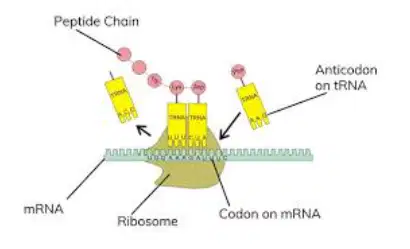
Describe the process of Translation (8 points)
What is Translation aim?
What is found at the top and bottom of tRNA?
At least __ different types of ____ exist for different _____ _____
(a)
tRNA's anticondon binds to mRNA's condon using...
(a)
How many tRNA fit inside a ribosome during translation?
How can polyribosomes be seen?
(a)
When a polypeptide leaves the ribosome what does it fold into?
Its quaternary structure
Its tertiary structure
Its primary structure
Its secondary structure
How many ribosomes can be working on the same mRNA strand?
Two ribosomes can attach to an mRNA strand
Only one ribosome can work on a mRNA strand
Many ribosomes can work on the same mRNA strand at the same time
Three ribosomes can work on the same mRNA strand
What might the protein after it has finished folding do?
Why do proteins (histones) and DNA attract?
(a)

