
Font size
 Worksheets
Biomechanics Review Quiz
Total questions: 60
Worksheet time: 36mins
Defined as "the study of the underlying causes of motion".
kinematics
kinetics
What term is this the definition of:
The/An effect of one body on another
motion
acceleration
force
Which of Newton's Law is described like this?
The change in motion is proportional to the force applied and will be in the direction the force is applied.
Law 1
Law 2
Law 3
Opening a door by pushing at the farthest point from the hinge is a practical example of what?
work
inertia
torque
Biomechanics is ...
the study of the mechanical laws and principles that govern movement in biological systems, particularly in the human body.
The study of mechanics
The study of mechanical engineering of the human body
The study of bioengineering
What role do muscle forces play in biomechanics?
They resist sliding motion
They are exerted by gravity
They generate movement through contractions
They provide stability only
What is torque in the context of biomechanics?
A push or pull acting on an object
A scalar quantity indicating speed
Rotational force causing movement around an axis
The total distance traveled
How is biomechanics applied in sports performance enhancement?
By increasing muscle mass
By analyzing and refining athletic techniques
By developing new sports rules
By reducing the number of games
How does biomechanics assist in injury prevention?
By designing new sports equipment
By identifying faulty movement patterns
By analyzing chemical reactions
By increasing the number of sports events
What is linear motion?
Movement along a straight path, such as running straight ahead.
movement around an axis
movement in a spiral pattern
movement up and down
What is angular motion?
motion where the body moves along the curved path
Movement along a straight path
movement of a zig-zag pattern
movement up and down
Which law states "a body will remain at rest or keep moving at a constant speed unless it is acted upon by a force"?
Newton's 1st Law
Newton's 2nd Law
Newton's 3rd Law
Which law states "the acceleration of an object depends on the mass of the object and the amount of force applied"?
Newton's 1st Law
Newton's 2nd Law
Newton's 3rd Law
Which law states "every action has an equal and opposite reaction"?
Newton's 1st Law
Newton's 2nd Law
Newton's 3rd Law
The energy a person or an object has due to its motion is called ________ energy
Kinetic
Potential
Chemical
Physical
Waiting at the top of a hill on a skateboard is an example of ________ energy.
Kinetic
Potential
Which type of lever has the fulcrum located between the effort and the load?
Second-class lever
Third-class lever
First-class lever
Fourth-class lever
In a first-class lever, where is the effort applied in relation to the fulcrum?
On one side of the fulcrum
On top of the fulcrum
On the opposite side of the fulcrum
On both sides of the fulcrum
Which type of lever is most commonly found in the human body?
First-class lever
Second-class lever
Third-class lever
Fourth-class lever
What parts of the body create effort?
Joints
Muscles
Resistance
What part of the body creates fulcrums?
Joints
Muscles
Resistance
The one-point where the two arms of a lever are hinged, is known as what?
Load
Effort
Fulcrum

What type of lever is this?
First Class
Second Class
Third Class

What type of lever is this?
First Class
Second Class
Third Class

What type of lever is this?
First Class
Second Class
Third Class
A diver twists in the air after jumping off a diving board. What type of motion is this?
Linear
Angular
A ski jumper slides down a run in a crouched position. What type of motion is this?
Linear
Angular
A basketball player pivots on one foot to make a pass. What type of motion is this?
Linear
Angular
Newton's first law of motion, also known as the law of inertia, applies only when an object is in a stationary position and not when an object is in a state of motion
True
False
When a speedskater pushes off at the start of a race, the surface of the ice exerts a force that is equal and opposite in magnitude to the force applied by the skater
True
False
The property of matter that causes an object or body to resist any changes in motion is known as:
(a)
Shoulder Adduction would be classified as:
Class 1 lever; Deltoid is Force; Shoulder joint as Fulcrum; Arm as Resistance
Class 3 Lever; Deltoid is Force; Shoulder joint as fulcrum; arm as resistance
Class 2 Lever; Lats is Force; Shoulder joint as fulcrum; arm as resistance
Class 3 Lever; Lats is Force; Shoulder joint as fulcrum; arm as resistance
Angular motion is the circular motion that occurs about a(n) _?_ of rotation
(a)
If the _?_ generated at any point of a movement places excessive strain on a tendon, a condition known as tendonitis can result
(a)
The use of joints in order- from largest to smallest- results in the production of maximum:
speed
acceleration
velocity
all of the above
If a diver opens up from a tuck position before entering the pool, the diver's moment of inertia:
increases
decreases
neither increases nor decreases
none of the above
An example of newtons 3rd law of motion (action-reaction) would be:
a diver pushing off a diving platform
a basketball player jumping up to take a shot
a kettlebell resting on a gymnasium floor
all of the above
An example of Issac Newton's 1st law of motion (inertia) would be:
a basketball resting motionless on the floor
a rock travelling endlessly into outer space
a bowling ball rolling evenly down a lane
all of the above
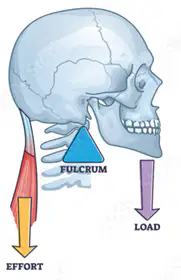
This diagram is an example of which class type of lever?
1st class lever
2nd class lever
3rd class lever
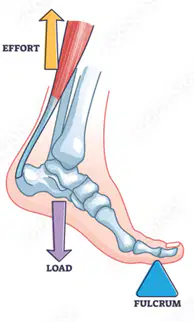
This diagram is classified as which class of lever?
1st class lever
2nd class lever
3rd class lever
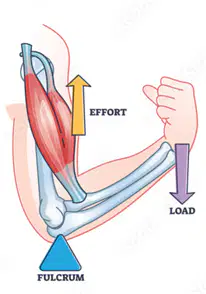
This diagram is classified as which class of lever?
1st class lever
2nd class lever
3rd class lever
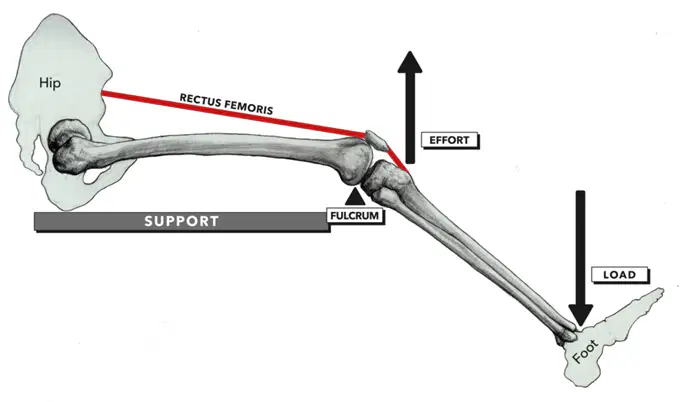
This diagram is an example of which class of lever:
1st class lever
2nd class lever
3rd class lever
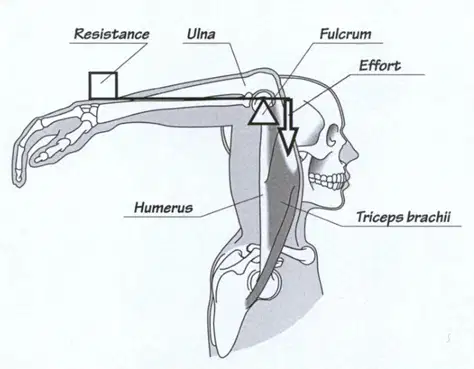
The diagram represents which class of lever for a triceps extension:
1st class lever
2nd class lever
3rd class lever
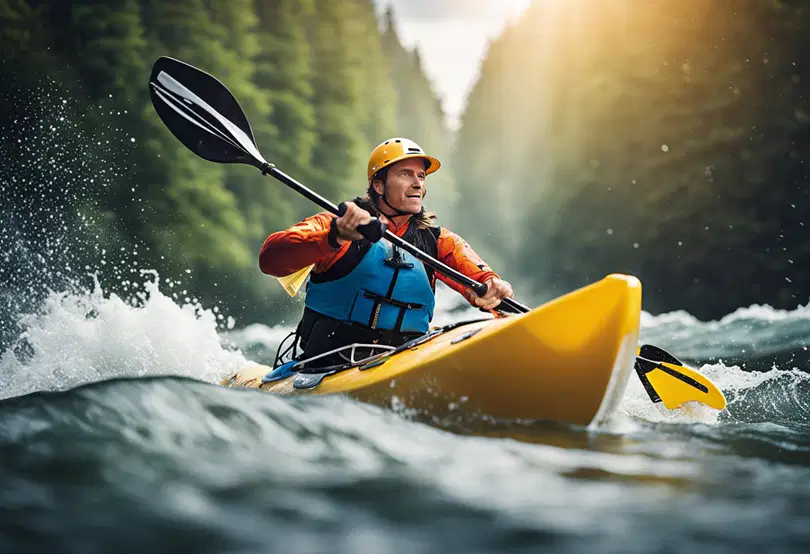
Kayaking is a representation of this type which class of lever?
1st class lever
2nd class lever
3rd class lever
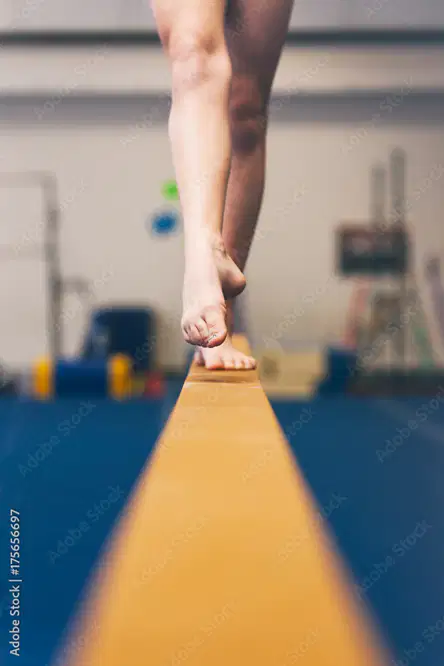
This Gymnast's foot (shown) on the balance beam represents which class of lever?
1st class lever
2nd class lever
3rd class lever
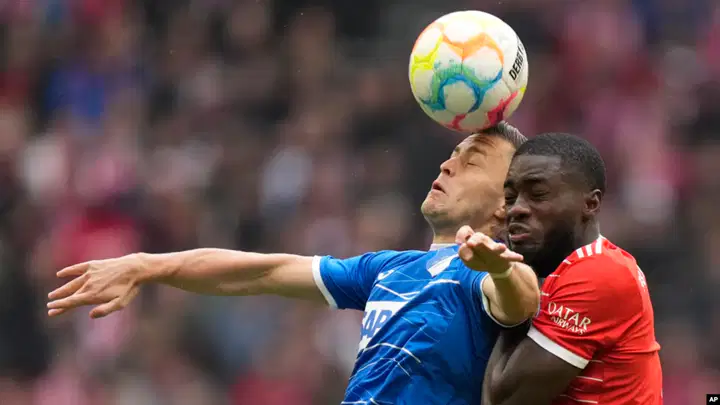
This soccer header represents which class of lever?
1st class lever
2nd class lever
3rd class lever
A sprinter pushes backward against the starting blocks at the beginning of a race. Which biomechanical principle best explains the resulting forward motion of the sprinter?
Newton’s First Law
Newton’s Second Law
Newton’s Third Law
Principle of Summation of Forces
Which force is primarily responsible for slowing a soccer ball as it rolls across artificial turf?
Gravity
Normal Force
Air resistance
Friction
A diver rotates rapidly while tucking their body during a somersault. Which type of motion is primarily occurring?
Linear motion
Angular motion
Projectile motion
Oscillatory motion
According to Newton’s (a) Law, an object will remain at rest or in uniform motion unless acted upon by an external force.
In the human body, most joints function as (a) -class levers, prioritizing speed and range of motion over force.
Motion that occurs around a fixed axis, such as elbow flexion during a throw, is classified as (a) motion.
A hockey puck sliding across ice continues moving until friction slows it down, demonstrating Newton’s (a) Law of Motion.
In a standing long jump, the ankles function as (a) -class levers, allowing the athlete to generate greater force against the ground.
When a soccer player kicks a ball, the quadriceps apply effort between the knee joint and the foot, making the leg a (a) -class lever
The curved path of a basketball during a free throw is an example of (a) motion.

