
 Worksheets
AAC Chemistry Pre-Assessment (25-26)
Total questions: 98
Worksheet time: 1hrs 5mins
The gram formula mass of magnesium chloride, MgCl2, is
5908 g/mol
95.2 g/mol
125.8 g/mol
76.4 g/mol
What is the percentage of barium in the compound BaCl2?
20.5%
34.08%
66.0%
79.5%
How many grams are present in 6.02x10²³ atoms of mercury?
200.59 grams
401.18 grams
200.59 amu
200.59 %
Francisco was heating a metal pan on the stove. He tried to take it off the stove. He quickly let go of the handle of the pan because he burned his hand. What kind of heat transfer occurred through the metal handle of the pan?
Radiation
Conduction
Convection
Insulation
The second floor of a building is always warmer than the first floor. This is an example of heat transfer by ______.
Radiation
Conduction
Convection
Phase change
Which of the following is an example of solar energy being converted to chemical energy?
Plants producing sugar during the day
Water evaporating and condensing in the water cycle
The sun unevenly heating the earth’s surface
Lava erupting from volcanoes for many days
When boiling a pan of water on the stove the water starts to bubble. The heat source is at the bottom of the pan. When the water gets hot it rises to the surface where it cools off and transfers heat to the air. The cooler water sinks to the bottom of the pan. This heat motion in a boiling liquid is called ______.
Convection
Conduction
Radiation
Insulation
Heat energy moves through solids by transmission through the solid material. This type of heat movement is called ______.
Conduction
Convection
Radiation
Nuclear
The sun is a huge sphere of gas and plasma. How does heat energy reach the earth?
Radiation only
Conduction only
Convection only
Radiation and convection
A car uses gasoline for fuel. Which of the following describes the energy conversion from gasoline to the movement of the car?
Mechanical to electrical
Heat to light
Electrical to nuclear
Chemical to mechanical
Your body is composed of many moving parts capable of doing work. If energy is defined as the ability to do work, then where does the energy come from to make your body work?
Chemical energy
Mechanical energy
Nuclear energy
Thermodynamics
Of the following, which material is the best conductor of heat?
Plastic
Copper
Rubber
Cotton fabric
Insulators ______.
speed up heat transfer
heat up quickly
can be metal
slow heat transfer
Trees in a prehistoric forest were converted to coal millions of years ago. The energy in the plant material has been ______.
permanently destroyed
transformed into potential energy
stored in bonds between its atoms
both stored in bonds between its atoms AND transformed into potential energy
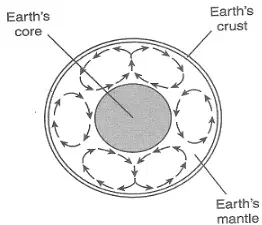
Molten rock rises in Earth’s mantle and then sinks back toward the core in a circular pattern, as shown in the diagram. This method of heat transfer is known as ______.
Conduction
Vibration
Radiation
Convection
The reason for wafting or fanning a small amount of chemical vapors toward the nose as a means to detect odors in a test tube is to —
avoid experimental error from excessive loss of mass of reactants or products
avoid splashing chemicals into the face of any person
protect the respiratory tract against potentially harmful vapors
determine the relative strength of the odor before smelling directly
If you were to touch the flask in which an exothermic reaction were occurring
The flask would feel cooler than before the reaction started.
The flask would feel warmer than before the reaction started.
The flask would feel the same as before the reaction started.
None of the above.
In which of the following situations would water molecules have the most energy?
When water is frozen as ice.
In a mixture of ice and water.
When water is boiling.
When water is superheated steam.
When a substance condenses, it changes from
A liquid to a solid.
A liquid to a gas.
A gas to a solid.
A gas to a liquid.
If you were to touch the flask in which an endothermic reaction were occurring
The flask would feel cooler than before the reaction started.
The flask would feel warmer than before the reaction started.
The flask would feel the same as before the reaction started.
None of the above.
Solids
Are dense and incompressible.
Are fluid.
Are amorphous in nature.
Consist of particles in chaotic motion.
An increase in the temperature of particles in a system results from:
An increase the average kinetic energy of the molecules.
A decrease in the average kinetic energy of the molecules.
A decrease in the rate of collision of the molecules.
The average kinetic energy of the molecules is not related to the temperature.
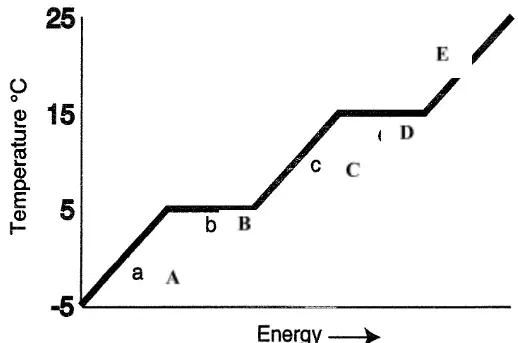
Use the graph of Temperature (°C) versus Energy with labeled segments A, B, C, D, and E to answer: At what point does the substance have the most kinetic energy?
D and E
A and B
D only
E only
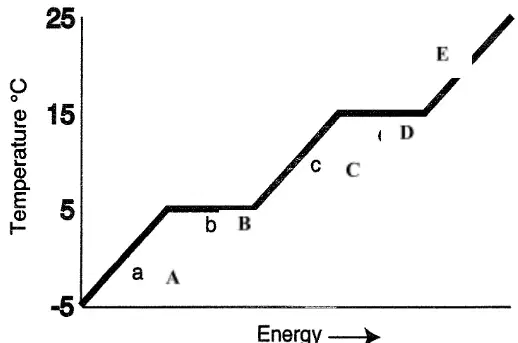
Use the graph of Temperature (°C) versus Energy with labeled segments A, B, C, D, and E to answer: What is the freezing point for the substance on the graph?
-5°C
5°C
10°C
15°C
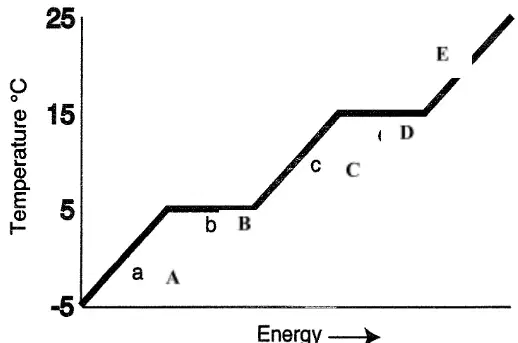
Use the graph of Temperature (°C) versus Energy with labeled segments A, B, C, D, and E to answer: What state of matter is represented by letter C on the graph?
Solid
Liquid
Gas
None of the above
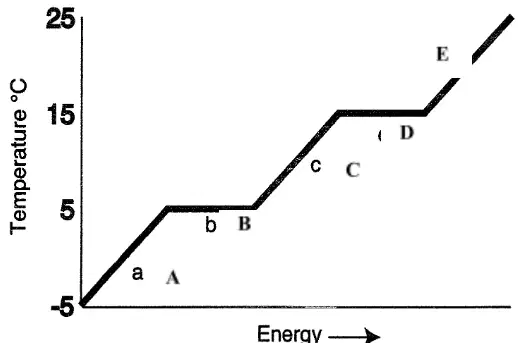
Use the graph of Temperature (°C) versus Energy with labeled segments A, B, C, D, and E to answer: What is happening to the temperature at point D on the graph?
The temperature is increasing
The temperature is decreasing
The temperature is not changing
The temperature is both increasing and decreasing.
Which is an assumption of the kinetic-molecular theory?
Matter is composed of tiny particles.
The particles of matter are in continual motion.
The total kinetic energy of colliding particles remains constant.
All of the above.
Diffusion between two gases occurs most rapidly if the gases are at a
High temperature and the molecules are small.
Low temperature and the molecules are small.
Low temperature and the molecules are large.
High temperature and the molecules are large.
The volume of a gas is 400 mL at 30°C. If the temperature is increased to 50°C without changing the pressure, what is the new volume of the gas?
375 mL
400 mL
426 mL
667 mL
A sample of chlorine gas has a pressure of 7.25 kPa at 20.0°C. What will its pressure be at 60.0°C if its volume remains constant?
2.42 kPa
8.24 kPa
21.8 kPa
6.38 kPa
The pressure of 6.24 L of a gas is increased from 25.0 kPa to 55.0 kPa. What will the new volume be?
13.7 L
5.67 L
6.87 L
2.84 L
A balloon is heated from 23 K to 56 K. The balloon will ____________.
expand
shrink
expand then shrink
none of the above.
The total pressure of a container filled with gases would be __________.
The product of the partial pressures of the individual gases
The sum of the partial pressures of the individual gases
A fraction of the partial pressures of the individual gases
A multiple of the partial pressures of the individual gases
K+, Na+ and Ca2+ are ions found in the body and are necessary for proper cellular functions involving electrical impulses. These ions are
Vitamins.
Acids.
Organic.
Electrolytes.
Jennifer set up a conducting device in her chemistry lab and was testing saltwater’s conductivity. When she placed the electrodes in the solution, the light bulb glowed very dimly. What can Jennifer do to make her light bulb glow more brightly?
Add more water to the solution.
Cool the solution down.
Use pure water instead of saltwater.
Add more salt (NaCl) to the solution.
No matter how much you stir the tea, you cannot dissolve any more sugar into the solution. This is an example of a _?_ solution.
Solvent.
Hot.
Heterogeneous.
Saturated.
In a solution, the substance that is dissolved is the _____.
Solute
Solvent
Gas
Liquid
A solution that has 4 g of KCl dissolved in 100 mL of water is __________ compared to a solution that has 30 g of KCl dissolved in 100 mL of water.
Concentrated
Filtrate
Residue
Dilute
The “universal” solvent is
Alcohol
Water
Ammonia
Benzene
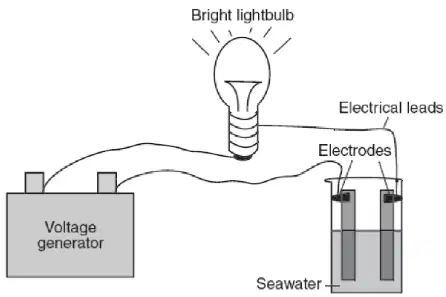
In this apparatus shown at right, the seawater is an example of a __________.
Strong electrolyte
Weak acid
Nonelectrolyte
Strong base
Which of the following is most directly responsible for water’s high boiling point?
Ionic attractions
Hydrogen-bonding
Dispersion forces
Covalent bonding
A colligative property that occurs when a solute is added to solvent, such as salt to ice in ice cream making, is __________.
Freezing point elevation
Freezing point depression
Boiling point elevation
Boiling point depression
Air is a gaseous solution made up of 20% oxygen, 79% nitrogen, and 1% miscellaneous gases. Which of these is the solvent?
Oxygen
Nitrogen
Miscellaneous gases
Air is not a solution.
What effect does temperature have on the rate a solid solute dissolves?
Higher temperatures increase the rate of dissolving.
Lower temperatures increase the rate of dissolving.
Temperature has no effect on the rate of dissolving.
Higher temperature decreases the rate of dissolving.
The phrase "like dissolves like" refers to the fact that ?
Gases can only dissolve other gases.
Polar solvents dissolve polar solutes and non-polar solvents dissolve non-polar solutes.
Solvents can only dissolve solutes of similar molar mass.
Polar solvents dissolve non-polar solutes and vice versa.
An unsaturated solution is one that ?
Contains more solute than it can dissolve.
Contains no solute.
Contains less solute than it can dissolve.
Will rapidly precipitate if a seed crystal is added.
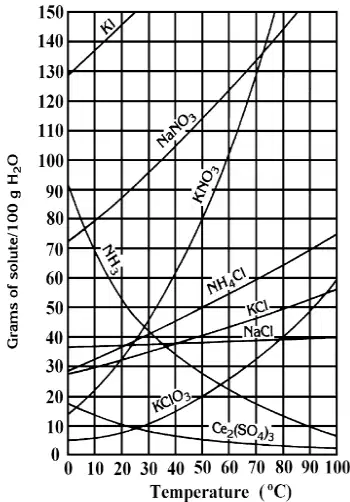
Use the solubility chart of grams of solute per 100 g H2O versus temperature to answer: At 50 °C, how much potassium nitrate (KNO3) can be dissolved in 100 g of water?
40 grams
80 grams
400 grams
800 grams
To dissolve CO2 into Sprite, manufacturers need to have the following conditions:
High temperature, low pressure
High temperature, high pressure
Low temperature, low pressure
Low temperature, high pressure
Mr. Philpott wakes up at 5 AM and wants his coffee. What should he do in order to increase the rate of sugar solvation?
Decrease sugar particle size, increase the coffee temperature
Increase sugar particle size, decrease the coffee temperature
Increase sugar particle size, increase the coffee temperature
Decrease sugar particle size, decrease the coffee temperature

Use the solvent table at right to answer: Claire wrote in permanent marker on the couch, but the permanent marker would not dissolve in water. Which other solvents listed could be used to clean the couch?
Solvents B & C
Solvents A & B
Solvents A & C
Solvents A & D
When an acid reacts with a base what compounds are formed?
Water only
A salt only
A salt and water
Metal oxide and water
Which of the following is a property of an acid?
Sour taste
Slippery feel
Non-electrolyte
Strong color
Which of the following is a property of a base?
Sour taste
Slippery feel
Non-electrolyte
Strong color
If the hydrogen ion concentration [H+] is 1×10⁻¹⁰ the solution is ____________.
Acidic
Basic (alkaline)
neutral
none of the above
A solution with a pH of 1 is how many more times acidic than a solution with a pH of 3?
2
20
100
1,000
If the pH is 6, what is the hydrogen ion concentration?
1×10⁻¹⁴ M
1×10⁻⁸ M
1×10⁻⁶ M
1×10⁻¹ M
Which of the following is a strong acid?
HC2H3O2
HCl
NH3
NaOH
The equation for pH is pH=−log[H+] . If the hydrogen ion concentration is 1.0×10⁻¹⁰ M , then the pH of the solution is ____________.
10
-10
4
14
Sodium hydroxide completely dissociates into positive and negative ions and is, therefore, a
Strong acid.
Weak acid.
Strong base.
Weak base.
All of the following are bases except
HBr
Al(OH)3
NaOH
NH4OH
This equation is representative of what type of reaction? H2SO4 + Mg(OH)2 → MgSO4 + 2H2O
Buffering
Combination
Neutralization
Hydrolysis
Which of the following statements is true?
Strong acids always have a higher pH than weak acids.
Strong acids partially dissociate in water while weak acids almost completely dissociate in water.
Strong acids almost completely dissociate in water while weak acids partially dissociate in water.
Strong acids produce hydroxide ions in solution and weak acids produce hydronium ions in solution.
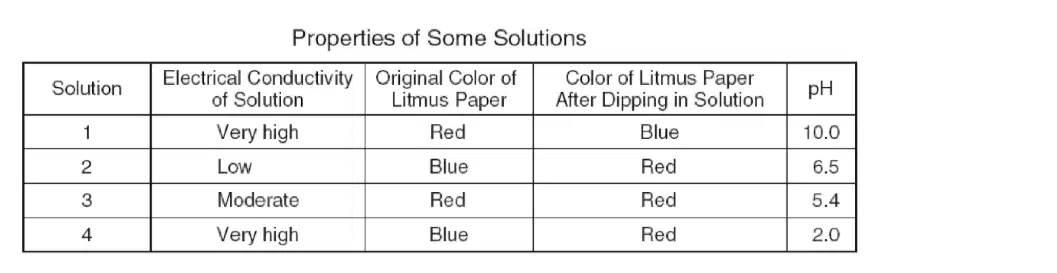
The table shows data from an investigation designed to find a liquid solution that is both an acid and a strong electrolyte. Based on the data, a solution that is both an acid and a strong electrolyte is —
Solution 1
Solution 2
Solution 3
Solution 4
Beta emission during the decay of carbon-14 is represented by:
612C→614C+−10e
614C→714N+−10e
614C+−10e→714N
What particle is needed to complete this alpha decay reaction? 86222Rn→84218Po+?
−10e
24He
+10e
01n
Gamma emission during the decay of Thorium-230 is represented by:
90230Th→88226Ra+24He+γ
90230Th→91230Pa+−10e
90230Th→89230Ac+−10e
Sodium-25 has a half-life of 50 hours. How much sodium-25 will remain in a 200 g sample after 250 hrs?
25 g
50 g
6.25 g
100 g
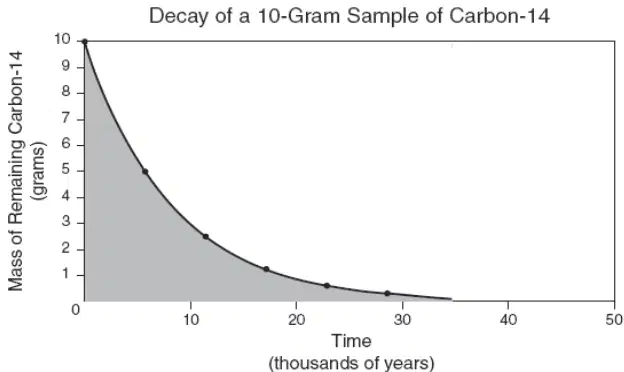
According to the graph, what is the approximate half-life of carbon-14?
5.7 years.
3,000 years.
5,700 years.
1,000,000 years.
Which of the following is a true statement?
Matter is conserved in a chemical reaction.
Matter is created in a chemical reaction.
Matter is destroyed in a chemical reaction.
All of the above statements can be true depending on the reaction.
Which of the following equations is balanced?
H2SO4 + 2 NaOH → Na2SO4 + H2O.
CH4 + Cl2 → CH2Cl2 + HCl.
H2O + MgO → Mg(OH)2.
Al(OH)3 + H3PO4 → AlPO4 + 2 H2O.
___AlCl3 + ___Ba(OH)2 → ___Al(OH)3 + ___BaCl2. When this equation is correctly balanced, the coefficient of the AlCl3 will be...
1.
2.
4.
6.
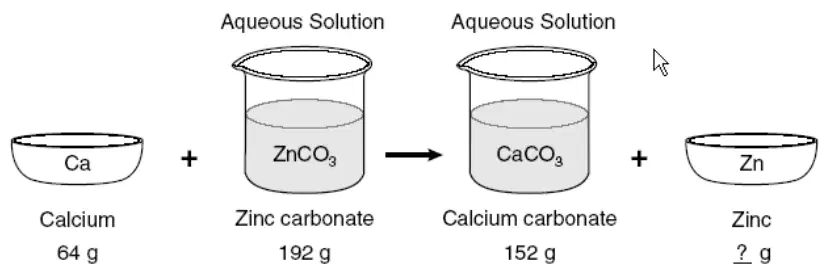
According to the law of conservation of mass, how much zinc was present in the zinc carbonate?
40 g
88 g
104 g
256 g
Which of the following reactions is an example of a single-replacement reaction?
2 AgNO3 + Cu → Cu(NO3)2 + 2 Ag.
NaOH + HCl → NaCl + H2O.
CO2 → C + O2.
4 Fe(OH)2 + O2 → 4 Fe(OH)3.
In chemistry class, Mr. Smoak adds a small piece of sodium metal to a glass of water. The sodium reacts violently with the water producing a small flame. The end products are hydrogen gas and sodium hydroxide. Which of the following is the correct balanced chemical equation for the reaction described above?
2 Na + 2 H2O → 2 NaOH + H2.
Na + H2O + O2 → 3 NaOH + H2.
H2O2 + 2 Na → 2 NaOH + H2.
2 NaOH + H2 → 2 Na + 2 H2O.
Your feedback prompt states: On the back of your answer document, write a short essay giving feedback, explaining what was good about this course, what was bad about this course, and how it could be improved. Which items should your feedback include?
What was good about the course.
What was bad about the course.
How the course could be improved.
The grading rubric used for the test.
You should get all lab equipment out and organized before the teacher begins class and gives instructions.
True
False
You are working to complete the lab when you accidentally splash chemicals in your eye. What should you do first?
Blink several times and continue working.
Rinse your eye with water for at least 15 minutes.
Wipe your eye with a paper towel.

1s22s22p63s23p64s23d10


What were John Dalton two contributions to atomic history?
Created the atomic theory
Discovered that the atom is mostly empty space
Believed that atoms cannot be rearranged during chemical reactions
Hypothesized that the atom is a tiny, hard sphere
Discovered the electron

Which of the following is the best analogy for Thomson's model of the atom?
marble
plum pudding
solar system
ripple in water standing still
Protons have a (a) charge.
Which values are the same for a neutral element?
Atomic mass and # of neutrons
Atoms, Subatomic Particles, and Reactivity
Atomic mass, atomic number and atomic symbol
Atomic #, # of protons and # of electrons

Which is the property of matter in which a substance can transfer heat or electricity?
magnetism
conductivity
density
solubility

Which of the following is an example of a physical change?
Water freezing into ice.
A piece of wood burning.
A toy car rusting.
Zinc producing hydrogen gas when mixed with water.
Density is _____________.
Mass/Volume
Weight/Volume
Mass/Weight
Volume/Mass
Volume/Weight
What is the correct formula for calculating density?
d= m + v
d = m - v
d = m * v
d = m / v
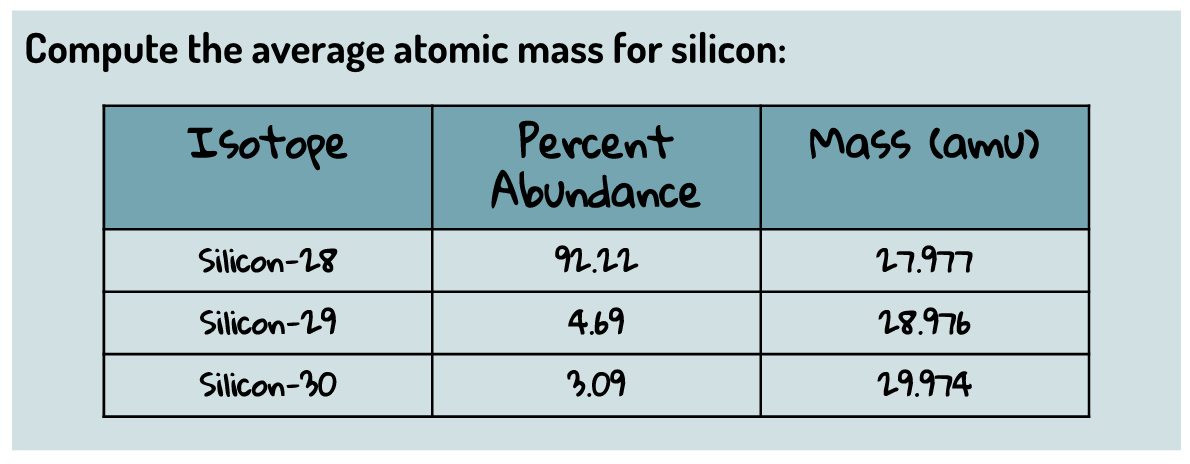
An element with 4.35% have a mass of 49.9461 amu, 83.79% have amass of 51.9405 amu, 9.50% have a mass of 52.9407 amu, and 2.36% have a mass of 53.9389amu. What is the average atomic mass of this element?

