
Font size
 Worksheets
Wilhelmine Germany to the Weimar Constitution
Total questions: 131
Worksheet time: 1hrs 6mins
Which statement best describes the Kaiser’s power in Imperial Germany before WW1?
He controlled military and could ignore government
He only advised the Chancellor on foreign policy
He needed Reichstag approval for all decisions
He was elected by men over twenty five years
What was the main role of the Chancellor under Kaiser Wilhelm II?
Chief minister advising Kaiser over Bundesrat
Judge settling disputes between employers
Elected leader representing the Reichstag
Commander of the German navy and army
How could the Bundesrat limit the Reichstag before WW1?
By appointing Kaiser Wilhelm II
By dismissing the Chancellor alone
By organising strikes in the states
By vetoing laws with fourteen votes
Which feature made the Reichstag relatively weak under the Kaiser?
It held more Prussian seats than others
It controlled the army and the navy
Its members were appointed for life
Its decisions could be ignored by Kaiser
Which idea motivated Kaiser Wilhelm II’s Weltpolitik?
Uniting with Austria into one country
Reducing the size of the army and navy
Expanding German power and global influence
Ending militarism and cutting military costs
Which belief describes militarism during Wilhelmine Germany?
Workers must avoid joining any unions
Only the navy should defend the nation
A country should maintain a strong army
The Kaiser should be elected by citizens
Which development most helped socialism grow in Wilhelmine Germany?
Rural farming replaced heavy industry
Declining factories reduced union activity
Industrialisation created more urban workers
High wages ended worker dissatisfaction
Which event showed worker organisation before WW1?
Arbitration courts banned negotiations
SPD lost seats in every election
Reichstag abolished all Social Laws
Many workers joined unions and strikes
Which government response aimed to slow socialism’s rise?
Declaring conscription across the empire
Ending proportional representation voting
Closing all factories in major cities
Passing laws on safety and health insurance
Which social change occurred in Germany during WW1?
Factory owners earned less than workers
Upper classes paid war pensions to workers
Women entered workforce challenging traditions
Kaiser returned and strengthened monarchy
Which political outcome followed Germany’s defeat in WW1?
All citizens supported ending the war
Revolutions ended and monarchy strengthened
Germany peacefully united with Austria
The Kaiser abdicated and fled the country
Which Treaty of Versailles term limited Germany’s army?
Conscription kept for rapid expansion
Anschlus with Austria permitted
Tanks allowed for defensive purposes
Army restricted to one hundred thousand
Which land term of the Treaty of Versailles was imposed on Germany?
Rhineland annexed by the United States
West Prussia remained entirely German
All colonies retained under German rule
Alsace Lorraine returned to France
What did Article 231, known as the War Guilt Clause, state?
Germany was responsible for causing the war
All nations shared equal responsibility
Austria alone must accept sole blame
Responsibility would be decided later
How did many Germans perceive the Treaty of Versailles?
As a generous plan for German colonies
As a temporary truce without payments
As a fair treaty with equal benefits
As a harsh dictated peace or Diktat
Who became the first President of the Weimar Republic in 1919?
David Lloyd George became President
Woodrow Wilson led the new republic
Kaiser Wilhelm II returned as leader
Friedrich Ebert was elected President
Which statement about the Weimar electorate is correct?
Women could not vote until after 1933
Only men over twenty five could vote
Men and women over twenty could vote
Only property owners over thirty could vote
What is Proportional Representation in the Weimar system?
Seats matched the proportion of votes won
Largest party automatically formed government
President handpicked all Reichstag members
Every region had equal numbers of seats
Which was a strength of the Weimar Constitution?
Equal rights and votes for all Germans
Unlimited power for the Chancellor
Permanent single party majorities guaranteed
President served for life without elections
Which was a weakness linked to Proportional Representation?
The system ignored most of the votes
Many parties and slow coalitions formed
Clear majorities and rapid laws passed
Small parties were completely excluded
What power did Article 48 give the Weimar President?
Rule by decree during a national crisis
Declare war without Reichstag approval
Annex Austria through a direct order
Appoint SPD leaders for seven years
Which limitation affected the Weimar Chancellor’s power?
Controlled the army and navy personally
Could never be removed or replaced
Elected directly by all adult citizens
Needed support of at least half the Reichstag
Which party mainly attracted working class voters in early Weimar elections?
German Democratic Party largely drew workers
Centre Party generally drew most workers
Social Democratic Party commonly drew workers
National People’s Party commonly drew workers
What was the main aim of the Spartacist Uprising in January 1919?
End reparations immediately
Restore the Kaiser’s monarchy
Achieve a Communist revolution
Force new democratic elections
Which group did the Weimar government rely on to suppress the Spartacist Uprising?
French allied troops
Regular police units
Reichswehr navy forces
Freikorps of ex-soldiers
A key result of the Spartacist Uprising was that the government looked weak because it
banned right‑wing parties
reduced reparations quickly
signed the Locarno Pact
could not end the revolt alone
What was the main aim of the Kapp Putsch in 1920?
Create a communist republic
Invite French troops to Berlin
Restore Germany and end Versailles
Unite workers through strikes
During the Kapp Putsch, why did the coup fail to seize lasting power?
Kapp refused foreign help
Nazis opposed the putsch
Army crushed the Freikorps
Workers’ strike paralysed Berlin
Which statement best explains why the Kapp Putsch made Weimar look weak?
Government fled Berlin during crisis
Ebert expanded the regular army
Versailles treaty was repealed
Workers welcomed the putsch
Which was NOT a cause of the Munich Putsch in 1923?
NSDAP had a private army SA
Weimar seemed weak to many
Stable economy reducing unrest
Hyperinflation crisis at peak
During the Munich Putsch, what immediate action did Hitler take at Kahr’s meeting?
Called off protests to avoid violence
Joined a coalition with Kahr and police
Disrupted the meeting and took Kahr hostage
Negotiated legal reforms for elections
Which outcome followed Hitler’s trial after the Munich Putsch?
He was banned from politics for life
He was executed by the state
The Nazi Party dissolved permanently
He gained national publicity
Why did France and Belgium occupy the Ruhr in 1923?
The Dawes Plan demanded occupation
Germany defaulted on reparations
Germany invaded the Rhineland
Poland requested Allied support
How did the German government initially respond to the Ruhr occupation?
Ordered passive resistance by workers
Signed the Young Plan immediately
Evacuated all Ruhr civilians
Called for armed guerrilla attacks
What was a direct economic effect of passive resistance in the Ruhr?
Government printed more money to pay workers
Unemployment fell sharply across Germany
Exports soared due to cheaper goods
Gold reserves increased significantly
Which description best defines hyperinflation?
Rapid price rises with money losing value
Sustained fall in prices and wages
Government fixing prices for essentials
Stable prices with strong currency
Who benefited during hyperinflation according to the material?
Small savers with cash at home
Paper industries producing banknotes
Those on fixed incomes
People with foreign currency
Farmers selling food in demand
Which statistic illustrates the scale of hyperinflation by November 1923?
Loaf of bread cost 201 billion marks
Annual inflation was around two percent
Gold mark regained its prewar value
Average wage matched 1918 levels
Which set of Stresemann’s economic actions tackled hyperinflation?
Increased war reparations
Expanded passive resistance
Introduced the Rentenmark
Destroyed old worthless currency
Stopped printing excessive money
What did the Dawes Plan of 1924 provide for Germany?
Loans from the USA to stabilize payments
Abolition of all reparations forever
Immediate rearmament of Germany
British troops to defend the Ruhr
How did the Young Plan of 1929 change reparations?
Transferred debt to France
Increased annual payments due
Cancelled the Dawes loans entirely
Reduced total payments owed
Which foreign policy achievement improved Germany’s international standing in the 1920s?
Reoccupying the Ruhr militarily
Annexing Austria by force
Kellogg‑Briand Pact renouncing war
Joining the League of Nations
Locarno Pact agreeing borders
Why were the years 1924–1929 called a ‘Golden Age’ for Weimar culture?
Economic security and stability fostered creativity
Return of the Kaiser inspired artists
Strict censorship promoted safe art
Isolation from foreign influence grew
Which cultural development was prominent in Weimar Germany’s cinema?
Silent films were banned by censors
Metropolis showcased advanced filmmaking
Hollywood fully controlled German studios
Newsreels replaced feature films entirely
Which nightlife feature angered right‑wing groups during the Golden Age?
Religious music replaced cabaret
Curfews restricted entertainment
American jazz played in clubs
Traditional opera dominated stages
Which statement about literature and art in the Golden Age is accurate?
Realism showed everyday social issues
Erich Remarque’s novel became a bestseller
Government banned over 120 newspapers
Bauhaus promoted modern practical design
Right‑wing groups praised new styles
Which economic shock most directly triggered Germany’s crisis in 1929–1930?
The Wall Street Crash in October 1929
The hyperinflation crisis of early 1923
The collapse of British coal exports
The French occupation of the Ruhr
What was an immediate effect when America recalled loans such as those from the Dawes Plan of 1924?
Germany lost American investment inflows
Germany gained cheap American imports
German industrial output increased sharply
German taxes were immediately cut
By roughly how much did German industrial production fall during the early Depression years?
Around 10 percent below normal
About 50 percent from earlier levels
Almost 5 percent in heavy industry
Roughly 75 percent in all sectors
Which policy combination did Chancellor Brüning introduce during the Depression?
Higher taxes and cuts to welfare benefits
Price controls and wage subsidies
Large public works and deficit spending
Mass privatization and new tariffs
What was a major social consequence of failing industry and bank collapses by 1932?
Rural migration to cities decreased
Savings were protected by strong insurance
Unemployment rose to about six million
Real wages increased for many workers
Why did many voters turn to the Nazis during the Depression?
They promised simple solutions like work and bread
They pledged to restore monarchy within weeks
They proposed abolishing all taxation immediately
They backed strict communist-style nationalization
Which fear pushed many industrialists and the middle class toward supporting the Nazis?
Monarchist coups in Bavaria
The spread of Communism in Germany
A rapid return to hyperinflation
A British naval blockade resuming
Which feature made Hitler’s speeches especially effective in winning support?
A flexible message told audiences what they wanted
Dense policy detail on economic theory
Long lectures with complex statistics
Use of foreign languages in many regions
Which sequence best describes Hitler’s path to becoming Chancellor in 1932–1933?
Papen and Hitler form a cabinet in May 1932, Nazis accept only one post
Hitler wins a majority in July 1932, Hindenburg steps down, Papen becomes Vice-Chancellor
Schleicher replaces Brüning, Papen replaces Schleicher, Hindenburg appoints Brüning
Papen replaces Brüning, Schleicher replaces Papen, Papen bargains with Hindenburg to appoint Hitler
What was the outcome of the July 1932 Reichstag elections for the Nazis?
They stayed at 28% with 196 seats
They fell to around 18% and lost influence
They secured over 50% and formed a government
They rose to about 37% with 230 seats
After the Reichstag Fire in February 1933, what power did Hitler obtain the next day?
State control of all trade unions and strikes
Direct control of the judiciary through new courts
Abolition of the presidency and army oath
Emergency powers under the Law for the Protection of People and State
What did the Enabling Act of 23 March 1933 allow Hitler to do?
Pass laws without the Reichstag’s approval
Dissolve the army and SA permanently
Appoint Hindenburg as Vice-Chancellor
Hold new elections every six months
What was a key result of the Night of the Long Knives in June 1934?
Von Papen replaced Hitler as Chancellor
The Catholic Party took over the Reichstag police
Communist leaders seized regional governments
The SA leadership was purged and the army swore loyalty to Hitler
Which concern best explains why Hitler ordered the purge against the SA?
Röhm’s ambitions and socialist ideas threatened his control
The SA demanded immediate war with France
The SA refused to recruit new members in 1934
Röhm sought alliance with Communists openly

Which policy under Hjalmar Schacht aimed to secure raw materials by making trade deals with South America and Southeast Europe?
Autarky self-sufficiency drive
Four Year Plan rearmament push
Total War economic conversion
New Plan trade agreements

What was a key difference between Schacht’s approach and Goering’s Four Year Plan?
Schacht focused on rapid autarky immediately
Schacht prioritized trade deals for materials
Goering reduced military production targets
Goering relied on imports more than Schacht
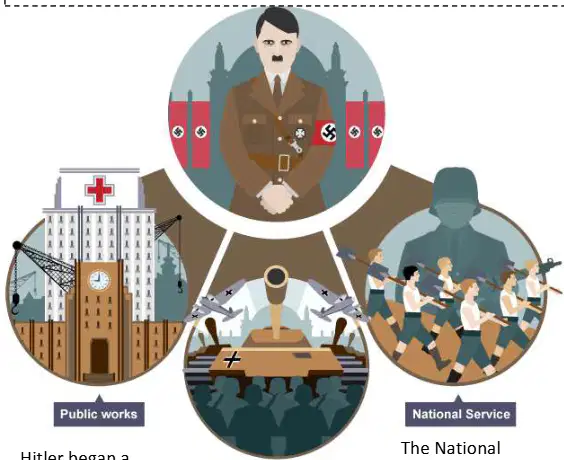
Which statement best explains why unemployment fell in Nazi Germany before the war?
Emigration removed millions of job seekers
Public works and rearmament created jobs
Agricultural exports boomed dramatically
Private unions negotiated better wages
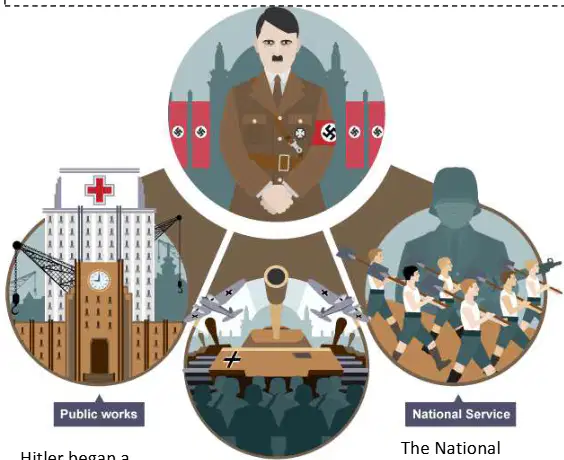
What was an example of ‘invisible unemployment’ in Nazi statistics?
Seasonal farm jobs double-counted
Women’s wages measured in households
Prisoners and camp inmates excluded
Part-time clerks counted as full-time
Which promise did the German Labour Front fail to keep for workers?
Right to change jobs freely
Abolition of striking rights entirely
Guaranteed cheap holidays always
Protection for employers’ interests
Which outcome describes living standards for German workers by the late 1930s?
Industrial accidents increased sharply
Wages rose above Depression levels
Working hours decreased noticeably
Meat and vegetables became plentiful
Which statement about Goering’s Four Year Plan is accurate?
Targets were met ahead of schedule
Germany was ready for war in 1939
Germany stayed reliant on imports
Unemployment rose significantly again
Autarky efforts included which measure?
Banning all synthetic research programs
Halting rearmament to save resources
Subsidies for farmers to grow more food
Importing more luxury consumer goods
Which sequence best tracks the turning points for Germany’s military fortunes in WWII?
Early blitzkrieg wins, then Stalingrad losses
US entry after 1944, then bombing starts
D-Day first, then Stalingrad later
Soviet invasion failed, Allies surrendered
What did ‘Total war’ announced in 1942 mean for German society?
Rationing ended for essential goods
Economy and society fully geared to war
Civilian bombing ceased entirely
Only front-line soldiers fought harder
Which home-front change occurred in 1944?
Food rationing first introduced
Clothing production expanded rapidly
Cinemas closed except for propaganda
Women released from factory work
In 1945, which event showed the severe civilian impact of the war in Germany?
Return of all evacuees to cities
Opening of new luxury shops
Bombing of Dresden mass casualties
End of rationing nationwide
Which set lists changes experienced by ordinary Germans between 1939 and 1943?
Clothing production stops; non-essentials scarce
Luxury imports increase; censorship eased
Heating reduced; fur coats donated
Food rationing begins; longer work hours
Which slogan summarized the Nazi ideal for women’s roles in society?
Kinder, Küche, Kirche
Ordnung und Fortschritt
Arbeit, Brot, Freiheit
Ein Volk, Ein Reich
What was a key goal of Nazi policy toward women in the 1930s?
Promote women in legal professions
Encourage female political leadership
Increase women’s university enrollment
Raise the birth rate of Aryan children
Under the Law for the Encouragement of Marriage (1933), what benefit was offered to German couples?
Free houses for newlyweds in rural areas
Tax exemptions for childless couples
Guaranteed factory jobs for both spouses
State marriage loans with debt reduced per child
Which program encouraged unmarried Aryan women to have children with SS men to build a ‘master race’?
Four Year Plan
Reich Labour Service
Strength Through Joy
Lebensborn Programme
Which policy change allowed the state to forcibly prevent certain women from having children?
Sterilisation and Prevention of Diseased Offspring
Equal Pay and Opportunity Act
Women’s Emancipation Charter
Universal Reproductive Rights Law
What rewards did the Mother’s Cross provide to encourage large families?
Guaranteed housing for large families
Free schooling for fourth child
Savings bonds for newborn infants
Medals for mothers with many children
Which group of women were removed from key jobs in 1933 as part of Nazi social policy?
Artists, musicians, dancers, writers
Nurses, midwives, shopkeepers, clerks
Farmers, miners, dockworkers, drivers
Teachers, doctors, lawyers, judges
Which behaviors were discouraged to shape women’s appearance under Nazi norms?
Smoking as ‘unladylike’
Slimming discouraged for fertility
Short haircuts encouraged
High-heeled shoes discouraged
What was one measure of success for Nazi policies toward women by 1939?
Most women joined opposition movements
Birth rate increased to about 1.4 million
Women dominated senior government roles
Female university numbers surged sharply
Which development during World War II undercut earlier Nazi efforts to keep women at home?
Labor shortages pushed more women into work
Foreign aid programs replaced domestic labor
Universal conscription of women for the army
Closing all women’s organizations nationwide
Which change in education helped indoctrinate youth into Nazi ideology?
Eugenics and race studies introduced
Textbooks rewritten to fit Nazi views
Nazi Teachers’ League membership required
Religious studies replaced by philosophy
How were boys’ and girls’ schooling emphases divided under Nazi ideology?
Boys on military and politics; girls on domestic skills
Both focused mainly on classical languages
Boys on arts and music; girls on sciences
Both focused on equal academic and civic skills
Which statement accurately describes the Hitler Youth for boys?
Membership became compulsory in 1939
It only met once per month for lectures
It banned physical training and marching
It ended at age ten for all members
Which organizations were the main groups for girls within the Nazi youth movement?
Young Girls and League of German Maidens
Pioneers and Komsomol
Girl Guides and Scouts
Young Eagles and Future Mothers
What activities were emphasized for girls in Nazi youth groups?
Fitness and camping
Cooking and childcare skills
Preparation for motherhood
Advanced military weapons training
Which tactic encouraged children to police adults in their lives?
Reporting parents and teachers who criticized Nazis
Writing anonymous letters to foreign newspapers
Electing classroom representatives democratically
Organizing secret debates on policy issues
Which factor shows limits to Nazi control over youth?
Opposition groups like Edelweiss Pirates existed
Hitler Youth popularity never declined
All children volunteered happily for service
No girls joined any youth organizations
What was the primary role of the SS within the Nazi system?
Overseeing church-state relations nationwide
Responsible for all security and racial policy
Managing foreign trade and agriculture
Running municipal schools and libraries
Which powers made the Gestapo particularly feared?
Running regular elections across Germany
Imprisoning without trial under Gestapo Law
Investigating even Nazi Party members
Tapping telephones and opening mail
Which practices were common in early concentration camps to intimidate prisoners?
Free speech debates on policy
Summary executions of inmates
Random beatings by guards
Hard labor for ‘re-education’
How did Nazi law courts help maintain the police state?
They refused to enforce any political laws
They protected civil rights with independent juries
Judges swore loyalty to Hitler and held show trials
They abolished the death penalty for speech
Which examples show how many acts became capital crimes under Nazi rule?
Telling an anti-Hitler joke
Having a relationship with a Jew
Listening to foreign radio stations
Voting against the Nazi Party
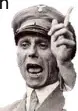
Which role did Joseph Goebbels hold that gave him control over propaganda and censorship in Nazi Germany?
Head of the Gestapo police
Reich Minister for Propaganda
President of the Reichstag
Commander of the Luftwaffe
What was a key goal of Nazi censorship of newspapers?
Publish more anti-war articles
Promote independent editors
Increase foreign news coverage
Print only pro-Nazi stories
Which statement best describes how films were used by the Nazis?
Banned newsreels before features
Focused on abstract modern themes
Produced without state oversight
Checked to praise Nazis and vilify enemies
What was the purpose of the Chamber of Culture led by Goebbels?
Control cultural life nationwide
Negotiate foreign alliances
Rebuild war-damaged cities
Coordinate military training
Which architectural approach did Hitler prefer during Nazi rule?
Baroque ornate palaces
Bauhaus minimalist designs
Gothic revival cathedrals
Classical monumental designs

What change did the Nazis impose on music performance and taste?
Replaced opera with cinema
Mandated jazz in schools
Outlawed all orchestras
Banned Jewish composers’ works
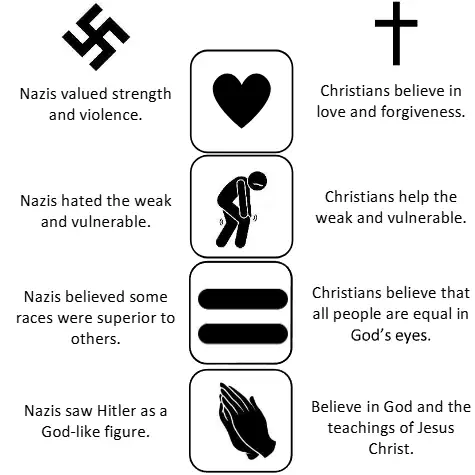
Which value clearly conflicted between Nazism and Christianity?
Luxury versus poverty
Work versus leisure
Strength versus forgiveness
Science versus superstition

Which event signaled Catholic alarm about Nazi hostility to the Church?
Reichstag Fire decree
'With Burning Anxiety' letter
Nuremberg Rally speech
Hitler Youth law reform
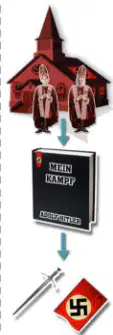
How did Nazis reshape Protestant churches under the Reich Church?
Old Testament teachings removed
Swastika replaced the cross
Bible was replaced with Mein Kampf
Bishops wore Nazi-style uniforms
Why did some Christians initially support the Nazis?
Belief in pacifism above all
Promise to respect churches
Hatred of communism
Shared family and moral values
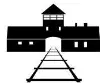
Which religious groups suffered persecution for refusing military service?
Lutheran pastors
Jehovah’s Witnesses
Benedictine monks
Anglican missionaries

What made opposing the Nazi regime particularly difficult for many Germans?
Lack of elections or parties
Gestapo informer network
Propaganda praised Hitler
Open borders for emigration
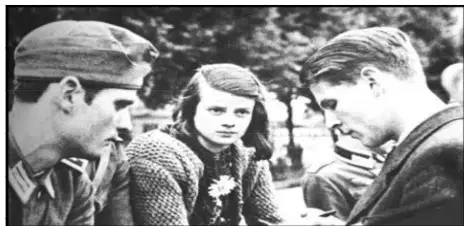
Before the war, what typical Edelweiss Pirates actions annoyed authorities?
Organized factory strikes
Sabotaged rail lines nightly
Sang banned songs together
Published underground newspapers
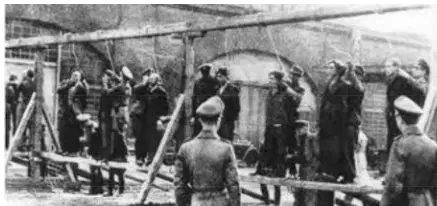
By the end of the war, how did Nazi responses to the Edelweiss Pirates change?
Groups were legalized
Leaders were pardoned
Tolerance increased greatly
Punishments became severe

What core message did the White Rose Group promote in 1943?
Called for compulsory service abroad
Advocated isolation from Europe
Supported total loyalty to Hitler
Denounced persecution and mass murder
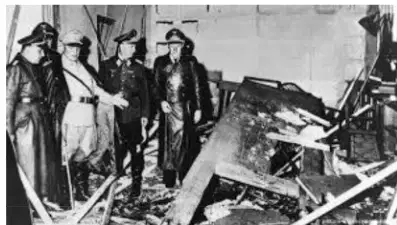
What was the goal of the July Bomb Plot in 1944?
Capture Berlin and sue for peace
Rescue prisoners from camps
Sabotage factories in the Rhineland
Assassinate Hitler and form new government
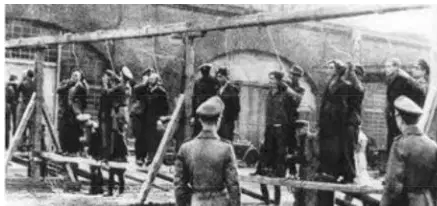
Which outcome followed the failed July Bomb Plot?
Mass arrests and executions
Resistance groups were legalized
Hitler resigned immediately
Allied invasion was delayed
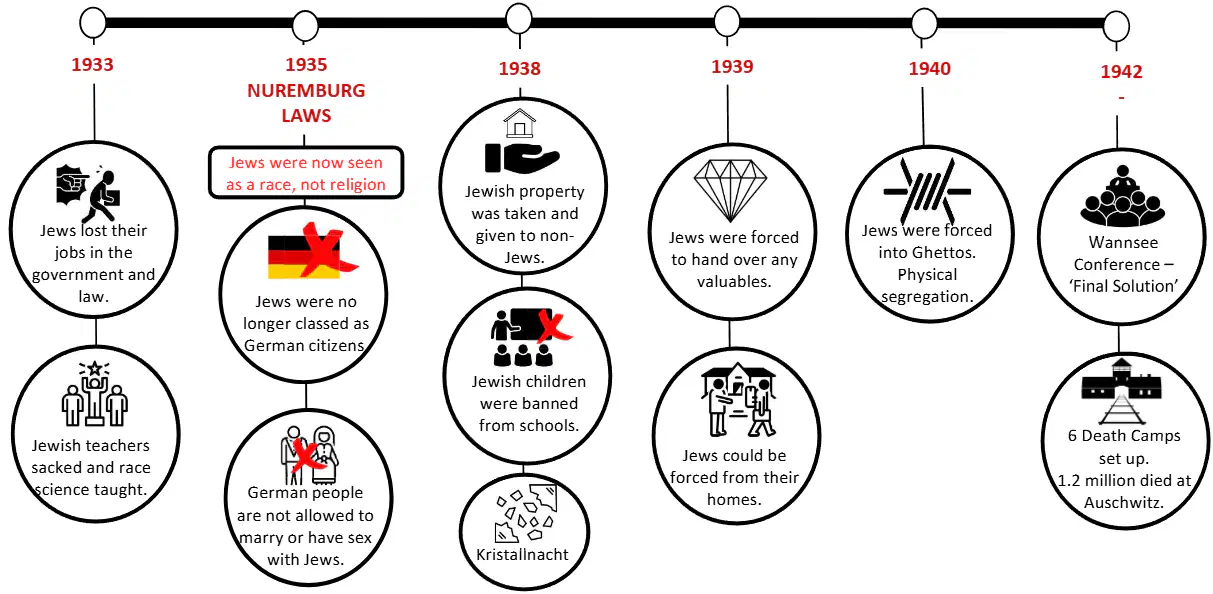
What event is known as Kristallnacht and when did it occur?
Night of Broken Glass in November 1938
Wannsee meeting in January 1942
Mass deportations in April 1939
Boycott of shops in April 1933

Which action was taken against Jewish people in Germany in 1938 before Kristallnacht?
Granting of business licenses
Forced relocation to death camps
Registration of possessions for confiscation
Return to government jobs
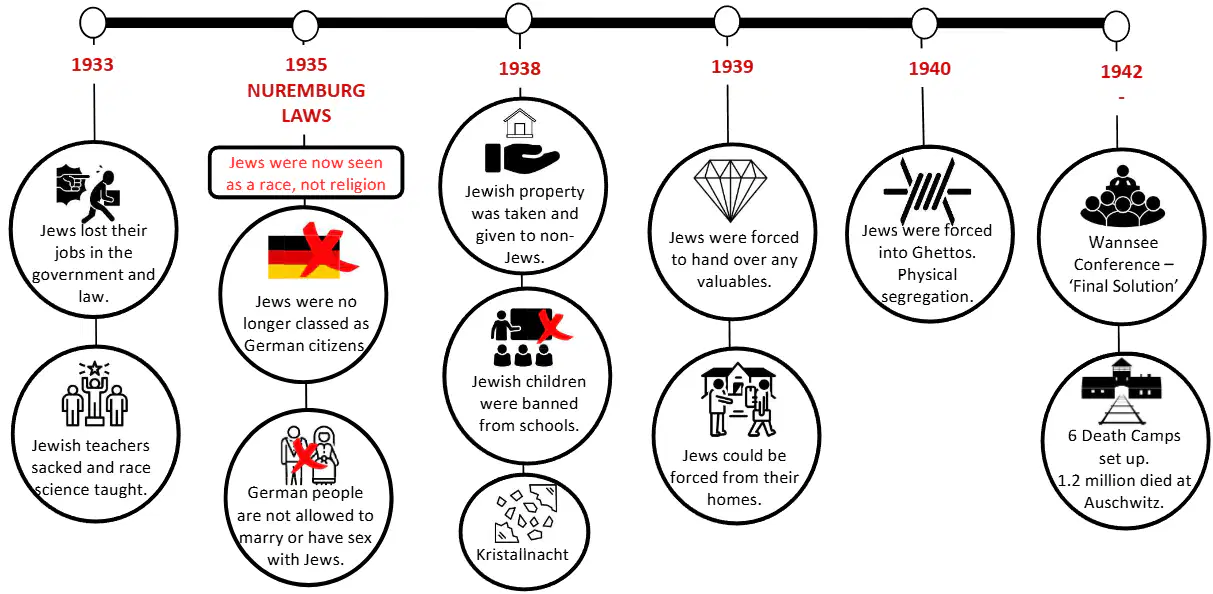
By 1940, what was a key feature of Nazi policy toward Jews in occupied areas?
Restoration of civil service rights
Mandatory army conscription
Immediate citizenship to all Jews
Confinement in ghettos and segregation
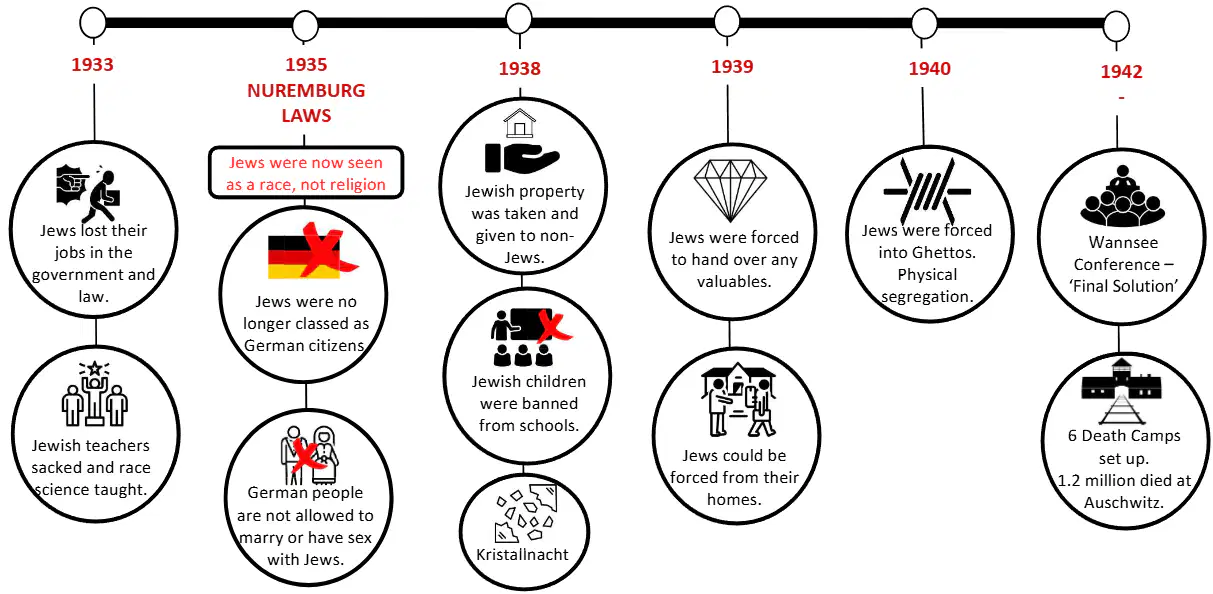
What decision emerged from the Wannsee Conference in 1942?
Creation of the SA leadership
Signing of the Molotov–Ribbentrop pact
Launch of the Munich Putsch
Coordination of the Final Solution
Which statement best describes Nazi racial beliefs about the 'Aryan' ideal?
Short, dark‑haired and modest
Cosmopolitan, mixed and tolerant
Religious, obedient and charitable
Strong, tall, blue‑eyed and blond
Which minority group was targeted by sterilisation laws beginning in 1933?
University professors from abroad
Foreign tourists visiting Berlin
Elderly retired civil servants
People with mental or physical disabilities
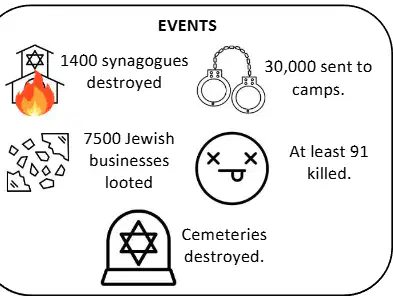
Which immediate outcome followed Kristallnacht according to the material?
Thousands of Jewish men sent to camps
Ghettos across Poland were dissolved
Universal suffrage extended to Jews
Nazi Party apologized publicly
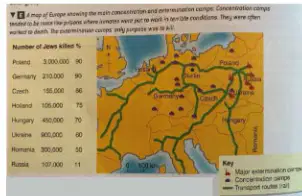
Which pair correctly matches a camp and a fact from the Final Solution?
Auschwitz—one of six main death camps
Dachau—site of the Wannsee meeting
Sachsenhausen—used Zyklon B first
Buchenwald—largest Warsaw ghetto
Which restriction was placed on German Jews under the 1935 Law for the Protection of German Blood and Honour?
Marriage and sexual relations with Aryans were illegal
Ownership of radios became compulsory
Voting in municipal elections was required
Military service was mandated for teenagers
Which consequence did Jewish businesses face after the April 1, 1933 action?
Shops received tax exemptions from the state
Stores were nationalized immediately
SA picketed to deter customers for one day
Owners were forced into government service
Which statement best distinguishes ghettos from death camps?
Ghettos confined communities; death camps systematically murdered
Ghettos trained soldiers; death camps housed refugees
Ghettos were rural farms; death camps were city prisons
Ghettos offered freedom; death camps focused on labor
What was a central aim of most Jewish armed resistance in ghettos and camps?
Establish independent territories
Negotiate long‑term ceasefires
Capture German political leaders
Escape from the ghetto or camp
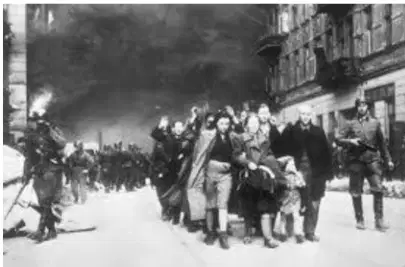
During the Warsaw Ghetto Uprising of 1943, how long did organized fighting last?
Over three years of battles
Nearly eight months of war
About two hours of skirmishes
About 28 days of resistance
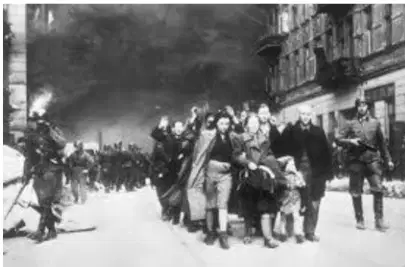
Which outcome followed the Warsaw Ghetto Uprising?
All fighters were pardoned and released
Large Allied forces arrived to defend the ghetto
German authorities recognized a Jewish council government
The ghetto was destroyed and residents killed or deported
What event sparked the Sobibor death camp escape in 1943?
Fears the camp would be shut down
Arrival of Allied tanks at the gates
A ceasefire announced by the Nazis
Orders to move prisoners to Warsaw
Which statement about the Sobibor escape is accurate?
Around 300 prisoners escaped; many were recaptured
Only guards fled while prisoners stayed
No one crossed the minefield successfully
The camp expanded and remained open

Which example shows passive resistance within ghettos?
Distributing underground political leaflets
Organizing mass shootings of guards
Keeping Oneg Shabbat historical archives
Smuggling food to sustain families
Why was effective resistance to Nazi rule often limited in ghettos and camps?
Local governments protected dissidents
Foreign armies provided constant support
Abundant weapons and open borders
Starvation and severe restrictions on movement
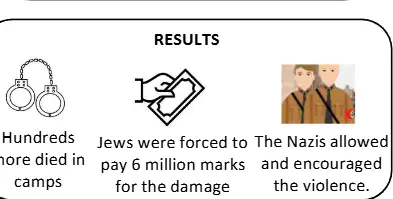
Which result did Nazi authorities impose on Jews after Kristallnacht?
Released from all previous racial laws
Granted protection by local police patrols
Forced to pay six million marks in damages
Given compensation for destroyed shops

