
NEW
Font size
 Worksheets
Electron configuration
Total questions: 62
Worksheet time: 57mins
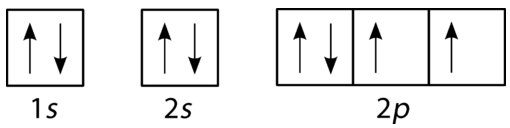
This orbital diagram represents:
Carbon
Boron
Nitrogen
Oxygen

TRUE or FALSE: valence electrons are in the last s or s and p orbitals.
true
false
An aluminium ion would have which electron configuration?
1s2 2s2 2p6 3s2
1s2 2s2 2p6 3s2 3p1
1s2 2s2 2p6 3s2 3p6
1s2 2s2 2p6
Which ion is this an electron configuration of: 1s22s22p63s23p6
Na+
O2-
P3-
Rb+


1s22s22p63s23p64s23d10


How many valence electrons?
2
5
6
8

Choose the correct electron configuration for Nickel (Ni).
1s2 2s2 2p6 3s2 3p6 4s2 3d8
1s2 2s2 2p6 3s2 3p6 4s2 3d2
1s2 2s2 2p6 3s2 3p6 4s10

Choose the correct electron configuration for Krypton (Kr).
1s2 2s2 2p6 3s2 3p6 4s8 3d8
1s2 2s2 2p6 3s2 3p6 4s2 3d8 4p3
1s2 2s2 2p6 3s2 3p6 4s2 3d8 4p6


How many valence electrons are shown in this Bohr diagram?
2
3
5
8

This Bohr diagram has only one orbit (shell) with electrons in it. It must come from which row of the Periodic Table?
1
2
3
4

Which row of the Periodic Table must this element come from?
1
2
3
4

Look at all those orbits (shells)! Which row of the Periodic Table is this element in?
1
2
3
4

Which row of the Periodic Table must this element come from?
1
2
3
4

Recall that valence electrons are the electrons on the orbit (shell) farthest from the nucleus. How many valence electrons?
2
4
6
8

How many valence electrons?
5
6
7
8

How many valence electrons?
2
3
4
5

How many valence electrons?
2
5
8
10

How many valence electrons?
2
3
8
20

How many valence electrons?
2
7
8
9

How many valence electrons?
2
3
4
5

How many valence electrons?
1
2
4
8

How many valence electrons?
2
4
5
6
How many valence electrons?
2
4
5
6

What is this element? Use a periodic table!
Beryllium (atomic #4)
Boron (atomic #5)
Carbon (atomic #6)
Nitrogen (atomic #7)


Which element would be in group 16?
V
W
X
Y
Z

Which element would be in group 2?
V
W
X
Y
Z

This is a correct dot diagram for nitrogen (N)
true
false
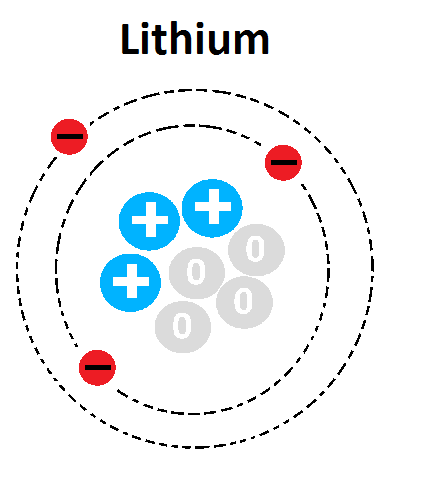

The periodic table is broken into Rows and Columns.
The Columns are called _____
Periods
Groups

Who is considered the Father of the Periodic Table?
Dimitri Mendeleev
John Dalton
Henry Moseley
Mr. Hanrahan
What is the largest group on the periodic table?
Transition Metals
Noble Gases
Metalloids
Alkaline Earth Metals

Which of the following is NOT a metalloid?
Aluminum
Silicon
Boron
Arsenic

Which of the following is a Metal?
Sodium
Carbon
Oxygen
Argon

Which of the following is a Nonmetal?
Sulfur
Gold
Iron
Calcium

What is the name of the group that contains unreactive nonmetals, each with 8 valence electrons?
Noble Gases
Halogens
Alkaline Earth Metals
Rare Earth Metals

What is the name of the group that contains reactive metals, each with 2 valence electrons?
Transition Metals
Halogens
Alkaline Earth Metals
Rare Earth Metals

What is the name of the group that contains highly reactive nonmetals, each with 7 valence electrons?
Noble Gases
Halogens
Alkaline Earth Metals
Metalloids
What does the Atomic Number of an element represent?
# of Protons
# of Neutrons
# of Electrons
# of Neutrinos
Which alkali metal is most reactive out of the following
rubidium
potassium
sodium
lithium
Is hydrogen an alkali metal?
no
yes
maybe
Which metal is NOT an Alkaline Earth Metal?
Calcium
Radon
Strontium
Radium
Alkaline Earth metals conduct heat and electricity
True
False
How many metalloids are there and which element is an exception to the rule where they are found on the periodic table?
8, Polonium
8, Astatine
8, Aluminum
7, Astatine
7, Polonium
What is the special name of the Lanthanides and Actinides together?
transitional metals
inner transitional metals
inner transitional nonmetals
transitional metalloids
Which answer has the Chemical Symbols for the elements in Group 7?
F, Cl, Br, I, At, Uus
N, P, As, Sb, Bi, Uup
Be, Mg, Ca, Sr, Ba, Ra
Ab, Cd, Ef, Gh, Ij, Kz
The reason that Noble Gases do not react is because
Their outer electron shell is filled
Their inner electron shell is filled
They are able to bond to fill their outer shell
None of the above, Noble Gases are highly reactive

