
 Worksheets
Unit 2 - Periodicity & Electron Configuration Test Review
Total questions: 63
Worksheet time: 2hrs 36mins
The energy level tells us what about an electron?
location of the valence electrons
shape of the electron cloud
speed of the electron
spin of the electron
Which of the following statements are FALSE about electron configuration?
electrons in the same orbital must have opposite spin
electrons enter orbitals of the highest energy level first
electrons enter orbitals of the lowest energy level first
orbitals can be occupied by no more than 2 electrons
If five electrons are available to fill five empty 3d orbitals, how will the electrons be distributed in the five orbitals?
five electrons in one orbital, none in the other four
one electron in each orbital
two electrons in the first and second orbitals, one electron in the third orbital
five electrons cannot enter the 3d orbitals
How many unpaired electrons are in an phosphorus atom (atomic #15)?
0
1
2
3
How many valence electrons are in a sulfur atom (atomic #16)?
2
6
8
16
The correct noble gas notation for Osmium (Os) is:
[Xe] 6s25d6
[Xe] 6s24f145d6
[Kr] 5s24d106s25d6
[Kr] 5s24d106s24f145d6
Which of the three major subatomic particles play the most important role in determining the physical and chemical properties of an element?
electron
neutron
proton
they are all important
The horizontal rows on the periodic table are called the:
families
groups
periods
families and groups
Vertical columns on the periodic table are called:
families
groups
periods
families and groups
The period where an element is located tells us:
the number of energy levels
the number of valence electrons
the number of energy levels and valence electrons
none of the above
Predict the conductivity of cadmium based on its location on the periodic table.
Cd will conduct heat/electricity
Cd will not conduct heat/electricity
Cd is a metalloid and has dual properties
More information is needed
The alkaline earth metals family ____________ electrons to form _____________ charged ions.
loses, negatively
gains, negatively
loses, positively
gains, positively
None of these
Which elements have the most similar chemical properties
Na, K, Cs
Fe, Co, Ni
H, He, Cl
B, Si, As
Which of the following is a metalloid?
Helium
Germanium
Copper
Lithium
Which of the following is NOT a diatomic element?
C
N
O
F
The amount of energy needed to remove the most loosely held electron from an atom is known as:
electron affinity
electronegativity
ionization energy
joule energy
A measure of the desire for electrons in a chemical bond is known as:
atomic radius
electronegativity
ionic radius
ionization energy
none of the above
Compare F, Fe, Fr. Which one has the largest atomic radius
F
Fe
Fr
Cannot be determined
Compare Ca, Zn, As, and Br. Which one has the smallest atomic radii.
Ca
Zn
As
Br
Elements in Group 7A or 17 on the periodic table (the halogens):
behave similarly
have 7 valence electrons
increase in atomic radius as you move from top to bottom
all of these are correct
none of these are correct
Lithium is a(n) __________ metal, therefore it is expected to react violently with water.
Alkali
Alkaline Earth
Inner Transition
Transition
In a compound containing sodium and chlorine, which is a nonmetal?
sodium
chlorine
both are metals
neither are metals
Which group of elements contains a metal, metalloid, and a nonmetal?
K, Li, Cs
Au, Ag, Cu
Pb, Sn, Ge
Co, As, Kr
Which of the following is a metal?
Mercury
Iodine
Carbon
Antimony
Why is ionization energy higher at the top of the periodic table?
Electrons are father away from the nucleus
Electrons are closer to the nucleus
Mendeleev determined it
None of these
Which of these following would require a greater amount of energy to remove an electron?
Halogen
Alkali Metal
Alkaline Earth Metal
Noble Gas
Which of the following has the smallest ionization energy?
Fluorine
Aluminum
Silver
They all have the same ionization energy
The most electronegative element on the periodic table is:
Fluorine
Francium
Helium
Need more information to determine
Compare Li, Be, B, and C. Which has the smallest electronegativity value?
B
Be
C
Li
Which scientist arranged the periodic table by increasing atomic mass and left gaps for yet to be discovered elements was
Bohr
Mendeleev
Moseley
Schrodinger
1s2 2s2 2p6 3s2

1s22s22p63s23p64s23d10
Which area on the periodic table represents the electrons in the "d" sublevel?
representative elements
columns 3-8
rare earth elements
transition elements
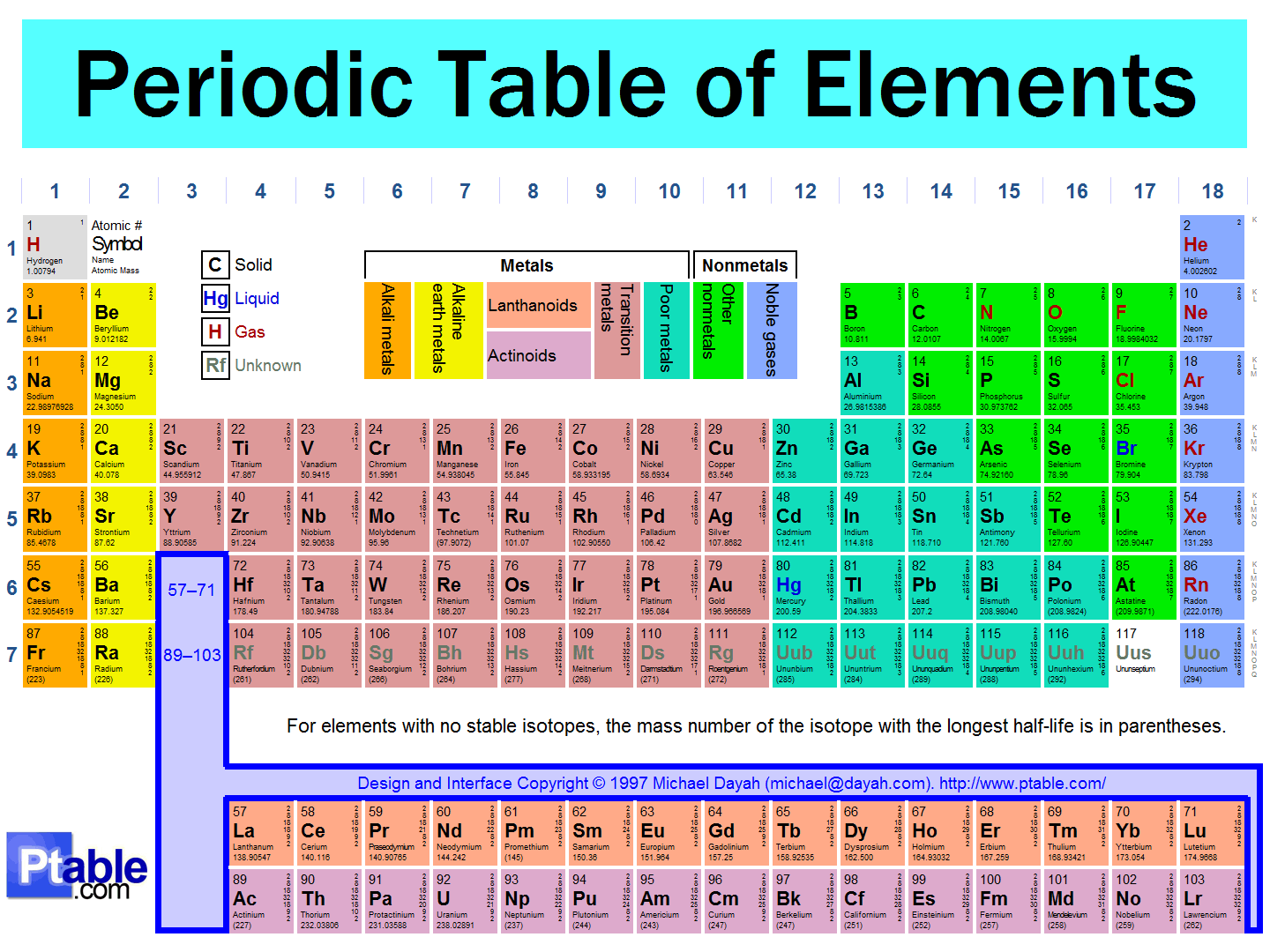
The vertical (up and down) columns in the Periodic Table are called
groups
towers
periods
atomic numbers

