
 Worksheets
Elephants Midterm Practice
Total questions: 60
Worksheet time: 30mins
Which phrase best describes a scientific question that is open-ended?
Requires a brief single-word answer
States a fact without needing evidence
Leads to a yes or no answer
Demands an explanation with supporting reasons
The driving question focuses on how organisms get what they need to live and survive. Which need is essential for all organisms?
Daily social interaction
Constant high temperatures
Access to video entertainment
Energy and matter for metabolism
Identify the dispersion pattern of elephants in the wild.
Uniform across habitats
Random across the range
Clumped around resources
Evenly spaced territories
Which term best describes the number of individuals in a population at a given time?
Population size
Population dispersal
Population distribution
Population density
What does population density measure in ecological studies?
How evenly resources are distributed
How tightly packed individuals are
How far individuals migrate yearly
How many species share a habitat
Which dispersal pattern shows individuals grouped in family units or around resources?
Uniform pattern
Clumped pattern
Diffuse pattern
Random pattern
Territorial plants competing for equal access to water would most likely exhibit which pattern?
Uniform spacing
Random spacing
Circular spacing
Clumped spacing
Which factor is density-dependent and becomes more likely as population density increases?
Disease transmission
Earthquake occurrence
Season length
Sunlight intensity
Smaller populations are at greater risk of which genetic problem?
Enhanced gene flow
Improved mutation rates
Perfect adaptation to climate
Inbreeding and loss of diversity
Which statement best explains why ecologists monitor population size over time?
To predict future changes
To label habitats by color
To reduce all predators
To increase tourist visits

Which dispersal pattern is expected in wind-dispersed plants like dandelions?
Uniform distribution
Clumped distribution
Linear distribution
Random distribution
The worksheet asks for possible limiting factors affecting elephants. Which option lists a valid ecological limiting factor?
Poaching reducing adult survivorship
Increased smartphone use by tourists
New zoo openings in distant cities
Faster internet in rural communities
Which statement best distinguishes biotic from abiotic factors in an ecosystem?
Biotic are chemical resources; abiotic are populations
Biotic are climate features; abiotic are predators
Biotic are physical forces; abiotic are organisms
Biotic are living components; abiotic are nonliving
Which example is an abiotic limiting factor for elephants in the Tsavo region?
Competition with zebras for forage
Elephant disease spreading in herds
Lion predation on juvenile elephants
Seasonal drought reducing water availability
Bottom-up regulation primarily limits populations by which mechanism?
Increased deaths from predators at high trophic levels
Restricted access to resources like food
Territorial behavior reducing reproduction
Sudden weather events causing mortality
Top-down regulation is best illustrated by which scenario?
Nutrient scarcity reducing plant growth
Pollution decreasing habitat quality
Predators causing more deaths in prey
Drought lowering water sources
Which factor is density-dependent?
Disease spreading as population grows
Hurricane impacting all individuals equally
Cold snap reducing survival regardless of size
Volcanic eruption causing habitat loss
Which factor is density-independent?
Food scarcity intensifying as numbers climb
Wildfire affecting a forest regardless of crowding
Competition increasing when space is limited
Parasite transmission rising with herd size
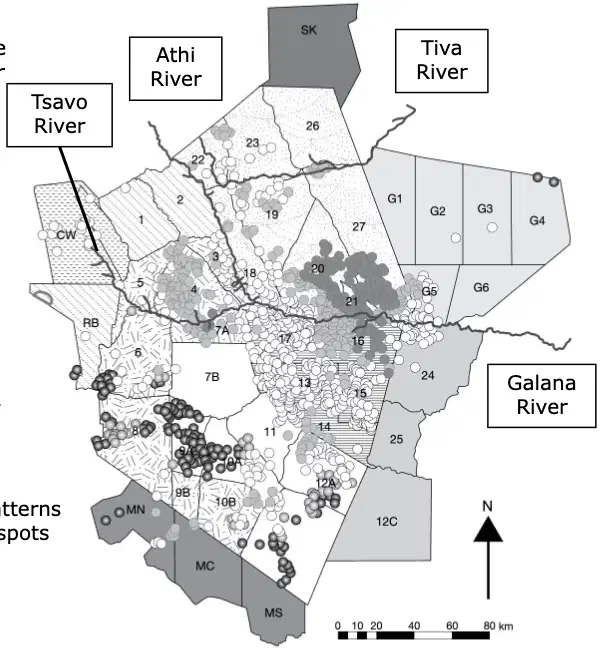
If elephant density is highest near the Galana River, which explanation fits?
Soils are rockier and less fertile
Water and vegetation are more abundant
Predators are more numerous there
Weather is harsher near the river
Dead organisms are considered which type of factor and why?
Abiotic because they are physical objects
Biotic because they were once living
Abiotic because they are not alive now
Biotic because they are chemical resources
Which pair correctly matches category and example?
Biotic: rainfall patterns
Top-down: nutrient shortage
Bottom-up: predator control
Density-independent: flood event
Which statement about density-dependent factors is accurate?
They are always abiotic environmental forces
They act the same regardless of population
They only occur at low trophic levels
They intensify as population size increases
What is the most likely reason poachers target elephants with tusks rather than tuskless elephants?
Tuskless elephants are easier to find
Tusked elephants run slower than tuskless
Tusks attract more predators than tusklessness
Tusks can be sold for ivory profit

What trend does the graph indicate about tusklessness after the Mozambican Civil War?
Tusklessness disappeared entirely after war
No change in tusklessness after war
Lower proportion of tuskless elephants after war
Higher proportion of tuskless elephants after war
Which explanation best connects poaching pressure to increased tusklessness frequency?
Civil war directly causes genetic mutations for tusklessness
Selective killing of tusked elephants increases tuskless survivors
Predators remove tuskless elephants, increasing tusked frequency
Tuskless elephants produce less offspring under stress
In natural selection, what is a selective pressure in the context of elephant tusklessness?
A seasonal behavior unrelated to survival
A laboratory method to measure alleles
A random mutation occurring without cause
An environmental factor that changes survival
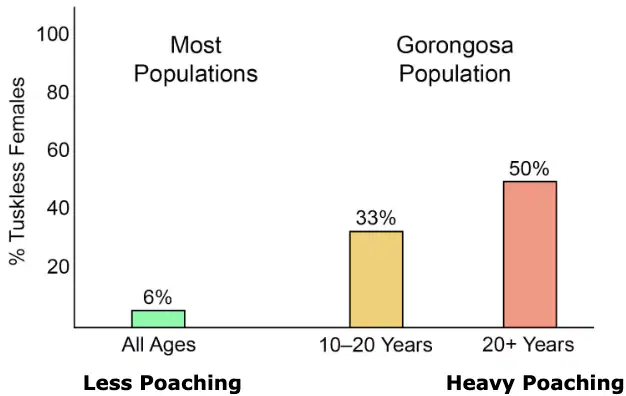
Which trend best describes female tusklessness in areas with heavy poaching compared with areas with less poaching?
Higher percentages under heavy poaching
No clear relationship observed
Equal percentages across all areas
Lower percentages under heavy poaching
If tuskless females survive poaching more often, what happens to the allele frequency for tusklessness over generations?
It remains unchanged over time
It increases in the population
It cycles randomly each year
It decreases in the population
Choose the best reasoning that links the claim and evidence in a CER: heavy poaching increases tuskless females.
Poachers target tusked elephants, so tuskless females survive and pass the allele
Migration brings tuskless elephants from distant regions without selection
Poachers protect tuskless elephants, reducing genetic diversity
Culling selects elephants randomly, keeping allele frequency constant
Which statement best describes natural selection?
Populations stop changing once well adapted
All individuals survive and reproduce equally
Organisms with beneficial traits leave more offspring
Individuals change traits to fit environments
In the VISA framework, what does Variation refer to?
Traits differ among individuals in a population
Traits are identical due to shared ancestry
Traits are chosen by organisms intentionally
Traits change only after environmental shifts
Which process most directly explains Inheritance in natural selection?
Predators removing weaker individuals
Beneficial traits passed from parents to offspring
Environments forcing traits to appear
Individuals learning behaviors during life
Why do not all individuals survive and reproduce?
Limited predators and abundant food
Predators or competition for resources
Universal access to shelter and mates
Stable climates and constant temperatures
In differential survival and reproduction, which outcome occurs?
All traits spread at equal rates
Individuals with certain traits leave more offspring
Environments favor all individuals equally
Mutations disappear after one generation
What happens to allele frequencies when a trait increases survival or reproduction over many generations?
They increase for beneficial alleles
They stay constant in the population
They eliminate all genetic variation
They decrease due to random chance
Which statement best describes a keystone species in an ecosystem?
A species that feeds only at the top trophic level
A species that migrates seasonally across regions
A species with the largest population in a habitat
A species whose presence stabilizes many interactions
What is the main goal of using DNA profiling in the CSI Wildlife case?
Determine elephant migration routes across Africa
Measure tusk growth rates in captive elephants
Identify individual elephants from genetic samples
Estimate global elephant population sizes
In genetics, what does STR stand for?
Sequential Tandem Ranges
Static Transfer Ratio
Single Transcript Region
Short Tandem Repeats
On a gel electrophoresis image, what do the visible bands represent?
Protein concentrations by mass
Cell counts from tissue samples
DNA fragments of specific sizes
Enzyme activity in reaction wells
Which source can provide elephant DNA for profiling in forensic contexts?
Leaf residues from feeding
Blood, feces, and hair samples
Sound recordings of calls
GPS tags from collars
What is the relationship between DNA fragment size and migration distance in an agarose gel?
Larger fragments migrate farther distances
Smaller fragments migrate farther distances
Migration distance increases with GC content
All fragments migrate equal distances
After running the gel, how could you tell which lane contains the largest fragment?
The band appears brightest under UV
The band has the widest smear pattern
The band is farthest from the well
The band remains closest to the well
If two bands at Marker C are the same size in one individual, what genotype is indicated?
Hemizygous on one chromosome
Heterozygous with two alleles
Homozygous for that STR locus
Triploid across the genome
Would STR profiles of sibling elephants be more similar or less similar than profiles of unrelated elephants?
More similar due to shared alleles
Less similar due to competition
Exactly identical across markers
Unpredictable without age data
Elephant populations differ genetically due to what primary factor affecting relatedness?
Predator pressure differences among habitats
Differences in tusk harvesting methods
Geographic distance and separation time
Seasonal diet variation across regions
Forest and savanna elephants diverged over 2.5 million years ago. Which profiles should be more similar?
Two forest elephants far apart
Two forest elephants in close range
Forest and nearby savanna elephants
Two savanna elephants in one herd
Elephants are considered a keystone species. Protecting them primarily helps ecosystems by what mechanism?
Increasing rainfall via trunk spray
Maintaining habitats through browsing and seed dispersal
Stopping volcanic soil erosion
Reducing soil bacteria diversity
Why do geographically isolated populations often show distinct genetic profiles?
Equal mating across continents
Constant migration every season
Limited gene flow over long time
Identical mutation rates everywhere
In conservation research, which prompt asks you to explain actions taken to protect a species and who is involved?
Success: status and future potential
Plan: actions, people, timing, place
Problem: causes of endangerment
Questions: remaining uncertainties
Which statement best describes the role of ATP in a living system?
ATP senses and adjusts the pH in the cellular environment.
ATP identifies and repairs weak components of cells and tissues.
ATP measures and provides heat to increase reaction rates in cells.
ATP captures and transfers energy released by the breakdown of glucose.
Which process uses the products of photosynthesis as reactants?
active transport
cellular respiration
DNA replication
protein synthesis
Which statement best explains why cellular respiration in plants and other organisms is dependent on photosynthesis?
Photosynthesis is one of the final steps in cellular respiration.
Photosynthesis provides the materials that fuel cellular respiration.
Photosynthesis absorbs excess energy produced by cellular respiration.
Photosynthesis absorbs materials that are catalyzed during cellular respiration.
Which two statements correctly describe one similarity and one difference between cellular respiration and photosynthesis?
1. Cellular respiration and photosynthesis both involve water.
2.Cellular respiration uses sugar, and photosynthesis produces sugar.
3. Cellular respiration and photosynthesis both use light to produce energy.
4. Cellular respiration requires light energy, and photosynthesis requires chemical energy.
statements 1 and 2
statements 1 and 4
statements 2 and 3
statements 3 and 4

In an energy pyramid, energy _______ as you move up the pyramid.
Decreases
Increases
Changes up and down
Stays the same
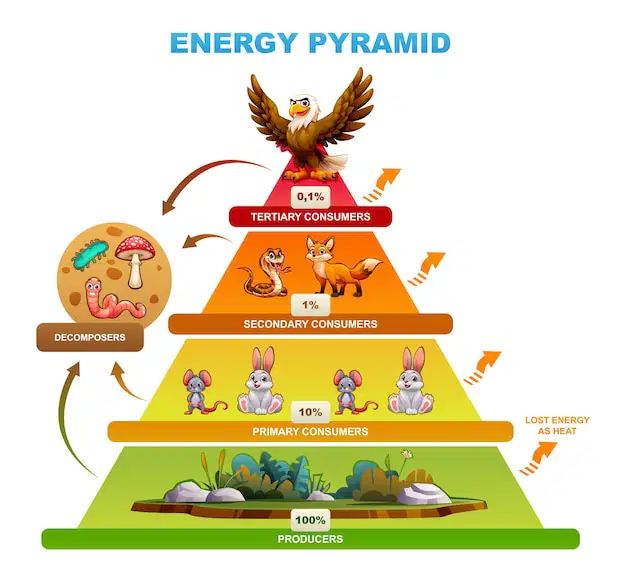
In this energy pyramid, which organism has the least amount of energy available?
Herbivores
Carnivores
Producers
Top Predator
If there is 1000 Kcal available in the producers in trophic level 1, how much energy is available in the herbivores in trophic level 2?
1000 Kcal
1 Kcal
100 Kcal
10 Kcal
If carbon dioxide is removed from a plant’s environment, what would you expect to happen to its production
of high-energy sugars?
More sugars will be produced.
No sugars will be produced.
The same number of sugars will be produced but without carbon dioxide.
Carbon dioxide does not affect the production of high-energy sugars in plants.
An endangered species is
a species growing on public land.
a species in danger of extinction.
an organism brought to a place where it has not lived before.
a species that has disappeared entirely.

