Font size
 Worksheets
Fall Semester Physical Science Exam
Total questions: 70
Worksheet time: 2hrs 47mins
What is the difference between distance and displacement?
Sadie walks 2.75 km to the store to buy some groceries. She then takes the bus to the coffee shop 5.23 km away. After she gets her coffee she walks 3.25 km back home. What is the total distance Sadie traveled?

Omar loves to go to the lake on Sunday's to feed the ducks after church. He wakes up and drives 4.25 miles North to church, then he drive 2.75 miles West to feed the ducks at the lake after church. What is his current displacement?

Jayden runs 30 m West. He then turns around and walks 22 m East. What is his displacement?
22 m
30 m
8 m
52 m
Match the following types of speed to their correct definition.

Speed at any given point in time

Speed that does not vary

Total distance traveled ÷ by total time
Leroy is on a road trip across the country. He drives a total of 2659 miles. It took a total of 39 hours to get to California from North Carolina. What was his average speed?
68.18 miles per hour
80.26 miles per hour
75.13 miles per hour
55.77 miles per hour
Jacklyn is on a boat for 3.5 hours traveling at an average speed of 1.25 km/h. How far does she travel?
4.4 km
2.8 km
4.8 km
.36 km
What is the difference between speed and velocity?
Velocity includes direction whereas speed does not.
Maria is driving her car onto the highway. When she enters the ramp, her speed is 10 m/s. After 4 seconds, she’s going 30 m/s as she merges into traffic.
Is this an example of positive or negative acceleration?
If two forces acting on an object are equal, what is the net force?
Categorize the following types of forces.


0N
Net force is +
Net forces added together
Categorize the following.
Friction in which two surfaces are not moving past each other.
Friction between a rolling object and the surface it's rolling on.
Friction in which two surfaces slide past each other.
Friction when an object moves through a liquid or a gas.


Calculate net force: A box is being pushed to the right with a force of 50 N, while friction pushes back to the left with a force of 20 N.
30 N right
70 N combined
50 N total
30 N left
Categorize Newton's Laws of Motion.
Law of Inertia
F=ma
Action and Reaction


Two objects — a hammer and a small rock — are dropped from the same height on Earth.
Which statement best explains why the hammer experiences a stronger gravitational force than the rock?
What two motions are involved in projectile motion?
In what direction does centripetal force act on an object moving in a circle?
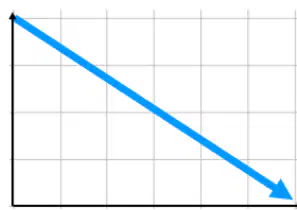
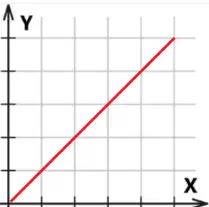
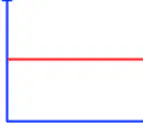
We graph motion to visualize how quickly an object moves over a given period of time. Which of the following graphs indicates that an object is slowing down.
What is momentum?
What unit do we use to measure force?
Kilogram
Anything that is shot or thrown through the air is a(n) _____________.
force
centripetal force
centripetal acceleration
We measure energy in what unit?
centimeters
inches
watts
Joules
Total Mechanical Energy =
Potential Energy - Kinetic Energy
Potential Energy x Kinetic Energy
Potential Energy + Kinetic Energy
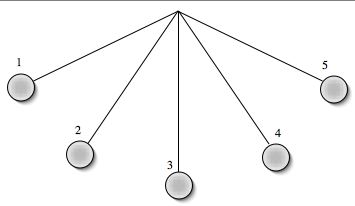
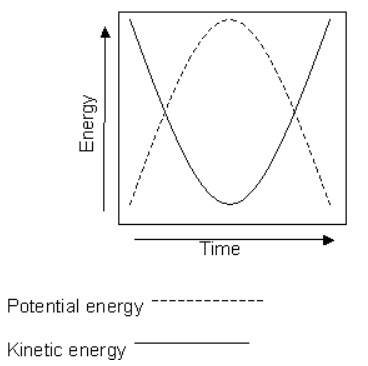
According to this graph, as kinetic energy decreases, potential energy must?
Increase
Decrease
Stay the same

What energy transformation takes place as a rock rolls down a hill?
None
Gravitational Potential Energy to Kinetic Energy
Thermal Energy to Kinetic Energy
Rock Energy to Mechanical Energy

Which of the following energy transformations takes place when you plug in a fan and the blades start turning
Electrical Energy to Kinetic Energy
Rotational Energy to Wind Energy
Thermal Energy to Cold Energy
None of these
According to the Law of Conservation of Energy, energy cannot be _________ or ____________.
destroyed, destroyed
created, saved
created, destroyed

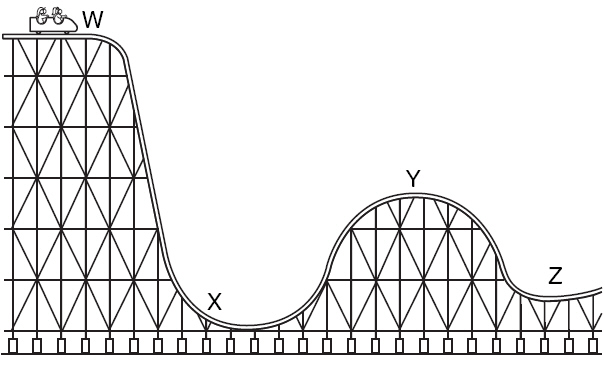
At point A the roller coaster has the most (a) energy. As the roller coaster goes from A to B the potential energy (b) and the kinetic energy (c) because the rollercoasters (d) increases and the (e) decreases.
if you push a cart with a force of 60 N for 2 m... how much work have you done
120 J
30 J
120 N
30 N
_______________ is done when a force acts on an object and the object moves in the direction of the force.
Work
Kinetic energy
Watt
Joule
________________ is the rate at which work is done.
Power
Work
Time
Energy
Brutus is a weightlifter. He completes a lift in 3.5 s, what is the power of Brutus, if he performed 660.0J of work?
2310 J
He performs no work
189 J
If you increase your work and decrease your time, you will have
more power
less power
same amount of power
power rating can not be determined
A force of 4.6 N moves a 2.7 kg box a distance of 3.3 m in 6.8 s. How much power is exerted?
2.23 W
6.03 W
17.4 W
278.7 W

A simple machine that consists a rigid bar that pivots on a fixed point
lever
pulley
wheel and axle
fulcrum

An axe is an example of a
pulley
inclined plane
screw
wedge

The device used to raise a flag up a flag pole is an example of a
wheel and axle
lever
inclined plane
pulley
A simple machine that is made up of an incline plane wrapped around a cylinder, often used to hold things together is a...
lever
screw
wedge
pulley

A force of 50 N is applied to the end of a lever to lift a rock that is 350 N. What is the MA of the lever?
70
0.14
7
17,500
A pulley system requires an input force of 75 N to lift a box with an output force of 240 N.
MA = (a) N
How is a fixed pulley different than a moveable pulley?
A moveable pulley is attached to a solid object, whereas a fixed pulley moves along a cable attached to a solid object.
A fixed pulley is attached to a solid object, whereas a moveable pulley moves along a cable attached to a solid object.
A rollercoaster has 362 J of kinetic energy going down a hill, and has 128 J of potential energy once it reaches the top. What is the mechanical energy of this rollercoaster? (a) J

Glass, rubber, wood, and plastic are all examples of (a) since electricity cannot pass through them.
A material where electrical charges can move easily is a....
insulator
conductor
nothing
rubber
Label the atom pictured:
When an object gains electrons, what is its charge?
Positive
Negative
Neutral
No charge
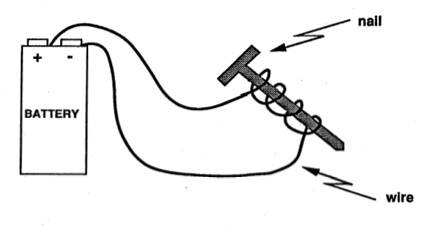
This is a picture of a simple electromagnet. How can the electromagnet be made stronger?
Add more coils of wire to the nail.
Decrease the current running through the wire.
Reverse the poles of the magnet.
Remove all the coils and the nail.
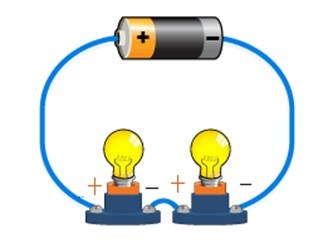
What will happen when you remove a bulb from the circuit pictured?
The other bulb will become brighter.
The other bulb will turn off.
The other bulb will become dimmer.
It will remain a closed circuit.
Which kind of circuit only has one path for electricity to flow?
Series Circuit
Parallel Circuit
Complex Circuit


Identify the type of circuit shown above as:
closed cicuit
open
series
parallel

What is an electromagnet?
a magnet that becomes neutral due to electricity
a magnet created by electric current flowing through wires
a magnet that produces electricity
a electrical current that has magnets

Magnetic Domain
Permanent Magnetism
Temporary Magnetism
Which two particles are attracted to each other?
Two neutrons
A proton and an electron
Two protons
An electron and a neutron


A cat jumped into a box full of Styrofoam pieces and rolled around. When he got out of the box, many of the pieces were stuck to his fur!
What is the best explanation for why this happened?
The paper box is an electrical conductor
Rolling in the Styrofoam created kinetic energy.
An electrical circuit formed between the cat and the Sytrofoam.
Negatively charged particles transferred between the cat and the Styrofoam.
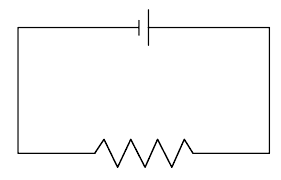
If the battery produced 12.6 Volts what would be the current flow for a 6 Ohm resistor?
2.1 Amps
2.4 Amps
1.71 Amps
15 Amps