
 Worksheets
Midyear Exam
Total questions: 85
Worksheet time: 7hrs 5mins
What is the term for a trait that is masked by a dominant trait?
Dominant
Recessive
Codominant
Incomplete dominant
What is the term for an organism that has two different alleles for a trait?
Homozygous
Heterozygous
Hemizygous
Polygenic
What are the different forms of a gene called?
Chromosomes
Alleles
Genotypes
Phenotypes
What is a Punnett square?
A model that helps make genetic predictions.
A type of genetic mutation.
A method for measuring genetic diversity.
A technique for cloning organisms.
A person who is homozygous for a trait can have a genotype of....
AA, Aa
Aa, aa
AA, aa
aa
What is the role of DNA in genetics?
A) It carries genetic information
B) It provides energy to cells
C) It acts as a structural component of cells
D) It transports oxygen in the blood
Genes pass from parents to offspring on _______.
ribosomes
nuclei
cell membranes
chromosomes


What belongs in the last box?
RR
Rr
rr
ff

In the punnett square, what is the probability for white fur?

(Click the picture to see it without the text)
Structure found inside the nucleus that contains DNA. Each cell contains 23 pairs.
Chromosomes
Deoxyribose Sugar
Deoxyribonucleic Acid
Trait

the children, such as babies or puppies, that are the result of reproduction

long, twisted strand of a molecule that stores genetic material
nucleus
DNA
cells

Segment of DNA, on a chromosome, that controls a trait.
trait
cell
nucleus
gene
In asexual reproduction, all of the offspring are:
Physically Identical
Genetically Identical
Physically and Genetically Identical
Not Identical
What is the type of reproduction that only requires one parent?
Asexual
Sexual
Which type of reproduction results in diversity because the offspring are a combination of the parents and genetically different?
Asexual
Sexual
Which type of reproduction has the following negatives (cons):
-must find a mate
-takes a longer time
-requires more energy
sexual
asexual
Select all the ADVANTAGE(S) of ASEXUAL reproduction
Produces offspring fast
Can produce many offspring
Creates variation in the offspring
Only need one parent to produce
Select all the ADVANTAGE(S) of SEXUAL reproduction
Produces offspring fast
Can produce many offspring quickly
Creates variation in the offspring
Have a better chance of survival in a changing environment
Mutations are SOMETIMES helpful to the organism.
true
false
What is an example of a neutral mutation?
None of these
a disease
blue eyes
lactose intolerance
A mutation that helps an organism survive and reproduce
harmful mutation
helpful mutation
neutral mutation

This animal has a rare mutation. Is this mutation helpful, harmful, or neutral to the crocodile? It makes it harder for it to hunt.
Harmful
Helpful
Neutral
If a mutation is beneficial to an organism, this mutation is likely to...
increase in the population
decrease in the population
go extinct
have a harmful effect
A mutation is a change in an organism's _____________.
Cell
DNA
Phenotype
Ribosome
True or false: both genetics and environment are responsible for making you who you are.
True
False

Dyed purple hair
inherited trait
acquired trait

earlobe attachment
Inherited trait
Acquired trait

If this pedigree shows a recessive disorder, what MUST the genotype of individual 4 be?
HH
Hh
hh
What word describes a trait that helps an organism survive in its environment?
natural selection
mutation
camouflage
adaptation
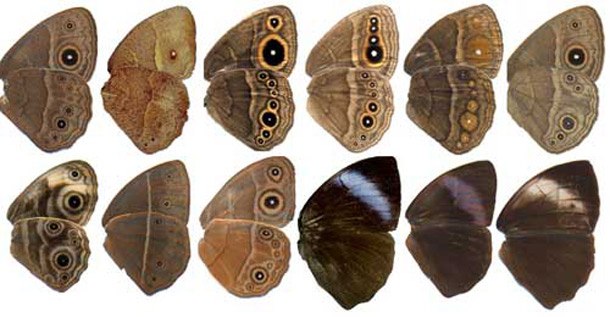
individuals changing to suit their environment
Individuals learned new traits and pass them on
no change in the environment cause a species change
small changes passed down through many generations
Natural selection results in change in a population's _____________ traits over time.
inherited
acquired
A new kind of seed plant has been found on a remote island. This plant has larger, harder seeds than those found on the Galapagos Islands. Which of the following finch adaptations would be likely to arise on this new island?
larger beaks
smaller beaks
longer legs
shorter legs

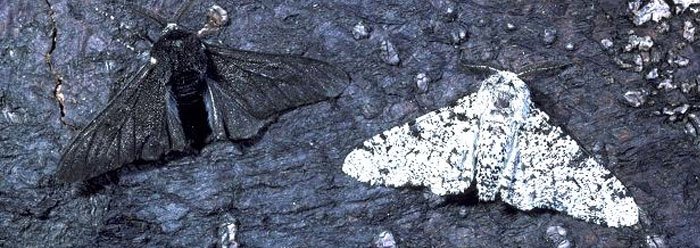
Which of the following statements best describes what will most likely occur to the moth populations in the image below?
The light moths will be captured by predators more easily than the dark moths, and the population of dark moths will rise
The light moths will be captured by predators more easily than the dark moths, and the population of light moths will rise.
The dark moths will be captured by predators more easily than the light moths, and the dark moths will probably go extinct.
The light moths will change their wing color to match that of the dark moths.

What is the most likely explanation of the data shown below?
There has been a drought in the area that is affecting all life forms.
The population of natural predators of the moths has gotten smaller.
The moths are living in an environment with light trees.
The moths are living in an environment with dark trees.
According to Darwin's theory of natural selection, the organisms that tend to survive are those that have
the biggest bodies
the ability to change their bodies to fit the environment
variations best suited to their environment
If an organism has good fitness, what does that mean?
It runs fast and has ability to reproduce
It has great strength and the ability to reproduce
It survives and reproduces, passing on its favorable traits to offspring

White tigers are becoming extinct, to overcome this a male and female white tiger are paired together in captivity to help their population continue to grow. This is an example of:
Natural Selection
Gene Flow
Artificial Selection
Genetic Drift
What is an example of artificial selection?
Letting dogs choose their own mate
Letting plants pollinate on their own
Crossing a labrador and a poodle to create a labradoodle
Which statement is true comparing natural selection and artificial selection?
In natural selection, traits benefit humans and in artificial selection, the traits benefit the species
In natural selection, traits benefit the species and in artificial selection, the traits benefit humans
In natural and artificial selection, the process takes hundreds of years to occur
In natural and artificial selection, nature determines what traits will be passed down to offspring.
The following is a similarity between artificial selection and natural selection
Takes hundreds of years
Humans determine traits
Nature determines traits
Offspring are produced
Artificial selection is also known as
natural selection
selective hearing
genetic manipulation
selective breeding

What is this an example of?
natural selection
artificial selection

What is the reason for the seasons?
earth's tilt and rotation
earth's tilt and revolution
the distance to the sun changes as the earth moves around the sun
earth's rotation and revolution

Which letter represents summer in the northern hemisphere?
A
B
C
D

Which letter represents summer in the southern hemisphere?
E
F
G
H

Which pair of letters represents the spring and fall in the northern hemisphere?
A and C
F and H
E and G
B and D

What season would the northern hemisphere be in based on the diagram?
Spring
Summer
Fall
Winter

What imaginary line separates the northern hemisphere from the southern hemisphere?
Tropic of Cancer
Equator
Tropic of Capricorn
Latitude

Which of the following is true about equinoxes?
longer days, shorter nights
equal day and night time hours
the axis is pointed towards the sun
the axis is pointed away from the sun

Which of the following is true about solstices?
longest or shortest day of the year
equal day and night time hours
the axis is neither pointed towards or away from the sun
happen in the spring and fall

Which is true about equinoxes?
happen in the summer and winter
longest days of the year
shortest days of the year
the axis is not tilted towards or away from the sun

Earth rotates on an imaginary line that runs from the north pole to the south pole. What is this line called?
orbit
equator
prime meridian
axis

True or False: Earth is closest to the sun when the northern hemisphere is experiencing summer.
True
False

The rotation of the earth causes us to experience:
seasons
day and night
years
solar eclipses

Earth's axis is tilted at:
20.5 degrees
23.5 degrees
25.5 degrees
90 degrees

What would happen if earth was not tilted on its axis?
earth would lose day and night
seasons would last way longer
earth would stop having seasons
day and night would last way longer

When the northern hemisphere is tilted towards the sun, daylight hours are
shorter than night time hours
equal to night time hours
longer than night time hours

If the northern hemisphere is experiencing spring, the southern hemisphere is experiencing:
spring as well
winter
fall
summer

In what month does the sun strike Massachusetts at the lowest angle?
March
June
September
December

How long does it take the earth to complete one full rotation cycle?
24 hours
12 hours
365.25 days
about 183 days

How long does it take for earth to complete one full revolution cycle?
24 hours
12 hours
365.25 days
about 183 days

Earth's temperature and hours of daylight and night time stay the most constant at:
the poles
the northern hemisphere
the southern hemisphere
the equator

Why does the equator stay warm all year long?
the equator gets direct sunlight all year long
the equator gets indirect sunlight all year long
there is so much desert like land on the equator; it just stays hot
there is so much water around the equator; it just stays warm

Which season has the most indirect sunlight?
summer
fall
winter
spring

Which of the following locations experiences midnight sun?
the equator
Florida
Massachusetts
the North Pole

How many hours of sunlight does the arctic circle receive on the Vernal Equinox?
24 hours
0 hours
12 hours
16 hours
Why does it get cooler as you get further away from the equator?
The sunlight is less direct because it hits the Earth at a greater angle.
The sunlight is more direct because it hits the Earth at a lesser angle.
The Earth is heated evenly by the sun.
The sunlight angle doesn't have an impact on temperature.

