
 Worksheets
BACOMM 1A UTS: The Digital Self
Total questions: 45
Worksheet time: 23mins
Which term best captures how a person presents themselves across digital platforms?
Printed identity on official documents
Analog profile within physical media
Digital self across online spaces
Offline persona across local circles
What is the most appropriate initial step when defining your online identity?
Add all trending hashtags
Clarify values and boundaries
Share all personal milestones
Post frequent status updates daily
Which practice most directly reduces the risk of identity theft?
Using strong unique passwords
Sharing birthdate and hometown
Posting high-resolution selfies
Publicly listing full home address
Which statement best describes congruence of offline self versus online self?
Adopting trends over personal principles
Hiding flaws through curated content
Aligning values and behaviors consistently
Keeping separate contradictory personas
Which is the most responsible way to present your digital self on social media?
Verify information before posting
Share rumors to spark debate
Post impulsively without context
Expose private details for transparency
Which institution’s role includes preventing false information and fake news?
Government, school, and church
Private brands and influencers
Sports clubs and leagues
Entertainment studios only
If your profile picture is not actually you, what risk increases?
Misrepresentation and trust issues
Improved privacy through clarity
Automatic account verification
Guaranteed professional credibility
Including your exact place of residence on your profile most likely leads to:
Automatic discount eligibility
Increased physical security risk
Better photo quality overall
Higher search engine ranking
Posting your relationship status publicly primarily affects:
Internet connection speed
Image resolution settings
Personal privacy boundaries
Device battery performance
Sharing health and wellness information online requires:
Posting daily without review
Critical evaluation and consent
Ignoring medical confidentiality norms
Only using anonymous accounts
Using social media for business purposes responsibly means:
Separating personal and business accounts
Mixing sales with private details
Ignoring analytics and feedback
Posting clients’ data publicly
What is a prudent guideline for posting pet or food photos?
Tag unfamiliar minors for reach
Use faces of strangers in frame
Avoid geotags that reveal location
Include personal IDs in captions
Uploading because you are bored can lead to:
Mindful curation and accuracy
Impulsive posts with consequences
Enhanced ethical reflection
Reduced exposure to misinformation
Sharing prayers or religious stories publicly should prioritize:
Targeting specific individuals
Leaking private confessions
Provocative content for clicks
Respectful tone and sensitivity
When posting about movies or books you plan to watch or buy, you should:
Disclose payment information openly
Reveal private shopping history
Avoid spoilers and respect rights
Publish torrent links for access
Expressing political views responsibly online involves:
Using evidence and civil discourse
Automating spam to trend
Doxxing opponents for impact
Spreading unverified rumors
Uploading photos with well-known people most responsibly requires:
Sharing backstage access codes
Obtaining consent and context
Forcing tags without permission
Revealing private schedules
Which statement best defines the digital self in contemporary life?
An offline persona identical to daily habits
A curated online persona used in platforms
A biological identity fixed from birth
A legal identity stored by institutions
Which comparison captures digital persona versus real-world self?
Always identical across all contexts
Completely unrelated and contradictory
Potentially distinct yet partially overlapping
Fully merged without any variation
Photo manipulation most directly supports which concept of self?
Collective self shaped by laws
Ideal self projected through images
Authentic self resisting change
Hidden self unknown to others
Which example illustrates impression management online?
Using random avatars without meaning
Avoiding any social media entirely
Curating positive posts to gain likes
Posting unedited images despite flaws
Social approval and acceptance primarily motivate which behavior?
Ignoring feedback from followers
Selective sharing of achievements
Neutral reporting of daily events
Private journaling without audience
Which risk is linked to striving for positive impressions online?
Enhanced critical thinking ability
Improved media literacy skills
Greater face-to-face empathy
Identity theft and cyberbullying
Which description fits tactical self-presentation?
Spontaneous disclosure without control
Selective portrayal to achieve goals
Uniform behavior across situations
Permanent identity fixed by genetics
Why can photo editing change perceived attributes like eye color?
Digital tools alter visual representations
Biology adapts to online preferences
Legal documents update automatically
Cameras block natural appearance
What effect does heavy online interaction have on relationships?
Limits meaningful face-to-face contact
Strengthens intimate family communication
Guarantees authentic self-expression
Eliminates misinformation and gossip
Which statement reflects the importance of digital technology?
Compresses data and speeds transmission
Stops people from relating in new ways
Prevents social change by stabilizing norms
Ensures reality cannot be represented online

Which scenario shows the ideal self overtaking the real self?
Using celebrity photos as profile image
Meeting friends offline regularly
Discussing flaws in a personal blog
Sharing daily routines without editing
Which balanced approach best protects mental health online?
Posting constantly for more validation
Mindful privacy with limited disclosure
Relying on strangers for self-worth
Ignoring all safety features available
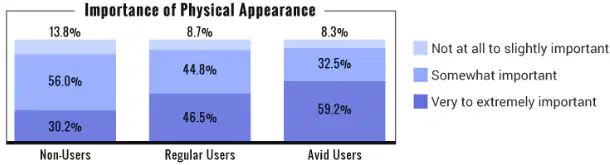
In the diagram, which group shows the highest percentage rating physical appearance as very to extremely important?
Non-users show the highest share
Regular users show the highest share
Avid users show the highest share
All groups show equal shares
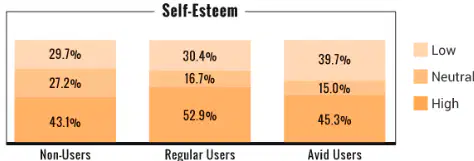
Which group reports the highest proportion of high self-esteem in the visual data?
Non-users report the highest proportion
Proportions are identical across groups
Regular users report the highest proportion
Avid users report the highest proportion
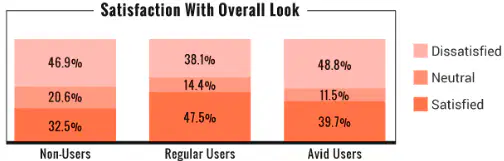
According to the chart, which group has the lowest percentage of dissatisfaction with overall look?
Dissatisfaction is equal across groups
Avid users have the lowest dissatisfaction
Regular users have the lowest dissatisfaction
Non-users have the lowest dissatisfaction
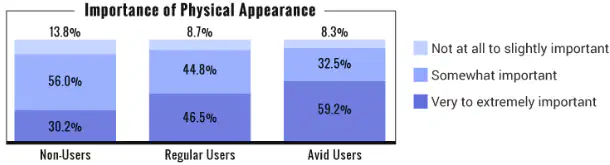
If you infer a trend from the first panel, how does increased social media use relate to the importance of physical appearance?
Importance decreases with more usage
Importance remains unchanged overall
Importance increases with more usage
Importance fluctuates without pattern
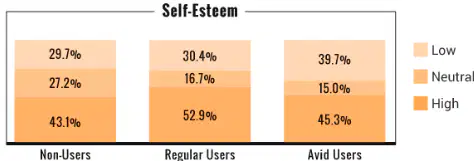
Which interpretation best aligns with the self-esteem panel?
Regular users show the highest high self-esteem
Avid users show the lowest low self-esteem
All groups have equal high self-esteem
Non-users show the highest neutral self-esteem
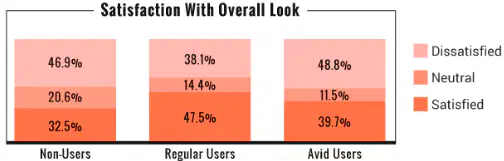
A student claims: “Avid users are most satisfied with their overall look.” What does the diagram suggest?
Claim is unverifiable from available data
Claim is trivial and not meaningful
Claim is contradicted by lower satisfied share
Claim is supported by highest satisfied share
Which responsible netizen principle is most relevant when interpreting such diagrams?
Avoid drawing conclusions beyond data
Always trust viral posts over surveys
Share personal images without consent
Ignore sources and methodology
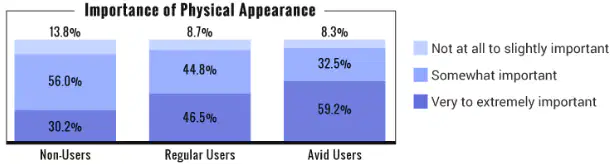
Considering all panels, which balanced conclusion fits the evidence?
No group differences exist anywhere
Lower usage guarantees satisfaction with looks
Greater usage guarantees high self-esteem
Greater usage correlates with appearance importance
Which action best aligns with the principle “think before you click” when encountering a sensational headline on social media?
Ignore it because headlines are always wrong
Share immediately to warn friends
Check source credibility and context
Post a skeptical comment without reading
Which example most clearly illustrates cyberbullying in online interactions?
Reporting a suspicious account to admins
Repeated insults targeting someone’s identity
Muting a user to avoid distractions
Firmly disagreeing once in a debate
Bashing as described in online contexts primarily harms which aspect of a person?
Financial stability and savings
Access to educational resources
Psychological well-being and dignity
Physical health and fitness
What is a responsible response to content that may contain malicious rumors about a public issue?
Save it offline and share privately
Amplify it to expose corruption
Verify claims using multiple reputable sources
Add personal speculation to make it engaging
Sharing viruses on social platforms is described as inappropriate primarily because it does what?
Improves platform engagement statistics
Damages reputations directly or indirectly
Boosts cybersecurity awareness campaigns
Protects users from fake news exposure
Which step best helps maintain your online reputation when posting opinions?
Consider long-term impact before publishing
Disable comments on all posts
Use anonymous accounts for everything
Delete old posts every weekend
Which type of personal information should be kept private to reduce online risk?
Favorite movie genres
Public holiday destinations
Full home address and daily schedule
General hobby preferences
Which approach best prevents spreading fake news during fast-moving events?
Rely only on friends’ interpretations
Prioritize speed over accuracy when posting
Trust the first viral thread you see
Wait for corroboration from reliable outlets

