
 Worksheets
BM2 review
Total questions: 87
Worksheet time: 2hrs 56mins
Mg(NO3)2
magnesium nitrate
magnesium nitrite
magnesium nitride
magnesium nitrogen oxide
Ga(CN)3
gallium cyanide
gallium carbon nitride
gallium (III) cyanide
gallium carbon trinitride
Ca(PO4)3
calcium phosphate
calcium phosphite
calcium phosphide
calcium (II) phosphorus oxide
ammonium sulfide
(NH4)2S
NH4S
(NH4)2SO4
NH4(S)2
sodium nitrate
NaNO3
Na(NO3)
NaNO2
Na(NO)2
When naming ionic compounds, write the cation as it is written on the periodic table and write the anion with which ending?
-ite
-ate
-ide
-ade
What is the charge (oxidation number) for sulfur?
+2
-2
-6
+3
What is the formula for zinc fluoride?
ZnF
ZnF2
Zn2F
ZnF4
Write the name for PbO2
lead oxide
lead (II) oxide
lead (IV) oxide
lead (II) peroxide
Write the formula for Fe(C2H3O2)3
iron acetate
iron (III) acetate
iron oxalate
iron (III) oxalate
Write the name for Ag2CO3
silver carbonate
silver (I) carbonate
gold carbonate
silver oxalate




Which two particles are attracted to each other?
Two neutrons
A proton and an electron
Two protons
An electron and a neutron
A repulsive force exists between which two particles?
Two neutrons
An electron and a neutron
An electron and a proton
Two protons
As you move across the periodic table atoms tend to get smaller because, ______________.
the atoms have more mass.
the atoms have less mass
the atoms have a bigger effective nuclear charge
the atoms have less electrons.
Which atom has the largest atomic radius?
potassium
rubidium
francium
cesium
Which of these has the largest atomic radius?
oxygen
fluorine
sulfur
chlorine
Which of these elements has the smallest atomic radius?
C
Ne
K
Al
P
Atomic radius generally increases as we move __________.
down a group and from right to left across a period
up a group and from left to right across a period
down a group and from left to right across a period
up a group and from right to left across a period
The effective nuclear charge of magnesium is
+1
+2
+12
+24
Effective nuclear charge ________ across a period.
increases
decreases
stays the same
Why does Ca have a larger radius than Se?
It has more energy levels
It has fewer energy levels
It has a more effective nuclear charge
It has a less effective nuclear charge
Which of the following elements has the most "shielding" electrons?
nitrogen
phosphorus
arsenic
bismuth
In the following configuration, which electrons are the core electrons? 1s2 2s2 2p6 3s2 3p4
1s2 2s2 2p6
3s2 3p4
1s2 2s2
2s2 2p6 3s2 3p4


What is the effective nuclear charge on alkaline earth metal atoms?
+2
+1
+3
+6
How many "dots" are used in a dot diagram of a nitrogen atom?
5
7
2
8
What are the vertical columns on the periodic table called
Groups
Periods
Exclamation Points
Cliques
What are the horizontal rows on the periodic table called
Groups
Periods
Exclamation Points
Cliques
Which property is the size of an atom
Atomic Radius
Effective Nuclear Charge
Ionization Energy
Electronegativity
Which property is the energy to remove an electron
Electron Affinity
Effective Nuclear Charge
Ionization Energy
Electronegativity
Which property is the attraction for other atom's valence electrons?
Electron Affinity
Effective Nuclear Charge
Ionization Energy
Electronegativity
Because Noble Gases do not want to change their number of electrons, they have the _________________ a period.
lowest ionization energies but the highest electron affinities
highest ionization energies but the lowest electron affinities
lowest ionization energies and electron affinities
highest ionization energies and electron affinities
Which of the following would have a greater effective nuclear charge?
An atom with 10 protons.
An atom with 20 protons.
An atom with 15 electrons.
An atom with 5 electrons.
Which of the following is responsible for the effective nuclear charge?
Protons
Neutrons
Electrons
Photons
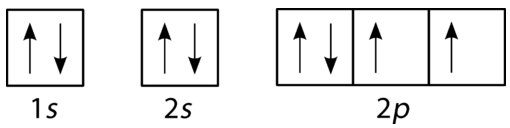
This orbital diagram represents:
Carbon
Boron
Nitrogen
Oxygen

Which example shows a violation of Hund's Rule?
A
B
C
D
Which of the following is written correctly?
A
B
C
D
An aluminum ion would have which electron configuration?
[1s2 2s2 2p6 3s2]+3
[1s2 2s2 2p6 3s2 3p1]+3
[1s2 2s2 2p6 3s2 3p6]_3
[1s2 2s2 2p6]+3
Which ion has this electron configuration [1s22s22p63s23p6]
Na+
O2-
P3-
Rb+

Which of the following elements is located in the "p" block of the periodic table?
Sc
Ca
Se
Sm
Which of the following elements has the largest atomic radius?
Cl
S
Br
As
Pick the atom from each pair listed below that has the larger atomic radius:
a. Be or Ba b. Si or S c. Ga or B d. Sr or Ag
Ba, Si, Ga, and Sr
Be, S, B, and Ag
Be, Si, Ga, and Ag
Ba, S, B, and Sr
Compare the following ions with their neutral atom and choose the ones with the larger radius of each set.
Ba2+ or Ba Br− or Br Al+3 or Al O−2 or O
Ba, Br−1, Al, and O−2 Ba, Br-1, Al, and O-2
Ba, Br, Al, and O
Ba, Br, Al, and O
What is the trend for ionic radius across a period for anions?
increase
decrease
remain constant since they are all the same type of ion
What is the trend for ionic radius across a period for cations?
increase
decrease
remain constant since they are all the same type of ion
Which is larger:
P or P-3 ?
P because it is the neutral atom.
P-3 because it lost 3 electrons.
P-3 because it gained 3 electrons.
They are the same size since they are both P.
Which is the smaller atom: Mg or Mg+2?
Mg because it gains an energy level since it gains 2 electrons.
Mg due to extra electron repulsion created by gaining 2 electrons.
Mg+2 because of extra electron repulsion created by gaining 2 electrons.
Mg+2 because it loses an energy level since it loses 2 electrons.
Arrange the following by decreasing ionic radius: Ag+1, In+3, Cd+2, Sn+4?
Ag+1, In+3, Cd+2, Sn+4
Ag+1, Cd+2, In+3, Sn+4
Sn+4, In+3, Cd+2, Ag+1
Sn+4, Cd+2, In+3, Ag+1
Which is the larger atom? Ca+2, K+1, Ga+3?
Ca+2
K+1
Ga+3
they are all the same size since they are all cations
Which is the larger atom: F-1, Cl-1, Br-1?
F-1
Cl-1
Br-1
they are all the same size since they are all anions

This circles in this diagram could represent
Sulfur
Potassium
Phosphorous
Bromine
What is the example of species that are isolectronic?
Na+ and Si4+
Na+ and Cl-
Mg2+ and Al +
S2- and O2-
What is meant by isolectronic?
Group of atoms or ions that have the same electronic configuration
Group of atoms or ions that have the same protonic configuration
Group of atoms or ions that have the same electrical properties
Group of atoms or ions that have the same electron charge
Arrange these species in increasing order of size.
Cl- , Ca2+ , S2- , Ar , K+
Ca2+ > K+ > Ar > Cl- > S2-
S2- > Cl- > Ar > K+ > Ca2+
Ca2+ < K+ < Ar < Cl- < S2-
S2- < Cl- < Ar < K+ < Ca2+
Na+ and Al3+ are isoelectronic species (1s2 2s2 2p6). Which of these ion is smaller?
Na+
Al3+
I'm not sure
They have the same size

