
 Worksheets
3rd Quarter Practice Assessment
Total questions: 85
Worksheet time: 1hrs 3mins
What is the hard, solid rock in the outer layer of Earth called?
asthenosphere
mantle
core
lithosphere (crust)
Studying meteorites
Samples from inside Wells
Going into deep mines
Tracking seismic waves from earthquakes
Primary (p-wave) waves
Secondary (s-wave) waves
Surface Waves
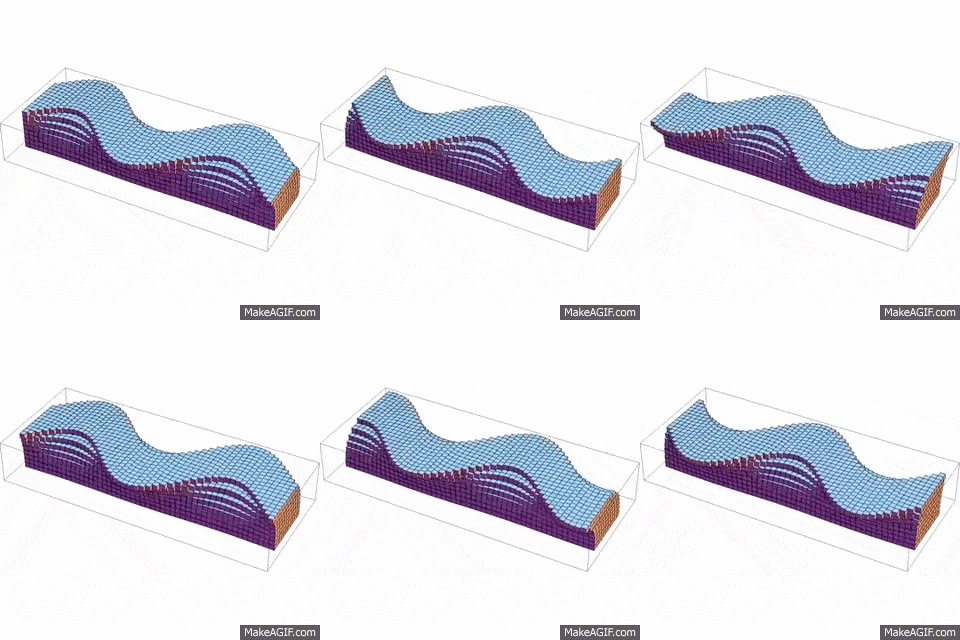
Which Seismic Wave is pictured?
P-Wave
S-Wave
Surface Wave
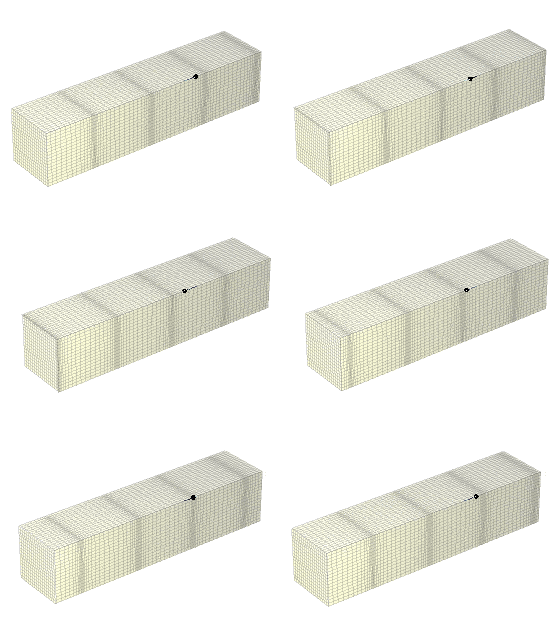
Which type of Seismic Wave is pictured?
P-Wave
S-Wave
Surface Wave
The point beneath the Earth's surface where the earthquake begins.
epicenter
fault
focus
magnitude
Which is the location of an earthquake ON EARTH'S SURFACE?
Landslide
Seismic
Epicenter
Focus
It can travel through only the mantle and the crust.
Seismic waves
Surface waves
Primary waves
Secondary waves

Which of the following statement correctly identifies the focus and epicenter of an earthquake in the given illustration?
Point A is the focus and Point B is the epicenter.
Point A is the epicenter and Point C is the focus
Point A is the epicenter and Point B is the focus.
Point A is the focus and Point C is the epicenter.
A seismic wave is simply a means of transferring energy from one spot to another within the earth through vibrations or shock waves. What are the two types of seismic waves?
P-Waves
Light Waves
S-Waves
T-Waves
Radio Waves
How are the two types of waves different from each other?
Within the earth, P waves can travel through solids and liquids, whereas S waves can only travel through solids.
Within the earth, S waves can travel through solids and liquids, whereas P waves can only travel through solids.
How do scientists find where earthquake begins?
Scientists read seismographs from at least 3 different locations to find the epicenter of an earthquake.
Scientists read news reports about earthquakes.
Scientists read a seismograms.


Which of the following increases as depth increases into the Earth? (choose all that apply)
time
Pressure
temperature
density
What would happen if an s-wave were to pass from a solid to a liquid?
It would slow down because the molecules are spaced further apart.
It would speed up because it has more room to move between molecules.
It would stop because s-waves can't pass through liquids.
It would maintain a constant speed.
How many major layers are there in Earth's interior?
2
3
4
6
Main type of waves that can travel through the earth's inner layer.
surface waves
body waves
Love waves
Rayleigh waves
Two types of surface waves
Love waves and Rayleigh Waves
P waves and S waves


What is the tool that records earthquakes?
A. Seismograph
B. Seismologists
C. Seismic wave
D. Seismogram
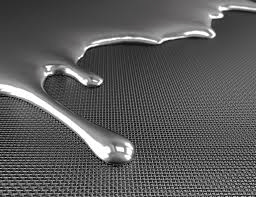
Which layer is made (mostly) of LIQUID iron and nickel?
crust
mantle
outer core
inner core
Which of the following is true regarding the composition of the lithosphere?
The lithosphere is mostly liquid, with some medium-density materials, such as silicon.
The lithosphere is more plastic and flows slowly compared to the solid crust of Earth.
The lithosphere includes the core and the lower portion of the mantle.
The lithosphere includes the crust and the uppermost portion of the mantle, which is sold and rigid.
Which layer is the hottest?
crust
mantle
outer core
inner core
Which layer is the coolest?
crust
mantle
outer core
inner core


Three Types of Plate Boundaries
Transform (slide past)
Convergent (collision)
Divergent (pull apart)
All the above
Boundary between two colliding plates, often associated with mountain building, and volcanic eruptions
plate boundary
magma
divergent boundary
convergent boundary

Example of divergent boundary between two continental plates.
Mid-Atlantic Ridge (valley in the Atlantic Ocean)
Andes Mountains (S. America)
Himalayan Mountains
None of the above

What type of boundary is this?
convergent
divergent
transform
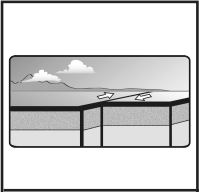
What type of boundary is this?
convergent
divergent
transform

What type of boundary is this?
convergent
divergent
transform
New crust forms along a(n)
subduction zone
divergent boundary
convergent boundary
transform boundary
___________, meaning "all land," is the name of the great landmass that existed millions of years ago.
lithosphere
Pangaea
subduction zone
tectonic
Wegener

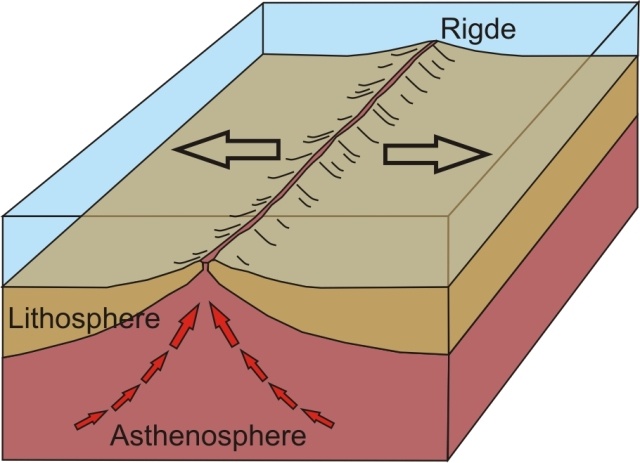

What is a tectonic plate?
a block of mantle
a block of lithosphere
a portion of continental matter
segments of oceanic crust
In a convection current, heat tends to:
fall
sink
float
rise
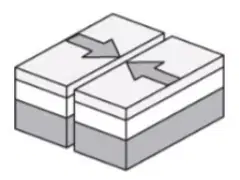
This plate is
convergent
divergent
transform
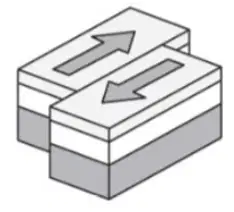
This plate is
convergent
divergent
transform
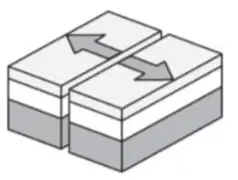
This plate is
convergent
divergent
transform
Seafloor spreading occurs when two plates
are colliding into each other
when one plate subducts beneath another less dense one
slip past each other creating earthquakes
are moving away from each other creating ridges
Rocks found along divergent boundaries are youngest away from the plate boundary.
True--rocks are younger as you move away from the boundary
False--rocks are younger closer to the boundary
What type of land feature is created when two continental plates move away from each other?
trenches
island arcs
rift valleys
ridges


This is the continuous process of rock changing from one type to another.
Igneous rocks
Sedimentary rocks
Metamorphic rocks
Rock Cycle
What type of rock might contain evidence of past life?
Sedimentary Rock
Igneous Rock
Metamorphic Rock
Which of the following lists the steps a rock undergoes in order to become sedimentary rock, in the correct order?
Deposition, erosion, melting, cooling
Erosion, weathering, eruption, cooling
Dissolving, deposition, cooling, fracture
Weathering, erosion, deposition, compaction
Limestone is a sedimentary rock. During the rock cycle, limestone is changed into marble, a metamorphic rock. The processes that act on limestone and change it into marble are
weather and erosion
heat and pressure
compacting and cementing
melting, cooling, and hardening
The process by which igneous rocks are formed
weathering and erosion
melting and cooling
heat and pressure
compaction and cementation

This rock formed when lava cooled very quickly on Earth's Surface. What type of rock is this?
Sedimentary
Extrusive Igneous
Intrusive Igneous
Metamorphic

Using your understanding of the Rock Cycle, what would the label A represent?
Metamorphic
Igneous
Sedimentary
Using your understanding of the Rock Cycle, what would the label B represent?
Metamorphic
Igneous
Sedimentary
Using your understanding of the Rock Cycle, what would the label C?
Metamorphic
Igneous
Sedimentary
The process in which sediment becomes "glued" or stuck together is called _________ .
erosion
weathering
compaction
cementation

In this diagram, what is represented at location A?
sediment
metamorpohic rock
igneous rock
sedimentary rock
lava or magma

