
 Worksheets
Height and Weight
Total questions: 16
Worksheet time: 8mins
Based on the reading passage titled "Height and Weight," which situations are given as times when a person’s height and weight might be measured? Select all that apply.
During a regular physical examination or check-up
When a patient is admitted to a hospital, rehab center, or nursing home
To track growth and detect changes that may indicate a problem with growth and development
While a patient with cancer undergoes radiation or chemotherapy to monitor weight loss
Before buying new clothes to check how a shirt fits
According to the passage, which are recommended guidelines for taking daily or weekly weights? Select all that apply.
Use the same scale each time and use the same units each time
Measure around the same time each day
Wear the same amount of clothing each time you are weighed
Drink extra water before stepping on the scale
Switch scales frequently to compare numbers
Abigail is helping a patient get on and off a scale in a clinic. What should Abigail do to help keep the patient safe?
Offer help and remind the patient to be careful stepping on and off the scale
Stand far away so the patient can be independent
Ask the patient to hurry to finish quickly
Avoid speaking to protect privacy only
Why does the passage say to make only positive comments while weighing a patient?
Many patients feel self‑conscious, so positive comments help protect their comfort and privacy
Positive comments change the number on the scale
Negative comments make the scale inaccurate
Positive comments are required by law
According to the passage, which units are used to measure weight?
Pounds (lbs) and kilograms (kg)
Feet and inches
Centimeters (cm)
Meters (m)
Which list correctly names the units used to record height in the passage?
Feet, inches, centimeters
Pounds, kilograms, grams
Meters, yards, miles
Liters, milliliters, gallons
Which statement from the passage explains one way parents can affect your weight?
Genes from parents can influence body fat distribution and body composition
Parents decide the exact number you will weigh
Family genetics only affect height, not weight
Weight is unrelated to family genetics or habits
What is Body Mass Index (BMI) as defined in the passage?
A calculation using height and weight to judge how appropriate a child’s weight is for a certain height, age, and gender
A measure of how fast someone grows during adolescence
A chart that shows how tall someone should be by age
A rule that people with the same height must weigh the same
Why is calculating BMI important according to the passage?
It helps doctors monitor body fat and identify at‑risk kids to prevent adult obesity through changes in eating and exercise
It guarantees that all kids will weigh the same
It replaces the need to measure height and weight
It is only used to compare shoe sizes
True or False: It is normal for two people of the same height and age to have different weights.
True
False
True or False: You can tell if a person is overweight by their weight alone.
True
False
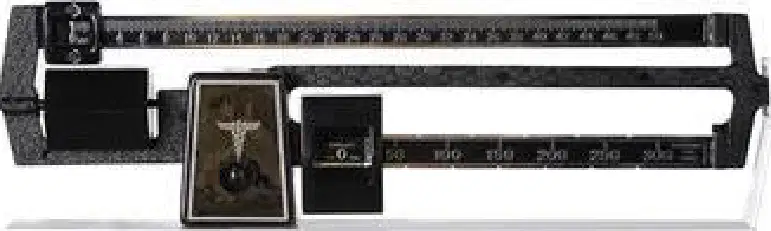
According to the worksheet, how do you determine your weight on a physician’s scale?
Add the value of the large weight to the value of the small weight
Read only the value of the small weight
Read only the value of the large weight
Average the large and small weight values
Subtract the small weight value from the large weight value
According to the worksheet, how should height be recorded on this form?
In feet and inches
In meters only
In centimeters
In inches only
True/False: Unhealthy eating habits can be passed down from parents to their children.
true
false
Kids and teens with a BMI over the _____ percentile are most likely to have weight problems as an adult.
50%
75%
85%
95%
True or False: BMI is calculated using both height and weight measurements.
False
True

