
 Worksheets
Maintenance of Appliances and Blockage Causes
Total questions: 46
Worksheet time: 23mins
You are planning a periodic maintenance visit for a multi‑unit building. Which sequence best prioritizes actions to minimize future overflow incidents while staying within standard practice?
Inspect overflows, clean traps, check access covers, record actions
Record actions, clean traps, check pipework, inspect overflows
Clean overflows, record actions, check access covers, clean traps
Check pipework, clean traps, record actions, inspect overflows
A property has recurring slow drainage despite previous cleaning of traps. What is the most strategic next step to identify the root cause efficiently?
Open access covers and visually assess upstream sections
Schedule routine cleaning every month without inspection
Increase water flow to force debris through the system
Replace the appliance without checking the pipework
During maintenance you find damp soil above a buried line and repeated blockages in the same area. To plan the most effective diagnostic action, what should you arrange first?
Jetting to clear probable waste accumulation immediately
Camera inspection to confirm a possible broken drain
Root cutting without confirming tree intrusion
Chemical treatment to dissolve organic build‑ups quickly
A client reports gurgling sounds and occasional overflow at a bath. You have limited time on site. Which combination of tasks gives the best evidence‑based chance of resolving and documenting the issue?
Flush the system, leave site, call back if needed
Apply chemicals, avoid disassembly, no documentation
Check pipework, replace fittings, skip the paperwork
Clean overflows, clean traps, note actions on the report
On a blocked soil stack, you suspect tree root intrusion but cannot locate the exact point. What plan balances safety, efficiency, and confirmation of the cause?
Use jetting at full pressure without PPE or survey
Schedule a camera survey, wear PPE, then plan cutting
Dig exploratory trenches before any internal inspection
Replace the entire stack immediately as a precaution
A tenant used wipes labeled ‘flushable’. The stack now backs up at peak times. Which action is the most suitable initial intervention and why?
Root cutting because wipes attract tree growth
Camera inspection first because wipes never break down
Jetting first to dislodge a likely waste blockage
Full pipe replacement because damage is guaranteed
You are auditing a maintenance schedule for a housing contract. Which item is missing that could increase unnoticed system failures?
Cleaning traps only when complaints occur
Inspecting pipework for signs of overflowing
Checking access covers at scheduled intervals
Recording all actions after each visit
While unblocking a drain, you must brief an apprentice on safety. Which guidance aligns with best practice for this task?
Wear rubber gauntlets, eye protection, mask, suit, boots
Use basic gloves only to maintain tool dexterity
Skip PPE when using jetting to improve mobility
Wear eye protection only because splashes are rare

You are sent to a blocked wash basin. Water is standing in the bowl. Which action plan best uses a force cup to clear the blockage safely and effectively?
Skip PPE, drain basin fully, plunge vigorously with dry cup
Remove trap immediately, skip plunging, run hot water only
Wear PPE, fill basin partially, press and release force cup repeatedly
Wear PPE, pour chemicals first, then plunge lightly once

A customer reports a slow-draining bath. The trap is intact and accessible. Which reasoning best justifies your first-line tool choice?
Use a force cup because water can form a seal for pressure pulses
Use a WC plunger because its ribbed cone fits any bath waste
Use compressed air because baths have strong soldered joints
Use a hand spinner because baths need mechanical cutting first
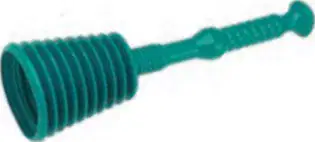
You need to clear a blockage in an external gully connected to a toilet pan. Which tool choice shows correct reasoning about form and function?
WC plunger, because its shape seals pans and gullies effectively
Force cup, because flat rims seal best on curved WC outlets
Hand spinner, because flexible cable grips porcelain surfaces
Chemical drain opener, because it protects rubber seals in WCs
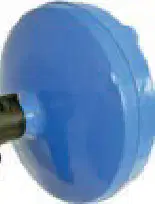
While using a hand spinner with an auger in a plastic push‑fit waste system, what plan minimizes creating leaks?
Advance and rotate gently, avoid forcing joints, test thoroughly after
Drive the auger fast, push hard through elbows, avoid testing
Remove all traps, ram the cable quickly, rely on visual checks
Switch to a WC plunger, ignore pipe movement, skip testing

On a service call, you find a blocked sink and no visible trap damage. Which sequencing shows sound reasoning from safety through verification?
Skip PPE, plunge hard first, leave site when water drops, invoice
Don PPE, use WC plunger only, avoid testing because seals are delicate
Don PPE, create water seal, plunge repeatedly, test for free flow and leaks
Don PPE, run hot water only, assume clearing, skip inspection
A trainee suggests using a hand spinner inside a push‑fit system without post‑work testing. What is the strongest critique based on system characteristics?
Push‑fit joints can be forced apart, so thorough testing is essential
WC plungers always damage push‑fit joints, so testing replaces them
Push‑fit joints are solvent‑welded permanently, so testing is optional
Hand spinners cannot travel through push‑fit bends, so testing fails
You encounter a bathroom blockage but cannot determine whether it is in the sink trap or the waste pipe run. Which strategy best narrows the location while protecting the system?
Use WC plunger on every fixture, then skip functional tests to save time
Start with auger through vent, then dismantle all push‑fit joints immediately
Apply high‑strength chemicals first, then test joints with compressed air
Begin with plunger at the fixture, then escalate to auger if symptoms persist
A single-bathroom home needs refurbishment. Plan the WC replacement to minimize disruption while maintaining hygiene. Which approach best balances access and safety?
Install temporary WC and ignore soil pipe blanking
Remove WC last without any soil pipe blank
Leave WC until others fitted and blank soil pipe
Remove WC first and leave soil pipe open
You arrive to replace multiple bathroom appliances. There will be a period with no WC connected. What is the most prudent step to control odors and biohazards from the stack?
Stuff the pipe with rags and tape
Leave the soil pipe vented for airflow
Fill the trap with disinfectant solution
Seal the soil pipe using an appropriate blank
While removing a cracked wash-hand basin, choose the safest handling plan to reduce laceration risk from vitreous china edges.
Wrap basin in thin plastic sheeting
Lift bare-handed and avoid pressure points
Wear rubber gauntlets and eye protection
Score and snap pieces for easier carry
Develop a removal sequence for sanitary ware that addresses disease risks from previous use. Which PPE combination is most defensible for routine handling?
Rubber gauntlets and eye protection
Hard hat and knee pads
High-visibility vest only
Dust mask and cotton liners
A cast iron bath must be taken downstairs through a narrow turn. Evaluate the practical method that controls manual handling and sharp edges.
Drag bath along floor with ropes
Break bath into four pieces before carrying
Suspend bath and lower from window
Carry whole bath with four workers
During refurbishment, a client insists the WC be removed first. What additional control should you implement immediately to manage the system safely?
Flush other appliances repeatedly
Disconnect the cold water main
Blank off the WC soil pipe securely
Open all windows for ventilation
A technician chips a WC during removal and shards scatter. Decide the next action that best mitigates harm from vitreous china.
Sweep quickly without PPE
Collect shards wearing gauntlets and goggles
Rinse floor to move shards to drain
Cover shards with cardboard and continue work
You are supervising a team removing old sanitary ware in a property with possible infection exposure. Which management directive most effectively reduces disease transmission during handling?
Work faster to shorten exposure
Prohibit breaks until tasks finish
Mandate appropriate PPE usage at all times
Limit team size to two workers
You are preparing to commission an above‑ground sanitation system. Which sequence best ensures both visual inspection and regulatory performance before handover?
Check Building Regulations Part H, then tighten all joints
Perform multistorey staged tests, then check clipping distances
Visual inspection for support, then BS EN 12056 performance test
Conduct BS EN 12056 test, then visual check for leaks
During visual inspection, you must verify support and obstructions. Which set of checks most directly confirms sound pipework before any pressure tests?
Manufacturer’s warranty, installer ID, delivery notes present
Leak paths sealed, adequate pipe support, unobstructed runs
Future maintenance plan, access permit, handover schedule
Water authority approval, permit conditions, site safety signs
You notice a stack installed in a four‑storey building. To plan the soundness testing, which approach aligns with guidance for multistorey properties?
Only test the top floor because it sees highest flow
Skip tests on intermediate floors to save time
Stage tests by floor, confirming each level separately
Test entire building at once using maximum head
Clipping distances must be acceptable before testing begins. Faced with mixed materials, how should you plan verification to meet standards?
Use one spacing for all materials regardless
Increase clip spacing to reduce installation time
Ignore vertical runs because gravity supports them
Follow material‑specific clips and spacing references
You must demonstrate compliance with regulations during commissioning. Which combination of references provides the most appropriate evidence for performance?
BS EN 12056 parts 1–5 and Building Regulations Part H
Manufacturer brochures and site method statements
Local bylaws only and project specification notes
Installer experience logs and client acceptance forms
Before beginning soundness testing, you find several solvent‑weld joints. Which reasoning best determines readiness to proceed?
Bypass visual checks since standards are tested later
Start testing if at least half the joints look acceptable
Delay testing until joints appear correctly made and cured
Proceed immediately because joints cure under test load
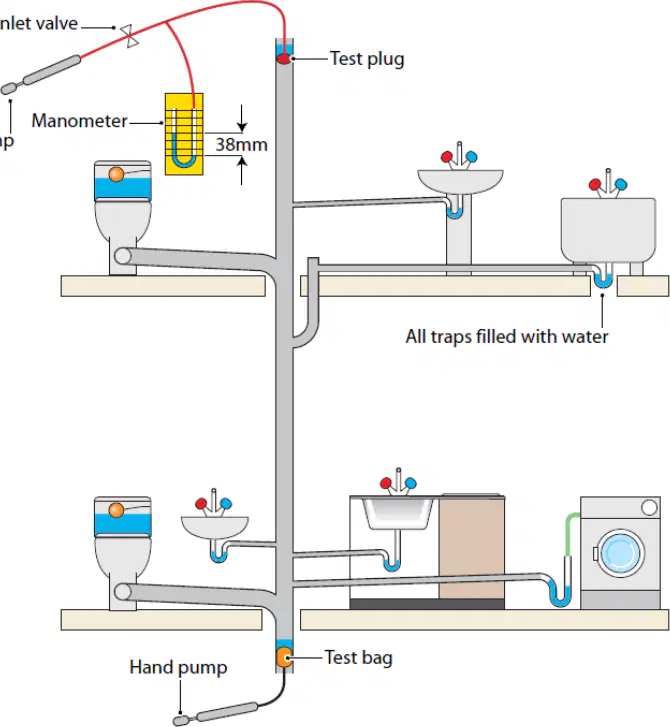
You are planning a pressure test on an above‑ground drainage stack. Which sequence best ensures an airtight setup before applying pressure?
Fill traps first, then insert hollow plugs with test nipple, then cap vents
Insert drain test bag first, then fill traps, then fit hollow plugs
Fit hollow drain plugs and bottom test bag, then fill all traps with water
Connect manometer and pump, then fill traps, then install drain plugs
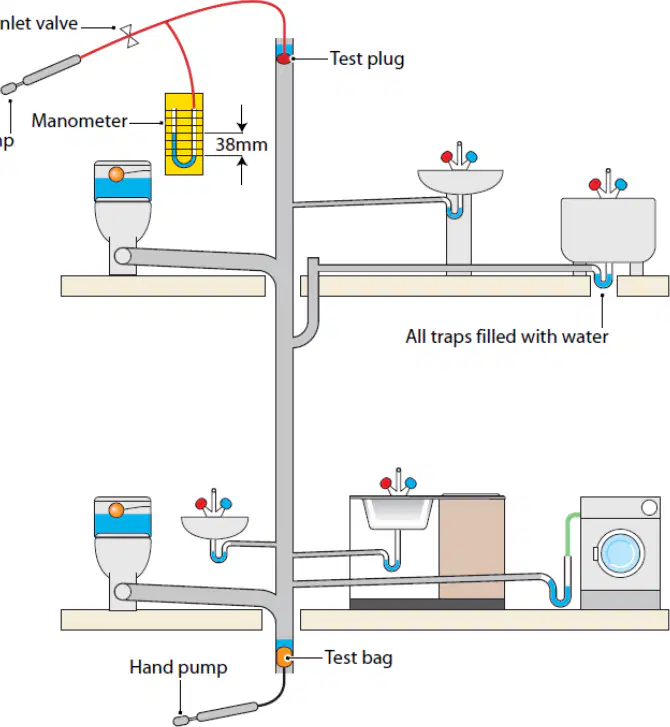
While setting up the test, access to the base of the stack is awkward. What is the most suitable adjustment to maintain the test’s integrity?
Use a solid rubber bung instead of any plug
Increase air pressure to compensate for leakage
Install a testing bag in position and inflate to seal
Skip sealing the base and rely on water traps
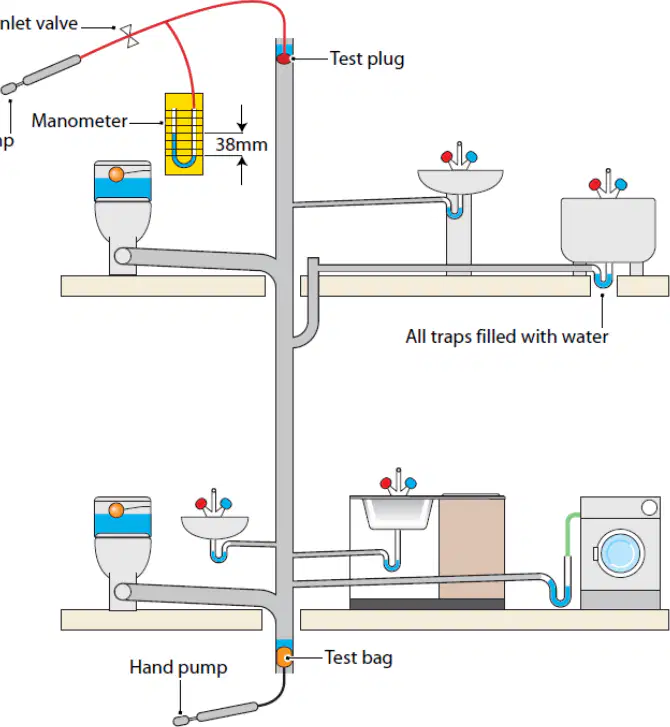
You reach a 38 mm water head on the manometer. What is the next step to follow the standard test method?
Pump until both manometer columns equalize
Release pressure immediately to protect fittings
Increase to 50 mm head for added safety margin
Turn off the plug cock and hold for three minutes
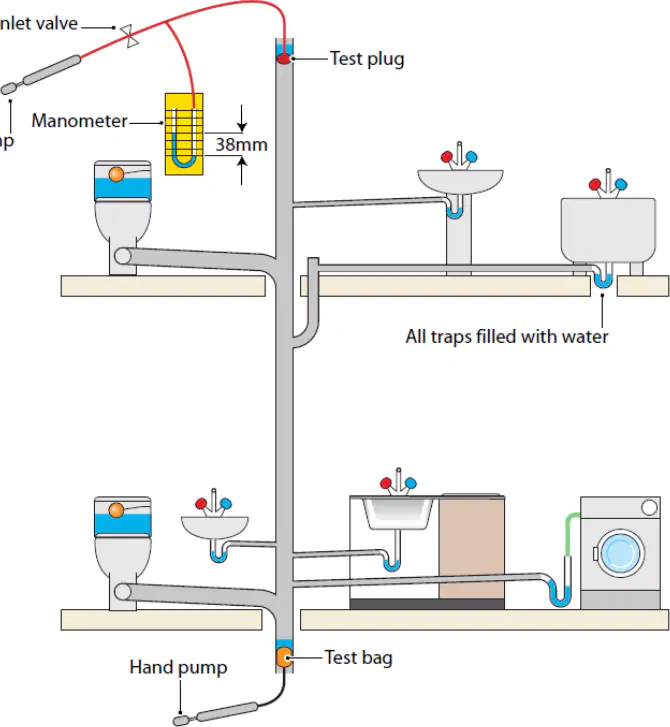
A small pressure drop is observed during the three‑minute hold. What is the most systematic way to locate the fault?
Replace all plugs and retest without diagnosis
Increase water head to force leaks to show
Apply leak detection fluid to joints while under test
Drain the system fully and visually inspect dry
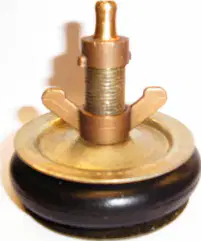
Which component must allow connection of the hose from the manometer and hand pump to the stack during testing?
Water trap sealing the fixture outlets
Drain plug with test nipple at the selected point
Test bag with integral check valve only
Standard drain plug without any fittings
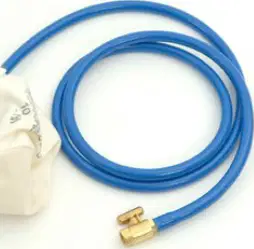
You are choosing between a drain plug and a drain test bag to seal the base of a stack. Which reasoning best guides your choice?
Use a drain plug when access is easy through an access cover
Use a test bag only when testing with water not air
Use a drain plug because bags cannot achieve airtight seals
Use a test bag because plugs are banned in vertical stacks
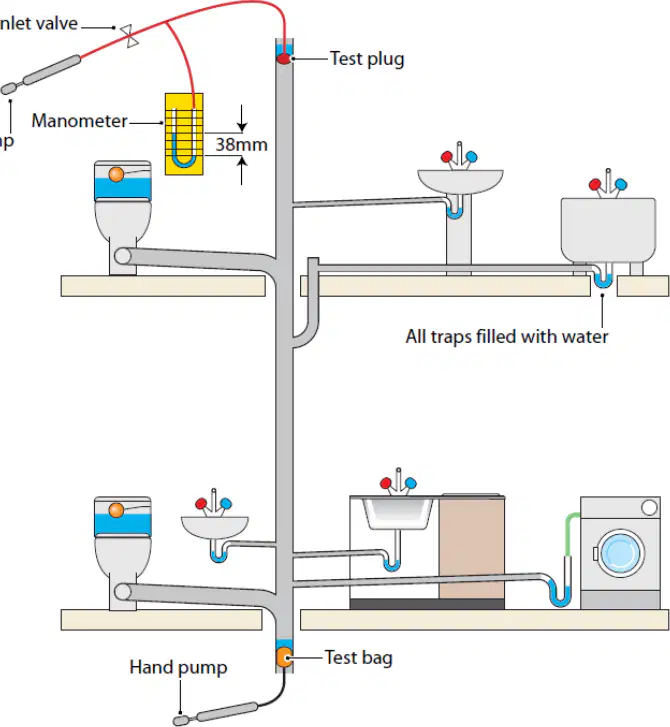
During setup, a trainee connects the hand pump directly to the stack without a manometer. What risk does this create, and what should be done instead?
Risk of under‑pressurizing; instead listen for air hiss
Risk of over‑pressurizing; instead monitor 38 mm head on manometer
Risk of contaminating the system; instead flush with water first
Risk of valve failure; instead fit a vacuum breaker upstream
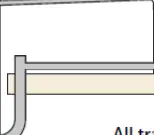
Which setup best ensures every trap acts as a seal during the air test shown?
Open hot and cold taps to equalize pressures
Leave traps dry and cap fixtures with tape
Fill each trap with water and keep trap seals intact
Bypass traps so air flows freely through fixtures
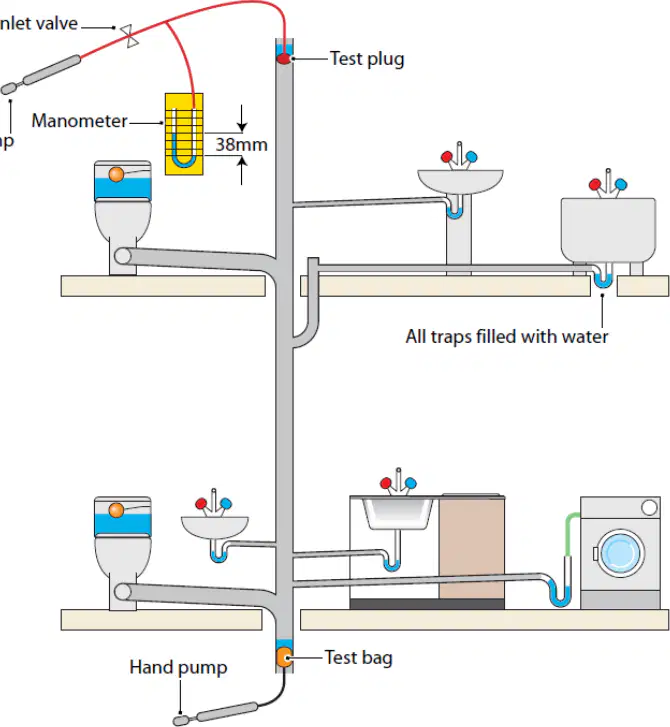
After inflating the test bag at the base, the pressure fails to build. Which troubleshooting step is most logical before replacing equipment?
Verify the air inlet valve is closed and plugs are tight
Increase pump speed to raise pressure quickly
Add more water to traps to increase resistance
Move manometer to a higher elevation to read more
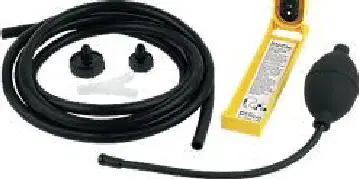
You must document the equipment used for a standard above‑ground drainage air test. Which list is most complete for this task?
Manometer, hand pump, hoses, drain plugs, test bag, leak fluid
Spirit level, tape measure, pipe bender, wrench set
Hand pump, washers, PTFE tape, solvent cement, rags
Pressure gauge, compressor, solder torch, vac pump, sealant
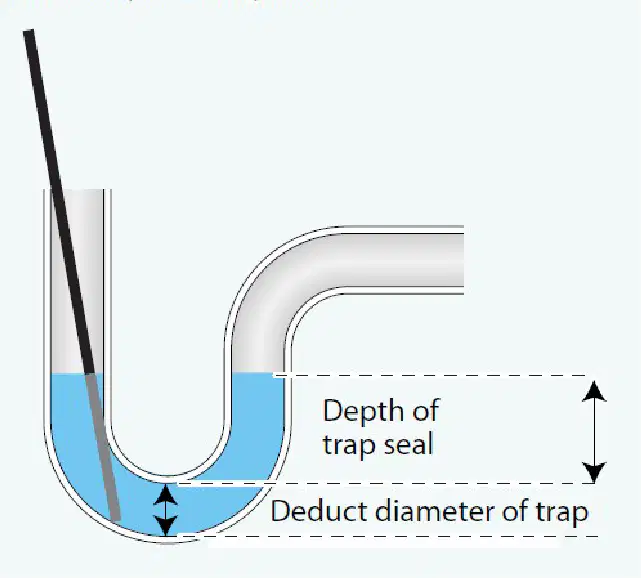
You have removed test equipment and must verify compliance. Which plan best ensures traps maintain required seal depth while avoiding system stress?
Run taps briefly, release randomly, check 40mm, no repetition
Fill appliances halfway, release sequentially, check 20mm, repeat two cycles
Fill only basins, release individually, check 30mm, repeat once
Fill each appliance to overflow, release together, check 25mm, repeat three cycles
A bathroom’s trap seal measures 18 mm after simultaneous discharge. What is the most appropriate next step?
Replace all appliances without investigation
Identify cause and rectify fault, then retest
Ignore result because within tolerance, continue
Increase overflow height to raise seal depth
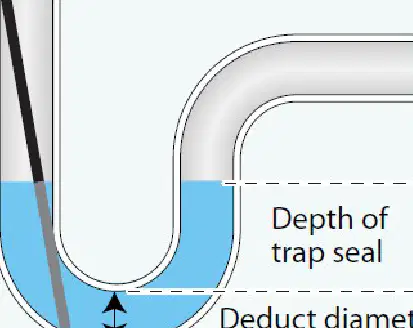
When measuring trap seal depth with a dip rod, what calculation ensures an accurate reading?
Measure water column, deduct trap diameter
Measure seal depth directly without corrections
Measure pipe bend, add fixture overflow
Measure discharge rate, multiply by time
You are planning a final performance test for a new installation. Which sequence demonstrates sound reasoning under monitored conditions?
Skip overflow checks, test only once under supervision
Fill halfway, release separately, verify ≥20 mm, repeat twice
Release water first, then fill to overflow, check ≥40 mm, repeat once
Fill to overflow level, release water simultaneously, verify ≥25 mm, repeat three times
During retesting, results show trap seals fluctuating between 22 mm and 26 mm. How should you proceed to ensure compliance?
Investigate causes of low readings, rectify, retest until consistent ≥25 mm
Accept average value across tests, document and finish
Increase pipe diameter without diagnosing issues
Reduce test repetitions to minimize variation
Why is simultaneous release of water from all appliances included in performance testing?
It simulates peak usage to challenge trap seals
It prevents overflow indicators from operating
It guarantees maximum seal depth under any condition
It hides minor installation defects from monitors
Who may monitor the retesting after rectifying a trap seal issue, and what is their role?
Manufacturer’s salesperson, approves warranty claims
Homeowner, signs off professional certification
Site laborer, replaces fixtures as needed
Building Control Officer, verifies system works correctly

