
 Worksheets
Botany Midterm Review 2026
Total questions: 80
Worksheet time: 40mins
Choose the best definition for Seed.
A mature ovule containing an embryo and stored food, typically enclosed in a protective coat
A plant’s underground stem used for storage
A reproductive cell that develops without fertilization and lacks an embryo
A structure that performs photosynthesis in animal cells
Choose the best definition for Photosynthesis.
The process by which plants convert light energy to chemical energy, forming sugars from carbon dioxide and water and releasing oxygen
The breakdown of glucose to release energy in the absence of oxygen
The movement of water through plant tissues by capillary action
The transport of minerals through xylem and phloem
Choose the best definition for Chloroplast.
An organelle in plant cells that contains chlorophyll and is the site of photosynthesis
A storage compartment for waste and pigments in animal cells
A network of protein fibers that supports cell shape
A pore on leaf surfaces that regulates gas exchange
Choose the best definition for Angiosperm.
A flowering plant that produces seeds enclosed within fruits
A nonvascular plant that reproduces by spores
A seed plant whose seeds are exposed on cones
An aquatic alga with no true roots or leaves
Choose the best definition for Gymnosperm.
A seed plant that produces naked seeds typically on cones
A flowering plant with enclosed seeds in fruits
Choose the best definition for Seed Coat.
The protective outer covering of a seed that shields the embryo and regulates water entry
A waxy layer on leaves that reduces transpiration
The nutrient-rich tissue that feeds the embryo in angiosperms
The outer wall of pollen grains that aids dispersal
What is the main purpose of respiration in plants?
To produce glucose for food and energy
To absorb carbon dioxide from the atmosphere
To allow for plants to remove chemicals from the Earth
To release energy from glucose for activities in the plant cell
Choose the best definition for Germination.
The process in which a seed resumes growth, the embryo emerges, and a new plant begins to develop
The seasonal shedding of leaves by deciduous plants
The fusion of 2 seeds together.
The transport of pollen from anther to stigma
Choose the best definition for Dormancy.
A period of suspended growth and reduced metabolic activity enabling survival under unfavorable conditions
A rapid growth phase after fertilization
A permanent loss of seed viability
A process of leaf expansion due to turgor
Choose the best definition for Photoperiod.
The length of day and night that regulates timing of developmental events such as flowering
The intensity of sunlight measured at noon
The angle at which light strikes a leaf
The amount of chlorophyll per unit leaf area
Choose the best definition for Water Pollution.
An undesirable change in the characteristics of a body of water that can negatively affect the health, survival, or activities of living things.
The natural mixing of fresh and salt water in estuaries
The movement of groundwater through soil pores
The evaporation of surface water due to heat
Choose the best definition for Eutrophication.
Nutrient enrichment of water bodies causing algal blooms, oxygen depletion, and ecosystem decline
The removal of excess salts from irrigation water
The process of sediment settling in reservoirs
The formation of wetlands from river flooding
Choose the best definition for Bioaccumulation.
The gradual buildup of chemicals or toxins in an organism’s tissues over time from the environment or diet
The rapid excretion of pollutants after exposure
The dilution of contaminants across trophic levels
The breakdown of organic matter by microbes
Which of the following correctly identifies two benefits that plants provide to humans?
Oxygen production and provides food
Decorative flowers and soil erosion
Protein from meat and medications
Volcanic soil and tectonic stability
Identify the statement that best defines botany.
The scientific study of plants
The art of gardening
The classification of animals
The study of ecosystems
Choose the option that best summarizes how plants evolved from aquatic ancestors to complex seed-bearing land plants, including reproductive changes and adaptations for survival on land.
Aquatic algae gave rise to early land plants using spores; later vascular plants evolved with tissues for water transport, followed by seed plants where seeds protect embryos and aid dispersal, enabling reproduction and survival on dry land
Terrestrial plants evolved into flowering plants through gradual changes in bone structure and internal fertilization
Early seed plants lived only in deep oceans; spores replaced seeds to prevent dehydration and plants remained aquatic
Algae directly evolved into angiosperms without intermediate stages; seeds were unnecessary for land colonization
Why do plants require sunlight to grow?
Sunlight powers photosynthesis, allowing plants to make glucose for energy and growth
Sunlight warms the soil so roots do not freeze, which is the main source of plant nutrition
Sunlight attracts pollinators that feed plants directly
Sunlight prevents herbivores from eating leaves by making them bitter
Why are so many plants green? What makes them green?
The pigment chlorophyll in chloroplasts reflects green wavelengths of light
Plant cell walls are naturally green due to cellulose color
Leaves absorb green light more than other colors, so they appear green
Roots transport green minerals that dye the leaves
Why do plants wilt without water?
Loss of water reduces turgor pressure in the vacuoles of plant cells, so tissues lose rigidity and cause plants to droop
Water evaporates from leaves, increasing leaf mass and bending stems
Water blocks sunlight, causing leaves to close permanently and bend plants
Dry soil releases gases that chemically soften stems
Why is it important that seeds are dispersed?
Dispersal reduces competition with the parent and spreads offspring to new habitats
Dispersal keeps seeds near the parent plant
Dispersal ensures seeds remain underground
Dispersal accelerates photosynthesis in seeds
What are the 6 requirements for seed germination? Choose the option that correctly lists the six items.
Correct photoperiod, light, oxygen, water, dormancy, temperature
Water, carbon dioxide, extreme heat, shade, nutrients, wind
Water, oxygen, cold conditions only, no light, fertilizer, insect activity
High temperature, bright light only, carbon dioxide, moisture, heavy nutrients, pruning

Which statement correctly compares monocot and dicot plants?
Monocots have one cotyledon and parallel leaf veins; dicots have two cotyledons and branched leaf veins
Monocots have two cotyledons and branched veins; dicots have one cotyledon and parallel veins
Monocots and dicots both have two cotyledons and parallel veins
Monocots lack cotyledons; dicots have one cotyledon with random vein patterns
In monocots, the number of cotyledons is:
one
two
three or more
none
In dicots, the number of cotyledons is:
one
two
three or more
none
Floral parts (petals) in monocots are most often in multiples of
2
3
4
5
Floral parts (petals) in dicots are most often in multiples of
3
4 or 5
6
7
The typical root type in monocots is
taproot
fibrous root system
adventitious aerial roots only
no roots
The typical root type in dicots is
fibrous root system
taproot
stilt roots
no roots
In monocots, the arrangement of vascular bundles in the stem is
in a ring
scattered throughout the tissue
restricted to the pith
only in the cortex
In dicots, the arrangement of vascular bundles in the stem is
scattered throughout the ground tissue
in a ring
random and sparse
only near the epidermis
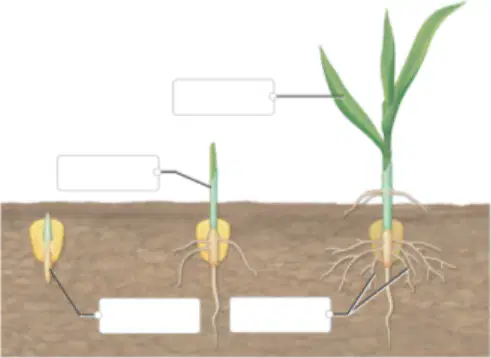
Which seed structure develops into the primary root?
coleoptile
radicle
hypocotyl
epicotyl

In monocots, which structure protects the emerging shoot as it pushes through soil?
cotyledon
coleoptile
hypocotyl
primary leaves
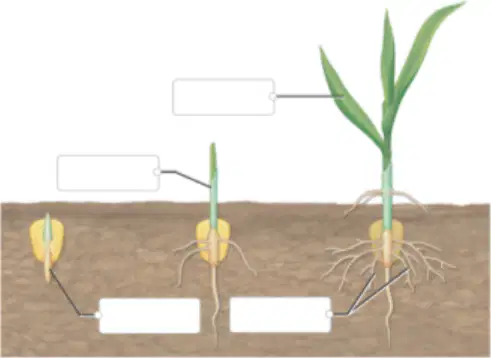
Which term names the stem region below the cotyledons that lifts the seedling above the soil?
epicotyl
hypocotyl
radicle
primary leaves
Why is dormancy important for the survival of plants?
It allows plants to conserve resources and survive unfavorable conditions until growth is favorable again.
It makes plants photosynthesize continuously without rest.
It ensures seeds germinate immediately after dispersal regardless of conditions.
It permanently stops growth so plants do not need nutrients.
How does temperature affect dormancy?
Seasonal decreases in temperature help induce dormancy, and periods of increased temperatures later help break dormancy.
Higher summer temperatures always keep plants dormant.
Temperature changes have no role in dormancy regulation.
Brief warm spells permanently end dormancy in all species.
How does photoperiod affect dormancy?
Shortening day length signals many plants to enter dormancy.
Lengthening day length triggers dormancy in most plants.
Photoperiod has no influence on dormancy processes.
Dormancy depends only on soil nutrients, not light duration.
What is the difference between point and nonpoint source pollution?
Point source pollution comes from a single, identifiable discharge such as a pipe, while nonpoint source pollution is diffuse and carried by runoff from many areas.
Point source pollution is natural and nonpoint source pollution is always industrial.
Point source pollution occurs only in rivers, while nonpoint source pollution occurs only in lakes.
Point source pollution is less regulated than nonpoint source pollution.
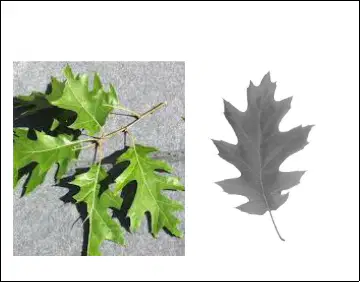
For the rightmost leaf image (oak-like leaf with deep lobes), identify the leaf type and/or shape.
Palmately lobed
Pinnately lobed
Entire (unlobed)
Needle-like
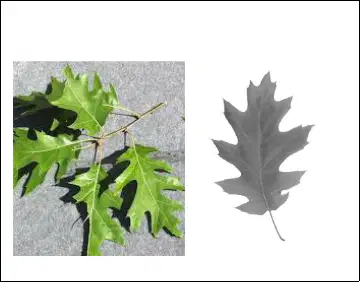
For the rightmost leaf image (oak-like leaf with deep lobes), identify the leaf margin.
Serrate
Entire
Lobed
Crenate
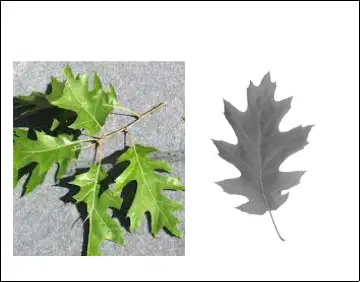
For the rightmost leaf image (oak-like leaf with deep lobes), identify the leaf tip shape visible at the ends of the lobes.
Acuminate (long tapering point)
Obtuse (rounded)
Truncate (flat end)
Mucronate (tiny sharp point)
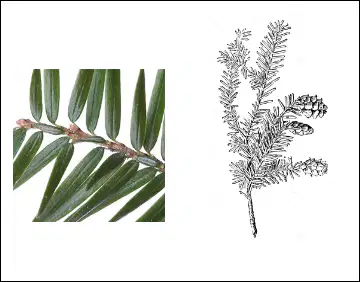
For the middle panel showing a twig with needle-like leaves (conifer spray), identify the leaf type.
Needle-like
Palmately lobed
Compound pinnate (with distinct leaflets)
Simple heart-shaped
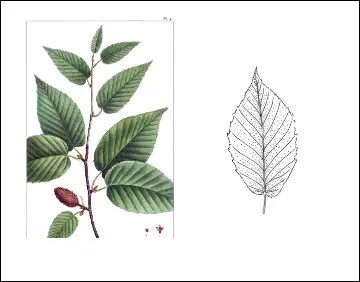
For the left panel line drawing of a single leaf (simple leaf outline), identify the leaf margin.
Serrate (saw-toothed)
Entire (smooth)
Lobed
Spinose (spiny)
It is considered the “plumbing” of the plant.
X — xylem
P — phloem
B — both xylem and phloem
If this does die, it becomes the bark of trees.
X — xylem
P — phloem
B — both xylem and phloem
Always alive.
X — xylem
P — phloem
B — both xylem and phloem
It is a type of vascular tissue.
X — xylem
P — phloem
B — both xylem and phloem
Die after a year and regrow.
X — xylem
P — phloem
B — both xylem and phloem
Is what makes tree rings that we visualize.
X — xylem
P — phloem
B — both xylem and phloem
The “UPS transport” of a plant.
X — xylem
P — phloem
B — both xylem and phloem
Is responsible for transporting sugars produced by photosynthesis and some water.
Xylem
Phloem
Vascular cambium
Epidermis
Select all structures that fit the description: Is found in the vascular bundle within the plant stem.
Xylem
Phloem
Cortex
Epidermis
Choose the plant structure or process that fits the description: How water gets from the roots far away to the leaves.
Xylem
Phloem
Photosynthesis
Phototropism
Choose the term that fits the description: Is essential for a plant’s growth and development.
Vascular tissue (xylem and phloem)
Leaf epidermis (outer layer)
Stomatal pores on outsides of leaves
Cork (bark)
Choose the plant structure that fits the description: Is responsible for the sap coming from trees.
Phloem
Xylem
Epidermis
Guard cells
Choose the plant structure that fits the description: Can move food and water in both directions.
Phloem
Xylem
Root hairs
Cuticle
Select all structures that fit the description: Consist of specialized cells to get the job done.
Xylem
Phloem
Parenchyma of cortex
Cuticle
Tiny raised pores on the twig surface that allow gas exchange.
Lenticel
Node
Leaf Scar
Pith
The point on the stem where leaves and buds are attached.
Node
Internode
Terminal Bud
Bundle Trace
The region of stem between two nodes.
Internode
Node
Leaf Scar
Bud Scale Scar
The mark left on the twig where a leaf was attached.
Leaf Scar
Bundle Trace
Bud Scale Scar
Lateral Bud
The small dots or lines within a leaf scar that indicate vascular tissue connections.
Bundle Trace
Bud Scale Scar
Pith
Lenticel
The soft central tissue in the middle of the twig.
Pith
Node
Cortex
Bud Scale
A bud located on the side of the twig.
Lateral Bud
Terminal Bud
Bud Scale Scar
Leaf Scar
The main bud at the very tip of the twig.
Terminal Bud
Lateral Bud
Node
Internode
The protective coverings around a bud.
Bud Scale
Bud Scale Scar
Leaf Scar
Lenticel
The circular or ring-like marks left after bud scales fall off.
Bud Scale Scar
Node
Bundle Trace
Pith
Choose the best definition for Bud Scale.
A small, modified leaf on the outside of a bud.
A bud along the sides of a twig and not at the tip.
The scar left on a twig when a bud scale falls.
A bud that is at the tip of a branch.
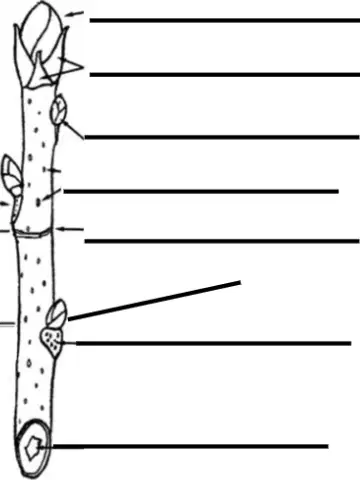
Choose the best definition for Bud Scale Scar.
The scar left on a twig when the leaf falls.
A corky spot on the bark that acts like a pore to let gas enter the twig.
Where on the twig the leaf is attached.
The scar left on a twig when a bud scale falls.
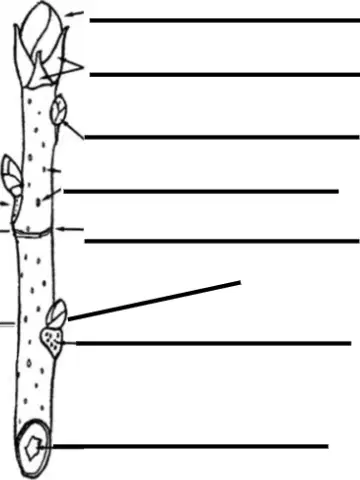
Choose the best definition for Bundle Trace.
The center, soft part of a twig containing the xylem and phloem.
The scar left on a twig when the leaf falls.
The part of the twig between two nodes.
Dot-like scars within a leaf scar, representing the broken ends of vascular bundles.
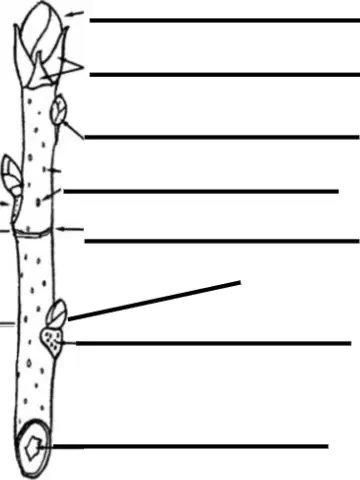
Choose the best definition for Internode.
Where on the twig the leaf is attached.
The part of the twig between two nodes.
A bud along the sides of a twig and not at the tip.
The center, soft part of a twig containing the xylem and phloem.
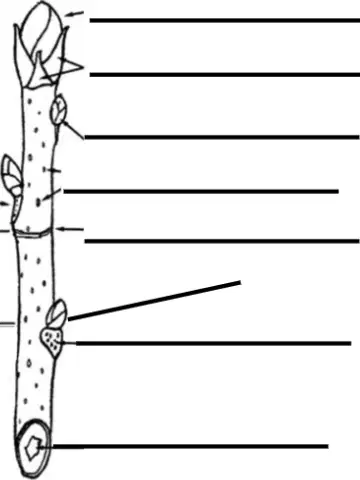
Choose the best definition for Lateral Bud.
A bud that is at the tip of a branch.
A small, modified leaf on the outside of a bud.
Where on the twig the leaf is attached.
A bud along the sides of a twig and not at the tip.

Choose the best definition for Leaf Scar.
The scar left on a twig when the leaf falls.
The scar left on a twig when a bud scale falls.
Dot-like scars within a leaf scar, representing the broken ends of vascular bundles.
A corky spot on the bark that acts like a pore to let gas enter the twig.
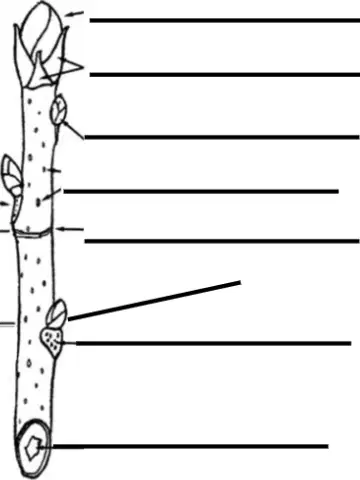
Choose the best definition for Lenticel.
A corky spot on the bark that acts like a pore to let gas enter the twig.
The center, soft part of a twig containing the xylem and phloem.
The part of the twig between two nodes.
The scar left on a twig when the leaf falls.
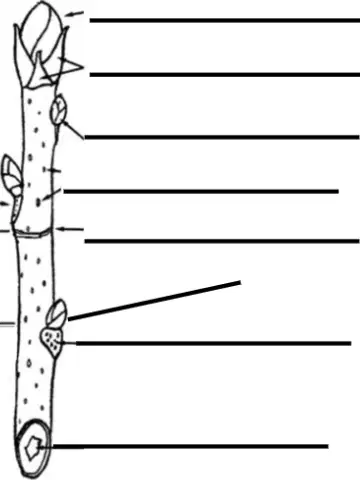
Choose the best definition for Node.
Where on the twig the leaf is attached.
The part of the twig between two nodes.
A bud along the sides of a twig and not at the tip.
A bud that is at the tip of a branch.
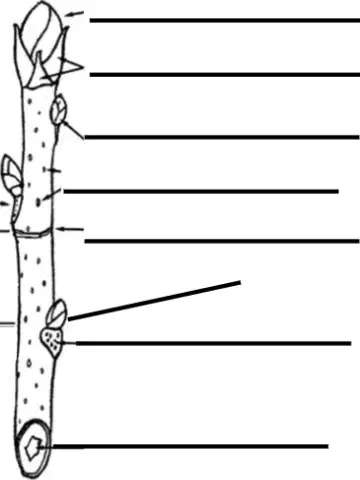
Choose the best definition for Pith.
The center, soft part of a twig containing the xylem and phloem.
Dot-like scars within a leaf scar, representing the broken ends of vascular bundles.
A corky spot on the bark that acts like a pore to let gas enter the twig.
The scar left on a twig when a bud scale falls.
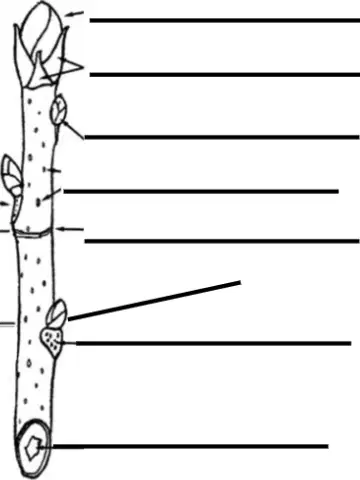
Choose the best definition for Terminal Bud.
A bud that is at the tip of a branch.
A bud along the sides of a twig and not at the tip.
A small, modified leaf on the outside of a bud.
Where on the twig the leaf is attached.
Why do we plant seeds in seed starting mix rather than potting soil?
Potting soil does not provide enough oxygen for seeds to germinate.
Seed starting mix is free of pests, has good drainage, and is sterile with no bacteria for fast root development.
Potting soil contains special fertilizers that are harmful to seeds.
Seed starting mix retains more nutrients, which is essential for the successful growth of young seedlings.
The three early land plants were:
Mosses, ferns, and gymnosperms
Mosses, liverworts, and hornworts
Ferns, grasses, and trees
Algae, fungi, and lichens
This seed type is lightweight and has a thin, flat extension that allows it to glide through the air.
Wing
Nut
Pod
Capsule
What happens to seeds given too much water?
Seeds get water logged, there won’t be enough oxygen in the soil and the roots will rot and die.
Seeds get completely full with water and will grow several large roots that are difficult to care for.
Seeds end up leaking water to the surrounding soil and create more spread out plants.
The roots of the seeds will dry out and die.

