
 Worksheets
OpenSciEd Physics Unit 2 (Review)
Total questions: 58
Worksheet time: 29mins
What primary geological feature appeared in the Afar region of Ethiopia in 2005, triggering the investigation in this lesson?
A new island in the Red Sea
A giant crack in Earth's crust
A massive sinkhole caused by erosion
A new mountain range
When comparing the earthquake in the Afar region to historical North American cases, what was a unique characteristic of the Afar event?
It was the only event that caused the ground to shake.
It was the only event that occurred on a fault line.
It was the only event that involved a volcanic eruption.
It was the only event located in the middle of a tectonic plate.
According to the map analysis performed in class, where do most earthquakes globally occur?
They are distributed evenly across all landmasses.
They are exclusively found in the center of continents.
They only happen in desert regions with dry soil.
They occur primarily along plate boundaries.
In the study of earthquake patterns, what is observed when changing the scale (zooming in or out) on a map of mid-plate earthquakes?
The location of the earthquakes changes based on the zoom level.
Some lines or clusters are only visible at specific scales.
Earthquakes always form a perfect circle when zoomed in.
Patterns become less clear at all scales.
At what approximate magnitude do people generally begin to feel the effects of an earthquake, as noted in the StoryMap?
7.5
4.0
1.0
2.5
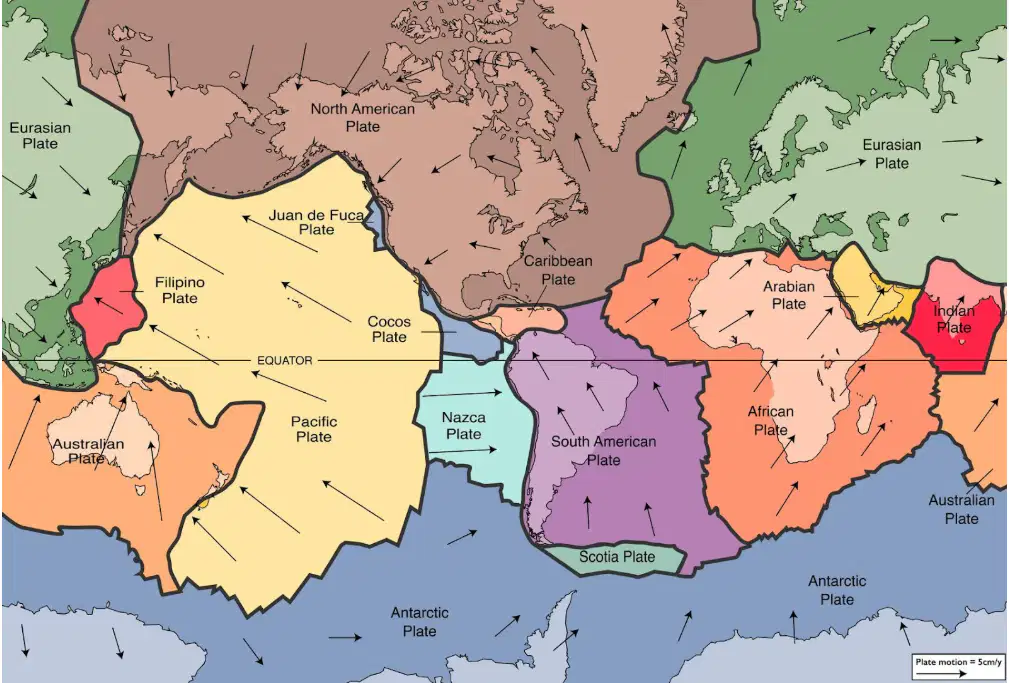
On a GPS plate map, what does the length of a vector arrow represent?
The thickness of the Earth's crust at that specific location.
The speed or magnitude of the plate's motion.
The depth of the plate below the ocean floor.
The duration of time the plate has been moving in that direction.
Which statement best describes the relationship between 'stability' and 'scale' in a system?
Only very large systems like Earth's plates can be considered truly stable.
All systems change, and whether they appear stable depends on the scale of space and time at which they are studied.
Stability is an absolute state that does not change regardless of the timeframe observed.
Changing the scale of an observation usually makes a stable system appear more chaotic.
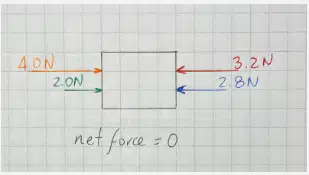
What is the net force acting on an object that remains stationary or 'stable'?
The net force is determined by the strongest single force acting on the object.
The net force is always a positive value in the direction of gravity.
The net force must be exactly 0 N.
The net force is equal to the mass of the object.
In physics, what does the term "magnitude" refer to?
The total area of a tectonic plate.
The geographic direction in which a force is applied.
The angle at which two plates collide.
The numerical value or strength of a measured quantity.
What happens to the motion of an object if a force is removed from a stable system, making the forces unbalanced?
The object will move in the opposite direction of the force that was removed.
The object's motion will change because the net force is no longer zero.
The object will immediately reach a new stable state without moving.
The other forces will automatically increase to maintain stability.
According to the physical model developed in the lesson, what are plates primarily composed of?
Thick sections of solid rock.
Loose piles of gravel and boulders.
Liquid lava that flows continuously.
Thin layers of soft sediment and dirt.
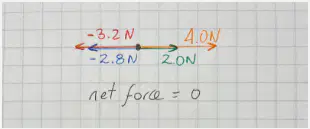
When drawing a free-body diagram, how should forces be represented if they are acting in opposite directions along the same axis?
Both forces should be given positive values to show their strength.
The arrows should always originate from the center of the object and point outward.
One direction should be assigned a positive value and the opposite direction a negative value.
Only the largest force should be drawn to simplify the model.
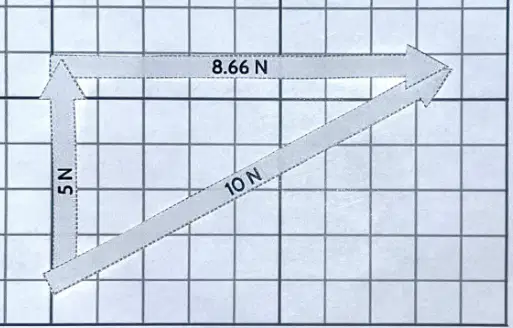
If an object has a horizontal force (a) and a vertical force (b) acting on it, what mathematical theorem helps determine the magnitude of the resulting angled force (c) needed for stability?
The Law of Conservation of Energy.
The Slope Formula
The Pythagorean Theorem
Newton's Second Law
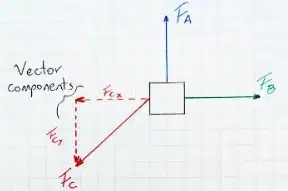
What is a 'vector component'?
The material, like foam or rock, that a force acts upon.
The total length of the arrow representing a force.
The point where two different tectonic plates touch.
The part of a two-dimensional vector that acts along a specific axis (horizontal or vertical).
Why might the Caribbean plate appear stable on a global GPS map even though it is actually moving?
The map may lack visible data for that plate at that specific scale to avoid overlap or clutter.
The forces acting on it are perfectly balanced by the Earth's rotation.
It only moves during large earthquakes and remains still otherwise.
It is jammed so tightly between other plates that it has stopped moving entirely.
What is the scientific term for a solid object that changes shape temporarily when forces are applied and returns to its original shape once the forces are removed?
Static stability
Plasticity
Permanent deformation
Elastic behavior
According to the M-E-F (Matter-Energy-Force) model, what is the primary cause of energy being transferred into or out of a system?
Unbalanced forces
Balanced forces
Constant velocity
Thermal equilibrium
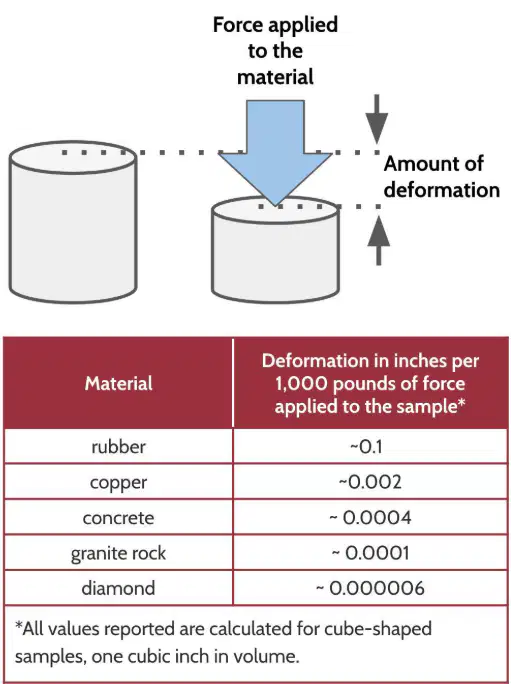
Based on the provided data table, which material exhibits the least amount of deformation per 1,000 pounds of force applied to a one-cubic-inch sample?
Concrete
Granite rock
Diamond
Rubber

In the foam panel demonstration, when a 50 g weight is hanging and the panel is curved but stationary, what is the state of the forces acting on the panel?
The net force is greater than zero due to the weight of the mass.
There are no forces acting on the system because it is not moving.
The forces are balanced because the system is stable and stationary.
The forces are unbalanced because the shape of the panel has changed.
What occurs when a solid material is compressed or stretched beyond its 'elastic limit'?
It stops transferring energy into the system.
The magnitude of balanced forces becomes zero.
It returns to its original shape faster.
It undergoes permanent deformation, such as cracking or breaking.

When we cut the string of the hanging mass, how does the magnitude of the applied force affect the energy transfer in the foam projectile system?
Force magnitude only affects matter changes, not energy transfers.
Energy transfer remains constant as long as the material does not break.
Increasing the force magnitude decreases the energy transfer because the foam becomes too stiff.
Increasing the force magnitude increases the amount of energy transferred into and out of the system.
Which of the following statements best describes the behavior of solid rock found in Earth's tectonic plates?
Rock is perfectly rigid and cannot deform without breaking.
Rock does not store energy when it is compressed.
Rock exhibits elastic behavior similar to foam, though the scale of deformation is much smaller.
Rock only deforms when it is molten or extremely hot.
According to the particle-level model developed in the lesson, what is the fundamental cause of all changes in matter, such as bending, breaking, or state changes?
The creation of new particles to fill gaps.
A total loss of energy within the system.
The cooling of particles until they become static.
Unbalanced forces causing changes in motion.
When a solid material like a tectonic plate elastically deforms before an earthquake, where is the energy primarily stored?
In the nucleus of each individual atom
Within the empty space where no fields exist
In the electric fields between particles
It is converted entirely into heat immediately
In the context of material science, what is 'pressure' or 'stress' described as at the particle level?
The average amount of internal force per particle
The total number of particles in a given volume
The speed at which particles vibrate
The total mass of the object divided by its velocity
Why do tectonic plates have the capacity to store such vast amounts of energy before a sudden earthquake occurs?
Energy is stored as light within the Earth's crust
The plates are made of specialized energy-absorbing gas
They have a massive number of particles and electric fields
The plates are moving at extremely high velocities
What occurs at the particle level when a material reaches its 'elastic limit' and breaks?
All electric fields in the material disappear
Particles move so far apart that their bonds break
The particles fuse together into a single large atom
The particles lose all of their mass suddenly

Which of the following is a limitation of the foam panel model (Model 1) used to simulate plate boundaries?
It cannot show that plates have irregular edges
It does not allow for any observable deformation
It doesn't show the electric fields or particles directly
It cannot be broken by human hands
What is a good explanation for the periods of 'apparent stability' between major earthquakes in a single region?
The Earth's core stops rotating between earthquakes
Forces on the plates cease to exist during these times
It takes time for energy to build up in the fields
The particles in the crust are perfectly stationary
Seismic waves are classified as mechanical waves. Which characteristic determines this specific classification?
They move at the speed of light in a vacuum.
They transfer matter along with the energy of the vibration.
They are only produced by volcanic eruptions.
They travel through a medium made of matter.

In a longitudinal wave like a P-wave, how do the particles of the medium move?
Only in the direction opposite to the wave energy.
In a circular motion that returns to the origin.
Parallel to the direction of wave travel.
At a 90 degree angle to the direction of travel.
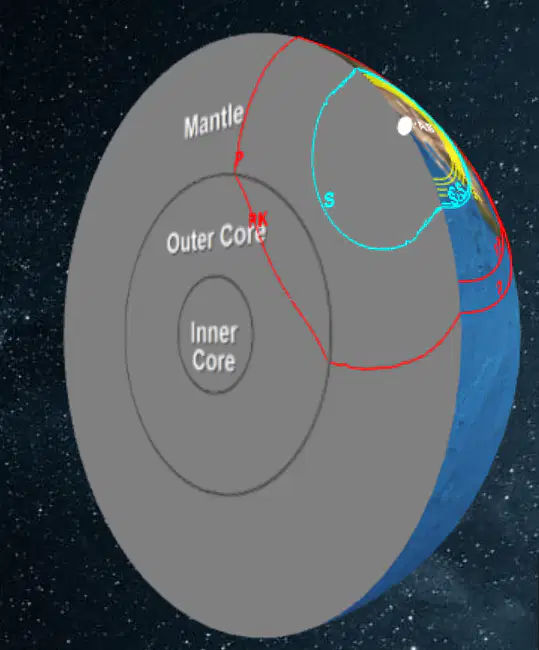
What happens to the arrival time of P-waves at a seismic station when they pass through the liquid outer core?
The waves arrive later than expected because they slow down in liquids.
The arrival time remains constant because wave speed only depends on distance.
The waves do not arrive at all because liquids block compressional energy.
The waves arrive earlier than expected because liquids are more dense.
Scientists use seismic velocity anomalies to map Earth's interior. What does a 'negative velocity anomaly' (often colored red) typically indicate in the mantle?
The region is hotter than the surrounding mantle.
The region is composed of solid iron and nickel.
The seismic waves are traveling faster than expected.
The area is completely hollow of filled with gas.
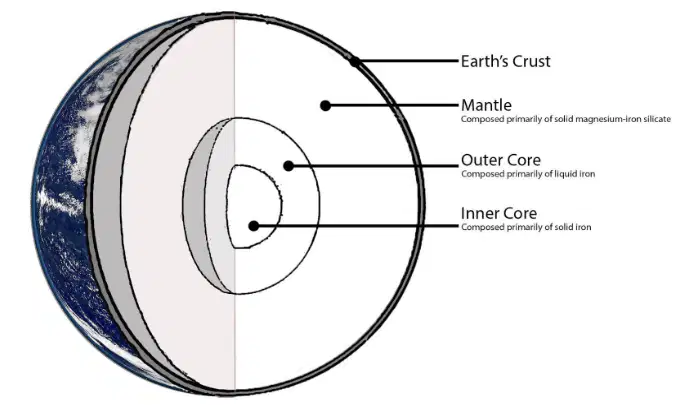
Why are S-waves unable to travel through Earth's outer core?
The outer core is too far away for the energy to reach it.
The pressure in the core turns the waves into heat energy.
S-waves only travel through the crust and mantle
S-waves are transverse waves that require a solid to propagate (move through).
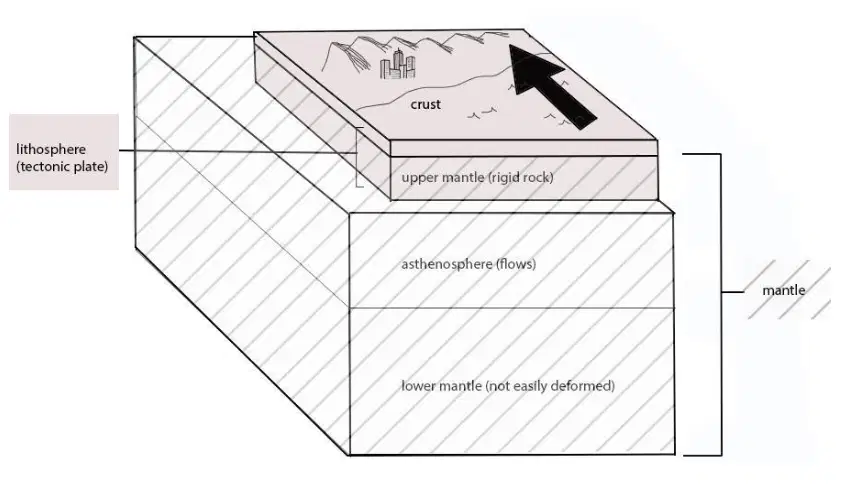
Which of the following best describes the 'Moho'?
The boundary between the Earth's crust and the mantle.
The layer of liquid iron located at the center of the Earth.
A tool used to calculate the distance of an earthquake epicenter.
A specific type of seismic wave that travels along the surface.
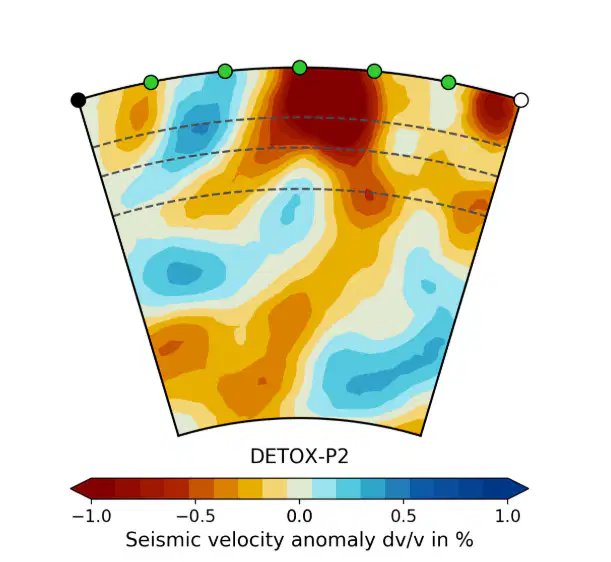
In seismic tomography, what does a 'positive velocity anomaly' (often colored blue) imply about mantle material?
The seismic waves have stopped moving through this region.
The material has melted into a liquid state.
The material is cooler and denser than the average mantle at that depth.
The region is undergoing a volcanic eruption.
How does observing the mantle on a local scale help explain surface features like those in the Afar region?
It proves that the mantle is a uniform solid throughout the entire planet.
It shows that surface features are independent of the Earth's interior.
It allows scientists to measure the exact depth of the ocean floor.
It reveals that the mantle is heterogeneous, with local temperature differences causing unbalanced forces.
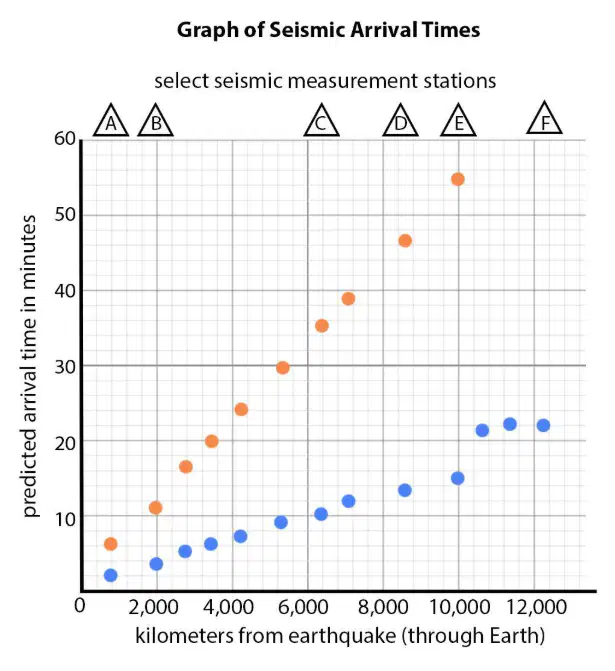
When analyzing a graph of seismic arrival times, what would a 'wonky' or inconsistent line for P-waves after 10,000 km represent?
A change in the state of matter the waves is passing through.
An error in the mathematical calculation of the seismic station.
The earthquake energy becoming strong as it travels deeper.
The waves reflecting off the surface of the Moon.
If an earthquake occurs at the North Pole, a seismic station at the South Pole would likely detect which of the following?
S-waves only, because they travel faster through the core.
Both P-waves and S-waves arriving simultaneously.
Neither wave type, as the core is a perfect insulator of energy.
P-waves only, but with a delay in their arrival time.
When a parcel of mantle material is heated, what is the primary change observed at the particle scale?
The particles increase in size, causing the parcel to occupy more volume.
The individual mass of each particle increases as it absorbs thermal energy.
The average kinetic energy of the particles increases, causing them to move faster and farther apart.
The particles begin to vibrate more slowly, allowing them to slide past each other.
When a parcel of mantle material is heated, what is the primary change observed at the particle scale?
The density remains stable because the mantle is a solid material.
The density decreases because the total mass of the parcel is reduced by heat.
The density increases because the particles are moving more rapidly.
The density decreases because the matter expands to occupy a larger volume while mass stays the same.
From a 'Forces' perspective, why does heated mantle material move upward toward the crust?
Gravity ceases to pull on particles once they reach a certain temperature threshold.
The less dense parcel is pushed upward by the denser, cooler matter surrounding it.
The core exerts a magnetic repulsion force that pushes hot rock away from Earth's center.
Vacuum pockets at the surface pull the heated material up through suction.
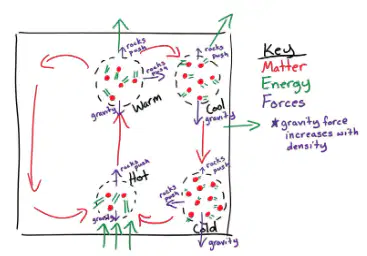
What happens to the energy of a mantle parcel as it moves horizontally across the top of the mantle?
The energy level remains perfectly stable until the parcel reaches the side of the tank.
The parcel gains energy because it is closer to the sun's radiation.
Energy is transferred from the parcel to the cooler surroundings, such as the crust.
The kinetic energy of the particles increases due to the speed of the horizontal flow.

Why did the class compare the mantle tank model to a lava lamp?
To show that convection only occurs in liquids and not in solid rock.
To help explain why the tomography data shows parcels of hot matter in irregular shapes and locations.
To prove that the energy source for the mantle is located at the surface rather than the core.
To demonstrate that the mantle's convection is always perfectly symmetrical and uniform.
What role does the force of gravity play in the process of mantle convection?
It pulls more strongly on denser, cooler parcels, causing them to sink toward the interior.
It only affects the material once it has reached the surface and turned into crust.
It pulls upward on the less dense parcels, helping them rise faster.
It is balanced by the magnetic field, preventing the mantle from moving too quickly.
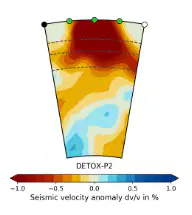
In the Afar tomography data, what do the 'red' areas represent in terms of the M-E-F (Matter-Energy-Forces) triangle?
Matter with high kinetic energy that is less dense and likely being pushed upward.
Regions where gravity is the only force acting on the mantle rock.
Matter with low kinetic energy that is being pulled down by gravity.
Areas where energy transfer is minimal and the matter is stable.
What is a significant limitation of using the liquid-filled 'mantle tank' to model Earth's mantle?
The tank is too large to represent the scale of the mantle accurately.
The tank contains pellets, but the mantle contains no solid particles.
The liquid in the tank flows much faster than the solid rock of the mantle.
The tank is heated from the bottom, whereas the mantle is heated from the top.
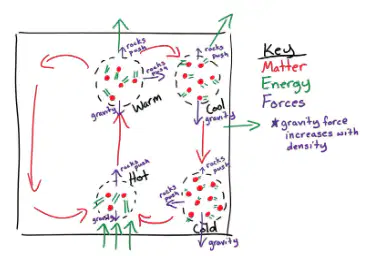
According to the consensus model, what causes the net force on a parcel of mantle material to become unbalanced?
A change in the parcel's density caused by energy transfer.
The movement of the crustal plates pulling the mantle along with them.
The addition of new matter from the core increasing the parcel's mass.
A total loss of gravity in the center of the mantle tank.
What is the primary source of the thermal energy that drives mantle convection according to the source material?
Chemical reactions between different mineral layers.
Nuclear fusion occurring within the Earth's core
Radioactive decay of unstable isotopes.
Solar radiation absorbed by the Earth's crust
According to the readings, what specific subatomic event characterizes alpha decay?
The nucleus absorbs a nearby electron to stabilize its charge
A neutron transforms into a proton and an electron
High-frequency electromagnetic waves are released without particle loss
Two protons and neutrons split off from the nucleus
What causes particles to be ejected from the nucleus during radioactive decay?
An imbalance between the strong nuclear and electric forces.
Extreme pressure from the weight of the overlying crust
Collisions with high-speed electrons from the atom's out shells
Gravitational pull from the Earth's center acting on the nucleus
Why is nuclear fusion considered an unlikely contributor to mantle convection?
The internal temperature of Earth is too low to initiate the process
Fusion only happens in gaseous environments like stars
The Earth lacks the hydrogen required for fusion
Fusion processes absorb energy rather than releasing heat
In the context of the mantle, how does energy transfer from the subatomic scale to the macroscopic scale?
Decaying nuclei cause the entire Earth to expand and contract
Subatomic particles release light that heats the mantle rocks
Kinetic energy from escaping particles transfers into the vibration of surrounding atoms
Magnetic fields generated by decay pull the mantle material upward
What is a key difference between spontaneous radioactive decay and typical nuclear fission as described in the MA Adaptation?
Radioactive decay releases energy, but fission absorbs it
Fission results in smaller atoms, but decay creates larger ones
Fission usually requires a neutron to initiate the process, while decay is spontaneous
Radioactive decay only happens in the crust, while fission happens in the core
If a neutron in an atomic nucleus suddenly becomes a proton and an electron is ejected, what type of decay has occurred?
Nuclear fusion
Beta decay
Alpha decay
Gamma radiation
Which statement best describes the relationship between spatial (space) and temporal (time) scales for radioactive decay and mantle convection?
Decay occurs at a very tiny spatial scale, while convection occurs at a global spatial scale
Decay occurs over millions of years, while convection happens in seconds
Both processes occur at the same microscopic spatial and temporal scales
Decay involves the entire mantle, while convection is localized to single atoms
What is the main reason seismic waves slow down when passing through a region of the mantle with a negative velocity anomaly?
The region contains more iron than the surrounding mantle.
The seismic waves are reflected back to the surface.
The temperature in that region is higher, reducing the rigidity of the material.
The pressure is significantly lower than elsewhere in the mantle.
Which process is primarily responsible for the movement of tectonic plates on Earth's surface?
Direct gravitational pull from the Moon.
Convection currents in the mantle caused by heat transfer.
Wind erosion acting on the crust.
Solar radiation heating the atmosphere.

