
 Worksheets
8th Science Physics Review
Total questions: 110
Worksheet time: 2hrs 4mins
Newtons are the correct unit for which of the following?
Force
Work
Power
Acceleration
A 10 kg object is accelerated upward at 2 m/s2. What force is required?
20 N
2 N
5 N
0 N
A 20 kg bike accelerates at 10 m/s2. What was the force?
25 Newtons
20 Newtons
200 Newtons
10 Newtons
If a 10 kg object accelerates suddenly at 15 m/s2, how much force was applied to the object?
150 Newtons
15 Newtons
150 kilograms
100 kilograms
What is the formula for force?
F=M/A
F=A/M
F=M*A
F=M*F

How much force is needed to accelerate a 3kg skateboard at 5m/s2?
8N
1.6N
0.6N
15N

How much force is needed to accelerate a 25kg bowling ball at 2m/s2?
50N
5N
12.5N
100N
What is velocity?
the quickness of an object
the location of an object
acceleration
speed in a specific direction
What is speed?
how far you go
how much distance is covered over a period of time
how fast you accelerate
the change in the location of a object
A runners races in the 100 meter dash. It takes her 10 seconds to finish. What is her average speed?
10 m/s
1000 m/s
100 seconds
10 seconds
If a cheetah runs 180 miles in 3 hours, what is its average speed?
60 hours
60 miles
60 miles/hour
60 miles/second/second
How far will a person go if they jog for 2 hours at a speed of 12 km/hr?
6 km
0.5 km
10 km
24 km
A 20 kg bike accelerates at 10 m/s2. what was the force?
25 Newtons
20 Newtons
200 Newtons
10 Newtons
45 m/s2 is the...
Mass
Force
Acceleration
weight
If a force of 26 N is exerted on two balls, one with a mass of 0.52 kg and the other with a mass of 0.78 kg, which ball will have the greater acceleration? (F=ma)
The one with a mass of .78 kg will have the greatest acceleration.
The one with a mass of .52 kg will have the greatest acceleration.
They will both accelerate at the same rate.
If a force of 50 Newton's was applied to an object with a mass of 500 grams, what will the object's acceleration be?
10 m/s^2
.1 m/s^2
100 m/s^2
1 m/s^2
If an object was accelerating at 10 m/s^2, and a force of 10 newtons was required to accelerate it, what was the object's mass?
1 kilogram
10 kilograms
2 kilograms
5 kilograms
If a 10 kilogram object accelerates suddenly at 15 m/s^2, how much force was applied to the object?
150 Newtons
15 Newtons
150 kilograms
100 kilograms

Why is person B having a hard time moving down the hill?
Person B has more friction than person A.
Person B has the same friction as person A.
Person B is out of shape.
Person B has less friction has person A.
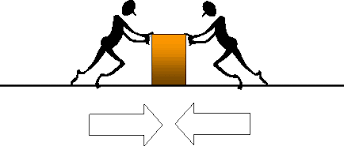
If an object is stationary (not moving) the forces acting upon it are _____________
unbalanced
weak
balanced
Hulk Smash!

In a tug of war, when one team is pulling with a force of 100 N and the other at 80 N. What is the net force?
20 N
80 N
100 N
180 N

What is the net force?
17 N Right
3 N Right
3 N Left
17 N Left

What is the net force?
5000 N right
4000 N right
40 N left
4000 N left
You and your dad are moving the couch from one side to another. Your dad pushes with a force of 35 N to the right and you push with a force of 25 N right. What is the net force on the couch?
60 N right
10 N left
60 n right
50 N left
You and your friend, are playing tug of war. Your friend pulls with a force of 55 N, to the rights. You pull with a force of 65 N, to the left. What is the net force on the rope?
10 n, to the left
20 N
10 N, to the left
10 N, to the right
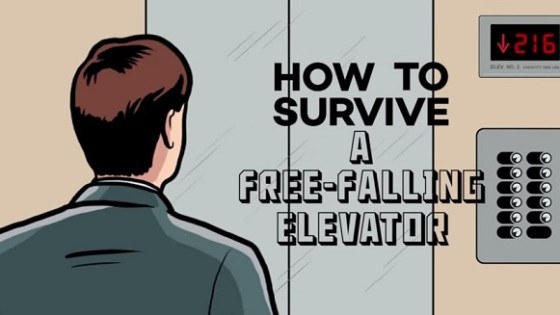
What is the force on a 1000 kg elevator that is falling freely at 9.8 m/sec2
102.04 n
9,800 n
980 n
103 n
What is the acceleration of a 50 kg object pushed with a force of 500 newtons?
100 m/s2
25,000 m/s2
10 m/s2
25 m/s2
Newtons 1st law of motion states:
An object in motion will stay in motion and an object in rest will stay in rest unless acted upon by and unbalance force.
For every action there is an equal and opposite reaction.
Acceleration is produced when a force. acts on a mass.
The greater the mass the greater the amount of force needed to change its motion.
The law of inertia is also known as which law of motion?
Newtons first law of motion.
Newtons second law of motion.
Newtons third law of motion.
Inertia has nothing to do with the laws of motion.
A 50 kg skater pushed by a friend accelerates 5 m/sec2. How much force did the friend apply?
45 N
15 N
10 N
250 N
A force of 250 N is applied to an object that accelerates at a rate of 5 m/sec2. What is the mass of the object?
100kg
1,250kg
50kg
5kg

This triangle is used to determine speed.
True
False
Which example below demonstrates Newton's third law of motion the best?
When a boxer lands a powerful hit on his or her opponent the opponent loses composure or can even get knocked down.
It takes more force for a boxer to knock out a larger opponent vs a smaller opponent.
Sometimes when a boxer is warming up by running but they can be slowed down if there is traffic in the road.
There are only two laws of motion.
The classes are playing tug of war. Barsoum’s room pulls to the left with a force of 45 N. Coach Camacho's room pulls to the right with a force of 50 N. What is the net force? And who won?
5N right. Coach Comacho's Class won.
5N Left. Barson's class won.
95N and Coach Comacho's class won.
95N and Barson's class won.
Which is an unbalance force?
A book sitting on a desk.
A ball moving in a constant speed in the same direction.
While doing a mannequin challenge Jose suddenly falls over when a bug lands on his nose.
Every student in class is sitting perfectly still at their desks.
Determine the accelerations that result when a 12-N net force is applied to a 3-kg object and then to a 6-kg object.
A 3-kg object experiences an acceleration of 2 m/s/s. A 6-kg object experiences an acceleration of 2m/s/s.
A 3-kg object experiences an acceleration of 4 m/s/s. A 6-kg object experiences an acceleration of 2 m/s/s.
A 3-kg object experiences an acceleration of 2 m/s/s. A 6-kg object experiences an acceleration of 4 m/s/s.
A 3-kg object experiences an acceleration of 4 m/s/s. A 6-kg object experiences an acceleration of 4 m/s/s.
What is inertia?
How heavy an object is.
How fast an object is moving.
The movement of an object.
The resistance of an object to change in motion.
What is a force?
A force is a push or pull.
A force is anything that acting on another object.
A force can be balanced or unbalanced.
all of the above
You give a shopping cart a shove down the isle. The cart is full of groceries and has a mass of 18 kg. The cart accelerates at a rate of 3 m/s2. How much force did you exert on the cart?
6N
54N
21N
18N
Coach Camacho and his wife were trying to move their new chair. Coach Camacho pulls with a force of 30N while Mrs. Camacho pushes with a force of 25 N in the same direction. What is the net force?
15N
5N
55N
25N
What is the unit of measurement for Force?
Kilogram
Newton
Meter
Joule

The diagrams show forces acting on a toy car as it moves to the right. Which diagram shows the toy car that will most likely accelerate to the right based on these conditions?


Which of the following is an example of an UNBALANCED force?
Pushing a lawnmower
Car traveling at a constant speed
Person sitting in a chair
Book sitting on a shelf
If a rock is sitting motionless on the ground, what statement would best explain why the rock remains motionless?
No forces acting on the rock
Only force acting on the rock is gravity
Forces acting on the rock are balanced
Sidewalk is an unbalanced force
(a) Mass = More Acceleration
What is acceleration? Pick all that apply.
Speeding up
Slowing down
Changing direction
Constant Speed

Explain why this picture demonstrates Newton's 1st Law of Motion.

Explain why this picture demonstrates Newton's 2nd Law of motion.
Inertia is an objects ability to resist a change in motion... Which of the following best represents Inertia?
When paddling a canoe, you push the oar backward and the canoe moves forward.
A balloon playing around the room when the air is let out of it.
A motorcycle requires less force to accelerate than a truck.
Moving forward when your bicycle suddenly stops moving due to hitting a curb.
An object at rest remains at rest, and an object in motion remains in motion unless acted upon by an unbalanced force.
1st Law of Inertia
2nd Law of Force, Mass, Acceleration
An objects acceleration depends on the objects mass and the amount of force applied.
1st Law
2nd Law
Force = _________ x _________
(a)
A push or pull...
Gravity
Inertia
Force
Acceleration

Which distance/time graph would represent an object moving forward at a constant speed?
A
B
C
D
The 1,100 kg car comes to a stop. If the vehicle is accelerating at a 1.2 m/s2, which force is CLOSEST to the net force acting on the vehicle?
F = M × A9,600 N
1,300 N
900 N
94 N

A dad (more mass) and a daughter (less mass) push against each other while ice skating. What would the motion of the two people be?
The dad moves forward, and the daughter moves backward with greater acceleration.
Both move forward, but the dad moves with greater acceleration.
The dad moves backwards, and the daughter moves forward with greater acceleration.
Both will move backwards, but the daughter moves with a greater acceleration.
Four boxes with different masses are all pushed with a force of 8 N. Which box would have the greatest acceleration?
Box with a mass of 2 kg
Box with a mass of 4 kg
Box with a mass of 6 kg
Box with a mass of 8 kg

Based on Newton's 3rd Law, if you are exerting a downward force on the chair, then the chair is...
destroying the forces
exerting a stronger downward force
causing the load to accelerate upwards
exerting an upward force that is equal to the downward force
A wagon is pulled 1.5 m to the right in 2.5 sec. What is the block's average speed to the nearest hundredth?
AS = TD ÷ TT0.6 m/s
1.67 m/s
3.75 m/s
2.55 m/s

Jackson throws a football 30 meters at a speed of 15 m/s. How long was the football in the air before Laurrence caught it for the touchdown?
450 s
2 s
0.5 s
3 s
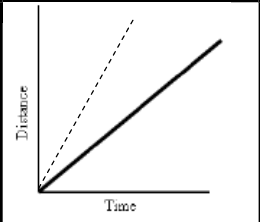
What does this graph represent?
Constant Speed
Acceleration
Not moving

How long did it take this object to travel 10 m?
0 s
10 s
15 s
20 s
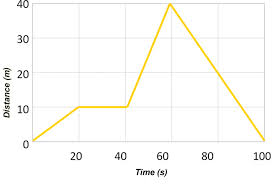
How long did it take this object to travel back to its reference/starting point?
20 s
30 s
60 s
100 s

At 60 seconds, how far had this object traveled?
0 m
10 m
20 m
40 m
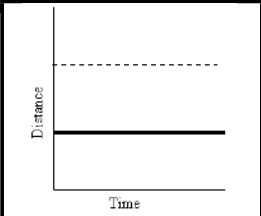
What does this graph represent?
Constant speed
Acceleration
Not moving

What does this graph represent?
Constant speed
Acceleration
Not moving
Match the description to the graph:
"The car is coming back."


Match the description to the graph:
"The car is traveling at a constant speed away from start."
Match the description to the graph:
"The car is slowing down."
At 60 seconds, how far had this object traveled?
0 m
10 m
20 m
40 m
What does this graph represent?
Constant speed
Acceleration
Not moving

What is happening at D?
Stationary
Accelerating
Fast steady speed; moving away from the starting position
Slower steady speed; moving away from the starting position

What is happening at C?
Stationary
Accelerating
Fast steady speed; moving away from the starting position
Slower steady speed; moving away from the starting position
What does this graph represent?
Constant speed
Acceleration
Not moving

Which runner had a head start?
A
B
C
Can be measured in meters (m)
Distance
Time
Speed
Acceleration
Match the description to the graph:
"The car is stopped."

Which runner won the race?
Albert
Bob
Charlie
Which runner stopped for a rest?
Albert
Bob
Charlie
How long did Charlie stop for a rest?
2.5 seconds
2 seconds
3 seconds
5 seconds

Whats Newtons First Law?
The more force applied to an object the faster it will accelerate.
An object in motion will stay in motion and an object at rest will stay at rest unless acted by an outside force.
for every ection there is an equal and oposite reaction

The Law of Inertia
Newtons 1st Law of motion
Newtons 2nd Law of motion
Newtons 3rd Law of motion

The tendency of an object to resist changes in its motion is...
Acceleration
Velocity
Inertia
Force
Newton's third law states that any action will have a(n) ___ and ___ reaction
Equal and similar
Equal and opposite
Equal and different
Greater and opposite

Acceleration: is the rate of change in _____.
distance
Speed
Velocity
displacement

What is the Net Force?
10
0
3
2

What is the net force?
30 N
25 N
5 N
55 N
What is the standard unit force is measured in?
Newtons
pounds
grams
meters

Any push or pull on an object.
force
velocity
inertia
momentum

Force exerted between the surfaces of two objects.
Friction
Inertia
Force
Gravity
Who is the scientist who came up with the Laws of Motion?
Sir Issac Newton
The Greeks
John Dalton
Sir John Newt
What is Newtons 2nd law of motion?
Pancakes
Force= Mass multiplied by acceleration
For every action there is a equal and opposite re-action.
Law of gravity
Which has more Inertia? (so need more force to move)
Truck
Ant
A cat
A skateboard

Balanced or Unbalanced?
Balanced
Unbalanced
If you lean against a wall, the wall pushes back on you with a(n) weaker force.
True
False
What pulls a ball back to earth?
Gas
Gravity
Friction
Molecules
1. Which is Newton's Third Law?
Force = mass x acceleration
The amount of acceleration depends on the size of the net force and the mass of the object.
For every action there is an equal and opposite reaction.
Objects at rest or in motion will stay at rest or in motion unless an external force acts upon that object.
The amount of force colliding objects impose on one another depends on what?
Their mass
Their velocity
Their weight
It doesn't depend on anything. They will always impose the same amount of force on one another.
A man is trying to pull an elephant off of the road but it doesn't move. The man pulls on the rope with a force of 5000 N. How much force does the elephant pull on the rope?
None, the elephant isn't moving so it isn't exerting any forces.
The answer is unknown unless we know the mass of the elephant.
2,500 N
5,000 N
A small car runs into a parked truck, which is much bigger than the car. Which of the following statements is correct?
The force that the car exerts on the truck is bigger than the force the truck exerts on the car because the car is moving and the truck is not.
The force that the car exerts on the truck is smaller than the force the truck exerts on the car because the car has a smaller mass.
The force that the car exerts on the truck is equal to the force the truck exerts on the car.
The car exerts a force on the truck, but the truck does not exert a force on the car because it is not moving. Only moving objects can exert forces.
Carlos is pulling his little brother on a sled at a constant speed. He is exerting a force of 128 N on the sled. Together, his brother and the sled have a mass of 32 kg. What is the acceleration of the sled?
Hint: Net Force = Mass x Acceleration; be sure to rearrange the equation to solve for ACCELERATION
96 m/s2
4096 m/s2
4 m/s2
0.25 m/s2
The Law of Inertia says that objects resist changes in motion due to their inertia. What is responsible for keeping an object at rest or maintaining an object's constant velocity?
External Forces
Unbalanced Forces
Gravity
Balanced Forces
Friction
According to Newton's first law of motion, what would happen to a car traveling west at a constant velocity of 55 MPH in the absence of an unbalanced force?
The car would continue moving west with a velocity of 55 MPH.
The car would slowing increase its velocity approaching but not reaching the speed of light.
The car would slow down but never reach 0 velocity.
The car would slow down and come to a stop.
The car would increase its velocity without changing acceleration.
Jasmine is trying to hang a new clock in her apartment. The clock experiences a force due to the gravity of 15N. She has a nail that exerts an upward force of 10N. Are the forces on her clock balanced or unbalanced and what will happen to the clock?
The forces are unbalanced and the clock will fall.
The forces are balanced, but the clock will still fall.
The forces are unbalanced and the clock will fly upward.
The forces are balanced and the clock will stay on the wall.

1. In physics class, a box slides across the table with an applied force of 20N. The students measure the net force to be 14N. What must the frictional force acting on the block be?
Hint: Friction opposes motion.
6 N
34 N
14 N
20 N
1. In physics class, students roll a toy car across the table. The toy car has a mass of 3kg. The students apply a force of 10 N to the car and friction holds it back with 1 N of force. What is the acceleration of the car?
Hint: FIRST calculate the Net Force, THEN use a = F/m to calculate acceleration.
3 m/s2
3.67 m/s2
7 m/s2
6 m/s2
Carlos applies a force of 50 N to his refrigerator to push it across his kitchen. If the refrigerator accelerates at a rate of 0.5 m/s2, what is the mass of the refrigerator?
Hint: Net Force = Mass x Acceleration; be sure to rearrange the equation to solve for ACCELERATION
10 kg
25 kg
100 kg
250 kg
Which of the following scenarios illustrates the law of inertia?
A smaller cannon ball leaves the cannon much faster than a bigger heavier cannon ball.
When you throw a bowling ball out of a canoe, the bowling ball moves forward and the canoe moves backward.
A girl who has been pulling a sled behind her stops to tie her shoe and the sled keeps moving and hits her in the back of the leg.
It is easier to carry your backpack when it's empty rather than when it's full.
Which of the following scenarios best illustrates the law of force and acceleration?
When you give your friend a lift on the front of your bile you have to pedal harder to speed up than when you were on the bike alone.
When you hit the wall it hurts your hand.
When the bus you're riding suddenly stops, your body continues to move forward.
A basketball sits in the ball cage at the gym, and remains motionless.
Which of the following scenarios best illustrates the law of action and reaction?
A grocery cart full of groceries is harder to push than an empty cart.
Two bumper cars collide and each car jolts backwards.
As a boy slides down a slide, friction causes him to stop at the bottom.
A grocery cart is sitting motionless in a parking lot when you jump in and your friend pushes you around.

