
 Worksheets
Electric Fundamental — Electron Theory (Worksheet Extraction)
Total questions: 123
Worksheet time: 1hrs 2mins
A neutron has.
The opposite charge to an electron but half the weight of a proton.
The same charge as an electron but half the mass.
No electrical charge but will add weight to the nucleus.
The unit which consists of two or more different types of atoms is known as a.
Particle of an element.
Molecule of a compound.
Molecule of an element.
The unit which consists of two or more different types of atoms is known as a.
An element.
A molecule.
An atom.
What charge does the nucleus of an atom possess?
Positive.
Neutral.
Negative.
If electrons are added to an atom it becomes.
A neutral ion.
A positive ion.
A negative ion.
The charge on a proton is.
Positive.
Negative.
Neutral.
What is a molecule?
The smallest part of an atom.
The smallest part of a compound.
The smallest part of an electron.
An atom is.
The smallest part of an element that retains its characteristics.
The smallest part of a compound that can exist independently.
The smallest particle of matter.
A neutron is a particle, which is.
Is contained in the nucleus of all atoms.
Orbits the nucleus of the atom.
Is contained within the nucleus of most atoms.
The mass of an atom is contained mainly in the.
Proton.
Nucleus.
Electron.
When an atom loses or gains an electron it is called.
A molecule.
A current.
An ion.
A good electrical insulator is a material which.
Contains a large number of positive ions.
Has its electrons tightly bound to their parent atoms.
Has more protons than electrons.
An atom contains.
Hydrogen.
Molecules.
Electrons.
If a free electron is given to another atom, that atom is a.
Valency atom.
Negative ion.
Positive ion.
The atomic number of an atom is determined by the number of.
Protons.
Electrons.
Neutrons.
The valence electron is.
The electron in outer shell of atom.
The electron in inner shell of atom.
A positive electron.
An atom with a deficiency in electrons has.
Low resistance.
High resistance.
High impedance.
A hydrogen atom consist of a.
Proton, Neutron and an Electron.
Proton and an Electron only.
Neutron and a proton only.
For an atom to become a negative ion it must.
Gain at least one electron.
Have undergone ionisation by the sun.
Lose at least one electron.
The nucleus of an atom is.
Neutral.
Positive charged.
Negative charged.
A neutral atom gains electrons.
It gains a positive charge.
It gains a negative charge.
It remains neutral.
An element could be considered a conductor if it has.
A large number of electrons in its outer orbit.
A large number of electrons.
Neither A or B are correct.
An element could be considered a conductor if it has.
A small number of electrons in its outer orbit.
A large number of electrons in its outer orbit.
A large number of electrons.
A charged body is said to have.
A surplus or deficiency of electrons.
A deficiency of neutrons.
A surplus of protons.
If a free electron is given to another atom; that atom is a.
Valency atom.
Negative ion.
Positive ion.
A good electrical insulating material will contain.
Only a small number of electrons in the outer shell of each atom of the material.
Strongly bound electrons in the atoms of the material.
Weakly bound 'free' electrons in the atoms of the material.
Refer: M3.1.2 An oxygen molecule is made up of.
Two oxygen atoms sharing neutrons.
Two oxygen atoms sharing protons.
Two oxygen atoms sharing electrons.
Refer: M3.1.5 An element whose atoms have fewer than 4 electrons in their valency shell are.
Semiconductors.
Good insulators.
Good conductors.
Refer: M3.1.4 What effect do the electrons of one atom have upon the electrons of another atom?
They have no effect on each other.
They repel each other.
They attract each other.
Refer: M3.1.2 An atom is.
The smallest part of an element that retains its characteristics.
The smallest part of a compound that can exist independently.
The smallest particle of matter.
Refer: M3.1.4 When an atom loses or gains an electron it is called.
A molecule.
A current.
An ion.
Refer: M3.1.5 A good electrical insulator is a material which.
Contains a large number of positive ions.
Has its electrons tightly bound to their parent atoms.
Has more protons than electrons.
Refer: M3.1.5 Semiconductors
Are good at conducting and insulating.
Are commonly of Silicon and Germanium materials.
Are a type of inductor.
Refer: M3.1.4 Electron orbits are called
Waves.
Shells.
Valences.
Refer: M3.1.4 An oxygen atom has
Protons and electrons.
Neutrons and protons.
Protons, neutrons and electrons.
Refer: M3.1.5 An example of a good electrical insulator is
Aluminium.
Glass.
Mercury.
Sub - Module 02: Static electricity and conduction. Refer: M3.2.4 Ion current is found in.
Conductors and semi-conductors.
Liquids and gasses.
Semi-conductors.
Sub - Module 02: Static electricity and conduction. Refer: M3.2.4 Electricity conducts through.
Vacuum.
Solids and liquids and gasses.
Solids only.
Sub - Module 02: Static electricity and conduction. Refer: M3.2.2 Electricity built up as an electrical charge on the surface of an object. It is considered
DC
AC
Static
Sub - Module 02: Static electricity and conduction. Refer: M3.2.4 If an insulated conductor is placed near to a negatively charged rod, the nearest end of the conductor becomes.
No change will occur.
Negatively charged.
Positively charged.
Sub - Module 02: Static electricity and conduction. Refer: M3.2.4 The electromagnetic force between two charged bodies is.
Inversely proportional to the distance between them.
Inversely proportional to the square of the distance between them.
Proportional to the distance between them.
Sub - Module 02: Static electricity and conduction. Refer: M3.2.2 What effect do the electrons of one atom have upon the electrons of another atom?
They have no effect on each other.
They repel each other.
They attract each other.
Sub - Module 02: Static electricity and conduction. Refer: M3.2.4 A coulomb is.
One Ampere * Second.
One Second per Ampere.
One ampere per second.
Sub - Module 02: Static electricity and conduction. Refer: M3.2.4 A charged body is said to have.
A surplus or deficiency of electrons.
A deficiency of neutrons.
A surplus of protons.
Sub - Module 02: Static electricity and conduction. Refer: M3.2.4 If a negatively charged conductor is placed next to an insulated rod.
The rod becomes negatively charged.
The rod has no charge.
The rod becomes positively charged.
Sub - Module 02: Static electricity and conduction. Refer: M3.2.2 A static electric charge can be created whenever two surfaces contact and separate, and at least one of the surfaces has:
A high resistance to electric current
A low resistance to electric current
A grounding point
Sub - Module 02: Static electricity and conduction. Refer: M3.2.4 Electricity can be conducted through.
Solids, liquids
Solids, liquids, and gases
Solids, gases
Sub - Module 02: Static electricity and conduction. Refer: M3.2.4 As the distance between charges becomes greater
The repulsion or attraction between the charges decreases.
The repulsion or attraction between the charges increases.
The repulsion or attraction between the charges still constant.
Sub - Module 02: Static electricity and conduction. Refer: M3.2.2 The thunder is
The shock wave created as the superheated air expands explosively.
Created from the contact between two clouds.
The shock wave created from a collision between electrons.
Sub - Module 03: Electrical terminology. Refer: M3.3.1 Which of the following is 1 Amp?
1000 mA.
1000 kA.
1000 μA.
Sub - Module 03: Electrical terminology. Refer: M3.3.3 A volt can be considered to be a.
Unit of electrical power.
Quantity of electrical energy.
Unit of electrical pressure.
What is 3.25 volts in millivolts?
3,250 millivolts.
325,000 millivolts.
3.25 millivolts.
Electromotive force is.
Watts.
Ohms.
Volts.
A 1µF capacitor is equivalent to.
1,000,000 Farads.
0.000,001 Farads.
0.001 Farads.
What is the SI unit of conductance?
Ohm.
Siemen.
Ohm-metre.
Potential difference is another term for
Voltage
Charge
Energy
The property of a conductor of electricity that limits or restricts the flow of electric current is.
Limiter.
Resistance.
Fuse.
An electric current is a flow of.
Electrons from a positively charged area to a negatively charged area.
Electrons from a negatively charged area to a positively charged area.
Protons from a positively charged area to a negatively charged area.
A volt can be considered to be a.
Unit of electrical power.
Quantity of electrical energy.
Unit of electrical pressure.
In electrical circuit, Direct Current power is represented by the.
Ampere.
Watt.
Joule.
If the resistance is reduced.
Then the current will increase.
Then the voltage will increase.
Then the current will decrease.
The resistance of the conductor determines:
The amount of voltage in the circuit.
The amount of current in the circuit.
The amount of current that flows under the given voltage.
A piezoelectric device generates electricity through.
Friction.
Light.
Pressure.
A photozoidal cell produces electricity when subjected to.
Light.
Pressure.
Heat.
A component that produces an output voltage due to incident light is called a.
Liquid crystal.
Solar cell.
Light emitting diode.
Thermocouple harnesses are made from the same materials as the thermocouple so that.
Mini junctions are not formed.
The resistance is not increased beyond limits.
They will not corrode.
Thermocouples are pairs of dissimilar metal wires joined at one end, which generate a voltage between the two wires that is proportional to the temperature at the junction. This is called?
Friction fusion
Seebeck effect
Electric polarization
A simple generator converts mechanical energy and magnetism into?
Lines of flux per revolution
Reverse polarity
Electrical energy
A solar cell or a photovoltaic cell is a device that:
Converts sun energy into electricity.
Converts electricity energy into light energy.
Converts light energy into electricity.
Thermocouples generate:
A voltage between the two wires that is proportional to the temperature at the junction.
A current between the two wires that is proportional to the temperature at the junction.
A variable resistance between the two wires that is proportional to the temperature at the junction
A battery rated at 40 Ah will supply 200 mA for.
200 hours.
20 hours.
5 hours.
A 20 cell battery with each cell having an internal resistance of 0.1 ohms is charged with 2 leads having a total resistance of 0.1 ohms. The battery is charged with a current of 5 amps. What is the charging voltage?
0.5 volts.
10.5 volts.
0.005 volts.
Two 10V, 20 Ah batteries are connected in parallel and connected across a 10 ohm load. How long could they supply normal current before the voltage begins to decay?
40 hours.
20 hours.
4 hours.
A zinc-carbon battery life depends upon.
The amount of zinc.
The purity of the carbon rod.
The amount of the electrolyte paste.
Two batteries 12V and 40 Ah each, are in series. What is the total capacity?
12V 80 Ah.
24V 40 Ah.
24V 80Ah.
If a battery has got low internal resistance, then the.
No load voltage will be the same as on load voltage.
On load voltage will be greater than no load voltage.
No load voltage will be greater than on load voltage.
Conventional current flow inside a battery is from.
Either anode to cathode or cathode to anode, depending on the active elements.
Cathode to anode.
Anode to cathode.
Two 12V 40 amp hour batteries connected in parallel will produce.
24V 80Ah.
12V 80Ah.
24V 40Ah.
A 24-volt source is required to furnish 48 watts to a parallel circuit consisting of four resistors of equal value. What is the voltage drop across each resistor?
12 volts.
24 volts.
3 volts.
What is the ampere-hour rating of a storage battery that is designed to deliver 45 amperes for 2.5 hours?
112.5 ampere-hour.
90.0 ampere-hour.
45.0 ampere-hour.
Two 2 volt 10AH cells are connected in series, the output voltage and the capacity would be
4 volt 10 AH.
4 volt 20 AH.
2 volt, 20 AH.
The electrolyte in a NiCad battery is.
Potassium hydroxide.
Nickel hydroxide.
Cadmium hydroxide.
The capacity of a battery is measured in.
Volts.
Ampere-hours.
Cubic centimetres
The internal resistance of a battery off load compared to on load is
The same.
Increased.
Decreased.
Two 12V, 40Ah cells in series gives.
24V 80Ah.
12V 40Ah.
24V 40Ah.
A primary cell.
Cannot recharged.
Can be recharged but only a few times.
Can be recharged.
When charging current is applied to a nickel-cadmium battery, the cells emit gas only.
When the electrolyte level is low.
If the cells are defective.
Toward the end of the charging cycle.
What is the internal resistance of a battery?
The resistance measured across the two terminals.
The resistance measured when the battery is half charged.
The resistance present inside the battery while connected to a load.
For how many hours will a 140AH battery deliver 15A?
9.33 hours.
27.25 hours.
15.15 hours.
A 24V 40AH battery discharges at 200mA. How long will it last?
400 hours.
300 hours.
200 hours.
When checking the SG of the electrolyte in a lead acid battery, you should.
Check any cell because they will all be the same.
Check only the no. 1 cell because it is the master cell.
Check all cells because they may be different.
The PD at the terminals of an open circuit battery with a small internal resistance will be.
More than the EMF.
Less than the EMF.
The same as the EMF.
In the aircraft, the storage battery is charged by the aircraft generator system. This method is called?
Constant voltage method.
Constant current method.
Fully regulated method.
The method of ascertaining the voltage of a standard aircraft lead-acid battery is by checking.
The voltage on open circuit.
The voltage off load.
The voltage with rated load switched ON.
The electrolyte in a nicad battery would rise if the battery was
Remaining at constant voltage.
Charging.
Discharging.
A lead acid cell is normally rated at
approximately 1.2 volts.
approximately 2 volts.
approximately 3 volts
The typical open circuit cell voltage of a nickel cadmium battery is about:
1.25 volts.
1.5 volts.
2.1 volts
Thermocouple junctions for EGT in jet engines are
Iron and constantan
Copper and constantan
Chromel and alumel
When the temperature rises at the "hot junction", an electromotive force is produced
This voltage is indirectly proportional to the temperature.
This voltage is directly proportional to the temperature.
Rises on linear scale.
Convention requires that in a symmetrical 3 phase system, the.
Red voltage is taken as the reference phase.
Yellow voltage phase leads the red phase by 120 degrees.
Red voltage phase leads the blue phase by 120 degrees.
What is the wave shape of the x-axis input of a traversing oscilloscope image?
Rectangular.
Triangular.
Square.
One advantage of using AC electrical power in aircraft is.
Space and weight can be saved, since AC devices, especially motors, are smaller and simpler than DC devices.
AC electrical motors can be reversed while DC motors cannot.
The effective voltage is 1.41 times the maximum instantaneous voltage;
Name three values of alternating current.
Instantaneous, peak, effective (root mean square, RMS)
Instantaneous, peak, inductive
Cyclic, instantaneous, peak
Frequency (Hz) is the number of cycles per.
Minute
Second
Revolution
In an AC circuit, the effective voltage is.
Less than the maximum instantaneous voltage
Equal to the maximum instantaneous voltage
Greater than the maximum instantaneous voltage
An integrated step input at unequal time base produces.
a sine wave
a square wave
saw tooth wave
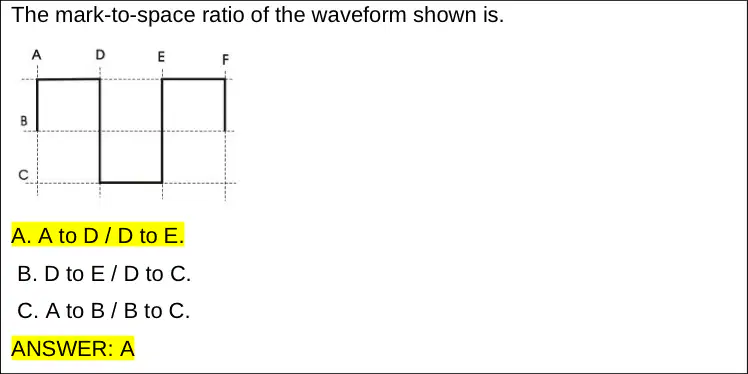
The mark-to-space ratio of the waveform shown is.
A to D / D to E
D to E / D to C
A to B / B to C
A wave form having equal amplitude and time base is a.
Rectangular
Saw tooth
Square waveform
Peak factor in a standard AC circuit is.
1.414 times max the effective value
1.11 times max value of applied voltage
0.707 time max value of applied voltage
If an AC sine wave has an RMS value of 5V its peak value is.
6.37 V
7.07 V
14.14 V
The average value of 100 volts peak AC is.
70.7 volts
141.4 volts
63.7 volts
The RMS value of 200 volts peak to peak is.
127.4 volts
70.7 volts
141.4 volts
A sine wave of RMS value 7.07 volts has a peak to peak value of.
20.0 volts
10.0 volts
0.707 volts
The value of an AC sine wave that will give an equivalent heating effect in a DC resistor is the.
Peak value
RMS value
Average value
Wavelength is.
The distance that a waveform travels during a period
Phase relationship between voltage and current
Distance of peak to peak
Most AC voltmeters will display.
effective values
instantaneous values
maximum values
What sort of wave would be used in a CR oscilloscope to control sweep?
Square
Sine wave
Saw tooth
What value is the same as the equivalent D.C. heating effect?
Peak
Average
Root Mean Square
The frequency is:
the number of cycles of alternating current per minute
the number of cycles of alternating current per second
the variation of alternating current per second
To be in phase, the two waveforms must go through their maximum and minimum points at:
The same time
The same time and the same frequency
The same time and in the same direction
.707 times the maximum value is.
Effective value
.607 Peak Value
Inverse to DC values
What is meant by saying that a current is of 400 Hz?
A current fluctuates 400 half cycles each second
A current fluctuates 400 complete cycles each second
A current fluctuates 400 cycles twice each second
How is power defined in an AC cycle?
Power is the average of all values of a cycle
Power is the average of all peak values of a cycle
Power is the average of all instantaneous values of a cycle

