
 Worksheets
AIRCRAFT STRUCTURES-1-U1
Total questions: 60
Worksheet time: 57mins
Which definition BEST fits a 'Truss'
A bridge made from beams joined into triangular members
A structure comprised of members joined at their ends by friction pins
A structure comprised of members joined at their ends by friction-free pins
A structure comprised of beams joined in triangles, spanning between 2 supports
Which source of loads are ALWAYS acting on a truss?
Dead
Live
Environmental
Extreme
When calculating 'Reactions at the Supports', which support would you choose for the initial Moment pivot?
Roller
Non-Roller

Determine the magnitude of the Reaction at the Non-Roller support
6kN
8kN
10kN
20kN

Determine the direction of the Reaction at the Pin support
Vertically Up
Up and to the Left
Up and to the Right
Vertically Down

What is the magnitude of the force in member AB?
4.9 kN
7.0 kN
8.9 kN
9.9 kN

What is the magnitude of the force in member AB?
2.75 kN
4.8 kN
6.4 kN
11 kN

When using 'Method of Sections' to determine BE, which equilibrium equation would you use?
ΣF vertical = 0
ΣF horizontal = 0
ΣM = 0
When using 'Method of Sections' to determine CE, which pivot point would you use for ΣM = 0 ?
A
B
C
D
E

What is the magnitude of the force in member BD?
(a)
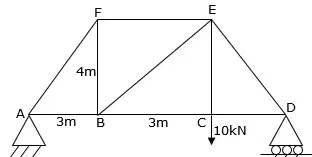
Find the forces in the members CD and the reaction forces at A and D. CD = 3m.
Force @ CD = 5kN
Force @ CD = 5.5kN
Force @ CD = 10kN
Force @ CD = 6.8kN
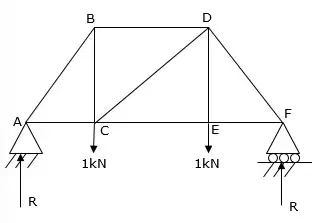
For symmetric truss with loading as shown in fig., the force in member CD is,
0 kN
2 kN
1 kN
1÷2 kN
Where have you seen truss in real life?
Mobile tower
Electricity Transmission tower
both
I have not seen yet
How many methods are there to solve a truss
3
4
5
2

What is the value of Member FC?
50 KN
-50 KN
0
30 KN
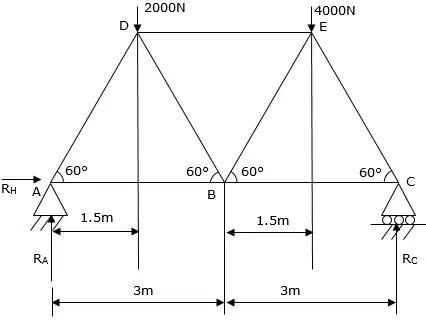
Find the axial force in DE of truss for the loading shown.
577.35N (Compressive)
577.35N (Tensile)
1732N (Compressive)
1732N (Tensile)
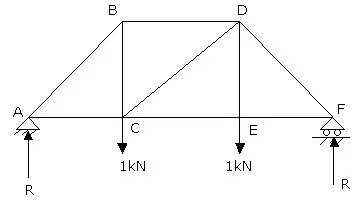
For symmetric truss with loading as shown in fig., the force in member CD is,
0 KN

1 KN

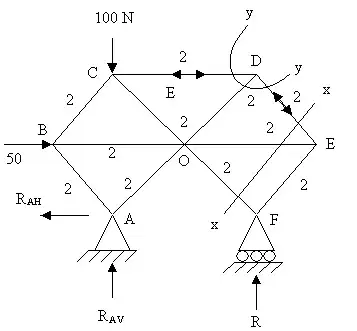
A hexagonal truss is formed of 11 bars of 2m each. It is hinged at one end & roller supported at the other end. The axial force in the member CD is,
15 N
20 N
-25 N
30 N
For symmetric truss with loading as shown in fig., the force in member CD is,
0 kN
2 kN
1 kN
1÷2 kN
Find the forces in the members CD and the reaction forces at A and D. CD = 3m.
Force @ CD = 5kN
Force @ CD = 5.5kN
Force @ CD = 10kN
Force @ CD = 6.8kN

Which of the following assumptions are made when considering a truss system? (Choose 3)
Each member has weight
No loads are applied at the joints
All members are perfectly straight
All joints are pinned & frictionless
Members can only experience tension or compression forces

A pinned support, seen on the left side in this truss bridge, has how many reactions?
1
2
3
None

A roller support moves with forces applied to the truss bridge. How many reactions does roller support have?
1
2
3
None

This bridge contains one pinned support and one roller support. How many reactions does this bridge have?
1
2
3
4
What are the three Equations of Static Equilibrium?
∑Fx=0
∑Fy=0
∑M=0
∑V=0
Which of the following methods is commonly used for analyzing trusses?
Finite Element Method
Method of Joints
Method of Sections
Both B and C
In the method of joints, which principle is primarily used to solve for unknown forces?
Conservation of Energy
Newton's Second Law
Static Equilibrium
Kinematic Equations
What is the condition for static equilibrium in a truss?
∑Fx=0 and ∑Fy=0
∑Fx=0 , ∑Fy=0 , and ∑M=0
∑M=0 only
∑Fx=0 only
In the method of sections, how many unknown forces can be solved at a time?
1
2
3
4
Which of the following is true for a zero-force member in a truss?
It carries a significant load.
It is always horizontal.
It can be removed without affecting the truss's stability.
It is always vertical.
In a truss, if a joint is in equilibrium, what can be said about the sum of the forces acting on it?
They are equal to the weight of the truss.
They are equal to the external load.
They sum to zero.
They are equal to the internal forces.
Which of the following is a common assumption in the analysis of trusses?
All loads are applied at the joints.
Loads are distributed along the members.
Members are curved.
Members are made of different materials.
What is the main advantage of using the method of sections in analyzing trusses?
To simplify the calculation of internal forces in selected members.
To determine the overall stability of the truss.
To assess the impact of temperature changes on the truss.
To evaluate the cost-effectiveness of the truss design.
What is the primary purpose of a truss in structural engineering?
To provide aesthetic appeal.
To support loads and provide stability.
To increase the height of a structure.
To reduce the cost of construction.
Which of the following is a characteristic of a simple truss?
It has more members than necessary for stability.
It is composed of triangles.
It is made of circular members.
It is always made of steel.
In truss analysis, what is the significance of a pin connection?
It allows rotation but no translation.
It allows both rotation and translation.
It restricts both rotation and translation.
It is used only in temporary structures.
What equation(s) do we use to solve a truss calculation? Select all that apply.
ΣM=0
ΣFx=0
ΣFy=0
ΣFz=0
2J=MR

Determine whether the structure show is statically determinate
Yes
No
Can't be determined

A beam is subjected to an inclined concentrated load as shown in the figure below. Neglect the weight of the beam.


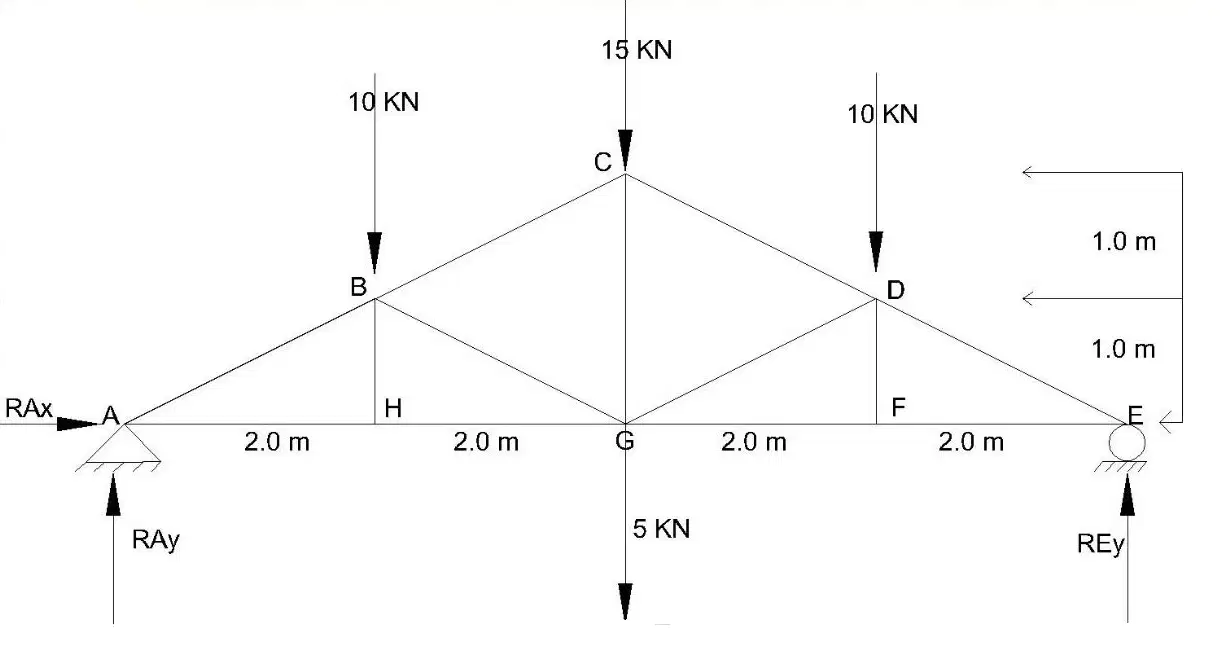
Solve for the reactions at both supports.
A: 20KN E: 20KN
A: 30KN E: 20KN
A: 20KN E: 30KN
A: 25KN E: 25KN
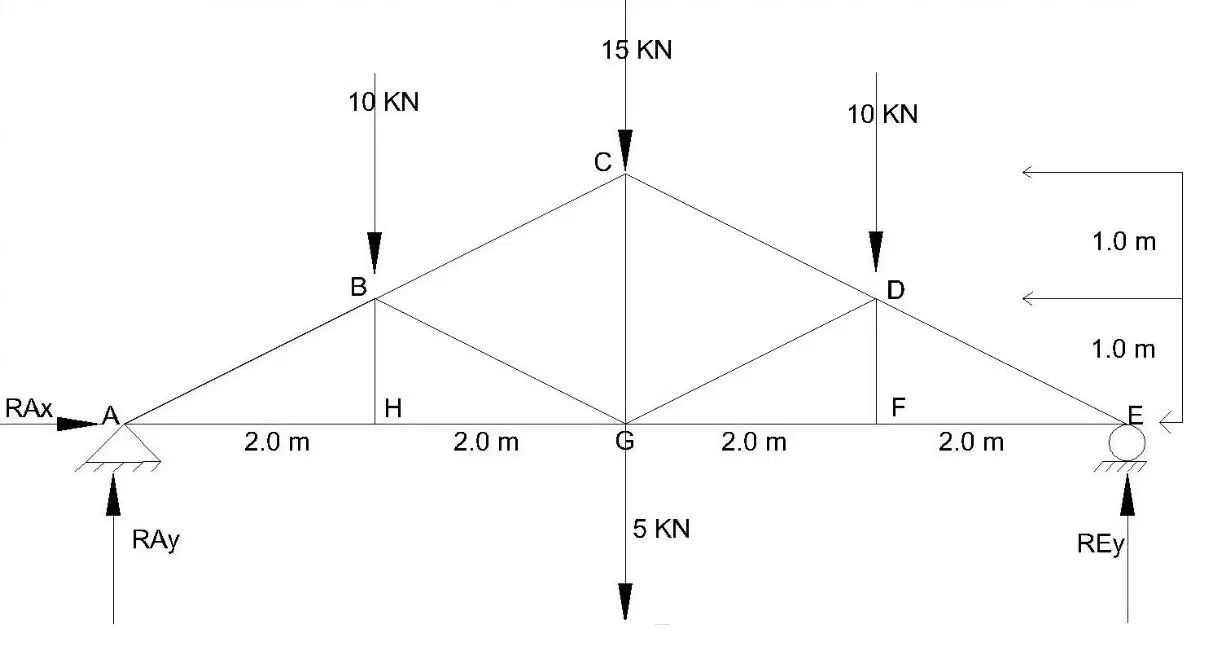
Using the given truss, solve for the force at member AH.
42 KN
40 KN
41 KN
43 KN
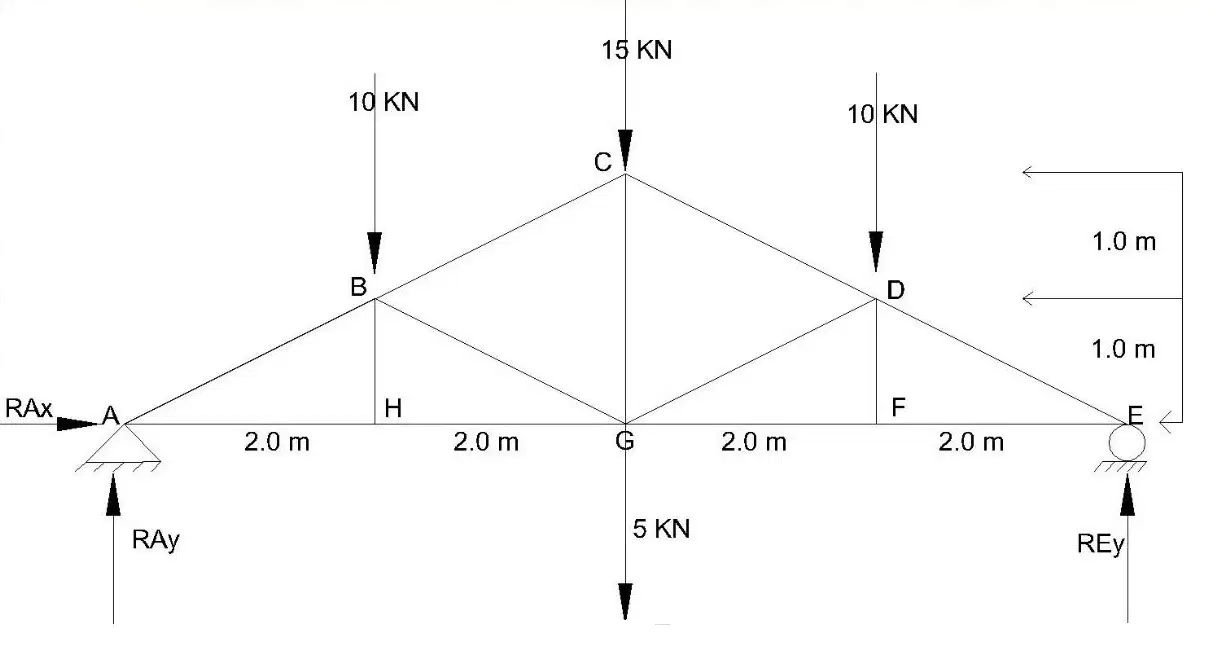
Using the given truss, solve for the force at member BC.
31.26 KN
34.67 KN
33.53 KN
34.98 KN
A member under compression is called
Strut
Tie
Beam
Shaft
A member of the truss does not sustain
tensile load
compressive load
bending load
axial load
If a member of a truss is in tension, then what will be the direction of force that it will apply to the joints?
Outward
Inward
Depends on case
No force will be there
The vertical component of a force inclined through θ° is obtained by multiplying the force by
sin θ
cos θ
tan θ
sin θ cos θ
A truss, in which the number of members is greater than 2j-3, is known as a
Perfect
Imperfect
Deficient
Redundant
A truss, in which the number of members is less than 2j-3, is known as a
Perfect
Imperfect
Deficient
Redundant
Statically indeterminate structure requires _______.
Equilibrium Conditions Only
Compatibility Conditions Only
Equilibrium and Compatibility Condition together
Cannot be solved analytically
In the method of joints, typically _________ equations of equilibrium are applied at every joint.
2
3
4
6
If a member of a truss is in compression, then what will be the direction of force that it will apply to the joints?
Outward
Inward
Depends on case
No force will be there
A member under tension is called
Strut
Tie
Beam
Shaft
If in a plane truss (m + 3) > 2j, then the truss is
stable and statically determinate
stable and statically indeterminate
unstable and statically determinate
unstable and statically indeterminate
A fixed –fixed beam is
Indeterminate structures
Determinate structures
Imperfect structures
Redundant structures
For the same magnitude of force to be carried, truss members in compression are generally made _______ as compared to members in tension.
Thicker
Thinner
The same size
Half size
A square truss is
Perfect
Imperfect
Deficient
Redundant
The horizontal component of a force inclined through θ° is obtained by multiplying the force by
sin θ
cos θ
tan θ
sin θ cos θ
In the method of sections, generally a “cut” passes through no more than _____ members in which the forces are unknown.
1
2
3
4
Which of the following is not a valid assumption in analysis of truss?
Members are subjected to axial forces only
Loads and reactions will act directly or indirectly at the members only
Member varies linearly only
All joints are smooth and frictionless hinges
Which of the following is statically determinate structure?
Fixed –fixed beam
Continuous beam
Propped cantilever beam
Double overhanging

