Wayground logo

Free Printable Worksheets

Font size

S
M
L
XL
Worksheets

P4 Electric Circuits

Total questions: 91

Worksheet time: 1hrs 17mins

Name
Class
Date
1.

a)

A

b)

B

c)

C

d)

D

2.

a)

A

b)

B

c)

C

d)

D

3.

a)

A

b)

B

c)

C

d)

D

4.

a)

A

b)

B

c)

C

d)

D

5.

a)

A

b)

B

c)

C

d)

D

6.

Cathode rays are electrons

a)

A

b)

B

c)

C

d)

D

7.
a)

A

b)

B

c)

C

d)

D

8.

a)

A

b)

B

c)

C

d)

D

9.

a)

A

b)

B

c)

C

d)

D

10.

a)

A

b)

B

c)

C

d)

D

11.
What is the unit for Current
a)
C
b)
Q
c)
I
d)
A
12.
What is the unit for Charge
a)
C
b)
Q
c)
I
d)
A
13.
What is the unit for Potential difference (Volt)
a)
Q
b)
V
c)
I
d)
A
14.
What is the unit for Energy
a)
Q
b)
V
c)
J
d)
E
15.
How much charge must pass by a point in 10 s for the current to be  0.50 A? 
a)
0,05C
b)
5,0C
c)
20C
d)
2,0C
16.

What is the Total Resistance for this circuit?

a)

200

b)

330

c)

460

d)

560

17.
What is this symbol?
a)
Thermistor
b)
Resistor
c)
Diode
d)
Cell
18.
This is the symbol for 
a)
Variable resistor
b)
Thermistor
c)
Resistor
d)
Fuse
19.
This is the symbol for 
a)
Variable Resistor
b)
Thermistor
c)
Light Dependent Resistor
d)
Resistor
20.
What is this symbol for?
a)
light dependent resistor
b)
light emitting diode
c)
thermistor
d)
variable resistor
21.
This is the symbol for a _____?
a)
Lamp
b)
Water wheel
c)
Loudspeaker
d)
Motor
22.
This is the symbol for a _____?
a)
Diode
b)
LED
c)
Microphone
d)
Loudspeaker
23.
This is the symbol for a _____?
a)
Fuse
b)
Resistor
c)
Heater
d)
Strip light
24.

What are the units for electrical resistance?

a)

ohms

b)

joules

c)

volts

d)

amps

25.

A 25 ohm resistor is connected in series with a 15 ohm resistor. What is the total resistance?

a)

10 ohms

b)

375 ohms

c)

40 ohms

d)

9.4 ohms

26.

If the length of a wire increases, the resistance ____________

a)

decreases

b)

increases

c)

stays the same

d)

unknown

27.

The current is 10 amps. The resistance is 5 ohms. What is the voltage?

a)

2 V

b)

5 V

c)

50 V

d)

10 V

28.
How much charge must pass by a point in 10 s for the current to be  0.50 A? 
a)
0,05C
b)
5,0C
c)
20C
d)
2,0C
29.
Electricity is the flow of _________.
a)
Protons
b)
Neutrons
c)
Electrons
30.
This picture is an example of what kind of circuit?
a)
Series
b)
Complete
c)
Broken
d)
Parallel
31.

How do you convert kJ to J

a)

x 1000

b)

x100

c)

x10

d)

/1000

32.

How do you convert kW to W

a)

x1000

b)

x100

c)

/1000

d)

/100

33.

How do you convert minutes to seconds

a)

x10

b)

x60

c)

x3600

d)

x100

34.

How do you convert hours to seconds

a)

x1000

b)

x60 x60

c)

x60

d)

x100

35.

How much charge passes through a light bulb if a current of 2A after 20s?

a)

40C

b)

10C

c)

40V

d)

10V

36.
A light circuit is operating at 75 Volts. What is the circuit's current if the resistance is 5 Ohms?
a)
375 Amps
b)
50 Amps
c)
15 Amps
d)
0.07 Amps
37.
As temperature of a metal filament increases, what happens to resistance?
a)
Increases
b)
Decreases
c)
Not affected
d)
Resistance sings "electric love"
38.

What component does this symbol represent?

a)

Fixed resistor

b)

Filament lamp

c)

Diode

d)

Thermistor

39.

What component does this represent

a)

Diode

b)

LED

c)

LDR

d)

Thermistor

40.

What component does this graph represent?

a)

Fixed resistor

b)

Bulb

c)

Diode

d)

Switch

41.

Describe the graph

a)

As potential difference increases, current decreases. It is directly proportional.

b)

As potential difference increases, current increases. It is not directly proportional.

c)

As potential difference decreases, current increases. It is directly proportional.

d)

As potential difference increases, current increases. It is directly proportional.

42.

What component does this symbol represent?

a)

Fixed resistor

b)

Filament lamp

c)

Diode

d)

Thermistor

43.
This is an example of a _______ circuit
a)
open
b)
series
c)
parallel
d)
square
44.
In a series circuit which of the following is the same  throughout the circuit
a)
Resistance
b)
Voltage
c)
Current
d)
None of the above
45.
Pick the correct sentence.
a)
This circuit will work because it is a closed circuit.
b)
Energy will freely flow in this circuit.
c)
This circuit will not work because there is no energy source.
d)
This circuit will not work because there is no switch.
46.
This type of circuit only has one path for current to flow. 
a)
series
b)
parallel
c)
combination
d)
split
47.
What happens when you add a second bulb to a series circuit?
a)
The first bulb gets brighter
b)
The second bulb will be as bright as the first because they both get full power
c)
The circuit will no longer work
d)
Both bulbs will be half as bright because the voltage is divided by two now
48.

If the total current in the circuit shown is 3 amperes, the current through each (identical) bulb is __________.

a)

0 A

b)

1 A

c)

3 A

d)

9 A

49.

What type of circuit is pictured?

a)

alternating

b)

overloaded

c)

parallel

d)

series

50.

What is the total resistance (RT) across this circuit?

a)

50 Ω

b)

100 Ω

c)

300 Ω

d)

450 Ω

51.
What is the total current through this circuit? 
a)
0.01 A
b)
0.02 A
c)
0.03 A
d)
0.05 A
52.

If the total current (Itotal) is measured to be 0.02 A, What is the voltage measured at R1?

a)

2 V

b)

3 V

c)

5 V

d)

9 V

53.
As resistors are added in series to a circuit, the total resistance will...
a)
increase
b)
decrease
c)
stay the same
54.
As the resistance of a circuit increases, the current will...
a)
increase
b)
decrease
c)
stay the same
55.
A circuit with 3 resistors, 10 Ohms, 30 Ohms and 20 Ohms are in series. What is the total resistance
a)
30 Ohms
b)
50 Ohms
c)
60 Ohms
d)
100 Ohms
56.
What happens to my total resistance as I add more resistors to a parallel circuit?
a)
Increases 
b)
Decreases
c)
Stays the same
d)
No one really knows
57.
Which best describes a parallel circuit?
a)
Electricity flows along one pathway.
b)
The flow of electricity comes from one source. 
c)
Electricity flows along more than one pathway. 
d)
The flow of electricity comes from more than one source. 
58.
What is one benefits of using a parallel circuit?  
a)
It gets confusing.
b)
There are no problems.
c)
If one goes down, it does not affect the others. 
d)
Porque es para llelio. 
59.
What is a Parallel circuit? 
a)
Has only one path 
b)
Has more than one path 
c)
Allows energy to travel through easily 
d)
Has only one light bulb
60.
This is an example of a ______ circuit
a)
Series
b)
Parallel
c)
Open
d)
Dihexihedral
61.
What kind of circuit is this?
a)
Series
b)
Consecutive
c)
Parallel
d)
Training
62.
What is the missing current?
a)
Both 0.25A
b)
Both 0.5A
c)
0.2A and 0.3A
d)
0.1A and 0.4A
63.
What is the missing current?
a)
Both 3.7A
b)
Both 1.85A
c)
3.0A and 0.7A
d)
1.5A and 2.2A
64.
What is the missing current?
a)
Both 4.0A
b)
Both 3.0A
c)
Both 6.0A
d)
Both 1.5A
65.
What is the missing current?
a)
Top: 1.0A
Middle: 1.0A
b)
Top: 1.0A
Middle: 2.0A
c)
Top: 4.0A
Middle: 2.0A
d)
Top: 2.0 A
Middle: 2.0A
66.
What is the missing current?
a)
Top: 2.5A
Middle: 2.5A
b)
Top: 5.0A
Middle: 2.5A
c)
Top: 5.0A
Middle: 5.0A
d)
Top: 4.0A
Middle: 2.0A
67.
What is the total resistance?
a)
19 ohms
b)
0.05 ohms
c)
2.22 ohms
d)
0.45 ohms
68.
What is the missing voltage?
a)
1.0V
b)
0.5V
c)
1.5V
d)
2.0V
69.
What is the missing voltage?
a)
2.0V
b)
1.5V
c)
1.0V
d)
0.5V
70.
What is the missing voltage?
a)
1.0V
b)
1.5V
c)
2.0V
d)
2.5V
71.
What is the missing voltage?
a)
0.1V
b)
0.3V
c)
0.5V
d)
0.7V
72.
What is the missing voltage?
a)
Middle: 1.5V
Bottom: 3.0V
b)
Middle: 3.0V
Bottom: 3.0V
c)
Middle: 0.75V
Bottom: 0.75V
d)
Middle: 1.5V
Bottom: 1.5V
73.

Assume that the voltage of the battery is 9 V and that the three resistors are identical. What is the potential difference across each resistor?

a)

12 V

b)

0 V

c)

3 V

d)

4 V

74.

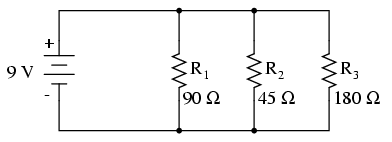
What is the current through R1?

a)

10 A

b)

5 A

c)

7 A

d)

2 A

75.

State the equation that links charge , current and time

a)

Charge = current x time

b)

charge = current / time

c)

current = charge x time

d)

current = time / charge

76.

State the equation that links change, potential difference and energy

a)

Potential difference = energy x charge

b)

charge = potential difference x change

c)

energy = potential difference / charge

d)

energy = potential difference x charge

77.

What is A?

(a)  

78.

What is B?

(a)  

79.

What is C?

(a)  

80.

What is D?

(a)  

81.

A circuit is a ( ) path for electricity.

a)

opened

b)

closed

c)

on

d)

off

82.

Which of the following are components of circuits?

a)

wires, switches

b)

switches, lamps

c)

batteries, wires, switches

d)

wires, batteries, lamps, switches

83.

Which is/are not the reason(s) of circuit break?

a)

unplugged

b)

electricity supply is broken

c)

overheat

d)

the device not working

84.

( ) is installed in homes and vehicles as circuit breaker to cause a gap to break the electricity flow.

(a)  

85.

When the circuit is opened, the light bulb glows.

a)

True

b)

False

86.

Electric current is a flow of tiny ( ) through the wire.

(a)  

87.

When the switch is off, the circuit is broken and the device will not work.

a)

True

b)

False

88.

Which of the following are components of circuits?

a)

wires, switches

b)

switches, lamps

c)

batteries, wires, switches

d)

wires, batteries, lamps, switches

89.

What is/are the reason(s) that the reading lamp is not on?

a)

The switch turns off

b)

Flat batteries

c)

Spent light bulbs

d)

none of the above

90.

( ) connections will cause breaks in circuit.

a)

Open

b)

Close

c)

Complete

d)

Incomplete

91.

Which of the following is not the component of circuit

a)

Battery

b)

Wire

c)

Energy

d)

Switch