wayground logo

Free Printable Worksheets

NEW

Font size

S
M
L
XL
Worksheets

Taxonomy and Classification Concepts

Total questions: 37

Worksheet time: 59mins
Name
Class
Date
1.
The scientific name for an organism is made from the:
a)
class and family name
b)
genus and species name
c)
domain and kingdom name
d)
kingdom and phylum name
2.
The 8 levels of classification, most broad to most specific.
a)
Domain, Genus, Family, Order, Class, Phylum, Kingdom, Species
b)
Domain, Species, Kingdom, Genus, Phylum, Family, Class, Order
c)
Domain, Kingdom, Phylum, Class, Order, Family, Genus, Species
d)
Domain, Kingdom, Species, Phylum, Family, Order, Class, Genus
3.
Who first proposed binomial nomenclature as a way of classifying organisms?
a)
Carolus Linnaeus
b)
Thomas Jefferson
c)
Charles Darwin
d)
Albert Einstein 
4.
Which Domain/Kingdom is capable of living in extreme environments like hot springs, geysers, or very salty waters?
a)
Bacteria
b)
Archaea
c)
Eukarya
5.
What is a species?
a)
A group of organisms that can mate with each other and produce fertile offspring. 
b)
A group of organisms that genetically are very different from each other. 
c)
A group of organisms that can mate, but do not produce offspring.
d)
Indivual organisms that live in the same environment. 
6.
Fungi are a type of...
a)
decomposer
b)
producer
7.
Mold, yeast, and mushrooms all belong to the Kingdom _______.
a)
Archaebacteria
b)
Fungi
c)
Eubacteria
d)
Protista
8.

The science of classification is known as ________.

a)

taxidermy

b)

taxonomy

c)

organization

d)

dichotomy

9.

In the cladogram shown, which animal clade possesses both mammary glands and a placenta?

a)

Bullfrog

b)

Kangaroo

c)

Shark

d)

Chimp

10.

In the cladogram shown, which animal clade would possess an amniotic egg?

a)

lamprey

b)

salamander

c)

tuna

d)

turtle

11.

Which taxonomic category is higher than the others?

a)

Class

b)

Genus

c)

Family

d)

Phylum

12.
Which organisms are closely related? 
a)
American badger and leopard
b)
coyote and gray wolf
c)
european otter and leopard
d)
coyote and american badger
13.

Which of the following is the proper way to write a scientific name for a tiger?

a)

Panthera Tigris

b)

Tigris Panthera

c)

Panthera tigris

d)

P. Tigris

14.

Why is Latin used for scientific naming?

a)

To confuse students

b)

To provide a common language for all scientists to understand

c)

To describe pigs

d)

To keep it alive

15.

What is another name for an internal balance that must be maintained for life to continue?

a)

Energy

b)

Metabolism

c)

Homeostasis

d)

Positive feedback

16.

What is the most broad way life could be grouped according to the classification system?

a)

Kingdom

b)

Domain

c)

Class

d)

Family

17.

___________a molecule that is present in all living cells and that contains the information that determines the traits a living thing inherits and needs to live.

a)

Cell

b)

Stimulus

c)

Homeostasis

d)

DNA

18.
When you step out into the cold, your body shivers in order to keep its temperature at 98.6F.
a)
All living things use energy
b)
All living things contain cells
c)
All living things maintain homeostasis
d)
All living things grow
19.
Green plants produce their own food through the process of photosynthesis.
a)
All living things use energy
b)
All living things contain cells
c)
All living things maintain homeostasis
d)
All living things grow
20.
A camel has eyelashes that work to keep the dust and sand out of its eyes.
a)
All living things adapt to their environment
b)
All living things grow
c)
All living things have cells
d)
All living things use energy
21.
Over three years, Tim's height has increased from 5'4" to 5'11".
a)
All living things contain cells
b)
All living things maintain homeostasis
c)
All living things use energy
d)
All living things grow
22.
The roots of a plant grow towards a source of ground water.
a)
All living things use energy
b)
All living things reproduce
c)
All living things respond to their environment
d)
All living things grow
23.

The sum of all the chemical reactions in your body?

a)

organization

b)

metabolism

c)

homeostasis

d)

evolution

24.

Living things are made up of units called

a)

DNA

b)

Cells

c)

Homeostasis

d)

Seeds

25.

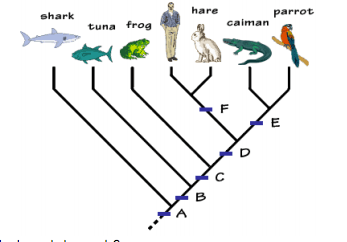
On the cladogram, which organism is the closest relative of the parrot?

a)

Frog

b)

Hare

c)

Caiman

d)

Parrot

26.

Who is most closely related to Taxidea taxus?

a)

Lutra lutra

b)

Panthera pardus

c)

Canis latrans

d)

Canis lupus

27.
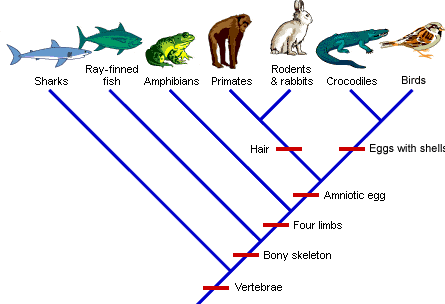
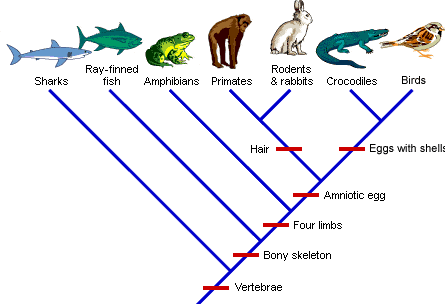
According to this cladogram, sharks are MOST closely related to which organism? 
a)
Amphibians
b)
Ray finned fish
c)
Crocodiles
d)
Birds
28.

What characteristic do all the organisms on this cladogram share?

a)

Being bi-pedal & having language

b)

Complex brains

c)

Fully binocular vision

d)

Partial binocular vision & opposable thumbs
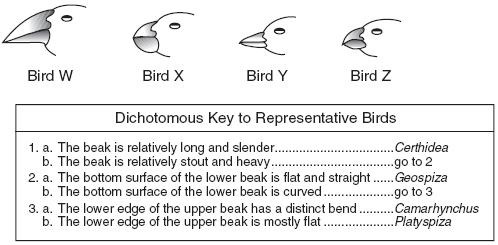
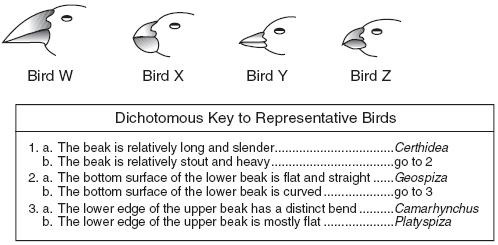
29.
What is the name of bird Z?
a)
Certhidea
b)
Geospiza
c)
Camarhynchus
d)
Platyspiza
30.
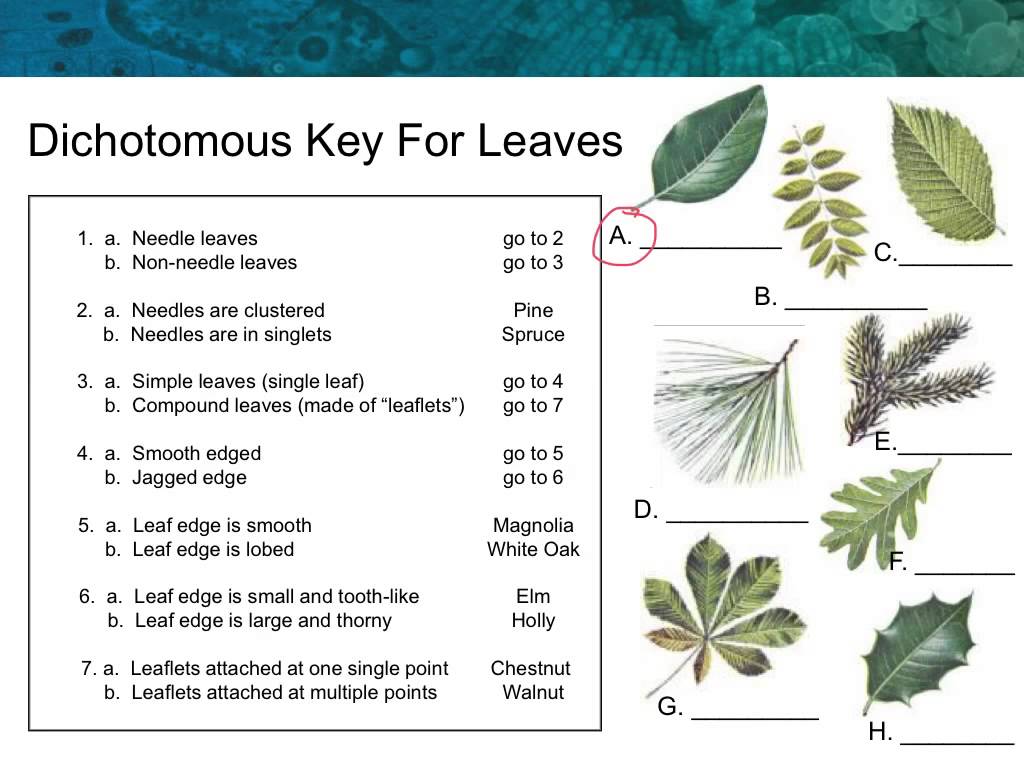
What is a dichotomous key used for in science?
a)
To organize biomes
b)
Classify organisms
c)
Identify bacteria only
d)
None of these
31.
What step do we always start with when using dichotomous keys?
a)
1
b)
2
c)
3
d)
4
32.
According to this cladogram, birds are LEAST related to: 
a)
Amphibians
b)
Sharks
c)
Ray Finned Fish
d)
Crocodiles
33.
According to the cladogram, which organism is most distantly related to the human?
a)
crayfish
b)
rat
c)
perch
d)
frog
34.
What is the name of bird W?
a)
Certhidea
b)
Geospiza
c)
Camarhynchus
d)
Platyspiza
35.
The first part of a scientific name is an organism's _______________ and the second part is its ________________.
a)
species, genus
b)
phylum, order
c)
class, spices
d)
genus, species
36.
What do protists, plants, fungi, and animals ALWAYS have in common? They are all...
a)
Multicellular
b)
Eukaryotic
c)
Prokaryotic
d)
Consumers
37.
The domain in which you would find methanogens, halophiles, and thermophiles.
a)
Bacteria
b)
Archaea
c)
Eukarya
d)
Prokarya