
 Worksheets
Seminar_X-ray Tube
Total questions: 60
Worksheet time: 30mins
Which material is commonly used for X-ray table tops to minimize beam attenuation?
Aluminum alloy composite
Radiolucent carbon graphite fiber
High-density stainless steel
Lead-embedded polymer panel
Where is the image receptor (IR) positioned when using a bucky for upright chest imaging?
Under the table bucky
On the wall vertical bucky
Inside the X-ray tube housing
Behind the grid in the cassette
Match each X-ray tube support type with its typical description.
Overhead
Ceiling-suspended rail movement
Floor to ceiling
Column anchored top and bottom
Floor mount
Base fixed to the floor
Mobile
Self-contained on wheels
Which functions can an X-ray table commonly provide? Select all that apply.
Built-in automatic tomography
Tilting capability for patient positioning
Height adjustment up and down
Stationary platform only
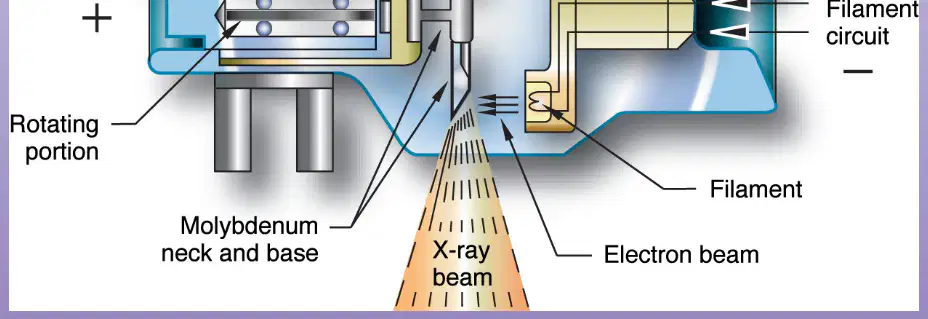
In the diagram, which component serves as the electron source through thermionic emission?
Molybdenum neck base
Cathode filament coil
Tungsten anode target
Stator electromagnets
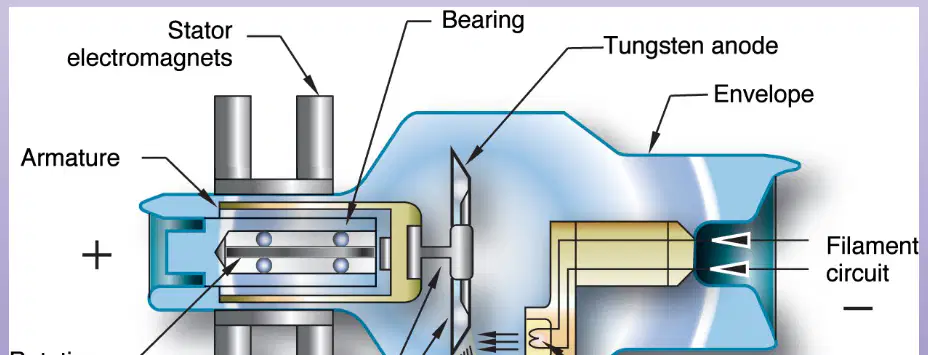
Which material is specifically indicated as the rotating anode target receiving the electron beam?
Graphite focal track
Tungsten anode target
Copper envelope body
Molybdenum rotor stem
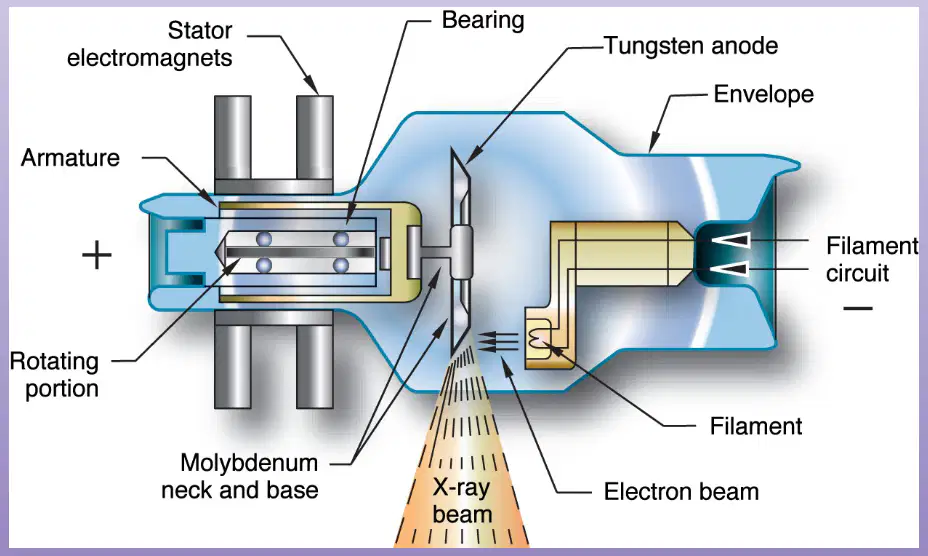
Match each X-ray tube part in the diagram to its primary function.
Filament
Electron source via heating
Tungsten anode
Target for electron deceleration
Stator electromagnets
Drives rotor for rotation
Vacuum envelope
Maintains evacuated space
Which conditions are essential for X-ray production as summarized in the slide?
External cooling fan
Vacuum in the tube
Magnetic field shielding
High-voltage potential
Source of electrons
Why is the vacuum inside an X-ray tube critical?
It amplifies X-ray wavelengths
It prevents rotor overheating
It avoids electron–gas collisions
It focuses the stator field
According to the production steps, what provides the high-voltage that accelerates electrons?
Auto-transformer alone
Filament circuit stages
Stator electromagnets
Battery pack supply
When electrons strike the anode target and stop suddenly, what two outcomes occur?
Generation of X-rays
Emission of visible light
Release of heat
Formation of vacuum
Production of neutrons
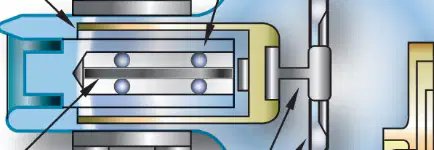
In the cutaway diagram, what part mechanically enables the anode to rotate for heat distribution?
Filament circuit
Vacuum envelope
Anode focal spot
Armature and rotor
Which component forms the negative end of an x‑ray tube and contains the filament and focusing cup?
Anode assembly with target
Cathode assembly with cup
High voltage rectifier unit
Primary transformer circuit
What is the main function of the cathode assembly during x‑ray production?
Accept low‑voltage to heat filament
Provide mechanical rotation of the anode
Measure patient exposure dose
Filter out low‑energy photons
During x‑ray generation, what accelerates electrons from the cathode toward the anode target?
High voltage between electrodes
Magnetic focusing lenses
Low‑voltage filament circuit
Cooling oil circulation
Most modern x‑ray tubes use what kind of cathode filament configuration?
Distributed focus mesh grid
Triple focus with three coils
Dual focus with two coils
Single focus with one coil
In a dual focus cathode, how are the two filaments positioned and wired?
Parallel sharing a ground wire
Perpendicular with separate grounds
Offset with independent cups
Twisted sharing high voltage
Which material commonly makes up the filament coil in diagnostic x‑ray tubes?
Pure molybdenum wire
Thoriated tungsten coil
Silver‑copper alloy
Graphite composite
Typical filament dimensions include thickness about 0.1–0.2 mm, width 1–2 mm, and length 7–15 mm. Why do these dimensions matter?
They reduce tube envelope size
They change anode rotation speed
They control radiation dose output
They determine recorded detail
What effect does a shorter filament length have on image quality?
Decreases recorded detail
No change in sharpness
Increases recorded detail
Causes random noise artifacts
Thermionic emission occurs when the filament reaches approximately what temperature?
3370 degrees Celsius
1200 degrees Celsius
1800 degrees Celsius
2200 degrees Celsius
Select all properties that make tungsten suitable for x‑ray tube filaments.
High melting point near 3370 C
Low electrical resistance at room temp
Strong magnetic permeability
Difficult to vaporize under heat
Match each filament material with its approximate melting point.
Tungsten
3370 C
Rhenium
3170 C
Molybdenum
2620 C
For a filament used in x‑ray tubes, which capability is essential to produce the electron cloud?
Boil off electrons when heated
Rotate to spread heat evenly
Reflect incident x‑ray photons
Absorb secondary radiation
Which material primarily composes the focusing cup in an x‑ray tube?
Nickel metal shell
Molybdenum ceramic
Tungsten alloy metal
Copper composite ring
What is the main purpose of the focusing cup relative to the thermionic cloud?
Heat the filament evenly
Focus electrons toward the anode
Increase tube vacuum pressure
Convert electrons into photons
Electrons are shaped into a narrow beam mainly because the focusing cup maintains what electrical condition?
Alternating mixed potential
High positive potential
Low negative potential
Neutral floating potential
Which sequence best describes how negative potential in the focusing cup affects electrons?
Stops electrons completely
Ionizes electrons instantly
Repels electrons inward
Attracts electrons outward
Match each focusing cup feature to its effect on the electron stream.
Negative charge around cup
Repels electrons toward center
Curved cup geometry
Channels electrons into narrow beam
Precise focal spot alignment
Directs beam to anode target
Housing the filament
Provides source of thermionic electrons
Which outcomes result from electron repulsion within the focusing cup? Select all that apply.
Electrons spread into a wide field
Electrons compress toward the center
Electrons form a concentrated stream
Electrons stop moving toward the anode
In some x‑ray tubes, the focusing cup is biased more negatively than the filament. What is the primary result?
Lowered focal spot sharpness
Stronger electron focusing
Reduced anode heat capacity
Higher photon energy output
Which statement best defines the space charge effect near the filament?
Positive ions attract more electrons
Built‑up electrons cap further emission
Vacuum improves electron boiling
Heat eliminates electron repulsion
Where does the focusing cup direct the compressed electron stream?
Cathode support arm
Anode target focal spot
Glass envelope wall
Oil cooling bath
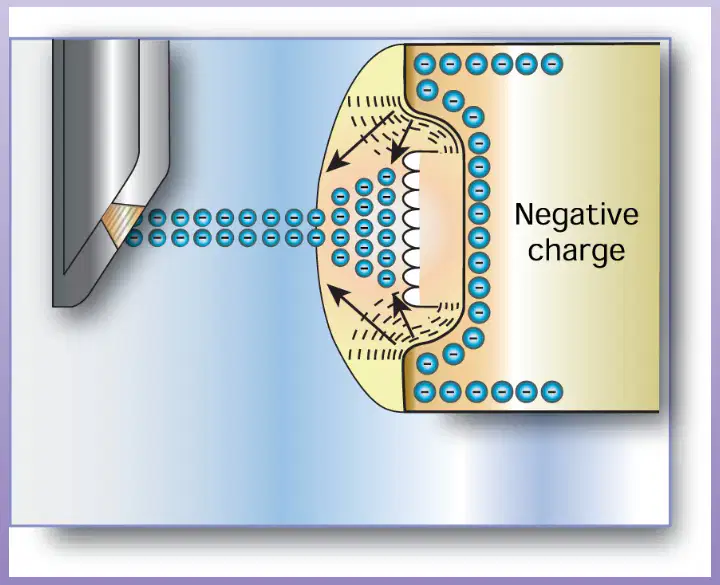
In the diagram, arrows and blue dots indicate electron motion near a negatively charged cup. What is the depicted focusing action?
Electrons oscillating randomly
Electrons halting completely
Electrons converging inward
Electrons diverging outward
Which component set makes up the anode assembly in an x‑ray tube?
Envelope, bearings, target
Cathode, grid, filament
Transformer, rectifier, timer
Anode, stator, rotor
What is a primary function of the anode during x‑ray production?
Serve as target surface
Regulate filament current
Shield external radiation
Emit thermionic electrons
Why is the anode considered the primary thermal conductor in an x‑ray tube?
It increases focal spot size
It reduces exposure time
It absorbs and dissipates heat
It minimizes leakage current
Which statement best describes the stator in a rotating anode system?
Tungsten target on focal track
Graphite disk within envelope
Internal copper bars on shaft
External electromagnets around neck
What causes the rotor to spin in a rotating anode?
Continuous DC current
Static electric charge
Direct mechanical linkage
Rotating magnetic field
Where is the rotor located and what is it made of?
Inside tube; copper bars, soft iron
Outside tube; permanent magnets
Above tube; aluminum rings
Below tube; ceramic bearings
Which pair of components interact through mutual induction to turn the anode?
Collimator and housing
Stator and rotor
Filament and grid
Transformer and rectifier
Match each part of the rotating anode system to its role.
Stator
Creates rotating magnetic field
Rotor
Spins when energized
Anode target
Receives electron beam for x‑rays
Which sequence explains continuous rotor motion in the induction motor?
Static field holds constant alignment
Stator pairs energize sequentially
Single pulse drives rotor once
Permanent magnets lock orientation
What does the induced magnetic field in the rotor do relative to the stator field?
Opposes stator orientation
Aligns with cathode grid
Amplifies stator voltage
Cancels tube current
Which statements are true about mutual induction in the x‑ray tube? Select all that apply.
Process drives rotor continuously
Induced field always reinforces source
A nearby coil has induced current
Changing current creates a magnetic field
Which function is NOT one of the anode assembly’s listed roles?
Serve as thermal conductor
Regulate filament heating
Conduct high voltage
Provide x‑ray target surface
Which material is most commonly used for the anode target surface in diagnostic x‑ray tubes?
Pure tungsten coating
Graphite composite plate
Tungsten‑rhenium alloy
Molybdenum‑only layer
What is the primary purpose of adding rhenium to tungsten in the anode target?
Spread heat and reduce cracking
Improve image receptor sensitivity
Increase electron emission rate
Lower melting point significantly
What is the atomic number of tungsten used in x‑ray tube targets?
62
52
74
82
Which property of tungsten makes it suitable for withstanding repeated x‑ray exposures?
Low density and softness
Rapid oxidation at room temperature
High thermal conductivity level
Low tensile strength overall
Match each x‑ray tube component to its description.
Envelope
Sealed chamber maintaining vacuum
Cathode
Filament and focusing cup assembly
Anode
Rotating or stationary target
Port/window
Opening where x‑rays exit
Pyrex glass is used for the tube envelope primarily because it can do what?
Store charge like a capacitor
Convert x‑rays into visible light
Maintain a vacuum and resist heat
Conduct electricity efficiently
Which list best represents items contained within the x‑ray tube assembly?
Transformers, console, bucky tray, lead apron
Filter, AEC chamber, patient table, exposure switch
Generator, collimator, grid, image plate, cassette
Envelope, cathode, anode, tube housing, port/window
Select all properties that make tungsten effective for anode targets.
Low thermal capacity
High thermal conductivity
High melting point
High atomic number
Which statement best describes the primary purpose of the lead-lined protective housing around an X‑ray tube?
Block unwanted radiation and control leakage
Reduce patient motion by stabilizing the table
Improve image sharpness through beam focusing
Provide structural support only for the tube
What is the typical regulatory limit for leakage radiation from an X‑ray tube housing, measured at 1 meter?
10 mR/hr
50 mR/hr
100 mR/hr
250 mR/hr
Which component most directly prevents high‑voltage breakdown within the X‑ray tube assembly?
Lead-lined metal casing
Water-cooling jacket on the anode
Dielectric oil surrounding the tube
Collimator shutters near the window
Select all features commonly included in the cooling system for safe X‑ray tube operation.
Copper filtration at the window
Water cooling in high-end designs
Fans to circulate air
Cooling oil around the tube
Match each protective housing function to its effect.
Lead lining
Blocks scatter and leakage radiation
Dielectric oil
Insulates high voltage and absorbs heat
Cooling fans
Circulates air to remove heat
Which outcome is directly supported by the protective housing during routine imaging?
Protects operators and equipment from radiation
Replaces the need for a collimator entirely
Calibrates detector sensitivity automatically
Increases tube current to improve exposure

