
 Worksheets
Sports 2
Total questions: 91
Worksheet time: 46mins
Which statement best distinguishes mastication from enzymatic activity during early digestion?
Enzymatic activity occurs only after food leaves the oral cavity
Mastication chemically hydrolyzes starch polymers into sugars
Mastication mechanically breaks food to increase surface area
Enzymatic activity physically mixes food without chemical change
Which sequence correctly traces the early path of ingested food before most absorption occurs?
Esophagus to mouth to stomach for absorption
Mouth to stomach to esophagus for digestion
Mouth to esophagus to stomach for churning
Stomach to esophagus to mouth for mixing
What is the primary role of saliva in the mouth during the first phase of digestion?
Neutralizes gastric acid with bicarbonate buffering
Provides moisture, lubrication, and starch-digesting enzymes
Emulsifies fats using bile-derived salts in the oral cavity
Absorbs amino acids directly into oral capillaries
How many salivary glands are present as paired units in humans?
Three paired glands for a total of six
Five paired glands across both jaws
Two paired glands located bilaterally
Four paired glands surrounding the tongue
Which set lists the three major salivary gland pairs?
Parotid, buccal, palatine
Parietal, sublingual, mandibular
Parotid, lingual, mandibular
Parotid, sublingual, submandibular
What term describes the moistened mass that forms after chewing and mixing with saliva?
Chyme produced by gastric mixing
Bolus prepared for swallowing
Chyle formed from lipid absorption
Mucus secreted by goblet cells
Which process primarily occurs in the stomach during early digestion?
Initial starch digestion by salivary glands
Extensive nutrient absorption into blood
Final elimination of undigested material
Mechanical churning and chemical digestion
Which statement about the stomach best reflects its absorptive capacity under normal physiology?
It absorbs most macronutrients efficiently
It allows some liquid absorption but minimal overall
It absorbs vitamins extensively and rapidly
It absorbs only proteins after denaturation
A patient has reduced chewing due to jaw pain. Which immediate consequence most directly impairs subsequent enzymatic digestion?
Decreased surface area for enzyme access to substrates
Complete failure of peristalsis through the esophagus
Inhibition of gastric acid secretion in the stomach
Loss of bile emulsification of dietary triglycerides
Which event most directly stimulates increased salivary flow from the major glands?
Exposure of the mucosa to hydrochloric acid
Stretch of the pyloric sphincter before emptying
The taste of food activating oral receptors
Elevated plasma glucose after a meal
During early digestion, what is the most accurate functional grouping of GI tract segments?
Mouth and esophagus for ingestion and digestion
Stomach and rectum for digestion and elimination
Large intestine and stomach for early ingestion
Small intestine and esophagus for absorption only
Which secretion is a major chemical component released by the stomach that facilitates protein digestion and defense?
Hydrochloric acid secreted into the lumen
Bile acids released from the gallbladder
Amylase delivered from the parotid
Lysozyme produced by the pancreas
Which structure primarily increases the absorptive surface area of the small intestine?
Longer intestinal length
Smooth interior walls
Circular folds alone
Thicker mucosal layer
Villi with microvilli
Where does the majority of chemical digestion occur within the small intestine?
Jejunum segment mainly
Duodenum segment mainly
Cecum segment mainly
Transverse colon mainly
Ileum segment mainly
Most nutrient absorption from the gastrointestinal tract occurs in the
Stomach chamber overall
Small intestine overall
Gallbladder lumen overall
Large intestine overall
Pancreatic ducts overall
Which pairing correctly matches a small intestine region with its predominant role?
Jejunum – primary absorption
Ileum – majority digestion
Ileum – feces formation
Jejunum – little absorption
Duodenum – absorption focus
Which statement best describes passive diffusion across enterocyte membranes?
Uses carrier proteins only
Moves against concentration gradient
Involves membrane engulfment
Requires ATP energy input
Moves down concentration gradient
Facilitated diffusion of glucose in enterocytes is characterized by
Vesicle-mediated, uses ATP
Simple bilayer passage, energy
Carrier-mediated, no energy
Carrier-mediated, uses ATP
Channel-independent, no energy
Active transport in intestinal absorption is best defined as
Movement down gradient without ATP
Membrane engulfment without ATP
Carrier-mediated movement using ATP
Random diffusion through lipid core
Paracellular solvent drag only
Endocytosis during intestinal absorption involves
Carrier flipping conformations
Tight junctions widening
Water following osmotic pull
Channel opening for ions
Cell membrane engulfing cargo
Which process most directly explains absorption of vitamin K in the large intestine?
Passive protein channels
Hepatic conjugation then export
Parietal cell acid production
Bacterial synthesis then uptake
Pancreatic enzyme secretion
What is a principal function of the large intestine?
Pepsin activation mainly
Lipid emulsification mainly
Protein denaturation mainly
Chylomicron assembly mainly
Water and mineral absorption
Which sequence correctly lists the colon segments in order from proximal to distal?
Transverse, ascending, descending
Cecum, sigmoid, hepatic
Descending, transverse, ascending
Ileum, cecum, rectum
Ascending, transverse, descending
A drug is hydrophilic and moves down its concentration gradient but cannot cross membranes without a protein. Which mechanism applies?
Passive diffusion only
Facilitated diffusion
Paracellular bulk flow
Active transport
Primary endocytosis
If villi were flattened and microvilli reduced, the most immediate physiological consequence would be
Decreased luminal digestion
Decreased absorptive capacity
Increased peristaltic speed
Increased bile secretion
Increased gastric emptying
Gas production in the large intestine primarily results from
Pancreatic amylases
Hepatic metabolism
Bacterial fermentation
Duodenal secretions
Brush border hydrolysis
Which enzyme initiates the chemical breakdown of starch during chewing in the mouth?
Amylase from saliva
Lipase from saliva
Pepsin from saliva
Trypsin from saliva
In the stomach, which process contributes most to carbohydrate digestion?
Bile-mediated emulsification
Minimal enzymatic activity
Amylase activation by acid
Pepsin hydrolysis of starch
Where does the majority of monosaccharide absorption occur in the gastrointestinal tract?
Small intestine lumen
Gastric pyloric region
Large intestine lumen
Esophageal mucosa
Which transport mechanism primarily moves fructose across the enterocyte apical membrane?
Primary active ATPase pumps
Facilitated diffusion transporters
Secondary antiport cotransport
Endocytotic vesicle trafficking
Glucose and galactose are mainly absorbed from the intestinal lumen by which mechanism?
Na+-coupled active transport
Simple passive diffusion
H+-ATPase mediated pump
Receptor-mediated endocytosis
After absorption, which statement best describes how carbohydrates are delivered to body tissues?
Transported in blood to cells
Secreted into lymphatic fluid
Packaged in chylomicrons first
Stored in bile for release
Which factor most directly promotes cellular uptake of glucose from blood after a meal?
Insulin-regulated transporters
Bile acid micelle carriers
Cortisol-induced channels
Amylase-dependent pores
Which enzyme begins lipid digestion in the mouth?
Gastric amylase action
Lingual lipase activity
Pancreatic peptidase action
Brush-border lactase action
In the small intestine, bile salts aid lipid digestion primarily by enabling which process?
Micelle formation for absorption
Protein denaturation by acid
Starch hydrolysis by amylase
Glucose polymerization reactions
The principal mechanism for fatty acid and monoglyceride entry into enterocytes is best described as:
Passive diffusion into cells
Sodium-dependent cotransport
ATP-driven lipid pumps
Clathrin-mediated endocytosis
Following intestinal absorption, most dietary lipids are transported to systemic circulation primarily via:
Erythrocyte bound carriers
Lymphatic chylomicron flow
Portal venous glucose flow
Direct gastric venous route
A patient with impaired bile secretion would most likely show decreased absorption of dietary fat because of reduced:
Pepsin-dependent proteolysis
Amylase-mediated hydrolysis
Micelle formation efficiency
Fructose facilitated transport
Which event primarily denatures dietary proteins during digestion?
Salivary lipase secretion in mouth
Pancreatic amylase action in jejunum
Bile salt emulsification in duodenum
Gastric acid exposure in stomach
Where does most absorption of amino acids into enterocytes occur?
Small intestine lumen
Esophageal epithelium
Large intestine colon
Gastric mucosa stomach
Which transport mechanism can move amino acids against their gradients into intestinal cells?
Bulk flow via capillaries
Osmosis across membranes
Simple diffusion through bilayer
Active transport via carriers
During protein digestion in the small intestine, which enzymes complete peptide breakdown?
Lipases and bile acids
Lysozymes and nucleases
Amylases and maltases
Proteases and peptidases
After absorption, amino acids travel first through which system to reach the liver?
Cerebrospinal fluid canals
Lymph via chylomicrons
Interstitial fluid diffusion
Blood via portal circulation
Which option best describes the amino acid pool?
Dietary peptides remaining undigested
Excess nitrogen excreted as urea
Stored proteins within skeletal muscles
Circulating amino acids available for synthesis
Match the cellular process with its role in protein synthesis: Which statement is correct?
Transcription makes mRNA from DNA
Translation synthesizes DNA from RNA
Transcription assembles polypeptides
Translation exports mRNA to nucleus
Which component delivers specific amino acids to the ribosome during translation?
snRNA with introns
rRNA with enhancers
mRNA with promoter
tRNA carrying anticodons
Ribosomes serve which primary function in cells?
Sites of polypeptide assembly
Organelles for fatty acid oxidation
Reservoirs for calcium storage
Vesicles for protein export only
A patient has impaired gastric acid secretion. Which digestion step is most directly reduced, and what is a likely consequence downstream?
Protein denaturation decreases, reducing protease efficiency
Carbohydrate emulsification decreases, delaying amylase action
Triglyceride hydrolysis decreases, limiting bile recycling
Nucleic acid condensation decreases, enhancing pepsin function
Which statement best distinguishes chemical energy from mechanical energy in human physiology?
Both chemical and mechanical energy store in molecules equally
Both chemical and mechanical energy strictly produce heat only
Chemical energy drives movement; mechanical energy stores in molecules
Chemical energy stores in molecules; mechanical energy drives movement
Which cellular compound is the body’s immediate energy currency used to power work?
Adenosine diphosphate
Creatine monohydrate
Adenosine triphosphate
Adenosine monophosphate
How many high‑energy phosphate bonds does ATP contain?
Zero high‑energy bonds
Two high‑energy bonds
One high‑energy bond
Three high‑energy bonds
During muscle contraction, electrical signals require what supportive factors to propagate effectively?
Adequate vitamins and minerals
Elevated body temperature
High glycogen storage
Low intracellular calcium
Which macronutrient classes provide substrates for cellular energy capture in humans?
Alcohols, ketones, lactate
Carbohydrates, fats, proteins
Nucleic acids, steroids, bile
Vitamins, minerals, water
Free fatty acids circulating in the blood primarily represent which energy source category?
Nucleotides used for ATP capture
Lipids used for ATP capture
Carbohydrates used for ATP capture
Amino acids used for ATP capture
Which organelle is directly responsible for most ATP capture from fuel oxidation?
Ribosome
Golgi apparatus
Mitochondrion
Lysosome
What structural feature increases the inner mitochondrial membrane’s capacity for ATP production?
Thick cellulose‑based wall
Large ribosome clusters externally
Attachment to the nuclear pores
Extensive folding forming cristae
Which statement correctly contrasts rough and smooth endoplasmic reticulum?
Both rough and smooth ER only package proteins
Rough ER synthesizes lipids; smooth ER bears ribosomes
Rough ER bears ribosomes; smooth ER synthesizes lipids
Both rough and smooth ER lack ribosomes entirely
Which process is primarily associated with the Golgi apparatus in eukaryotic cells?
DNA replication and RNA transcription
Oxidative phosphorylation and ATP synthesis
Proteolytic digestion of old organelles
Modification, sorting, and packaging of compounds
Lysosomes mainly function to do what within the cell?
Digest intracellular materials
Synthesize fatty acids de novo
Assemble ribosomal subunits
Generate electrical impulses
Which statement best describes cytosol in relation to cellular metabolism?
A rigid scaffold forming the cell wall structure
A vesicle that transports proteins to mitochondria
A semifluid where glycolysis and fatty acid synthesis occur
A membrane‑bound space enclosing chromosomes
Which membrane property is essential for homeostatic control at the cell boundary?
Active DNA packaging into chromatin
Passive leaking of all molecules equally
Permanent sealing against all solutes
Selective passage of substances in and out
Which three energy systems collectively support cellular ATP resynthesis during exercise?
Phosphagen, anaerobic, aerobic
Glycogen, lactic, cori
Sympathetic, parasympathetic, enteric
Photophosphorylation, fermentation, nitrogen
A mutation that removes ribosomes from rough ER would most directly impair which cellular outcome?
Protein synthesis for secretion
Lipid synthesis for membranes
ATP capture from carbohydrates
DNA repair within chromosomes
If inner mitochondrial membrane surface area decreases markedly, predict the most immediate cellular consequence under high demand.
Accelerated cytosolic glycolysis rate
Reduced ATP production capacity
Increased lysosomal digestion rate
Enhanced Golgi packaging efficiency
Which energy system provides ATP most rapidly for very brief, maximal efforts of about five to ten seconds?
Electron transport system
Aerobic oxidative system
Anaerobic glycolytic system
Phosphagen energy system
The phosphagen system primarily relies on which immediate high‑energy compound to regenerate ATP from ADP?
Creatine phosphate donating Pi
Glucose undergoing glycolysis
Fatty acids via beta‑oxidation
Amino acids after deamination
Which alternative name correctly matches the energy system: ATP‑CP or immediate energy system?
Anaerobic system
Aerobic system
Oxidative phosphorylation
Phosphagen system
During a 100‑meter sprint, which energy system contributes the most to ATP resynthesis at the start?
Anaerobic system predominates
Electron transport predominates
Phosphagen system predominates
Aerobic system predominates
Which statement best characterizes the anaerobic energy system during high‑intensity efforts lasting about 30 to 120 seconds?
Uses carbohydrates without oxygen
Uses fats with abundant oxygen
Uses proteins with slow oxygen use
Uses carbohydrates with high oxygen
Which is another correct label for the anaerobic energy system?
Beta‑oxidation energy system
Immediate ATP‑PC system
Oxidative phosphorylation system
Lactic acid or anaerobic glycolysis
Which activities best match primary anaerobic glycolytic contribution?
Marathon and ultra‑distance races
Yoga and flexibility sessions
Walking and light cycling
400‑meter dash and shuttle runs
Which substrates can the aerobic energy system utilize for ATP production?
Carbohydrates, fats, and proteins
Only carbohydrates exclusively
Only fats with no proteins
Only amino acids primarily
Which statement about the aerobic system is accurate regarding oxygen and ATP yield?
Requires oxygen and yields most ATP
Does not need oxygen and yields most
Requires no oxygen and yields least
Requires oxygen and yields least
Which term is synonymous with the aerobic energy system in exercise physiology?
Immediate ATP buffer
Lactic acid process name
Phosphate transfer system
Oxidative system terminology
Which pairing correctly matches energy system to its typical lag time before increased ATP production?
Phosphagen: none; instantaneous
Anaerobic: minutes delay
Aerobic: none; instantaneous
Phosphagen: several minutes
Which metabolic pathway set is associated with the aerobic system?
Beta‑oxidation, citric acid cycle, ETC
Glycolysis only without oxygen
Lactate formation exclusively
Creatine phosphate transfer only
Which pathway is linked specifically with the anaerobic system?
Electron transport chain steps
Deamination followed by urea
Beta‑oxidation of fatty acids
Glycolysis producing lactate
Arrange the aerobic metabolism of carbohydrates in the correct sequence of major stages.
Glycolysis → CAC → ETC
Glycolysis → ETC → CAC
ETC → glycolysis → CAC
CAC → glycolysis → ETC
Which fuel and pathway pairing is most characteristic of prolonged, lower‑intensity exercise like a marathon?
Phosphocreatine via ATP‑PC reactions
Amino acids via rapid deamination
Carbohydrates via anaerobic glycolysis
Fats via beta‑oxidation predominantly
Low carbohydrate intake during training most directly increases the risk of which outcome for muscle tissue?
Immediate lactate clearance rise
Greater phosphocreatine storage
Inhibited beta‑oxidation of fats
Protein breakdown and mass loss
Which system’s complexity is described as very high with many processes and the slowest maximal ATP rate but essentially unlimited capacity?
Aerobic oxidative system
Immediate lactate system
Anaerobic glycolytic system
Phosphagen ATP‑PC system
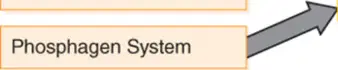
In the diagram showing a short sprint (about 10 seconds), which energy system is depicted as the primary supplier to the ATP pool?
Oxidative phosphorylation primarily supplies ATP
Anaerobic glycolysis primarily supplies ATP
Aerobic system primarily supplies ATP
Phosphagen system primarily supplies ATP

During a long sprint lasting 1–3 minutes at high intensity, which system contributes most to ATP according to the arrows feeding the ATP pool?
Phosphagen system dominates supply
Anaerobic glycolytic system dominates supply
ATP-PC system is negligible supplier
Aerobic oxidative system dominates supply

For long-duration, steady-state aerobic activity (about 30 minutes), which statement best matches the diagrammed arrow widths into the ATP pool?
Aerobic system contributes most with some anaerobic help
All three systems contribute equally throughout
Phosphagen system alone sustains most ATP demand
Anaerobic system contributes most with minimal aerobic help
According to the summary graph of percent ATP supplied versus exercise intensity and duration zones, which system rises as intensity decreases and duration increases?
All systems decrease uniformly
Aerobic system contribution increases steadily
Phosphagen system contribution increases steadily
Anaerobic glycolysis contribution increases steadily
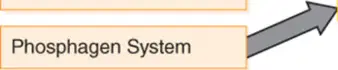
Which best explains why the phosphagen system is emphasized for a 100 m run as shown in the short burst diagram?
It provides immediate ATP through stored phosphates
It requires lactate accumulation to begin working
It relies on slow mitochondrial oxidation of fats
It uses gluconeogenesis from amino acids primarily
In the sequence of diagrams from short to long duration, how does the relative width of the anaerobic system arrow change?
Increases for 1–3 min, then decreases for longer efforts
Decreases steadily as duration increases
Remains the same across all activities
Increases steadily with longer durations
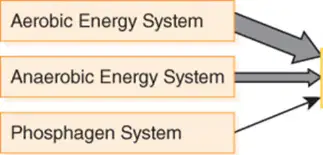
A mile run at lower intensity but still challenging is most consistent with which dominant ATP supplier in the diagrams?
Aerobic system with anaerobic support
Only stored ATP without resynthesis
Anaerobic system with aerobic suppression
Phosphagen system with minimal support
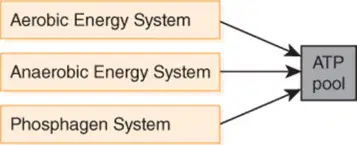
Which concept is illustrated by the arrows from all three systems feeding the ATP pool across activities of varying intensity?
Only one system ever supplies ATP at a time
Each system works only in isolation when active
All systems contribute concurrently to meet demand
Systems switch strictly at fixed time cutoffs
From the graph with four intensity regions, which system contributes the largest percentage during very short, very high-intensity efforts?
All three provide equal shares
Phosphagen system provides the largest share
Aerobic system provides the largest share
Anaerobic system provides the largest share
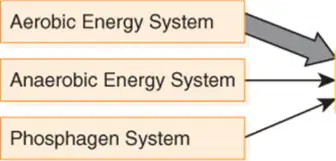
Which scenario best matches the diagram labeled 'Long Duration, Non–Steady-State Activity (4 to 6 minutes, all-out activity)'?
Gluconeogenesis exclusively fuels ATP production
Aerobic alone supplies nearly all ATP required
Phosphagen alone dominates throughout the bout
Aerobic and anaerobic both contribute with anaerobic larger

