
 Worksheets
Unit 3: Force & Motion
Total questions: 92
Worksheet time: 46mins
What is the definition of motion?
The change of position
The change of color
The change of temperature
The change of size
Which of the following is an example of motion?
Turning the page of a notebook
Sitting still in a chair
Sleeping
Thinking
What does it mean when we say "motion is relative"?
Motion is always described in relation to a reference point
Motion is always the same for everyone
Motion never changes
Motion is only possible on Earth
If you are in a car driving next to a truck at the same speed, how does the truck appear to you?
The truck wouldn't seem to move
The truck appears to move faster
The truck appears to move slower
The truck disappears
A truck is driving at 30 miles per hour down the road. If you are standing by the road, how fast does the truck appear to be moving to you?
30 miles per hour
0 miles per hour
60 miles per hour
10 miles per hour
Why does the same truck appear to move differently to a person standing by the road and a person in a car moving at the same speed as the truck?
Because motion is described relative to a reference point
Because the truck changes speed
Because the road is moving
Because the car is faster than the truck
What is the formula for speed?
speed = change in time / change in distance
speed = change in distance + change in time
speed = change in distance / change in time
speed = change in distance × change in time
In SI units, which unit is used to measure distance?
Seconds (s)
Meters (m)
Kilograms (kg)
Liters (L)
What is the SI unit for speed?
Meters per second (m/s)
Kilometers per hour (km/h)
Miles per hour (mph)
Seconds per meter (s/m)
Which of the following best describes average speed?
The speed at a certain given moment
The total distance traveled divided by the total time taken
The fastest speed reached during a journey
The slowest speed during a journey
An Olympic sprinter runs 100 meters in 10 seconds. What is her average speed?
1 m/s
5 m/s
10 m/s
100 m/s
Why don’t we feel the Earth spinning even though it rotates more than 1,000 miles per hour at the equator?
Because the air blocks the movement
Because everything around us is rotating along with Earth
Because gravity stops the movement
Because the Earth is not actually spinning
What is instantaneous speed?
The speed at the start of a journey
The speed at a certain given moment
The average speed over a journey
The speed at the end of a journey
What is the main difference between speed and velocity?
Speed includes direction, velocity does not.
Velocity includes direction, speed does not.
Speed and velocity are exactly the same.
Speed is always greater than velocity.
If you jog at 2 meters per second and then turn around and jog at 2 meters per second in the opposite direction, what happens to your velocity?
It stays the same.
It becomes zero.
It changes direction but keeps the same magnitude.
It doubles.
Which of the following best describes a situation where velocity changes but speed remains the same?
A car stops at a red light.
A runner increases their speed.
A car turns a corner at constant speed.
A cyclist slows down.
According to the material, what does a change in velocity mean?
Only a change in speed.
Only a change in direction.
A change in either direction or speed.
No change at all.
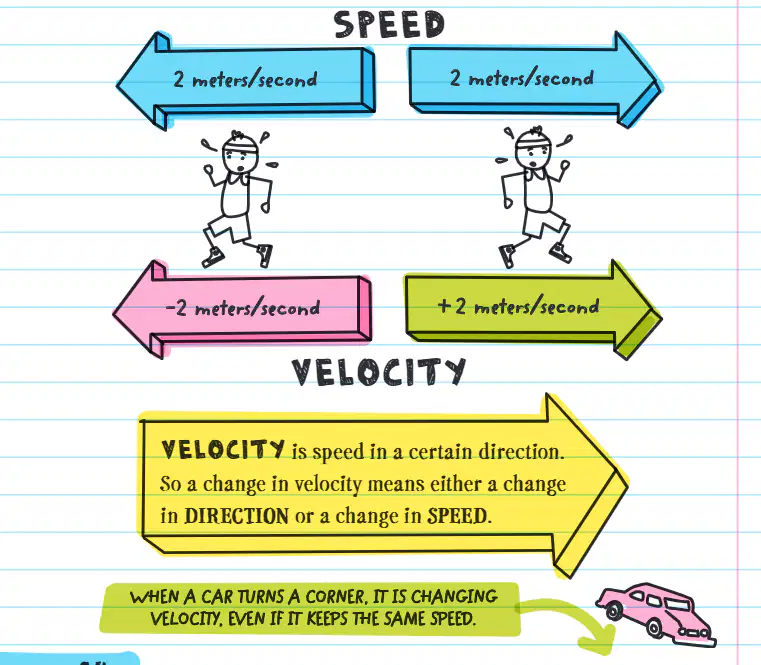
If a person jogs at +2 meters/second and then at -2 meters/second, what can be said about their speed and velocity?
Both speed and velocity are the same.
Speed is different, velocity is the same.
Speed is the same, velocity is opposite in direction.
Both speed and velocity are zero.
What is the rate at which velocity changes with time called?
Acceleration
Speed
Force
Distance
Which of the following is NOT a way an object can accelerate?
Speeding up
Slowing down
Changing direction
Staying at constant velocity
In which units is acceleration measured?
Meters per second (m/s)
Seconds (s)
Meters per second squared (m/s²)
Kilograms (kg)
Why do you feel a force pushing you toward the outside of a corner when your car goes around it, even if the speed stays the same?
Because of gravity
Because of acceleration due to change in direction
Because of friction
Because of air resistance
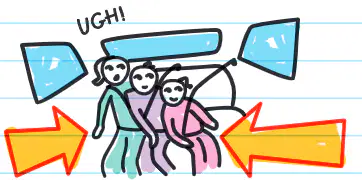
If a car changes direction but keeps the same speed, is it accelerating?
Yes, because acceleration includes changes in direction
No, because speed is constant
Yes, but only if it speeds up
No, unless it slows down
What is the formula for speed?
Speed = Distance × Time
Speed = Distance ÷ Time
Speed = Time ÷ Distance
Speed = Distance + Time
A dolphin swims 56 meters in 8 seconds and a walrus swims 30 meters in 6 seconds. Which is faster, the dolphin or the walrus?
The dolphin
The walrus
Both are equally fast
Cannot be determined
Explain why motion is relative. Give an example.
Motion is always absolute and does not depend on the observer.
Motion is relative because it depends on the observer’s point of view; for example, a person sitting in a moving train appears stationary to another passenger but moving to someone outside the train.
Motion is relative only when objects are moving at the same speed.
Motion is relative only in space, not on Earth.
What is required to know the velocity of an object?
Only the speed of the object
Only the direction of the object
Both the speed and direction of the object
The mass of the object
If you walk around a square block going at the same pace, how many times does your velocity change, and how many times does your speed change?
Velocity changes 4 times, speed changes 0 times
Velocity changes 0 times, speed changes 4 times
Velocity changes 1 time, speed changes 1 time
Velocity changes 4 times, speed changes 4 times
If a truck driver is driving at 30 kilometers per hour and she makes a U-turn, then starts driving at 30 kilometers per hour in the opposite direction, did the driver's speed or velocity change after changing direction? Why?
Speed changed, velocity stayed the same because direction does not matter
Velocity changed, speed stayed the same because velocity depends on direction
Both speed and velocity changed because both depend on direction
Neither speed nor velocity changed
If a bee is flying in a circle at a constant speed, is the bee accelerating?
Yes, because its direction is changing
No, because its speed is constant
Yes, because its speed is increasing
No, because it is moving in a circle
What are the three ways something can accelerate?
By increasing speed, decreasing speed, or changing direction
By increasing mass, decreasing mass, or changing direction
By increasing speed, increasing mass, or changing direction
By decreasing speed, decreasing mass, or changing direction
What is the formula for speed?
speed = change in distance / change in time
speed = change in time / change in distance
speed = distance × time
speed = time - distance
If a dolphin swims 56 meters in 8 seconds, what is its speed?
7 m/s
8 m/s
6 m/s
5 m/s
Which animal is faster: a dolphin swimming at 7 m/s or a walrus swimming at 5 m/s?
Dolphin
Walrus
Both are equally fast
Neither
Why don’t we see the earth rotating, according to the concept of relative motion?
Because everything around us is moving with it, including us
Because the earth is not rotating
Because the rotation is too slow
Because the sun blocks our view
What two things does velocity describe?
The speed and the direction of motion
The mass and the speed
The time and the distance
The acceleration and the force
If you walk around a block, changing direction each side, how many times does your velocity change?
Four times
Two times
Once
Not at all
Why did the driver’s velocity change but not the speed?
Because the driver changed directions
Because the driver slowed down
Because the driver stopped
Because the driver accelerated
Is a bee that is constantly changing direction accelerating? Why?
Yes, because acceleration is the change in velocity per unit of time
No, because the bee is not speeding up
Yes, because the bee is slowing down
No, because the bee is moving at a constant speed
What are three ways something can accelerate?
Speeding up, slowing down, or changing direction
Increasing mass, decreasing mass, or changing color
Moving in a straight line, stopping, or turning
Jumping, running, or walking
What is required to change the motion of an object?
Force
Energy
Temperature
Light
Which of the following best describes a force?
A push or pull
A type of energy
A form of light
A kind of sound
What are the two main characteristics of force?
Magnitude and direction
Color and shape
Temperature and mass
Volume and density
Which example best illustrates that force can change the shape of an object?
Squeezing an empty soda can until it crumples
Throwing a ball across a field
Heating water until it boils
Painting a wall
If you pedal a bike and the wheels turn, what is causing the wheels to move?
The force you exert on the pedals
The color of the bike
The air around the bike
The size of the wheels
Explain how force can cause motion without moving an object from one place to another. Use an example to support your answer.
By changing the shape of an object, such as squeezing a soda can until it crumples
By heating the object until it melts
By painting the object a different color
By making the object heavier
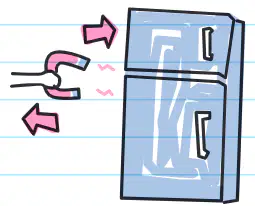
What is the term used to describe the combination of all the forces acting on an object?
Net Force
Magnetic Force
Friction
Gravity
If two forces are acting on an object in the same direction, how do you calculate the net force?
Add the forces together
Subtract the forces
Multiply the forces
Divide the forces
Who is the SI unit of force named after?
Albert Einstein
Isaac Newton
Galileo Galilei
Marie Curie
What is the SI unit for force?
Joule (J)
Watt (W)
Newton (N)
Pascal (Pa)
One newton is the force needed to accelerate an object with a mass of 1 kilogram at what rate?
1 meter per second squared
10 meters per second squared
1 meter per second
10 meters per second
If two forces are acting on an object in opposite directions, what should you do to calculate the net force?
Add the forces
Subtract the forces
Multiply the forces
Ignore the direction
Why do you need to consider direction when calculating net force?
Because force has direction, like velocity and acceleration
Because force is always positive
Because force does not affect motion
Because direction is only important for gravity
Strategic Thinking: If you are holding an apple against gravity and it requires about 1N of force, what would happen if you used less than 1N of force?
The apple would stay in place
The apple would fall down
The apple would float upward
The apple would become heavier
What is Newton's First Law of Motion?
An object in motion will remain in motion and an object at rest will remain at rest unless there is net force acting on the object.
An object in motion will always stop unless acted on by a force.
An object at rest will always start moving on its own.
An object in motion will slow down over time even without any force.
Which of the following best describes inertia?
Matter's resistance to change in motion.
The force that causes objects to move.
The speed at which an object travels.
The energy an object has due to its position.
Why does a soccer ball lying in an open field remain at rest until someone kicks it?
Because of inertia, it resists changes to its state of rest.
Because gravity pushes it down.
Because air resistance keeps it still.
Because it is too heavy to move.
What would happen if you kicked a ball in deep space, far from any stars or planets?
It would keep going in the same direction until acted on by another force.
It would stop after a short distance.
It would fall to the ground.
It would spin in circles.
Newton's First Law is sometimes called the Law of Inertia because:
It describes how objects resist changes in their motion.
It explains how gravity works.
It tells us how fast objects move.
It describes how objects gain energy.
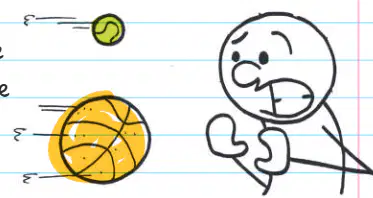
Why is it easier to stop the motion of a tennis ball compared to a basketball if both have the same velocity?
The tennis ball has less mass than the basketball.
The tennis ball is larger than the basketball.
The tennis ball moves slower than the basketball.
The tennis ball is made of rubber.
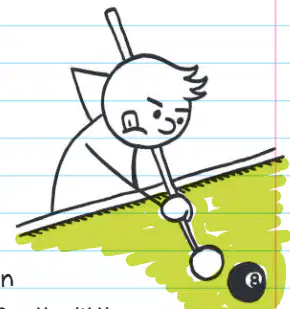
If a cue ball transfers its momentum to another ball in a game of pool, what happens to the total momentum in the system, ignoring energy lost to heat or friction?
It stays constant.
It doubles.
It is divided equally.
It becomes zero.
A student wants to predict the velocity of objects after a collision. Which scientific law should they use?
Law of Conservation of Momentum
Law of Gravity
Law of Thermodynamics
Law of Reflection
According to Newton's Second Law of Motion, what is the relationship between the net force, mass, and acceleration of an object?
Acceleration is equal to the net force divided by the mass.
Acceleration is equal to the mass divided by the net force.
Net force is equal to acceleration divided by mass.
Mass is equal to net force times acceleration.
If you apply the same amount of force to a shopping cart and a car, which one will accelerate more and why?
The shopping cart, because it has less mass.
The car, because it has more mass.
Both will accelerate equally.
Neither will accelerate.
What is the formula to calculate net force using mass and acceleration?
Net force = mass × acceleration
Net force = acceleration ÷ mass
Net force = mass ÷ acceleration
Net force = mass + acceleration
What does Newton's Second Law of Motion state?
The acceleration of an object is equal to the net force on an object divided by the mass of the object.
Every action has an equal and opposite reaction.
Objects at rest stay at rest unless acted upon by a force.
The force of gravity is the same for all objects.
If the mass of an object increases but the net force applied remains the same, what happens to the acceleration?
The acceleration decreases.
The acceleration increases.
The acceleration stays the same.
The acceleration becomes zero.
When the net force is in the same direction as the velocity, what happens to the object?
The object will slow down.
The object will stop.
The object will speed up.
The object will change direction.
If the net force is in the opposite direction to the velocity, what will happen to the object?
The object will speed up.
The object will slow down.
The object will remain at rest.
The object will move in a circle.
When you are coasting on a bike with the wind at your back, what happens to your motion?
You decelerate.
You accelerate forward.
You stop moving.
You move in the opposite direction.
Why is acceleration related to force?
Because force causes motion and velocity is motion.
Because force is always balanced.
Because acceleration is not affected by force.
Because velocity is always constant.
When you are coasting on a bike against the wind, what does the net force do?
Pushes in the same direction as velocity, so you speed up.
Pushes in the opposite direction, so you slow down.
Has no effect on your motion.
Makes you move in circles.
A student is riding a bike and the net force is balanced. What will happen to the student's motion?
The student will speed up.
The student will slow down.
The student will continue moving at a constant speed.
The student will stop immediately.
Which statement best describes an unbalanced force?
It has a net force in one direction.
It cancels out all acting forces.
It always results in no movement.
It is weaker than balanced forces.
What happens when forces are balanced?
The forces cancel each other out, so there is no acting force.
The object moves in the direction of the stronger force.
The net force increases.
The object accelerates rapidly.
What is Newton’s Third Law of Motion?
For every action, there is an equal but opposite reaction.
Objects in motion stay in motion unless acted upon by a force.
Force equals mass times acceleration.
Energy cannot be created or destroyed.
If you throw a bowling ball forward, what happens to your body according to Newton’s Third Law?
Your body is pushed backward with equal force.
Your body remains stationary.
Your body is pushed forward with greater force.
Your body is unaffected by the action.
What are coupled forces also called?
Action-reaction pairs
Balanced forces
Frictional forces
Gravitational pairs
According to Newton's third law, what happens when you exert a force on the ground while running?
The ground exerts an equal but opposite force on you
The ground absorbs all the force
You move backward
You stop moving
Why doesn't the Earth move noticeably when you exert a force on it while running?
Because Earth's mass is much greater than ours
Because Earth's surface is too hard
Because gravity holds Earth in place
Because air resistance stops it
Which of Newton's laws explains why the same force causes us to accelerate but barely affects the Earth?
Newton's second law
Newton's first law
Newton's law of gravitation
Newton's law of inertia
According to Newton's second law, what is the relationship between the acceleration of an object, the net force, and the mass of the object?
Acceleration equals net force divided by mass
Acceleration equals mass divided by net force
Acceleration equals net force times mass
Acceleration equals mass minus net force
A person jumps on a trampoline and is sent upward. Which statement best explains this using Newton's third law?
The trampoline exerts an equal but opposite force on the person
The trampoline absorbs all the force
The person floats due to gravity
The trampoline pulls the person down
Describe the difference between a balanced and an unbalanced force.
A balanced force does not change the motion of an object, while an unbalanced force causes a change in motion.
A balanced force always moves objects, while an unbalanced force keeps them still.
A balanced force only acts on liquids, while an unbalanced force acts on solids.
A balanced force is stronger than an unbalanced force.
You and your brother are playing tug-of-war. You pull with a force of 15 N, and your brother pulls with a force of 10 N. What is the net force?
5 N
25 N
10 N
15 N
What is Newton's first law of motion?
An object at rest stays at rest and an object in motion stays in motion unless acted upon by an unbalanced force.
Force equals mass times acceleration.
For every action, there is an equal and opposite reaction.
Energy cannot be created or destroyed.
If a 2,000-kilogram car accelerates at a speed of 3 meters per second, what is the force the engine applied to the car?
6,000 N
2,000 N
3,000 N
5,000 N
What is Newton's second law of motion?
Force equals mass times acceleration.
An object at rest stays at rest.
For every action, there is an equal and opposite reaction.
Energy is conserved in a closed system.
What is the unit of a force, and what is 1 unit equivalent to?
The unit is Newton (N), and 1 N is equivalent to 1 kg·m/s².
The unit is Joule (J), and 1 J is equivalent to 1 kg·m/s².
The unit is Watt (W), and 1 W is equivalent to 1 kg·m/s².
The unit is Pascal (Pa), and 1 Pa is equivalent to 1 kg·m/s².
What is Newton's third law of motion?
For every action, there is an equal and opposite reaction.
Force equals mass times acceleration.
An object at rest stays at rest.
Energy cannot be created or destroyed.
Explain why when you jump up in the air, you move but the ground doesn't move much?
Because the ground has much more mass than you, so it doesn't accelerate as much when you push off.
Because the ground is glued to your feet.
Because gravity only acts on you, not the ground.
Because air resistance keeps the ground in place.
What happens when forces are balanced?
There is no acting net force.
There is a net force in one direction.
The object will always move.
The forces add together.

