
NEW
Font size
 Worksheets
The Logic of Non-Rejection & The Courtroom Analogy
Total questions: 10
Worksheet time: 5mins

Which statement best explains why statisticians say “fail to reject H0” rather than “accept H0”?
Evidence supports certainty about H0 being true
Statistics deals in proof and final conclusions
P-values directly confirm the null hypothesis
Evidence may be insufficient to discard H0

According to the asymmetry of risk diagram, which statement best explains why “accepting H0” carries unknown risk?
Confidence equals one minus the test power
Power is one minus the Type I error rate
α is fixed by chosen significance level
β depends on true effect size unknown
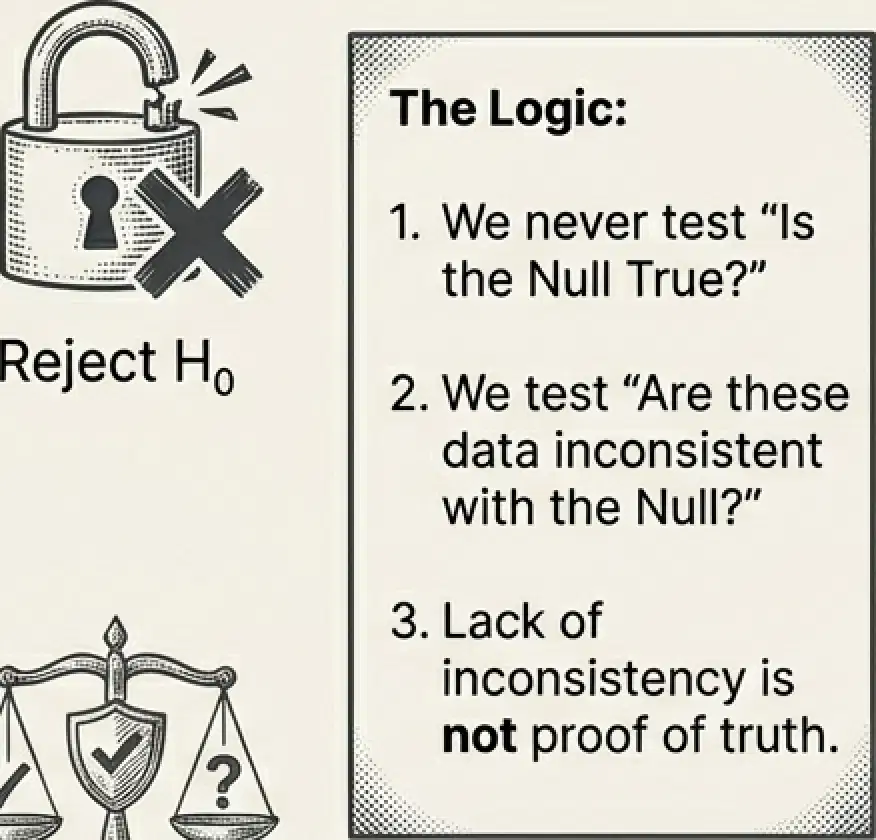
According to the Neyman–Pearson framework, what decision is made when the observed data are inconsistent with the null hypothesis?
Reject H0 as inconsistent with data
Accept H0 as confirmed true
Compute a larger sample size first
Conclude evidence proves the null true
Which statement best captures fallibilism in scientific inquiry?
Empirical claims are provisional and revisable
Knowledge is certain and permanently accepted
Truth is established by repeated confirmations
Acceptance follows when hypotheses pass tests
According to Karl Popper’s logic of discovery, what follows when a hypothesis survives a severe test?
It is retained only tentatively
It is confirmed beyond falsification
It is verified as finally true
It is accepted without reservation
According to Best and Kahn, what does failure to reject the null indicate?
Type II error must have been eliminated
Type I error has certainly occurred
The null is confirmed as universally true
Insufficient evidence rather than truth of null

What does the statistical mechanics layer explicitly control in hypothesis testing?
Type I error alpha specifically
Type II error beta precisely
Both errors exactly simultaneously
Sampling bias through design
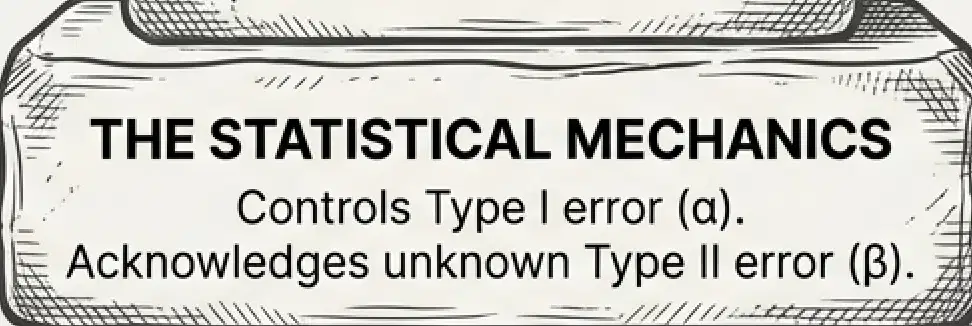
In the architecture, how is Type II error (β) characterized?
Calculated exactly for every test
Defined as always equal to α
Ignored because α control suffices
Acknowledged as unknown in practice
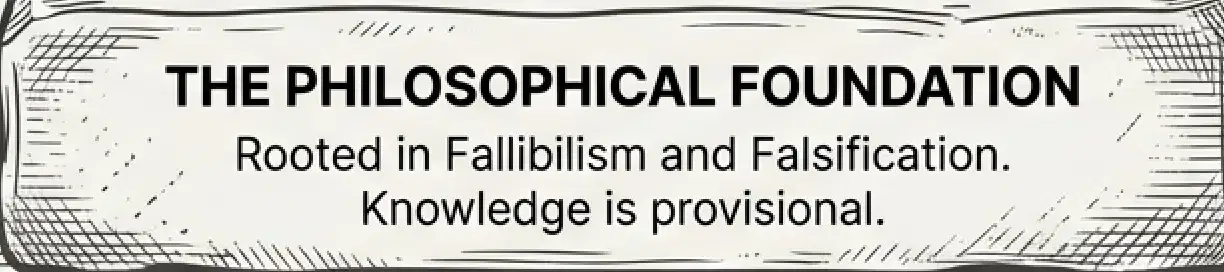
Which philosophical ideas form the foundation of the architecture of uncertainty?
Fallibilism and falsification together
Induction and verificationism only
Relativism and determinism combined
Dogmatism and essentialism solely
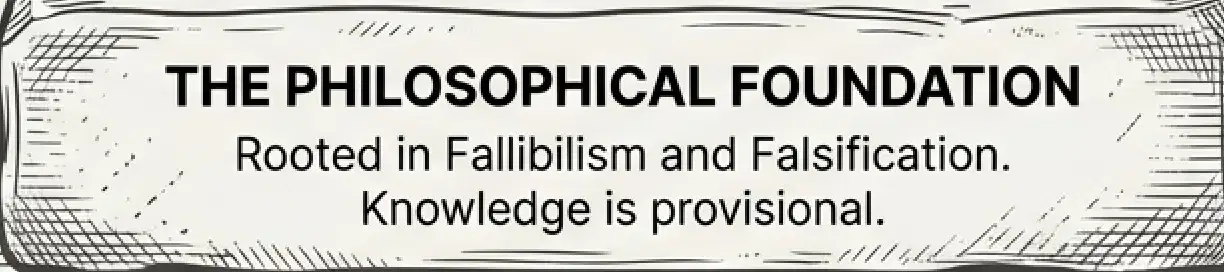
What overarching stance on knowledge does the foundation assert?
Knowledge is fixed and final truth
Knowledge is provisional and revisable
Knowledge is guaranteed by p values
Knowledge is purely subjective belief

