


Polygon Angle Sum Theorem Quizzes
Test your understanding of the Polygon Angle Sum Theorem with this interactive mathematics quiz designed for self-paced assessment. Practice calculating interior and exterior angles of polygons while receiving instant feedback to strengthen your geometry skills.

17 questions
Polygons and Angles Quiz

Quiz
•
8th Grade

20 questions
Triangle Interior Sum
Quiz
•
8th Grade
20 questions
Polygon Sum Theory
Quiz
•
8th Grade

19 questions
Interior and Exterior Angle Theorems
Quiz
•
8th Grade

50 questions
Math 8 End of Year Review: Transformations, Angles & Polygons
Quiz
•
8th Grade

30 questions
6B Sum of Interior Angles of Polygons
Quiz
•
7th - 10th Grade
17 questions
Lesson 2: Area of Triangles and other Polygons
Quiz
•
6th Grade
20 questions
Polygons and Angles of Polygons
Quiz
•
5th Grade
Explore Polygon Angle Sum Theorem Quizzes
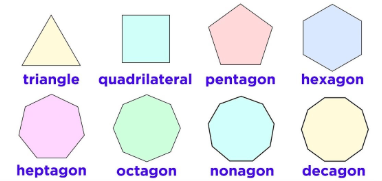
The Polygon Angle Sum Theorem forms a cornerstone of geometric understanding, establishing that the sum of interior angles in any polygon equals (n-2) × 180°, where n represents the number of sides. Wayground's comprehensive quiz collection provides students with targeted assessment opportunities to master this fundamental theorem through structured practice questions that progressively build understanding. These quizzes develop critical mathematical reasoning skills by challenging students to apply the theorem across various polygon types, from triangles and quadrilaterals to complex multi-sided figures, while providing immediate feedback to reinforce correct problem-solving approaches and identify areas requiring additional focus. Wayground supports mathematics educators with millions of teacher-created quiz resources specifically designed around polygon angle relationships and geometric theorems. The platform's robust search and filtering capabilities enable teachers to locate assessments perfectly aligned with curriculum standards and student ability levels, while customization tools allow for seamless differentiation to meet diverse learning needs. These digital-first quiz formats facilitate flexible delivery options for both classroom instruction and remote learning environments, empowering teachers to efficiently plan lessons, identify students requiring remediation, provide enrichment opportunities for advanced learners, and systematically reinforce geometric concepts through repeated practice and skill assessment.
FAQs
How do I teach the Polygon Angle Sum Theorem?
A powerful way to introduce the theorem is by showing that any polygon can be divided into triangles from a single vertex. For a polygon with 'n' sides, you can draw 'n-2' triangles. Since the sum of angles in a triangle is 180°, the total sum for the polygon is (n-2) × 180°. This visual approach helps students derive the formula themselves rather than just memorizing it.
What types of problems help students practice the Polygon Angle Sum Theorem?
Effective practice moves from simple to complex. Start with calculating the total interior angle sum for various polygons (e.g., pentagon, octagon). Then, have students find the measure of a single interior angle in a regular polygon. Finally, present problems with irregular polygons where students must find a missing angle given the others.
What are common student mistakes when applying the Polygon Angle Sum Theorem?
Students often make three types of errors: 1) miscounting the number of sides ('n'), especially in complex diagrams; 2) confusing the formula for the sum of interior angles with the formula for a single angle in a regular polygon; and 3) simple arithmetic mistakes when solving for a missing angle.
How can I use this Polygon Angle Sum Theorem quiz with my class?
You can assign this quiz in multiple ways to fit your classroom needs. Host it as a digital quiz on Wayground for immediate feedback, or download it as a printable PDF for hands-on, offline practice. Every quiz includes a complete answer key, and you can grade paper submissions quickly using the Wayground for Teachers mobile app.
How does this topic fit into the middle school math curriculum?
The Polygon Angle Sum Theorem is a key concept in middle school geometry, aligned with the Common Core's focus on geometric reasoning. It builds on students' prior knowledge of triangle properties (sum of angles is 180°) and serves as a foundation for more advanced topics like transformations and the properties of specific quadrilaterals.
How can I differentiate this quiz for diverse learners?
For students needing support, use Wayground's features to reduce the number of answer choices on digital assignments or use a dyslexia-friendly font on printable versions. For a challenge, ask advanced students to work with problems where angle measures are given as algebraic expressions (e.g., 2x + 10) and they must first solve for 'x'.

Accessibility
Features
Wayground Super
School & District
Wayground for Business
Create a quiz
Create a presentation
Wayground AI
Subjects
Mathematics
Social Studies
Science
Physics
Chemistry
Biology
About
Our Story
Wayground Blog
Media Kit
Careers
Support
F.A.Q.
Help & Support
Privacy Policy
Terms of Service
Teacher Resources
2026 Wayground


Get our app

