Search Header Logo
Net Force, Inertia, and Friction

Net Force, Inertia, and Friction

Assessment

Presentation

Science

10th Grade

Medium

NGSS
MS-PS2-2, HS-PS2-1

Standards-aligned

Created by

James Klein

Used 181+ times

FREE Resource

9 Slides • 12 Questions

1

Net Force, Inertia, and Friction
Slide image

2

What is net force?

  • Yesterday we talked about how forces could be balanced or unbalanced

  • There can be multiple forces acting on an object

  • Some forces 'cancel out'

  • Net force is the sum (add or subtract) of forces on an object

3

Multiple Choice

The total sum of forces acting on an object.
1
net force
2
potential energy
3
rest
4
trial

4

Multiple Choice

SI unit of force
1
kilogram, kg
2
m/s/s
3
kelvin, K
4
newton, N

5

Finding net force

  • Imagine two siblings pushing on each side of a door

  • One person is trying to open it, and the other to keep it closed

  • But the big sibling, being in high school, is stronger than the other

  • The older kid pushes closed with a force of 60N, while the younger kid pushes open with a force of 40N

  • Because the forces are going in opposite directions, they cancel-ish.

  • Opposite forces subtract: 60N-40N= 20 N

  • The door was pushed closed with a net force of 20 N.

6

Net force

The kid inside pushed with 60N, while the kid outside pushed with 40N. The net force is found by subtracting these opposite forces, 60N-40N=20N toward closing.

Slide image

7

Net force

  • In the top image, the two people push the car from the same direction. When forces are in the same direction, the add up. 100N force + 150N force= 250N in the forward direction.

  • In the image below, the forces face opposite each other. However, the blue (forward) force is stronger than the red (backward) force. So subtract the smaller to find the net force. 150N forward - 100N backward = Net force of 50 N in the forward direction.

Slide image

8

Multiple Choice

Question image
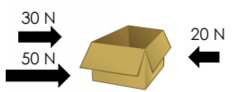
Calculate the Net Force. 
1
60N, Left 
2
40N, Right 
3
0N
4
60N, Right

9

Multiple Choice

Question image
What is the net force?
1
20 N 
2
0 N 
3
400 N 
4
40 N 

10

Multiple Choice

Question image

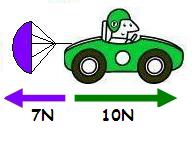
What is the net force?

1

17N Left

2

3 N, right

3

10N Right

4

3N Left

11

What is inertia?

  • Inertia is the tendency of objects to resist acceleration (acceleration is a change in motion, as in speeding up or slowing down).

  • The amount of inertia an object has depends on its mass.

  • Just like with gravity, more mass means more inertia.

  • Because of inertia, objects at rest (not moving) tend to remain not moving, and objects that are moving tend to keep moving, unless acted on by a force.

  • On earth there is usually forces acting against motion (friction)

12

Multiple Choice

What kind(s) of objects have inertia?
1
all objects with mass
2
only objects at rest
3
only objects in motion
4
only objects whose motion is being changed

13

Multiple Choice

Because of inertia, a resting object will remain at ________.
1
rest
2
a constant speed
3
school
4
inertia 

14

Multiple Choice

Because of inertia, a moving object will keep ________ unless acted on by an unbalanced force.

1

at rest

2

moving

3

in one spot

4

inertia

15

Multiple Choice

Objects with greater _________ also have greater inertia.
1
speed
2
mass
3
temperature
4
friction

16

Multiple Choice

The tendency of an object to resist a change in motion is...
1
inertia
2
kinetic energy
3
vector
4
net force

17

Multiple Choice

Unbalanced forces result in ____
1
motion
2
constant velocity
3
acceleration
4
inertia

18

Multiple Choice

Motion on earth is always opposed by this force

1

Gravity

2

Inertia

3

Friction

4

Net Force

19

What is friction?

  • Friction is a force that resists motion

  • There are a four kinds of friction (static, sliding, rolling, and fluid)

  • These are pretty simple when explained:

  • We will do that on the next slide


20

Four kinds of friction

  • Static: The resistance to movement when an object is just sitting there and it kind of sticks to the surface it is on.

  • Sliding: How objects slow down over time when you slide them over a surface, because it somewhat connects to that surface.

  • Rolling: when you roll a ball or tire it connects to little grooves in the surface which slows it down (but it slows it down a lot less than the other kinds of friction- that's why we use wheels a lot on transportation to go places fast and far away)

  • Fluid: This is the friction of air resistance or water resistance, how the air or water molecules stick to things and slow them down

21

Inertia vs Friction

  • Inertia resists acceleration (change in motion)

  • Friction resists motion


Net Force, Inertia, and Friction

Slide image

Show answer

Auto Play

Slide 1 / 21

SLIDE