Search Header Logo
  1. Resource Library
  2. Science
  3. Chemistry
  4. Law Of Conservation Of Mass
  5. Law Of Conservation Of Mass
Law of Conservation of Mass

Law of Conservation of Mass

Assessment

Presentation

Science

6th - 9th Grade

Practice Problem

Medium

NGSS
MS-PS1-4, MS-PS1-5, MS-PS1-2

+4

Standards-aligned

Created by

Jennifer LaSanta

Used 133+ times

FREE Resource

5 Slides • 22 Questions

1

Law of Conservation of Mass

Slide image

2

Multiple Choice

Which state of matter do the particles slip and slide past each other?

1

solid

2

liquid

3

gas

3

Multiple Choice

Question image

What state of matter is represented in the picture above?

1

solid

2

liquid

3

gas

4

Multiple Choice

Question image

What state of matter is represented in this picture?

1

solid

2

liquid

3

gas

5

Multiple Choice

Heating a solid to a high temperature will usually result in this phase change.

1

Condensation

2

Melting

3

Sublimation

4

Evaporation

6

Multiple Choice

This state of matter expands to fill its container.

1

Solid

2

Liquid

3

Gas

4

Plasma

7

Multiple Choice

When an object has the ability to be stretched into a thin wire this is

1

Density

2

Ductility

3

Dirtability

4

Dissovility

8

Multiple Choice

The ability to hammered into a thin sheet or be bent is

1

Ductility

2

Solubility

3

Density

4

Malleability

9

Multiple Choice

which one is the definition of chemical property?
1
a property or characteristic of a substance that is observed during a reaction where the chemical composition of a substance is changed
2
any change that results in the formation of new chemical substances
3
combustibility

10

Multiple Choice

Physical properties are
1
properties that can be observed without changing the identity of the substance
2
properties that describe how a substance changes into a completely different substance

11

Multiple Choice

Flammability (burns): Chemical or Physical Property
1
Chemical Property
2
Physical Property

12

Multiple Choice

Solubility (dissolves): Chemical or Physical Property
1
Chemical Property
2
Physical Property

13

Slide image

14

Slide image

15

Slide image

16

Slide image

17

Multiple Choice

Matter can not be created nor destroyed: it can only be

1

Destroyed a little bit

2

Invisible

3

Transformed, changed

4

None of the above

18

Multiple Choice

If reaction starts with 20g of reactants it should produce

1

a total of 40g of products

2

a total of 10g of products

3

a total of 80 g of products

4

a total of 20g of products

19

Multiple Choice

What is a closed system?

1

a system where none of the reactants or products are allowed to escape

2

compounds made of thousands of repeating smaller molecules

3

the output, or result of a chemical reaction

4

occurs when the atoms and molecules of two or more substances rearrange to form new substances

20

Multiple Choice

Question image

Open systems like the oven allows energy to enter and leave

1

True

2

False

21

Multiple Choice

Question image

A boiling pot of water on a stove is what type of system

1

Closed System

2

Open System

22

Multiple Choice

Mr. Brady did an experiment. He started with 15 grams of mass. At the end, he had 13 grams of mass. What happened?

1

His experiment was in an open system, so some mass escaped.

2

His experiment was in a closed system so the mass did not change.

23

Multiple Choice

Mr. Brady did an experiment. The mass he started with was 15 grams. How much mass should he end with?

1

less than 15 grams

2

more than 15 grams

3

15 grams

24

Multiple Choice

What is the Law of Conservation of mass?

1

Mass is created in a chemical reaction

2

Mass is created in a physical change

3

New chemicals formed from a chemical reaction have a larger overall mass than the original reactants

4

Mass is never created or destroyed

25

Multiple Choice

Why do some substances float on water?
1
they are warmer than water
2
they are cooler than water
3
they are more dense than water
4
they are less dense than water

26

Multiple Choice

Frank has an eraser. It has a mass of 4g, and a volume of 2cm3. What is its density?
1
8 g/cm3
2
2 g/cm3
3
1/2 g/cm3
4
24 g/cm3

27

Multiple Choice

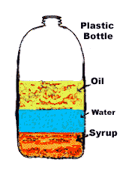
Question image
Which liquid is the least dense?
1
oil
2
water
3
syrup 
4
plastic bottle

Law of Conservation of Mass

Slide image

Show answer

Auto Play

Slide 1 / 27

SLIDE