Search Header Logo
Conceptual Science Chemistry Review

Conceptual Science Chemistry Review

Assessment

Presentation

Science

9th - 12th Grade

Medium

NGSS
MS-PS1-1, HS-PS1-1, MS-PS1-5

Standards-aligned

Created by

Rhianna Hastings

Used 6+ times

FREE Resource

7 Slides • 24 Questions

1

Conceptual Science Chemistry Review
Slide image

2

Slide image

3

Multiple Choice

Question image

Which subatomic particle is counted to determine the type of element the atom represents?

1

proton

2

neutron

3

electron

4

boron

4

Multiple Choice

Question image

The nucleus of an atom contains which subatomic particles?

1

protons and electrons

2

protons and neutrons

3

electrons and neutrons

4

protons, electrons, and neutrons

5

Slide image

6

Multiple Choice

Question image

How many protons are in Cadmium?

1

112.411

2

170

3

64

4

48

7

Multiple Choice

Which element has 6 protons?

1

N

2

C

3

O

4

B

8

Multiple Choice

The atomic mass is equal to _.

1

the number of protons only

2

the number of neutrons only

3

the total number of protons and neutrons

4

the number of protons, neutrons, and electrons.

9

Multiple Choice

How many neutrons in C-14?

1

6

2

7

3

14

4

8

10

Multiple Choice

How many neutrons does an atom of the isotope Neon-22 have?

1

12

2

10

3

22

4

20

11

Slide image

12

Multiple Choice

Question image
Lithium is located in Group 1 of the Periodic Table, which element has similar characteristics of Lithium?
1
Cesium (Cs)
2
Beryllium (Be)
3
Neon (Ne)
4
Magnesium (Mg)

13

Slide image

14

Multiple Choice

Question image
This could be the dot diagram of
1
Mg
2
Cl
3
C
4
O

15

Multiple Choice

How would you draw a Lewis dot diagram for Magnesium?

1
2
3
4

16

Multiple Choice

How many dots would you put around carbon, a group 14 element?

1

4

2

6

3

8

4

18

17

Slide image

18

Multiple Choice

Question image
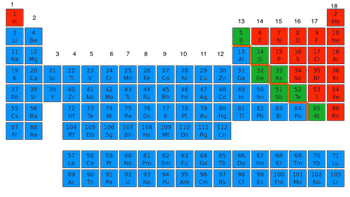
Where are metals located on the periodic table?
1
Blue
2
Green
3
Red

19

Multiple Choice

Question image
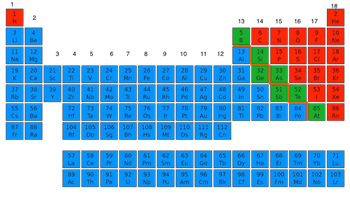
Where are the nonmetals located on the periodic table? 
1
Blue
2
Red
3
Green

20

Multiple Choice

Phosphorus

1

Metal

2

Non-metal

21

Multiple Choice

Potassium
1
Metal
2
Non-metal

22

Multiple Choice

Fluorine
1
Metal
2
Non-metal

23

Multiple Choice

Sodium
1
Metal
2
Non-metal

24

Slide image

25

Multiple Choice

Ions are: 
1
atoms with a positive or negative charge
2
atoms with no charge
3
atoms with ONLY a positive charge
4
atoms with ONLY a negative charge

26

Multiple Choice

An atom that has gained or lost electrons is called ...

1

a winner

2

an isotope

3

an ion

4

a loser

27

Multiple Choice

How are ionic bonds formed?
1
Transfer of electrons
2
Sharing of electrons

28

Multiple Choice

How are covalent bonds formed?
1
Sharing of electrons
2
Transfer of electrons

29

Multiple Choice

Covalent bonds are between...
1
Metal and Non-metal
2
Non-metal and Non-metal
3
Metal and Metal

30

Multiple Choice

Ionic bonds are between...
1
Metal and Non-metal
2
Non-metal and Non-metal
3
Metal and Metal

31

Multiple Choice

Which of the following is an ionic bond?
1
H3N
2
CaCl2
3
NO2
4
SCl

Conceptual Science Chemistry Review

Slide image

Show answer

Auto Play

Slide 1 / 31

SLIDE