Search Header Logo
STAAR Review Day 4

STAAR Review Day 4

Assessment

Presentation

Biology

9th Grade

Medium

NGSS
HS-LS4-1, HS-LS4-5, HS-LS4-2

+6

Standards-aligned

Created by

AMAIRENI BENJUME SANCHEZ

Used 14+ times

FREE Resource

14 Slides • 14 Questions

1

STAAR Review Day 4
Slide image

2

Slide image

3

Slide image

4

Slide image

5

Multiple Choice

Question image

7B The diagram shows data on the evolution of horses.


The data in the diagram is evidence that —

1

a new species of horse suddenly appeared

2

horses slowly developed over time

3

horses have similar stages of rapid embryological development

4

horses have a common ancestry with other hooved animals

6

Multiple Choice

7B: Niles Eldredge and Stephen Jay Gould researched the lenses of the eyes of fossil trilobites of different species. In 1972 they published a paper in which they described the tendency of a species to remain the same until a sudden change in the environment causes a new related to appear. Which hypothesis was most challenged by the work of Eldredge and Gould?

1

Redi's hypothesis that spontaneous generation does not occur

2

Haeckel's hypothesis that embryological development mimics the evolution of species

3

Wallave's hypothesis that geography affects the distribution of species

4

Darwin's hypothesis that the development of species is a slow, gradual process

7

Slide image

8

Multiple Choice

7A: Bactrian camels, dromedaries, llamas, and alpacas are all members of the same taxonomic family, Camelidae. Members of this family all have two toes, no hooves, true canine teeth, and a split upper lip. The family Camelidae originated in North America. The physical features of animals in this family and the family's geographical origin provide evidence that all these animals:

1

Live in the same type of ecosystem

2

Have slowly evolved to become herbivores

3

Have a common ancestor

4

Exchanged DNA at some point in the past

9

Multiple Choice

Question image

7A: The image shows part of the humerus bone in different genera of primates. Which statement is best supported by the observable structures of the different humerus bones?

1

The primates live in similar environments

2

The primates shared a common ancestor

3

The primates interbreed with similar organisms in a population

4

The primates had diets that consisted of similar types of foods

10

Slide image

11

Slide image

12

Multiple Choice

Question image

7A: Cetaceans are whales and their relatives. The diagram shows some fossils of cetaceans. Which statement provides the best evidence that Ambulocetus natans is an ancestor of Basilosaurus isis?

1

Homologous structures occur in each fossil

2

Similar nitrogenous bases are found in the DNA of each fossil

3

The fossils were found in different locations

4

The youngest fossil is larger than the older fossils

13

Slide image

14

Multiple Choice

Question image

7A: Researchers studying populations of lizards from the genus Gallotia on the Canary Islands compared the protein cytochrome B in different populations. The table shows the number of differences in the cytochrome B protein between different populations. Which conclusion about the relatedness of the lizards do the data support?

1

G. atlantica and G. stehlini are the least closely related

2

G. simonyi and G. bravoana are the most closely related

3

G. galloti eisentrauti and G. galloti palmae are the most closely related

4

G. galloti eisentrauti and G. galloti galloti are the least closely related

15

Slide image

16

Multiple Choice

Question image

7A Scientists can determine relatedness among organisms by comparing partial amino acid sequences. The table shows four partial amino acid sequences from four organisms.


Which organism is the LEAST related to the other three organisms?

1

Organism 1

2

Organism 2

3

Organism 3

4

Organism 4

17

Slide image

18

Multiple Choice

Question image

7C The quiver tree grows in desert areas in southern Africa. In recent decades average temperatures have been rising in southern Africa. Scientists predict that this warming trend will continue. Quiver trees in the hottest parts of their range near the equator are dying, but quiver trees at high elevations or in parts of the range that are farther from the equator are growing and reproducing.


Which of these best explains what is happening to the quiver tree population in southern Africa?

1

Individual quiver trees are unable to adjust to the rising temperatures, and only those in cooler parts of the range will survive.

2

The quiver tree species is unable to survive rising temperatures throughout its range. The species is likely to undergo rapid extinction.

3

Individual quiver trees can quickly adapt to rising temperatures. Individual trees will change their method of seed dispersal in cooler parts of the range.

4

The quiver tree species will survive by producing offspring suited for warmer temperatures.

19

Multiple Choice

Question image

7C: The diagram shows light- and dark-colored beetles that live on a tree. Which result is most likely to occur to the beetle population due to predation over time?

1

The number of light-colored beetles in the population will increase

2

There will be more dark-colored beetles than light-colored beetles

3

The number of light-colored beetles will decrease

4

The dark-colored beetles will move to a different type of tree

20

Slide image

21

Slide image

22

Multiple Choice

7F Lord Howe Island is a volcanic island in the Tasman Sea that is about 11 km long and 2.8 km wide. The island has two species of palm trees, Howea forsteriana and the more abundant Howea belmoreana. The two species do not interbreed even when they grow very close to each other. Which evolutionary process fails to occur?

1

Genetic drift of Howea forsteriana

2

Natural selection of adaptive traits in both species

3

Gene flow between the two species

4

Mutations in Howea belmoreana

23

Multiple Choice

7F Two populations of mice living in the same forest are separated by a large water-filled ditch. After a rainstorm, flooding brings several mice from one population to the other population. When the mice from the first population reproduce with members of the second population, which of the following will likely occur?

1

All the offspring will die as a result of reproductive mutations

2

The offspring will be forced to leave the second population.

3

The offspring will be genetically identical to their parent from the first population.

4

The offspring in the second population will have greater genetic variety

24

Slide image

25

Multiple Choice

7D Scientists estimate that there are more than 20,000 species of ants. The species range in size from 1 mm long to 38 mm long and live in most environments. The diets of ants range from flowers and seeds to fluids from their own larvae. Ants have been able to successfully inhabit so many different environments because their populations have been able to —

1

hybridize with other species of insects

2

adapt to a variety of habitats and food sources

3

fill niches usually occupied by mammals

4

occupy habitats that have no other life-forms

26

Multiple Choice

7D White-tailed deer are seasonal breeders. Female white-tailed deer begin their reproductive cycle in the fall. Rising testosterone levels in male white-tailed deer cause them to start their breeding season around the same time. Offspring are born the following spring and summer.


What is the most likely explanation for white-tailed deer having a seasonal breeding cycle instead of a monthly breeding cycle like many domesticated animals?

1

Male and female deer come into contact with each other only in the fall.

2

Large predators are not found in deer habitats during the spring and summer months.

3

Giving birth only in the spring and summer ensures that offspring are born when food is most available.

4

Deer give birth in the spring and summer in order to avoid being pregnant during the hot summer months.

27

Slide image

28

Multiple Choice

Question image

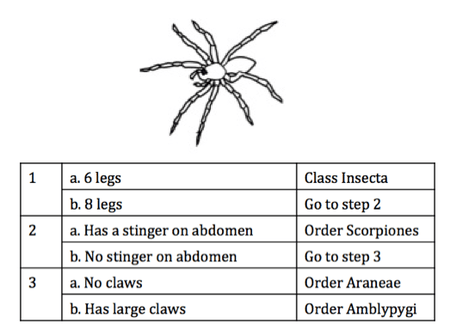
An illustration and a dichotomous key are given. What is the correct classification for this organism?

1

Class Insecta

2

Order Amblygygi

3

Order Araneae

4

Order Scorpiones

STAAR Review Day 4

Slide image

Show answer

Auto Play

Slide 1 / 28

SLIDE