

Keplers Law and Barycenters

Presentation
•
Science
•
9th - 11th Grade
•
Medium
+6
Standards-aligned

Alexander SERaleighHS
Used 12+ times
FREE Resource
9 Slides • 26 Questions
1
by Mr. Bienkowski
2
3
Johannes Kepler, working with data painstakingly collected by Tycho Brahe (from 1576-1601) without the aid of a telescope, developed three laws which described the motion of the planets across the sky.

4
Kepler’s First Law
Law of Orbits: All planets move in elliptical orbits, with the sun at 1 focus.
An ellipse is an oval shape centered on 2 points instead of 1 point.
The orbital period of a planet is how long it takes for it to travel a complete orbit around the Sun… a year!

5
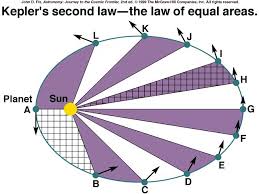
Law of Areas: A line that connects a planet to the Sun sweeps out equal (=) areas in equal (=) times.
Earth sweeps out a longer path when it is closer to the Sun.
Earth moves fastest when it is closest to the Sun

6
Law of Periods: The square of the orbital period of any planet is proportional to the cube of the semi major axis of its orbit.
P² = a³ If you know the distance of a planet to the Sun, you would be able to figure out its… orbital period. Basically… The closer a planet is to the Sun, the shorter its orbital period is. (planet closer to Sun takes less time to orbit.)

7

8
One more thing....
Barycenter
•A planet, such as Earth, actually orbits…
–a point between it and the Sun called the center of mass
–This center of mass is called the barycenter.

9
A Barycenter is ...
• the point between 2 objects where they balance each other.
•It is the center mass where two or more celestial bodies orbit each other.
•The Sun, although the center of the solar system, is not stationary, it moves as other planet’s gravity “tug” on it. But it never strays too far from the solar system’s barycenter.


10
Multiple Choice
11
Multiple Choice
12
Multiple Choice
13
Multiple Choice
14
Multiple Choice
What does Kepler's 1st Law state?
all planets move in elliptical shaped orbits around the sun
all ellipses have one foci
the area that a planet revolves around the sun is equal
the speed that a planet revolves around the sun changes
15
Multiple Choice
16
Multiple Choice

17
Multiple Choice
Which of the following is SMALLEST
Solar System
Galaxy
Universe
18
Multiple Choice
What unit is used to measure distances in space?
Light year
Kilometer
Miles
Solar unit
19
Multiple Choice
20
Multiple Choice
The splitting of an atom into smaller parts.
Astronomical Unit
Nuclear Fusion
Foci
Nuclear Fission
21
Multiple Choice
The combining of several small nuclei into one large nucleus with the subsequent release of huge amounts of energy.
Astronomical Unit
Nuclear Fusion
Foci
Nuclear Fission
22
Multiple Choice
Is the center of mass of two or more bodies that orbit one another and is the point about which the bodies orbit.
Nutation
Precession
Barycenter
Nuclear Fission
23
Multiple Choice
The Earth's orbital motion around the sun. Takes 365 days.
Nutation
Rotation
Barycenter
Revolution
24
Multiple Choice
A tide just after the new or full moon when there is the greatest difference between high and low water.
Neap
Rotation
Spring
Revolution
25
Multiple Choice

_______are daily changes in ocean water.
Waters
Tides
Colors
Earths
26
Multiple Choice
The tidal force exerted by the ______ is stronger that the tidal force exerted by the _______.
earth, ocean
sun, moon
moon, stars
moon, sun
27
Multiple Choice
28
Multiple Choice

29
Multiple Choice
30
Multiple Choice
Which of the following is LARGEST
Solar System
Star
Planet
Moon
31
Multiple Choice
32
Multiple Choice
33
Multiple Choice
34
Multiple Choice
35
Multiple Choice

by Mr. Bienkowski
Show answer
Auto Play
Slide 1 / 35
SLIDE
Similar Resources on Wayground

27 questions
Scientific Method and Intro to Physical Science
Presentation
•
9th - 11th Grade
28 questions
Healthcare Exploration
Presentation
•
9th - 10th Grade
29 questions
INFINITIVES AND INFINITIVE PHRASES
Presentation
•
9th - 11th Grade
29 questions
Levels of Organization
Presentation
•
10th - 11th Grade
30 questions
Eukaryotic Cell Structure
Presentation
•
9th - 12th Grade
30 questions
Evidence of Evolution
Presentation
•
9th - 12th Grade
27 questions
Groundwater
Presentation
•
9th - 10th Grade
28 questions
Cells Theory, Microscopes, and Types of Cells
Presentation
•
10th Grade
Popular Resources on Wayground
10 questions
Safety Day 2026 – Student Review

Quiz
•
9th Grade
21 questions
Continents and Oceans
Quiz
•
6th Grade
20 questions
Parts of Speech
Quiz
•
5th Grade
16 questions
Subject & Predicate
Quiz
•
5th Grade
25 questions
Multiplication Facts
Quiz
•
5th Grade
12 questions
Map Skills
Quiz
•
3rd Grade
22 questions
Continents and Oceans
Quiz
•
5th Grade
15 questions
Rounding Decimals
Quiz
•
5th Grade
Discover more resources for Science
10 questions
Exploring Chemical and Physical Changes

Interactive video
•
6th - 10th Grade
20 questions
Atomic Structure
Quiz
•
9th Grade
10 questions
Exploring the Electromagnetic Spectrum for Middle School Science
Interactive video
•
6th - 10th Grade
10 questions
Exploring Force and Motion Concepts
Interactive video
•
6th - 10th Grade
10 questions
Exploring Air Masses and Weather Fronts
Interactive video
•
6th - 10th Grade
14 questions
Periodic Trends
Interactive video
•
11th Grade
10 questions
Exploring the States of Matter
Interactive video
•
6th - 10th Grade
10 questions
Exploring Forces: Net Force, Normal Force, Gravity, and Friction
Interactive video
•
6th - 10th Grade