

Ozone

Presentation
•
Science, Chemistry, Biology
•
9th Grade - University
•
Hard

Pradhyumnan R.
Used 2+ times
FREE Resource
17 Slides • 16 Questions
1
by Quantum Supercomputing
2

3
Ozone (O3) is a triatomic molecule consisting of three oxygen atoms, which is generated by sunlight-driven reactions involving the oxides of nitrogen and volatile organic compounds.
4

5
In the lower troposphere, photochemical reactions of air pollutants (hydrocarbons and nitrogen oxides) produce ozone as well as other atmospheric oxidants such as hydrogen peroxide (H2O2), organic peroxides, and peroxyacyl nitrates that result in what is called photochemical smog. Ozone and other oxidants promote oxidation of sulfur dioxide (SO2) and nitrogen oxides into sulfuric and nitric acids, respectively, bringing about the occurrence of acid rain. In addition, ozone has strong absorption bands in the infrared region near 9.6 μm, and hence is one of the so-called greenhouse gases. Monitoring of ozone concentration is thus indispensable for protection of both the local and global environment.

6
Ozone can aggravate asthma and increase susceptibility to respiratory diseases such as pneumonia and bronchitis. The TCLo is 50 ppm. Pulmonary symptoms at low levels (60–200 ppm) include substernal pain, cough, dry throat, wheezing, and dyspnea. The American Conference of Governmental Industrial Hygienists (ACGIH) lists ozone as A4 (not classifiable as a human carcinogen).
7
Ozone produces cell injury and connective tissue alterations in the lungs.
The biochemical findings (e.g., increased lung content of DNA, protein, and collagen) were consistent with extensive breakdown and remodeling of the lung parenchyma and its associated vasculature. Histopathologic evaluation showed severe fibrosis, alveolar collapse, honeycombing, macrophage and mast cell accumulation, vascular smooth muscle hypertrophy, and other indications of severe progressive interstitial pulmonary fibrosis and end-stage lung disease. This animal model of progressive pulmonary fibrosis was judged to resemble the final stages of human idiopathic pulmonary fibrosis.
8
Multiple Choice
Good ozone is found in the
a) troposphere
b) stratosphere
c) mesosphere
d) both a and b
9
Multiple Choice
Photochemical smog is a
a) primary pollutant
b) secondary pollutant
c) poisonous gas
d) both b and c
10
Multiple Choice
Primary pollutants combine with ____________ to produce photochemical smog.
sunlight
O2
O3
CO
11
Ozone plays important roles in atmospheric chemistry and physics. Up to 5×10¹² molecules cm−3 or 4–5 ppmv (10−6 mixing ratio by volume) of ozone is found in the stratosphere where the solar radiation intensity of shorter wavelengths is high. Ozone in the stratosphere has made it possible for animals to live on land by preventing harmful 200–300 nm UV radiation from reaching the Earth's surface.
The absorption of UV radiation by ozone, however, heats the air, disturbing air convection and creating a layered structure in the stratosphere.

12
Ozone at the higher levels of the atmosphere is a product of UV radiation acting on oxygen (O2) molecules. The higher energy UV radiations split apart some molecular oxygen (O2) into free oxygen (O) atoms. These atoms then combine with the molecular oxygen to form ozone as shown-
O2-UV→ O+O
O+O2 → O3 (Ozone)
13
The gradual thinning of the earth’s ozone layer in the upper atmosphere due to the release of chemical compounds containing gaseous bromine or chlorine from industries or other human activities.
Ozone layer depletion is the deterioration of the upper atmosphere's ozone layer. This occurs when chlorine and bromine atoms in the atmosphere react with ozone, destroying the ozone molecules. One chlorine atom may destroy 100,000 ozone molecules, destroying faster than its formation.
The main causes of ozone depletion or formation of ozone hole are manufactured chemicals, especially halocarbon refrigerants, solvents, propellants, and foam-blowing agents (chlorofluorocarbons (CFCs), HCFCs, halons), referred to as ozone-depleting substances (ODS). These compounds release chlorine and bromine on exposure to high ultraviolet light, which then contributes to ozone layer depletion.

14
Natural Causes
Certain natural factors, such as sunspots and stratospheric winds, have been discovered to degrade the ozone layer. However, it only accounts for 1-2 percent of ozone layer loss. Volcanic eruptions are also contributing to the ozone layer's depletion.
Chlorofluorocarbons
CFCs, or chlorofluorocarbons, are the primary cause of ozone layer loss. Solvents, spray aerosols, refrigerators, air conditioners, and other appliances emit these. The UV radiations break down chlorofluorocarbon molecules in the stratosphere, releasing chlorine atoms. These atoms react with and destroy ozone.
Nitrogenous Compounds
Nitrogenous Compounds are compounds that contain nitrogen. Nitrogenous chemicals such as NO2, NO, and N2O are major contributors to ozone depletion.
15
Rocket Launches
According to studies, unregulated rocket launches deplete the ozone layer far more than CFCs do. If not regulated, this might lead to a significant depletion of the ozone layer by the year 2050.
Ozone Layer Depletion Reaction
When CFCs are discharged into the atmosphere, they interact with other Unregulated atmospheric gases and eventually reach the stratosphere. Strong UV radiations in the stratosphere degrade them, generating chlorine-free radicals.
CF2Cl2 → Cl + CF2Cl
When chlorine is discharged, it can react with ozone (O3) to produce chlorine monoxide (ClO) and oxygen (O2).
Cl + O3 = ClO + O2
When a molecule of chlorine monoxide (ClO) collides with another molecule of oxygen (O), it splits, releasing chlorine (Cl), which can “demolish” another molecule of ozone (O3), resulting in the catalytic cycle of chlorine.
ClO + O = Cl + O2
16
Ozone-Depleting Substances | Sources | |
Chlorofluorocarbons (CFCs) | Refrigerators, air-conditioners, solvents, dry-cleaning agents, etc. | |
Halons | Fire-extinguishers | |
Carbon tetrachloride | Fire extinguishers, solvents | |
Methyl chloroform | Adhesives, aerosols | |
Hydrofluorocarbons | Solvent cleaning, fire extinguishers, solvent cleaning |
17
Effects on Human Health
Because of the ozone layer depletion, humanity will be directly exposed to the sun's dangerous UV radiations. This might lead to major health problems in people, such as skin illnesses, cancer, sunburns, cataracts, premature aging, and a weakened immune system.
Effects on the Environment
Plants may experience reduced growth, blooming, and photosynthesis as a result of strong UV light. The woodlands must also withstand the negative impacts of UV light.
Effects on Marine Life
Exposure to damaging UV radiation has a significant impact on planktons. These are at the top of the aquatic food chain. If the planktons are eliminated, the species in the lower food chain suffer as well.
Effects on Animals
Animals acquire skin and eye cancer as a result of direct exposure to UV radiation.
18
Multiple Choice
The thinning of the ozone layer is also known as the
ozone hole
ozone gap
ozone space
ozone void
19
Multiple Choice
Ozone is formed in the
troposhere
stratosphere
mesosphere
thermosphere
20
Multiple Choice
SUnburn occurs when your skin is exposed to harmful ______ rays
radio
magnetic
ultraviolet
infrared
21
Multiple Select
CFCs are responsible for the damage caused to the ozone layer. Select ALL of chemical elements make up CFCs.
Carbon
Hydrogen
Oxygen
Fluorine
Chlorine
22
Multiple Choice
What are "holes" in the ozone layer?
places where the ozone concentrations are lower than under normal conditions, allowing more UV radiation to reach the Earth's surface.
places where the ozone concentrations are higher than under normal conditions, allowing more UV radiation to reach the Earth's surface.
places where the ozone concentrations are higher than under normal conditions, allowing lessUV radiation to reach the Earth's surface.
23
Multiple Choice
Where is the 'hole' in the ozone layer located?
Over the United States
Over Europe
Over Antarctica
Around the equator
24
Multiple Choice

Where is the "GOOD" ozone located?
troposphere
stratosphere
mesosphere
thermosphere
25
Multiple Choice
The Montreal Protocol banned the use of CFCs. What do they hope this will do for the ozone layer?
Deplete it completely
Make the ozone hole smaller
Make the ozone hole larger
Thin the layer to allow more gas to escape
26
Multiple Choice

Which of these sets of three items produce CFCs
cars, factories, and cardboard
spray cans, cardboard, insulation
spray cans, refrigerant, cardboard
spray cans, refrigerant, insulation
27
Multiple Select
Which are effects of UV radiation on living organisms? select ALL that are true.
It can denature proteins in the eye and cause foggy vision or blindness.
It can cause mutation in DNA.
It can disrupt food chains by causing harm to photosynthetic organisms.
It can stimulate the production of vitamin D.
28
Multiple Choice
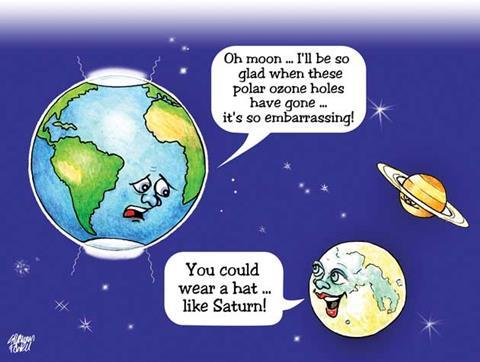
29
Ozone is being used in the field of water treatment, disinfection, decolorization, deodorization, organic synthesis, materials testing, dry etching and cleaning processes in semiconductor industries, and other industrial areas. The advantages of using ozone over other chemicals are: its strong oxidizing power, its clean nature leaving only oxygen after the treatment, and electrical generation at the site. Monitoring of ozone dose and residual levels is necessary in all these processes.

30
Most big-time users of ozone, like drinking water treatment systems, install generators on the spot and make it as needed. Several manufacturers make these generators. Almost all of them work on the principle of injecting oxygen, either in the form of air or pure oxygen, and subjecting it to a high voltage electric discharge. The spark produces ultra-violet light which breaks apart an oxygen molecule, O2 , into two O ions. These in turn react with another oxygen molecule to make ozone O3 .
31
Multiple Choice
Which is the proper expression about OZONE?
Good Up High, Bad Nearby
Bad Up High , Good Nearby
32
Multiple Choice
Which of the following is NOT an ingredient that is needed to produce the ozone hole?
Infrared Light
Cold Temperatures
UV Light
Chlorine from CFCs
33
by Quantum Supercomputing
Show answer
Auto Play
Slide 1 / 33
SLIDE
Similar Resources on Wayground

25 questions
Crime Scene Investigation and Evidence Collection Part 2
Presentation
•
9th - 12th Grade
25 questions
newton's laws
Presentation
•
9th - 12th Grade
29 questions
Families of the Periodic Table
Presentation
•
9th - 12th Grade
24 questions
Metallic Bonds and Alloys
Presentation
•
10th - 12th Grade
25 questions
Unit 4 Lesson 3 Quantum Numbers
Presentation
•
10th - 12th Grade
26 questions
Ionic Compounds Naming and Formula Writing
Presentation
•
10th Grade - University
27 questions
Reaction Rates
Presentation
•
9th - 12th Grade
Popular Resources on Wayground
10 questions
Safety Day 2026 – Student Review

Quiz
•
9th Grade
21 questions
Continents and Oceans
Quiz
•
6th Grade
20 questions
Parts of Speech
Quiz
•
5th Grade
16 questions
Subject & Predicate
Quiz
•
5th Grade
25 questions
Multiplication Facts
Quiz
•
5th Grade
12 questions
Map Skills
Quiz
•
3rd Grade
22 questions
Continents and Oceans
Quiz
•
5th Grade
15 questions
Rounding Decimals
Quiz
•
5th Grade
Discover more resources for Science
10 questions
Exploring Chemical and Physical Changes

Interactive video
•
6th - 10th Grade
20 questions
Atomic Structure
Quiz
•
9th Grade
10 questions
Exploring the Electromagnetic Spectrum for Middle School Science
Interactive video
•
6th - 10th Grade
10 questions
Exploring Force and Motion Concepts
Interactive video
•
6th - 10th Grade
10 questions
Exploring Air Masses and Weather Fronts
Interactive video
•
6th - 10th Grade
14 questions
Periodic Trends
Interactive video
•
11th Grade
10 questions
Exploring the States of Matter
Interactive video
•
6th - 10th Grade
10 questions
Exploring Forces: Net Force, Normal Force, Gravity, and Friction
Interactive video
•
6th - 10th Grade