Search Header Logo
Periodic Trends

Periodic Trends

Assessment

Presentation

Chemistry

10th Grade

Medium

Created by

Oyerohunke oyediran

Used 5+ times

FREE Resource

16 Slides • 29 Questions

1

media

The Periodic Table:

Periodic Trends

2

media
media

Trends are patterns seen in the periodic table.
Trends are seen in mass, size, and reactivity.

Trends

3

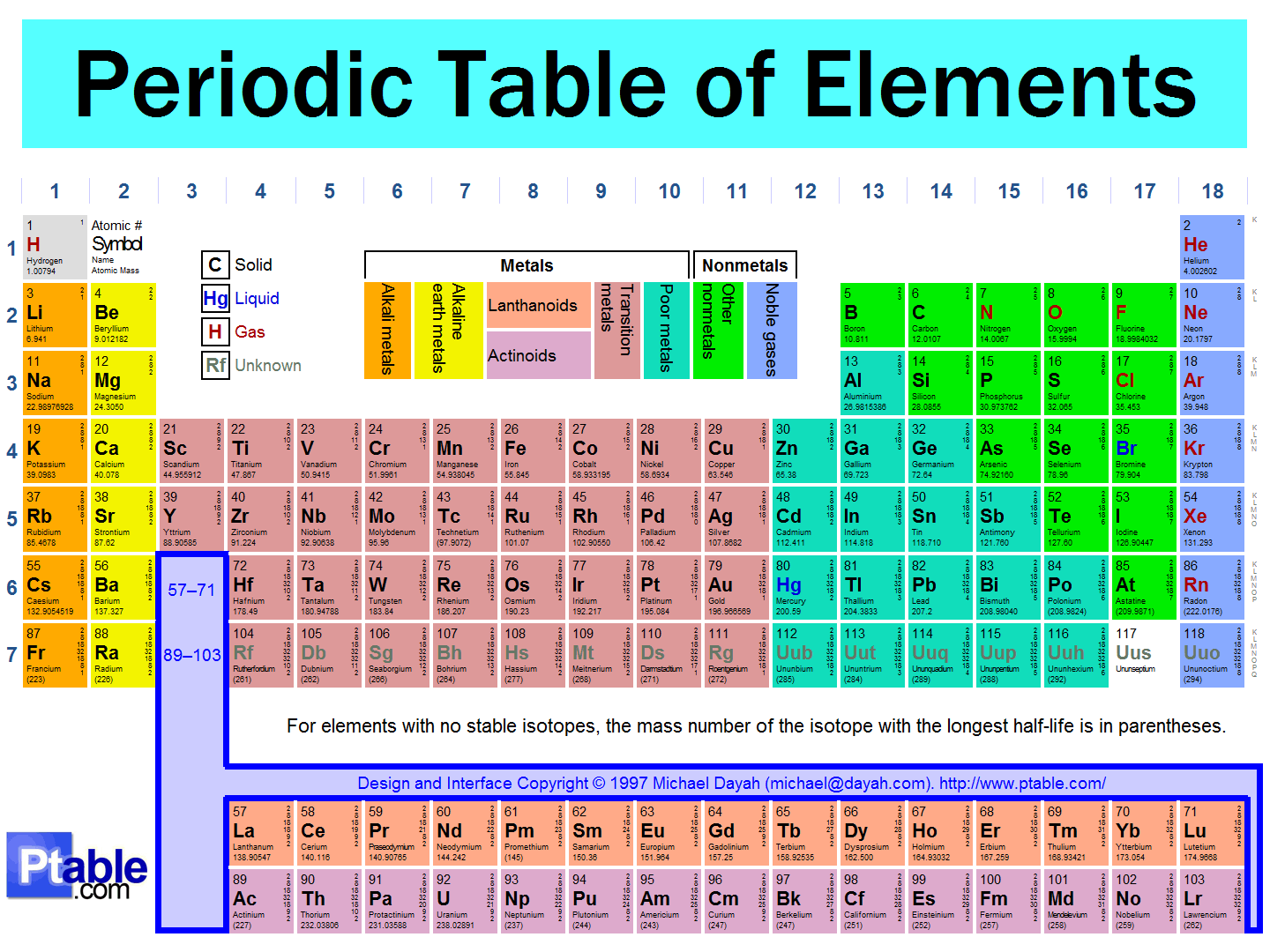
​Lets Review the Parts of The Periodic Table

​You can do it!

4

Multiple Choice

Question image

The vertical (up and down) columns in the Periodic Table are called

1

groups

2

towers

3

periods

4

atomic numbers

5

Multiple Choice

The Modern Periodic Table of Elements is arranged by
1
atomic mass
2
atomic number
3
valence electrons
4
number of isotopes

6

Multiple Choice

Question image

What group is element A in?

1

Alkali Metals

2

Alkali Earth Metals

3

Transition Metals

4

Halogens

7

Multiple Choice

Question image

What group is element B in?

1

Alkali Metals

2

Alkali Earth Metals

3

Transition Metals

4

Halogens

8

Multiple Choice

Question image

What group is element C in?

1

Alkali Metals

2

Alkali Earth Metals

3

Transition Metals

4

Halogens

9

Multiple Choice

Question image

What group is element D in?

1

Alkali Metals

2

Alkali Earth Metals

3

Transition Metals

4

Halogens

10

Multiple Choice

Question image

What group is element E in?

1

Halogens

2

Alkali Earth Metals

3

Transition Metals

4

Noble Gases

11

Multiple Choice

Most of the periodic table is mode of _______.

1

Metals

2

Non-metals

3

Semi-metals

12

Multiple Choice

Question image
The atoms along the staircase are called 
1
metals
2
nonmetals
3
metalloids
4
noble gases

13

media
media

Atomic Mass

The atomic mass of elements increases moving
down each group and right across each period.

Increasing Atomic Mass

14

media

We know that mass increases as the atomic number increases.....

Because there are more protons, it gets heavier.​

​Has nothing to do with the size.

Atomic mass depends on Protons and Neutrons.

15

media
media
media
media

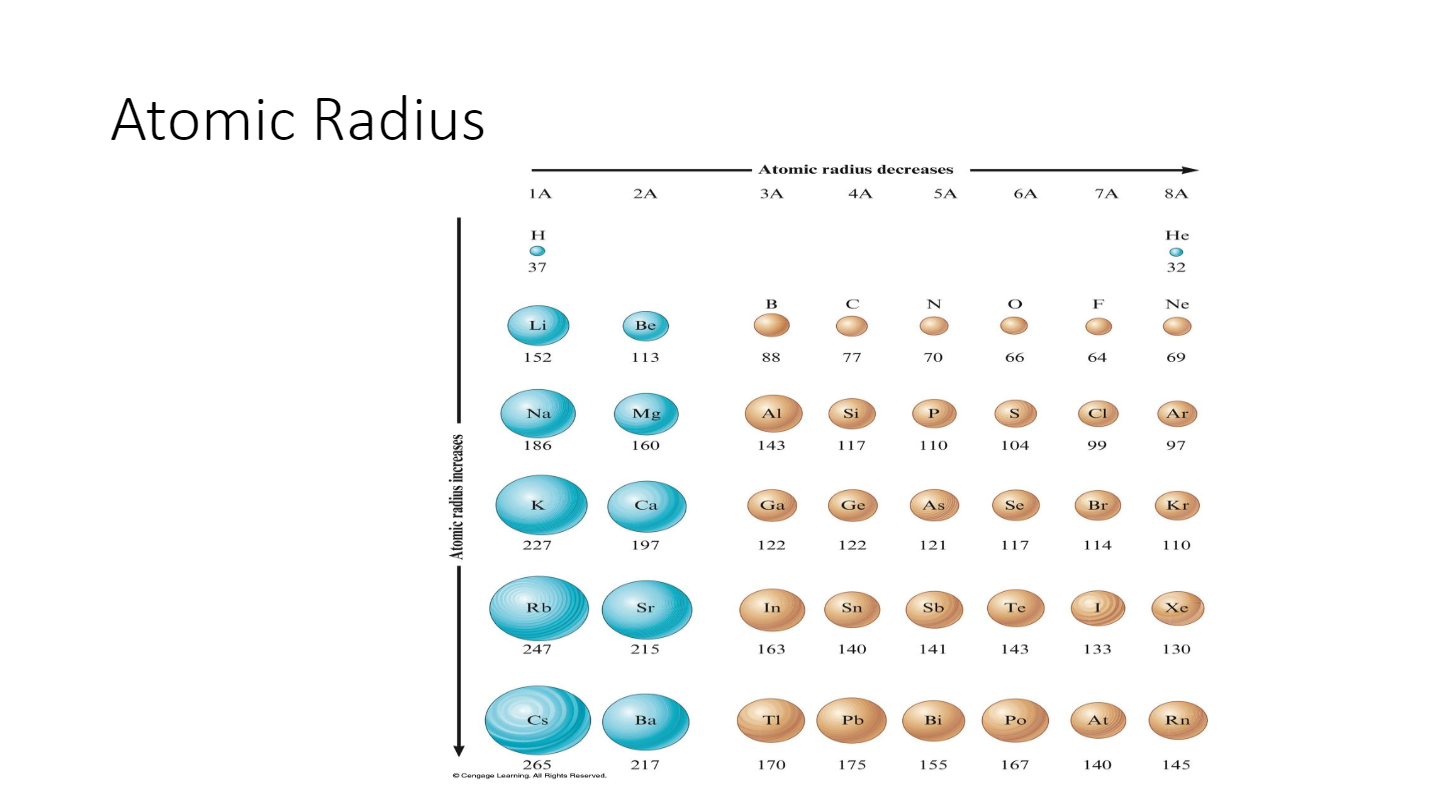
The atomic radius is the distance from

the valence electrons to the nucleus.

Simply put, it describes the size of an atom.

Atomic Radius

Increasing Atomic Radius

Lithium

Sodium

Potassium

16

media
media
media

Atomic Radius

The atomic radius of elements increases moving
down each group and left across each period.

Increasing Atomic Radius

17

Multiple Choice

As you move down a group, atomic radius increases because - 
1
you add more and more neutrons
2
you add more and more protons
3
you add more and more shells (energy levels)
4
you add more atomic mass

18

Multiple Choice

Question image
Which atom has the largest atomic radius?
1
potassium
2
rubidium 
3
francium
4
cesium

19

Multiple Choice

Of the halogens, which has the smallest radius?

1

F

2

Br

3

He

4

At

20

Multiple Choice

Which periodic group has the smallest atomic radius?
1
Alkali metals
2
Halogens
3
Noble Gases
4
Transition metals

21

Multiple Choice

Question image

What property is being measured in this diagram?

1

Density

2

Ionization Energy

3

Atomic Radius

4

Atomic Mass

22

Multiple Choice

Question image

Which of these elements in group 1A has the largest atomic radius?

1

cesium

2

rubidium

3

potassium

4

sodium

23

Multiple Choice

The atom with the largest atomic radius in Group 18 is - 
1
Ar
2
He
3
Kr
4
Rn

24

media
media

Ionization energy is the energy required to

remove an electron from an atom.

• The more tightly electrons are held by the

nucleus, the harder they are to remove.

Ionization Energy

Energy Needed

to Remove Electron

-

-

+

+

​The smaller the size of the atom the more

25

media
media

Ionization Energy

The ionization energy of elements increases
moving up each group and right across a period.

Increasing Ionization Energy

​Opposite of atomic radius

26

Multiple Choice

Francium (Fr) has the lowest ionization energy in Group 1 because - 
1
it has the smallest number of valence electrons
2
it has the greatest atomic mass
3
it has the greatest number of protons, so it attracts its electrons the strongest
4
its 1 valence electron is very far from the nucleus, so little energy is needed to remove it

27

Multiple Choice

Question image

Which group of elements has the lowest ionization energies?

1

Alkali Metals (Group 1)

2

Alkaline Earth Metals (Group 2)

3

Halogens (Group 17)

4

Noble Gases (Group 18)

28

Multiple Choice

Question image

What is the amount of energy required to remove an electron from an atom?

1

atomic energy

2

ionization energy

3

ionic energy

4

electron energy

29

Multiple Choice

As you move across the periodic table atoms tend to get smaller because, ______________.
1
the atoms have more mass.
2
the atoms have less mass
3
the atoms have more protons.
4
the atoms have less electrons.

30

Multiple Choice

As you move down the periodic table atoms get bigger.  This is because ____________.
1
The atoms have more mass.
2
The atoms have more protons.
3
The atoms have more energy levels
4
The atoms have more nuetrons

31

Multiple Choice

When across a period, the atomic size decreases so the first IE ___________.

1

increases

2

decreases

3

constant

4

i am not sure

32

media
media

Electronegativity is a measure of how

strongly an atom is attracted to electrons.

• In bonds, electrons will be more attracted to

the atom with greater electronegativity.

Electronegativity

Attraction of electrons

to the nucleus
-

-

+

+

33

media
media

Electronegativity

The electronegativity of elements increases
moving up each group and right across a period.

Increasing Electronegativity

​Same as

Ionization Energy

34

Multiple Choice

Which of the following will have a higher electronegativity than arsenic (As)?

1

Carbon (C)

2

Neon (Ne)

3

Antimony (Sb)

4

Germanium (Ge)

35

Multiple Choice

Question image

Which of the following halogens has the greatest electronegativity?

1

Chlorine (Cl)

2

Bromine (Br)

3

Iodine (I)

4

Astatine (At)

36

Multiple Choice

Question image

What is a measure of the tendency of an atom to attract a bonding pair of electrons when the atom is in a compound?

1

ionization energy

2

electropositivity

3

electronegativity

4

electron energy

37

Multiple Choice

Question image

Which element in period 4 has the highest electronegativity?

1

potassium

2

calcium

3

copper

4

bromine

38

Multiple Choice

Question image

What is a measure of the tendency of an atom to attract a bonding pair of electrons when the atom is in a compound?

1

ionization energy

2

electropositivity

3

electronegativity

4

electron energy

39

media
media

Reactivity is the tendency of an atom or

molecule to undergo a chemical reaction.

Certain elements react very easily with just

water. Other elements do not react at all.

Note: Noble Gas elements (Group 18)

are not reactive. They are excluded.

Reactivity

40

media
media

Reactivity of Metals

The reactivity of metals increases moving
down each group and left across each period. Because it gets easier to remove electrons

Increasing Reactivity of Metals

​Same as

atomic radius

41

media
media

Reactivity of Non-Metals

Increasing Reactivity of Non-Metals

The reactivity of non-metals increases moving
up each group and right across each period.

Because it is easier to gain electrons.

42

media
media

Reactivity of Non-Metals

Fluorine is the most reactive non-metal.

Francium is the most reactive metal.

F

Fr

9
F

Fluorine

18.99

87
Fr
Francium

223

43

media

44

Multiple Choice

What metal is most reactive

1

lithium

2

sodium

3

potassium

4

rubidium

45

Multiple Choice

What non-metal is the most reactive

1

iodine

2

sulfur

3

oxygen

4

fluorine

media

The Periodic Table:

Periodic Trends

Show answer

Auto Play

Slide 1 / 45

SLIDE