Search Header Logo
Unit 4 Section 3: Fossils

Unit 4 Section 3: Fossils

Assessment

Presentation

Science

8th Grade

Medium

NGSS
MS-ESS2-3, MS-LS4-1, HS-ESS1-5

+3

Standards-aligned

Created by

Abby Fancsali

Used 242+ times

FREE Resource

15 Slides • 15 Questions

1

​Science Root of the Day:

DO NOW: Write what you think the example words mean in your lab manual.

Extra Credit: Find three additional words that use this root and write them and their definition in your lab manual (6 Points Max)

media

2

Unit 4 Section 3: Fossils

media

In 1990, a woman named Sue Hendrickson went looking for fossils in Faith, South Dakota. During her search, she found several bones which lead to the ​discovery of the largest and most complete Tyrannosaurus Rex skeleton ever found. The skeleton named for her now resides in the Chicago Field Museum.

3

Multiple Choice

Question image
Who is the person credited with developing the theory of continental drift?
1
Harry Hess
2
Galileo
3
Alfred Wegener
4
Newton

4

Multiple Choice

Massive pieces of land that are part of the Earth's crust and upper mantle
1
Tectonic plates
2
Trenches
3
Divergent boundary
4
Continental shelves

5

Multiple Choice

Question image

What are the three types of Evidence that supports Alfred Wegener's Theory?

1

Fossils, Fish, and Land

2

Sedimentary, Magma, and Climate

3

Fossils, Land forms, and Climate

4

Climate, Land forms, and Metamorphic rock

6

Multiple Choice

Question image
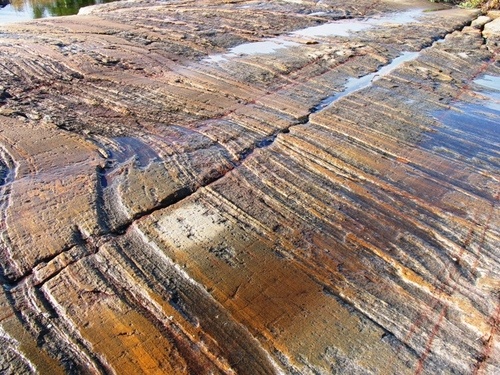
This is a picture of glacier scars found in Africa.  What are these evidence for?
1
Africa has always been near the equator
2
Africa was once in an area of the Earth that had a very cold climate
3
The continents have not moved
4
sea floor spreading

7

Multiple Choice

Why was Wegener's theory not accepted?
1
He had no proof of how they were moving
2

Pangea just didn't look right

3
He was married
4
He was not a Scientist

8

Multiple Choice

The OLDEST seafloor is located? 
1
Closest to the mid-ocean ridge
2
Farthest from the mid-ocean ridge

9

Multiple Choice

What happens when Subduction occurs?
1
Parts of the crust fall into the mantle
2
Parts of the crust fall into the core
3
Parts of the crust fall into space
4

Parts of the mantle rise up to the crust

10

media

Lesson Objectives

  • Describe how Fossils form

  • Differentiate between different kinds of fossils

  • Discuss what Fossils tell us about organisms and environments of the past

11

What are Fossils?

  • Fossil: the preserved remains or traces of living things

    • Includes things like:

      • Bones

      • Teeth

      • Imprints

media
media

12

How do Fossils Form?

  • Most Fossils form when living things die and are buried by sediment

  • Are found in or near still water where sediment builds up

    • After an organism dies, the soft tissue decays quickly or gets eaten

      • ​Usually, only hard tissues remain

    • Over time, sediment covers the organism in layers and hardens into sedimentary rock

media

13

What are the different kinds of Fossils?

  • ​Different kinds of of fossils include

    • Molds and Casts

    • Petrified Fossils

    • Carbon Films

    • Trace Fossils

    • Preserved Remains​

media

14

Molds & Casts

  • The most common types of fossils

    • Preserve the fine details of the organisms (Textures, shapes)

  • Mold: a hollow area in sediment in the shape of an organism

    • Forms when the organism is buried in sediment

    • Just an imprint

  • Cast: A solid copy of the shape of an organism​ where sediment fills in spaces

    • Shows all the fine details

media

15

Petrified Fossils

  • Petrified: turned to stone

  • In petrified fossils, minerals replace all or part of an organism

    • water seeps into the cells, carrying minerals

    • Eventually water evaporates and the minerals are left behind, taking the form of the organism

  • Are usually plants or bones​

media

16

Carbon Films

  • Carbon Film: An extremely thin layer of carbon is left behind of an organism

  • While other sediment is removed, the carbon leaves a flat image behind

  • Preserves the most delicate details of organisms

    • Shows the outer details of an organism

media
media

17

Trace Fossils

  • Show the activities of an organism

    • Footprints

    • Nests

    • Scat

  • Can reveal what an organism did and ate

media
media

18

Preserved Remains

  • Preserve the entire organism

    • Freezin​g in ice

    • Trapped in amber

      • Amber: Hardened tree sap

    • Tar Pits

media
media
media

19

Answering The Jurassic Park Question

  • It isn't possible to retrieve DNA from remains in Amber

    • While some tissue remains, the DNA degrades over time

  • Frozen Fossils do preserve some DNA, but it is extremely difficult to extract

    • DNA degrades as the fossil thaws

      • Wooly Mammoth DNA has been preserved

    • 2021:​ Scientists believe they may have successfully retrieved DNA from a frozen dinosaur

      • tests remain inconclusive as to whether it is true Dinosaur DNA

media
media

20

Multiple Choice

A __________ fossil can form when sediment buries the hard tissues of an organism.

1

mold/cast

2

Trace

3

Carbon Film

4

Petrified

21

Multiple Choice

A __________ fossil forms when minerals replace parts of an organism

1

mold/cast

2

Trace

3

Carbon Film

4

Petrified

22

Multiple Choice

Which of the following can you learn from a carbon film fossil?

1

How an organism behaved

2

What an organism ate

3

Fine Details of an organisms body

4

The bone structure of an organism

23

Multiple Choice

Which of the following substances is not able to preserve entire organisms?

1

Tar

2

Water

3

Amber

4

Ice

24

What do Fossils show?

  • Paleontologists: Scientists who study fossils

  • Paleontologists gather information into the Fossil Record

    • Provides evidence about the history of life and past environments on Earth

      • Helps show how organisms have changed over time

media

25

Fossils and Past Environments

  • The types of fossils found in an area can tell what the area was like in the past

    • Can tell if a location was under water or on land

      • Can distinguish between fresh and salt water

    • Can show the previous climates of area

      • Antartica has coal deposits, which only form in warm climate

26

Change and the Fossil Record

  • Looking throughout the fossil record, changes in species can be seen

  • Evolution: the change in living things over time

    • Organisms become more complicated in subsequent generations

    • Older rocks have simpler organisms while newer rock has more complex organisms

  • ​Some fossils show organisms that no longer exist

    • Extinct: a type of organism no longer ​exists and will no longer reproduce on Earth

      • Can occur due to different factors like environmental changes

      • Fossils help scientists construct models of what extinct organisms could have looked like

27

Multiple Choice

This is the sort of scientist who studies fossils/

1

Geologist

2

Evolutionist

3

Paleontologist

4

Fossilist

28

Multiple Choice

_____________ is the gradual change in living things over long periods

1

Evolution

2

Petrification

3

Fossilization

4

Paleontology

29

Multiple Choice

An organism that no longer exists on Earth is called

1
Decayed
2
Evolved
3
Extinct
4
Preserved

30

Multiple Choice

Which type of rock are most fossils found in?

1

sedimentary rock

2

metamorphic rock

3

igneous rock

4

fossilatary

​Science Root of the Day:

DO NOW: Write what you think the example words mean in your lab manual.

Extra Credit: Find three additional words that use this root and write them and their definition in your lab manual (6 Points Max)

media

Show answer

Auto Play

Slide 1 / 30

SLIDE