Unit 8 Part 2- Electric Charge & Static Electricity
Presentation
•
Science
•
8th Grade
•
Practice Problem
•
Medium
+5
Standards-aligned
Abby Fancsali
Used 18+ times
FREE Resource
16 Slides • 19 Questions
1
Science Root of the Day:
DO NOW: Write what you think the example words mean in your lab manual.
Extra Credit: Find three additional words that use this root and write them and their definition in your lab manual (6 Points Max)
2
Section 2: Electric Charge & Static Electricity
3
Multiple Choice
Magnetic field lines around a bar magnet
are only perpendicular to the magnet.
spread out from one pole and curve around to the other.
cross back and forth over one another.
are perfectly straight.
4
Multiple Choice
True or False: A magnet is attracting when it pushes objects away from each other.
True
False
5
Multiple Choice
Up
Down
6
Multiple Choice
What is responsible for the Magnetic Field around Earth?
The Sun
The Earth's core
The Earth's crust
The Earth's mantle
7
Multiple Choice
Every magnet, regardless of its shape, has two
magnetic poles.
magnetic fields.
magnetic charges.
magnetic needles.
8
Multiple Choice
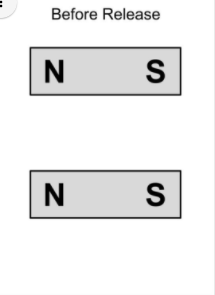
What does this picture represent?
Magnetic forces between like poles
Magnetic forces between opposite poles
Magnetic forces between two metals
9
Multiple Choice
As Earth’s magnetic poles move, the magnetic declination in a given location will
stay the same.
switch to point south.
change.
return to zero.
10
Hotspot
At which point is the magnetic field the strongest?
11
Lesson Objectives
Define an Electric Charge
Describe an Electric Field
Explain how Electric Charges and Fields interact
Describe Static Electricity
How it Builds up
How it is transferred
12
Types of Charges
All atoms contain small particles called Electrons and Protons
Electrons have a Negative Charge
Protons have a Positive Charge
Charges always interact the same way
Similar charges repel each other
Opposite Charges Attract each other
13
What is Electric Force?
Electricity: the interaction between electric charges
Electric Force: The force that occurs between charged objects
Can act at a distance
14
Electric Fields
Electric Field: The region around an object where an object's electric force is exerted on other charged objects
Is invisible
Gets weaker the farther away from the charge
15
Electric Field Lines
Just like with magnets, an electric field can be mapped out using lines
Lines are drawn to show how a positive charge would act
Repelled away from positive charges and toward negative charges
Adding more charges adds more lines because each charge exerts a force
16
Multiple Choice
Atoms contain charged particles called
Protons and Electrons
Protons, Electrons, and Neutrons
Protons and Neutrons
Electrons and Neutrons
17
Drag and Drop
18
How does Charge Build up?
Most objects have no overall charge
Has the same number of Protons and Electrons
Neutral
An object can become charged by gaining or losing electrons
If an object loses electrons, it becomes more positively charged
If an object gains electrons, it becomes more negatively charged
19
How does Charge Build up?
Static Electricity: the build-up of charge on an object
Charges do not flow continuously but slowly collect in an object
20
Drag and Drop
21
Drag and Drop
22
Drag and Drop
23
Multiple Choice
In Static Electricity, charges
flow continuously
flow intermittently
build up in an atom
build up on an object
24
Charging Objects
Law of Conservation of Charge: Charges are not created nor destroyed, only transferred from one object to another
There are four ways an object can gain or lose charge
Friction
Conduction
Induction
Polarization
25
Charging By Friction
Involves two uncharged objects rubbing against each other
As the objects are moved, electrons can be moved from one object to another
26
Charging By Conduction
Electrons are transferred from a charged object to another object through direct touching
Electrons move toward an area with a more positive charge
27
Charging By Induction
Electrons can react to the electric field of a charged object without touching the object itself
Metals tend to lose electrons very easily
Induction: When the electrons in a metal object react to an electrical field, and make an object have a positive and a negative end
Can produce a spark
28
Charging By Polarization
Sometimes Electrons do not move between atoms, but rotate in their atoms
Electrons move so they are on one end of an atom
Polarization: The process of individual atoms gaining a positive and negative charge on their ends
Does not involve transfer between objects
Overall the object remains neutral
29
Multiple Choice
A region around a charged object where the object's electrical force is exerted on other charged objects is an electrin
field
outlet
socket
power plant
30
Match
Match the following methods of charging to their description
Friction
Conduction
Induction
Polarization
Electrons are transferred through the rubbing of two uncharged
Electrons are transferred from a charged obect to another through contact
Electrons move within a charged object to create a positive and negative end
Electrons move in an atom to give it a positive and negative end
Electrons are transferred through the rubbing of two uncharged
Electrons are transferred from a charged obect to another through contact
Electrons move within a charged object to create a positive and negative end
Electrons move in an atom to give it a positive and negative end
31
Static Discharge
Once charged, an object will slowly change to become neutral
Negatively charged objects will lose electrons
Positively charged objects will gain electrons
Static Discharge: The loss of Static Electricity as electric charges transfer from one object to another
Often produces a spark from electrons heating the air
More common in dry weather because water is not in the air to attract charges
32
Static Discharge
Lighting is static discharge in action
During storms, air particles move inside clouds and become charged
As the electrons move from areas that are negatively charged to areas that are positively charged, they produce a spark
When charges form a negative electric field, the Earth becomes more positively charged, which can allow lightning to jump from clouds to the Earth's surface
33
Multiple Choice
Most objects have some overall charge
True
False
34
Multiple Choice
The buildup of charges on an object is called
static discharge.
static electricity
positive charge.
negative charge
35
Open Ended
People who work with computers have to be careful about static discharge because even a small shock can damage a computer board. What are two things a person can do to avoid static discharge from occurring? Explain how each one would change the amount of discharge.
Science Root of the Day:
DO NOW: Write what you think the example words mean in your lab manual.
Extra Credit: Find three additional words that use this root and write them and their definition in your lab manual (6 Points Max)
Show answer
Auto Play
Slide 1 / 35
SLIDE

Similar Resources on Wayground
25 questions
Atomic Structure Lesson
Presentation
•
8th Grade
26 questions
Earth's Changing Surface Review
Presentation
•
7th - 8th Grade
26 questions
Newton's Laws of Motion
Presentation
•
8th Grade
24 questions
Classification of matter
Presentation
•
8th Grade
34 questions
Mirrors and Lenses
Presentation
•
8th Grade
27 questions
Describing Phase Change at Two Scales
Presentation
•
7th Grade
28 questions
Science 9 Unit E Review Slides
Presentation
•
9th Grade
27 questions
Balanced and Unbalanced Forces
Presentation
•
8th Grade
Popular Resources on Wayground
10 questions
5.P.1.3 Distance/Time Graphs
Quiz
•
5th Grade
10 questions
Fire Drill
Quiz
•
2nd - 5th Grade
20 questions
Equivalent Fractions
Quiz
•
3rd Grade
22 questions
School Wide Vocab Group 1 Master
Quiz
•
6th - 8th Grade
20 questions
Main Idea and Details
Quiz
•
5th Grade
20 questions
Context Clues
Quiz
•
6th Grade
20 questions
Inferences
Quiz
•
4th Grade
12 questions
What makes Nebraska's government unique?
Quiz
•
4th - 5th Grade
Discover more resources for Science
8 questions
Amoeba Sister Asexual vs Sexual Reproduction
Interactive video
•
8th Grade
19 questions
Introduction to Properties of Waves
Presentation
•
6th - 8th Grade
16 questions
Interactions within Ecosystems
Presentation
•
6th - 8th Grade
10 questions
Exploring the Layers of the Earth
Interactive video
•
6th - 10th Grade
20 questions
Energy Transformations
Quiz
•
6th - 8th Grade
46 questions
8th Science STAAR Review
Quiz
•
8th Grade
20 questions
Cell Organelles and Functions
Quiz
•
6th - 8th Grade
20 questions
Moon Phases and Eclipses
Quiz
•
6th - 8th Grade