

Ecology#4

Presentation
•
Science
•
7th Grade
•
Easy
+3
Standards-aligned

Brian Foster
Used 4+ times
FREE Resource
16 Slides • 12 Questions
1
Drag and Drop
1. During primary succession the landscape starts out with NO
2. The first species (lichens and moss) to occupy an area of rocks during primary succession are known as
3. The last stage of both primary and secondary succession is known as a
4. If a natural disaster occurred (hurricane, fire, flood, etc.), then the formation of a new community of organisms is known as
5. What type of organisms are always found at the base of an ecological pyramid?
2

Conservation of Matter and Energy
• Conserve means to maintain at a constant
overall total.
▫ All over Earth, mass and energy are cycling
through different forms without being created or
destroyed.
• Matter is neither created or destroyed during
any chemical or physical change, it is changed
from one form to another
• Energy cannot be created or destroyed. Energy
is transferred from one form to another.
1
3


Types of Systems
• Isolated System:
▫ No matter or energy moves in or
out of the system
• Closed System:
▫ Matter cannot move in or out of the system, but
energy can
• Open System:
▫ Energy or matter
can move in and
out of the system
2
4

What is a cycle?
• A series of events that are
continuously repeated in the same
order.
• Cycles we will review:
▫ Water Cycle
▫ Carbon Cycle
▫ Oxygen Cycle
▫ Nitrogen Cycle
3
5


Water Cycle
4
• The continuous movement of water from the
Earth’s surface to the atmosphere and back.
• This process is driven by the Sun
6


Evaporation:
• Liquid water is changed to a gas and rises
into the atmosphere
▫ From oceans, lakes, rivers, streams
• Plants/Trees release water into the atmosphere
too, this is known as transpiration
5
7


Condensation:
• Rising water cools and changes back into
a liquid
• This forms clouds
6
8


Precipitation:
• When liquid water droplets become large
enough to be pulled down to the surface
of the Earth by gravity
▫ Rain, snow, sleet, or hail
7
9
Multiple Choice
This provides the power to keep the water cycle running.
The Sun
The Earth
The wind
living things
10
Labeling
Drag the processes to correctly label the diagram.
11


Carbon Cycle
• Carbon is considered the building block of life
• CO₂ (carbon dioxide) from the air is used by
producers (plants) for photosynthesis.
8
12


Follow the carbon
• Photosynthesis:
▫ This process makes sugar which contains
carbon.
• Carbon is also used by plants to make other
organic parts/structures.
9
13


Where does the carbon go next?
• Consumers eat the producers (plants)
and then pass the carbon along the food
chain.
• Consumers then break down the sugar from
the food to make energy then they release
CO₂and water into the air.
10
14


What happens to all the
carbon-based organisms?
• Eventually all the carbon-based organisms
die and are broken down by
decomposers in the soil
• The carbon then becomes available
to be used again
11
15
Multiple Choice

What do 'plants' do with the carbon they receive?
They turn it into water
They don't need carbon
They turn it into glucose (sugar) by photosynthesis
They keep it forever
16
Multiple Choice

How do animals get carbon?
Photosynthesis
They absorb it from the atmosphere
The sun
They ingest other plants and animals
17
Multiple Select

How does carbon get from animals and plants back into the atmosphere? (CHOOSE ALL THAT APPLY)
Perform respiration and exhale CO2
After they die, they are broken down by decomposers
More Photosynthesis and Respiration
All of these choices
18


Oxygen Cycle
12
• Producers release oxygen
▫ They perform photosynthesis!
• Aerobic organisms take oxygen in
▫ To perform cellular respiration!
19


Carbon and Oxygen Cycles Together
13
20
Multiple Choice
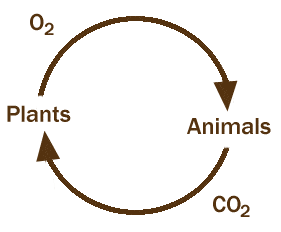
animals breathe in nitrogen and release oxygen which is used by plants
animals breathe in oxygen and release carbon dioxide which is used by plants
animals breathe in nitrogen and release carbon dioxide which is used by plants
animals breathe in carbon dioxide and release oxygen which is used by plants
21
Multiple Select

Which statement is an example of how plants and animals depend on each other?
SELECT ALL THAT APPLY!
animals provide food for plants
plants provide oxygen for animals
animals provide oxygen for plants
animals provide carbon dioxide for plants
22


Nitrogen Cycle
• Nitrogen is an important
component for building proteins
in animals and an essential
nutrient for plants.
• The air is about 78% nitrogen, but
organisms cannot use nitrogen in
the gas form.
▫ It is considered “free” nitrogen,
since it is not combined with any
other elements
• Nitrogen needs to be “fixed”
or combined with other elements.
14
23


Nitrogen Fixing
• Bacteria live on the
roots of certain plants.
• Bacteria and
lightning “fix” the
nitrogen from the air
into organic molecules
that the plant can use
15
24


• Nitrogen then cycles
from the producers to the
consumers.
• When the organisms die
decomposers then return
the nitrogen to the soil.
• Bacteria then breaks
down the nitrogen
compounds from the soil
and release it into the air
and the cycle continues.
16
25
Multiple Choice
True
False
26
Multiple Choice
through action of bacteria only
through lightning only
through action of bacteria & lightning
through photosynthesis
27
Multiple Choice
How do animals get the nitrogen they need?
From the air they breathe
From the water they drink
From the food they eat
From the sun
28
Multiple Choice
bacteria
plants
animals
producers
1. During primary succession the landscape starts out with NO
2. The first species (lichens and moss) to occupy an area of rocks during primary succession are known as
3. The last stage of both primary and secondary succession is known as a
4. If a natural disaster occurred (hurricane, fire, flood, etc.), then the formation of a new community of organisms is known as
5. What type of organisms are always found at the base of an ecological pyramid?
Show answer
Auto Play
Slide 1 / 28
DRAG AND DROP
Similar Resources on Wayground

23 questions
Hypothesis Review
Presentation
•
6th - 7th Grade
21 questions
Counting Atoms & Balancing Equations
Presentation
•
7th Grade
20 questions
Scale and Size of the Solar System
Presentation
•
7th Grade
20 questions
PURE SUBSTANCES and MIXTURES
Presentation
•
7th Grade
23 questions
Graphing Motion
Presentation
•
7th Grade
23 questions
Types of Reproduction
Presentation
•
7th Grade
21 questions
Chemical Reactions
Presentation
•
7th - 8th Grade
20 questions
Earth's Layers
Presentation
•
7th - 8th Grade
Popular Resources on Wayground
10 questions
How much do you know about our Portrait of an Eagle?

Quiz
•
10th Grade
10 questions
Fast Food Slogans
Quiz
•
6th - 8th Grade
21 questions
Continents and Oceans
Quiz
•
6th Grade
20 questions
Parts of Speech
Quiz
•
5th Grade
16 questions
Subject & Predicate
Quiz
•
5th Grade
25 questions
Multiplication Facts
Quiz
•
5th Grade
12 questions
Map Skills
Quiz
•
3rd Grade
22 questions
Continents and Oceans
Quiz
•
5th Grade
Discover more resources for Science
17 questions
7.6D Aqueous Solutions
Quiz
•
7th Grade
20 questions
Claim, Evidence and Reasoning (CER)
Quiz
•
6th - 8th Grade
18 questions
Counting Atoms
Quiz
•
7th - 8th Grade
10 questions
Exploring Chemical and Physical Changes

Interactive video
•
6th - 10th Grade
20 questions
Food Chains & Food Webs
Quiz
•
5th - 7th Grade
10 questions
Decoding the Periodic Table of Elements
Interactive video
•
6th - 10th Grade
16 questions
Photosynthesis and Cellular Respiration Review
Quiz
•
7th Grade
10 questions
Exploring the Periodic Table
Interactive video
•
6th - 10th Grade