
The Mughal Empire

Presentation
•
Social Studies
•
9th Grade
•
Practice Problem
•
Hard

REBECCA LAPPAS
Used 4+ times
FREE Resource
27 Slides • 0 Questions
1


BELLWORK
1.
List Three Things
You Notice about
this map:
2.
Make Two
inferences about the
Mughal and
Ottoman Empires
2


TURN AND TALK
•What problems might conquered
people present for the empire that
conquered them?
•In what ways might an empire
integrate conquered people into
society?
3


MUGHAL EMPIRE
• 1526-1857
• Main Emperors
1526–1530 Babur
1556-1605
Akbar the Great
1658-1707
Aurangzeb
4


CRASH COURSE MUGHAL EMPIRE
https://www.youtube.com/watch?v=nbuM0aJjVgE
Answer these Q’s based on the video above:
1.What religion were the rulers of the Mughal Empire?
2.Why was Babur [the founder of the Mughal Empire] and his
followers called “Mughals”?
3.The blending of Indian and Persian culture in the Mughal
Empire is an example of what?
4.According to John Green, what are two reasons why the
Mughal Empire is important to study?
5.Muslims were a minority in the Mughal Empire. Most
people in the empire were Hindu. How did the Muslim
Mughal leaders establish control over non-Muslims?
5


GROWTH OF THE MUGHAL EMPIRE
1. Using the map to
your left, describe
how the extent of
the Mughal
empire changed
from the reign of
Babur to the reign
of Aurangzeb.
2. What
geographic
feature
prevented the
Mughal Empire
from expanding
further to the
north?
6


MUGHAL EMPIRE 1500-1900
• https://www.youtube.com/watch?v=AWaOd-QYP8
w
7


ANSWER QUESTIONS
•What do the holes in
the map to your right
represent?
•What did the animated
video of the Mughal
Empire’s territorial
holdings reveal about
the stability of the
empire?
8


READING
• Complete Reading and 10 Q’s on Moghul Empire. If
not complete, homework.
9

The Great Mughal Empire
1526-1707
10


INTRODUCTION
• Under the Mughals, India was the heart of a great Islamic
empire and a prolific center of Islamic culture and learning.
• Dynasty was the greatest, richest and longest lasting Muslim
dynasty to rule India.
• Mongol Descendents
• The Great Mughal Emperors were:
• Babur (1526-1530) The First of the Mughals
• Humayun (1530-1556) The Luckless Leader
• Akbar (1556-1605) The Great
• Jehangir (1605-1627) The Paragon of Stability
• Shah Jehan (1627-1658) The Master Builder
• Aurangzeb (1658-1707) The Intolerant
11


BABUR 1526 - 1530
THE FIRST OF THE MUGHALS
• Babur was a direct descendant of the Turkish Ghengis Khan
and Timur from Tamerlane. (Rumor has it – Adele)
• Defeated the Delhi Sultanate & established the Mughal Empire.
• Gunpowder, a skilled commander, trained soldiers on horses
contributed to the victory
• Gained control of the whole northern India
• Made Agra capital
• He reigned for 4 short years and died at age 47 in 1530.
• Did not enact new laws or organization in the empire due to
early his death
12


HUMAYUN 1530 - 1556
THE LUCKLESS LEADER
• After Babur died, he was succeeded by his son Humayun in
1530. Humayun was 23 years old.
• He was not a soldier and unlike his father, neither skilled nor a
wise leader.
• Inherited a disunited and disorganized empire.
• In 1540, Sher Shah of Bengal defeated Humayun and took
over the Mughal Empire. The Empire was lost from 1540-1545.
• He was exiled but later regained power in 1555.
• Humayun died in 1556 after falling down the steps of his
library; he is known as “the luckless one”.
13


AKBAR 1556 - 1605
THE GREAT
• Akbar become the new Mughal ruler at the age of 14.
• Regent and his mother ruled in his name for 4 years
• Akbar was an ambitious and noble commander
• Built the largest army ever in the empire.
• Helped to conquer nearly all of modern-day northern India
and Pakistan.
• Great administrator
• developed a centralized government
• It delegated 15 provinces each under a governor and each
province into districts and each district was further sub-divided into
smaller sections.
• Best known for tolerance of his subjects (especially Hindus)
• Removed poll taxes on Hindus
• Invited religious scholars to debate him in his private
chambers.
• Developed his own faith call Din-I Ilahi.
• Din Ilahi was a mixture of the other religions Akbar had studied from
those debates.
• Religion never caught on
14


JAHANGIR 1605 - 1627
THE PARAGON OF STABILITY
• Jehangir succeeded his father Akbar in 1605.
• Opposite of his father
• Poor monarch and warrior but good at maintaining the
status quo.
• He continued many of Akbar’s policies.
• Freedom of worship.
• Fair treatment of Hindus.
• Continued friendship and alliance with Rajputs.
• Allowed foreigners like the Portuguese and English into
India for trade.
• Jehangir married Nur Jahan. She became the
real ruler of the empire until the death of her
husband.
15


JAHANGIR ISSUES (SPECIFIC)
• Under the influence of his wife and many others,
Jehangir was not an able ruler like his father.
• He loved to drink and enjoy himself.
• He had to suppress many rebellions.
• Important posts in the court were given to families,
friends, and especially those close to his wife, Jahan.
16


SHAH JAHAN 1627 - 1658
THE MASTER BUILDER
• Shah Jehan succeeded his father in 1627.
• Better ruler than Jehangir.
• Restored the efficiency of government.
• Recovered territories.
• Maintained peace
• Foreign traders were allowed into India and trade
increased considerably.
• The empire was expanded.
• Shah Jehan was a patron of the arts
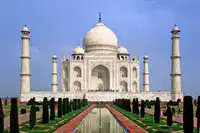
• Built many great architecture buildings including the Taj
Mahal and the Peacock Throne, a brilliant gold throne
encased in hundreds of precious gems.
17


SHAH JEHAN
•Taj Mahal
• Built in honor of his wife who died during childbirth.
• Took over a decade to build and it nearly
bankrupted the empire.
•1657 - Shah Jehan became seriously ill and a
dispute over the succession of the throne
ensued between his three sons.
•Aurangzeb deposed Shah Jehan in a coup
d’etat in 1658. Shah Jehan was imprisoned in
the Octagonal Tower of the Agra Fort from
which he could see the Taj Mahal. He died in
1666 and was buried next to his wife in the Taj
Mahal.
18


AURANGZEB 1658 - 1707
THE INTOLERANT
• Aurangzeb ascended the throne after
disposing his father and beating out his
two brothers.
• Despot
• severely persecuted Hindus of Northern India.
• Empire declines under his reign
• He removed the tax-free status for Hindus
• Destroyed their temples
• Crushed semi-autonomous Hindu states
• Primary Interest - Promote Islam vs
tolerance
19


AURANGZEB
• Aurangzeb over expanded the empire and strained his
resources.
• Large sums of money and manpower were lost.
• He lost the support of the Hindu people.
• The over expansion of his empire weakened his administration.
• Aurangzeb died in 1707
Hiss son Bahadur Shah succeeded him. Bahadur was so old by the
time he ascended the throne, he only managed to live a few
more years. But at this point in time, the government was so
unstable and so weak, the empire become an easy target of
invasion and exploitation, first by the Persians, and then by the
British.
• The death of Aurangzeb and the short reign of his son led to
the end of the Mughal empire and the beginning of British
Rule.
20


AURANGZEB’S ARCHITECTURAL LEGACY
Bibi ka Maqbara, Aurangbab 1678
Aurangzeb
Taj Mahal, Agra 1631-1652
Shah Jehan
Built nearly 50 years apart, the Taj Mahal and the Bibi la Maqbara are very
similar in architectural style. Aurangzeb’s other architectural legacy included:
• Moti Masjid (Delhi Fort), Delhi (1659)
• Buri-I-Shamali (Delhi Fort), Delhi
• Badshahi Mosque, Lahore (1674)
21


22


THE SUCCESS OF THE MUGHALS
• It is agreed among many scholars that the Mughal empire
was the greatest, richest and most long-lasting Muslim dynasty
to rule India. This period of Mughal rule produced the finest
and most elegant art and architecture in the history of Muslim
dynasties.
• The Mughal emperors, with few exceptions, were among the
world’s most aesthetically minded rules. Although Turkish and
Persian in background, the Mughals were not Muslim rulers of
India but Indian rulers who happened to be Muslims. This idea
is most evident in Akbar’s obsession of a utopian India for
Hindus and Muslims.
• The longevity of the Mughal empire can be contributed to a
number of factors. The Mughal emperors were ambitious and
for the most part able rulers. But Akbar is perhaps the Mughal
emperor responsible for much of the prosperity and harmony
achieved during the Mughal Empire.
23


• Akbar the Great, as he is
referred, perceived that 3
things were needed if his
Empire was to be stable and
long-lasting.
• 1. Fair rent must be fixed for the
peasant and a steady revenue
for the treasury,
• 2. The land must be ruled by
men who were impartial and
responsible to himself,
• 3. The Muslim must live at
peace with the Hindu.
• Akbar strove during his lifetime
to achieve these 3 things. He
showed tolerance to Hindu
scholars and women.
• By 1650, the Mughal empire
had expanded farther North
and South.
24


MUGHAL ART
• The Mughal Empire and the Great Mughals will
always be remembered as a great influence on
the artistic and cultural life of India. Their
architectural style can still be seen today such as
the Taj Mahal built by Shah Jehan and the
buildings at Fatehpur Sikri.
• The remarkable flowering of art and architecture
under the Mughal Empire is due to several
factors.
• The empire provided a secure framework within
which artistic genius could flourish. Both Hindu and
Muslim artists collaborated to produce some of the
best Indian art.
• The empire commanded wealth and resources that
were unparalleled in Indian history.
• The Mughal emperors were themselves patrons of
art whose intellectual ideas and cultural outlook
were expressed in the architecture.
25


SUMMARY: THE DYNASTY OF THE GREAT
MUGHALS IN INDIA
• 1605-1628
Jahangir succeeded his father, Akbar.
• 1628-1658
Prince Khurram was 35 years old when he
ascended the
throne as Shah Jehan, King of the World.
• 1659-1707
In the summer of 1659, Aurangzeb held a
coronation in
the Red Fort where he assumed the title of
Alamgir
(World Conqueror). After a bitter struggle with
his
two brothers, Aurangzeb was the victor who took
the
throne.
• 1857
Bahadur Shah II, the last Mughal emperor, was
deposed
in 1858. India was brought under the direct
rule of the
British Crown. This brought the end of the
Mughal
Empire.
26


•1526-1530
Babur’s victory at Panipat in 1526 established the
Mughal Empire and ended the reign of the Delhi
Sultanate. The rise of the great Mughal Dynasty in
India
began with Babur.
•1530-1556
Humayun succeeded his father Babur and became
emperor. He was defeated and dislodged by
insurrections
of nobles from the old Lodi regime. In
1540, the Mughal
domain came under control of
Farid Khan Sur (Shir Shah
Sur). Humayun died at
the age of 48 when he fell down the
steps of his
library.
•1556-1605
Akbar, the most sophisticated Mughal commander
and leader, was only 14 years of age when he
succeeded his father Humayun. Under Akbar's
reign,
Muslims and Hindu’s received the same
respect.
Summary: The Dynasty of the Great Mughals in India
27


REMINDER: HOMEWORK
BELLWORK
1.
List Three Things
You Notice about
this map:
2.
Make Two
inferences about the
Mughal and
Ottoman Empires
Show answer
Auto Play
Slide 1 / 27
SLIDE
Similar Resources on Wayground

21 questions
8.18 Declaration of Independence
Presentation
•
8th Grade
20 questions
International Trade
Presentation
•
8th Grade
22 questions
Review of the Renaissance
Presentation
•
10th Grade
22 questions
Understanding Taxes
Presentation
•
8th Grade
21 questions
The Battle of Puebla
Presentation
•
9th Grade
22 questions
Chernobyl
Presentation
•
9th Grade
18 questions
WWI Ends
Presentation
•
9th Grade
21 questions
Lewis and Clark
Presentation
•
8th Grade
Popular Resources on Wayground
10 questions
Safety Day 2026 – Student Review

Quiz
•
9th Grade
21 questions
Continents and Oceans
Quiz
•
6th Grade
20 questions
Parts of Speech
Quiz
•
5th Grade
16 questions
Subject & Predicate
Quiz
•
5th Grade
25 questions
Multiplication Facts
Quiz
•
5th Grade
12 questions
Map Skills
Quiz
•
3rd Grade
22 questions
Continents and Oceans
Quiz
•
5th Grade
15 questions
Rounding Decimals
Quiz
•
5th Grade
Discover more resources for Social Studies
10 questions
Exploring the Age of Exploration: Key Events and Figures

Interactive video
•
6th - 10th Grade
10 questions
Debating the Legacy of Christopher Columbus
Interactive video
•
6th - 10th Grade
27 questions
World Geography - Q1 9week Test
Quiz
•
9th Grade
25 questions
Gilded Age Gallery Walk
Presentation
•
9th - 12th Grade
30 questions
The Americas Review
Quiz
•
9th Grade
10 questions
Exploring the 13 Colonies Regions
Interactive video
•
6th - 10th Grade
23 questions
USHC 6 FDR and The New Deal Programs
Quiz
•
9th - 12th Grade
19 questions
Spanish American War
Presentation
•
8th - 12th Grade