

Atomic Structure Chemistry review

Presentation
•
Chemistry
•
11th Grade
•
Practice Problem
•
Medium
+5
Standards-aligned

NAUDIA LAWRENCE
Used 6+ times
FREE Resource
19 Slides • 29 Questions
1
2

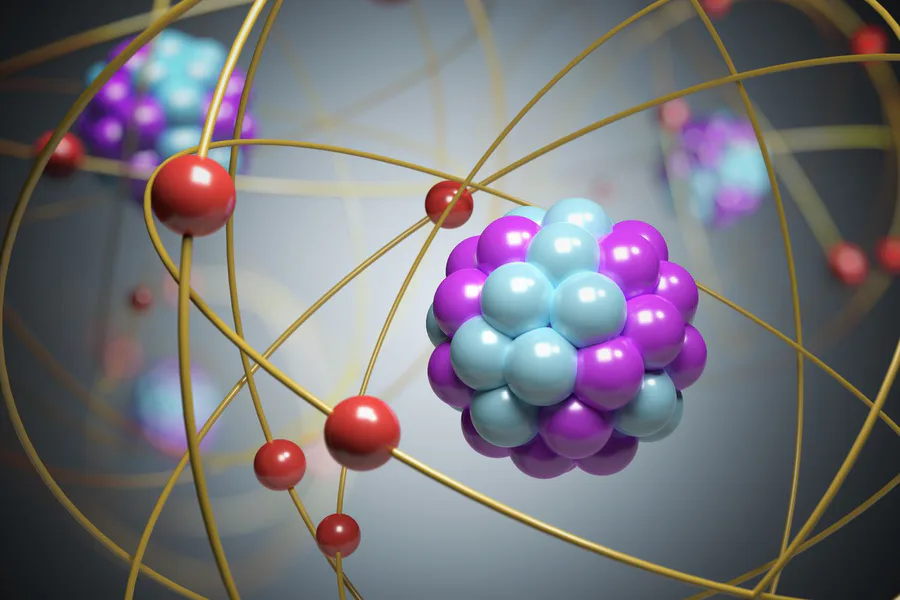
This is the newest model of the atom that we use today.
Nucleus (positive)
Electron cloud (negative)
3

4

5
6
Multiple Choice
In the wave-mechanical model of an atom, an orbital is defined as
(1) a region of the most probable neutron location
(2) a region of the most probable electron location
(3) the straight-line path of a neutron
(4) the straight-line path of an electron
7
Multiple Choice
Which statement describes a concept included in the wave-mechanical model of the atom?
(1) Protons, neutrons, and electrons are located in the nucleus.
(2) Electrons orbit the nucleus in shells at fixed distances.
(3) Atoms are hard, indivisible spheres.
(4) Electrons are located in regions called orbitals.
8
Multiple Choice
An orbital is a region in an atom where there is a high probability of fi nding
(1) an alpha particle
(2) an electron
(3) a neutron
(4) a positron
9
Multiple Choice
According to the wave-mechanical model, an orbital is defined as the most probable location of
(1) an alpha particle
(2) an electron
(3) a neutron
(4) a positron
10
Multiple Choice
According to the wave-mechanical model of the atom, electrons are located in
(1) orbitals
(2) circular paths
3) a small, dense nucleus
(4) a hard, indivisible sphere
11
12
13
(+, - , 0)
14

15

Table O has the Masses and charges of subatomic particles
Dont forget that the beta particle is the electron
If you forget go to Table O
16
Multiple Choice
Which subatomic particles are matched with their charges?
(1) Protons are positive and neutrons are negative
(2) Protons are positive and electrons are negative.
(3) Protons are negative and neutrons have no charge.
(4) Protons are negative and electrons have no charge.
17
Multiple Choice
Which statement describes the charge and location of an electron in an atom?
(1) An electron has a positive charge and is located outside the nucleus.
(2) An electron has a positive charge and is located in the nucleus.
(3) An electron has a negative charge and is located outside the nucleus.
(4) An electron has a negative charge and is located in the nucleus.
18
Multiple Choice

The diagram represents a particle traveling through an electricfi eld.
Which particle remains undeflected when passing through this electric fi eld?
(1) proton
(2) electron
(3) neutron
(4) positron
19
Multiple Choice
Which statement explains why a xenon atom is electrically neutral?
(1) The atom has fewer neutrons than electrons.
(2) The atom has more protons than electrons.
(3) The atom has the same number of neutrons and electrons.
.(4) The atom has the same number of protons and electrons.
20
Multiple Choice
Atoms are neutral because the number of
(1) protons equals the number of neutrons
(2) protons equals the number of electrons
(3) neutrons is greater than the number of protons
(4) neutrons is greater than the number of electrons
21
(atomic mass unit, amu)
22
Multiple Choice
Which particles are found in the nucleus of an argon atom?
(1) protons and electrons
(2) positrons and neutrons
(3) protons and neutrons
(4) positrons and electrons
23
Multiple Choice
Which statement describes the location of protons and neutrons in an atom of helium?
(1) Protons and neutrons are in the nucleus.
(2) Protons and neutrons are outside the nucleus.
(3) Protons are outside the nucleus, and neutrons are in the nucleus.
(4) Protons are in the nucleus, and neutrons are outside the nucleus.
24
25

Protons are positive
Neutrons have no charge
Overall charge of the nucleus is therefore POSITIVE
Nucleus has protons and neutrons
26
Multiple Choice
The part of an atom that has an overall positive charge is called
(1) an electron
(2) the nucleus
(3) the first shell
(4) the valence shell
27
Multiple Choice
Which phrase describes an Al atom?
(1) a negatively charged nucleus, surrounded by negatively charged electrons
(2) a negatively charged nucleus, surrounded by positively charged electrons
(3) a positively charged nucleus, surrounded by negatively charged electrons
(4) a positively charged nucleus, surrounded by positively charged electrons
28
Multiple Choice
What is the total charge of the nucleus of a Magnesium atom?
0
- 12
+ 12
+ 24
29
Multiple Choice
What is the total charge of a Nitrogen atom?
0
- 7
+ 7
+ 14
30
Multiple Choice
What is the total charge of the nucleus of a Xenon atom?
0
- 54
+ 54
+ 131
31
Multiple Choice
What is the total charge of the nucleus of a silver atom?
+ 47
0
- 47
+ 108
32
Multiple Choice
What is the total charge of a Carbon atom?
0
- 7
+ 7
+ 14
33
(atomic mass unit, amu)
34
35
Table O has the Masses and charges of subatomic particles
Dont forget that the beta particle is the electron
If you forget go to Table O
36
Multiple Choice
Which two particles each have a mass approximately equal to one atomic mass unit?
(1) positron and proton
(2) positron and electron
(3) neutron and electron
(4) neutron and proton
37
Multiple Choice
The mass of an electron is
(1) equal to the mass of a proton
(2) equal to the mass of a neutron
(3) greater than the mass of a proton
(4) less than the mass of a neutron
38
Multiple Choice
Which symbol represents a particle that has a mass approximately equal to the mass of a neutron?
(1) α
(2) β-
(3) β
(4) p
39
Multiple Choice
Which subatomic particles each have a mass of approximately 1 u?
(1) proton and electron
(2) proton and neutron
(3) neutron and electron
(4) neutron and positron
40
(electrons)
41
Multiple Choice
What is the number of electrons in an atom that has 20 protons and 17 neutrons?
(1) 37
(2) 20
(3) 3
(4) 17
42
Multiple Choice
Which electron configuration represents the electrons in an atom of sodium in the ground state at STP?
(1) 2-8-1
(2) 2-7-2
(3) 2-8-6
(4) 2-7-7
43
(Protons)
44
Multiple Choice
What is the number of protons in an atom with the electron configuration of 2 - 5?
(1) 5
(2) 2
(3) 3
(4) 7
45
46
Multiple Choice
In the ground state, which shell of a potassium atom has an electron with the greatest amount of energy?
(1) first
(2) second
(3) third
(4) fourth
47
Multiple Choice
Compared to the energy of an electron in the second shell of an atom of sulfur, the energy of an electron in the
(1) first shell is lower
(2) first shell is the same
(3) third shell is lower
(4) third shell is the same
48
Multiple Choice
Which electron shell in an atom of calcium in the ground state has an electron with the greatest amount of energy?
(1) first
(2) second
(3) third
(4) fourth
Show answer
Auto Play
Slide 1 / 48
SLIDE
Similar Resources on Wayground

40 questions
The Gaseous State
Presentation
•
11th Grade
40 questions
World War I
Presentation
•
11th - 12th Grade
39 questions
organic compounds
Presentation
•
11th Grade
43 questions
Random Variables
Presentation
•
11th Grade
42 questions
Isomers
Presentation
•
11th Grade
44 questions
Chemistry Chapter 5 Section 2
Presentation
•
11th Grade
41 questions
2.1 The Nuclear Atom
Presentation
•
11th Grade
44 questions
How to Improve Your Essay in CEFR-aligned SPM Writing Part 2
Presentation
•
10th - 11th Grade
Popular Resources on Wayground
10 questions
Safety Day 2026 – Student Review

Quiz
•
9th Grade
21 questions
Continents and Oceans
Quiz
•
6th Grade
20 questions
Parts of Speech
Quiz
•
5th Grade
16 questions
Subject & Predicate
Quiz
•
5th Grade
25 questions
Multiplication Facts
Quiz
•
5th Grade
12 questions
Map Skills
Quiz
•
3rd Grade
22 questions
Continents and Oceans
Quiz
•
5th Grade
15 questions
Rounding Decimals
Quiz
•
5th Grade
Discover more resources for Chemistry
20 questions
electron configurations and orbital notation
Quiz
•
9th - 12th Grade
20 questions
Periodic Table Trends
Quiz
•
11th Grade
50 questions
Unit 3: Atomic Assault Summative Review
Quiz
•
11th Grade
20 questions
Physical or Chemical Change/Phases
Quiz
•
8th Grade - University
15 questions
Periodicity Module Exam Practice Quiz
Quiz
•
9th - 12th Grade
15 questions
Electron Configurations and Orbital Notation
Quiz
•
11th Grade
8 questions
Label Energy Diagram
Quiz
•
9th - 12th Grade
20 questions
Naming Covalent Compounds
Quiz
•
11th Grade