Search Header Logo
Enviro Sci Final Review

Enviro Sci Final Review

Assessment

Presentation

Science

9th Grade

Medium

NGSS
MS-LS2-4, MS-LS2-5, MS-LS2-3

+28

Standards-aligned

Created by

Terry Smith

Used 1+ times

FREE Resource

0 Slides • 158 Questions

1

Multiple Choice

Question image

How does carbon dioxide return to the atmosphere?

1

Photosynthesis

2

Combustion and Cellular Respiration

3

Consumption

4

Decomposition

2

Multiple Choice

Question image

What is the main thing that carries out Nitrogen Fixation?

1

Lightning

2

Bacteria

3

Plants

4

Humans

3

Multiple Choice

Question image

How do non-human living things affect the carbon cycle?

1

animals do cellular respiration

2

plants do photosynthesis

3

Fires release carbon into the atmosphere

4

All of the above

4

Multiple Choice

Question image

What process removes carbon from the atmosphere?

1

combustion

2

cellular respiration

3

photosynthesis

4

decomposition

5

Multiple Choice

Question image
Where is carbon stored in the environment?
1

Fossil fuels

2

Wood of trees

3

Calcium carbonate (shells and bones)

4

All of the above

6

Multiple Choice

Question image
What 2 things does a plant make during photosynthesis?
1

oxygen, glucose

2

glucose, carbon dioxide

3

useable energy, glucose

4

oxygen, carbon dioxide

7

Multiple Choice

Question image
What 3 things are made during cellular respiration?
1

useable energy, water, glucose

2

glucose, water, carbon dioxide

3

oxygen, carbon dioxide, glucose

4

carbon dioxide, water, useable energy

8

Multiple Choice

Question image

Process where plants and animals release CO2 back into the atmosphere through exhaling.

1

Photosynthesis

2

Decomposition

3

Respiration

4

Uplift

9

Multiple Choice

Question image

Animals obtain nitrogen when they eat plants or other animals.

1

True

2

False

10

Multiple Choice

Question image

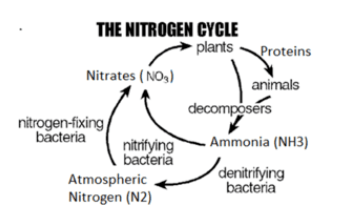
Which nitrogen cycle process is occurring when plant roots absorb ammonium ions and nitrate ions for use in making molecules such as DNA, amino acids, and proteins?

1

nitrogen fixation

2

nitrification

3

denitrification

4

ammonification

5

assimilation

11

Multiple Choice

Question image

According to this diagram, plants use nitrogen to make _________________________

1

carbohydrates

2

cellulose

3

proteins

4

unsaturated fats

12

Multiple Choice

Question image

Photosynthesis is an important part of the ______ cycle

1

Carbon

2

Water

3

Phosphorus

4

Nitrogen

13

Multiple Choice

A particular golf course is using large amounts of nitrogen fertilizer. What process could move this nitrogen into a local stream?
1

volatilization

2

nitrogen fixation

3

runoff

4

ammonification

14

Multiple Choice

Question image
What is the process of water droplets or ice crystals falling from the sky?
1

evaporating

2

condensing

3

precipitating

4

runoff

15

Multiple Choice

Question image
What is this a picture of?
1

Nitrogen cycle

2

carbon cycle

3

water cycle

4

plant cycle

16

Multiple Select

The biosphere includes which of the following?

1

Trees/Flowers

2

Bacteria/Protists

3

Water/Clouds

4

Rocks/Minerals

5

Insects/Arachnids

17

Multiple Choice

Which meaning goes with the Latin prefix Bio-

1

Living Things

2

Air

3

Land

4

Water

18

Multiple Choice

When plants draw nutrients from the soil, the interaction is between which two spheres? 
1

The atmosphere and the geosphere 

2

The geosphere and the hydrosphere 

3

The hydrosphere and atmosphere 

4

The biosphere and the geosphere 

19

Multiple Choice

Geo = 
1

Earth

2

Sphere

3

Life

4

Water

20

Multiple Choice

Question image
Which of the following describes all of the types of water found in the hydrosphere?
1

all frozen water on the Earth

2

all of the water on the Earth

3

all of the fresh water on the Earth

4

all of the water found on the surface of the continents

21

Multiple Choice

Question image

An ocean bay food web is pictured.


Imagine a sea otter moves to the area. The sea otter eats crabs. What would happen to the ecosystem?

1

The ecosystem would stay the same

2

The sea duck population will decrease (go down)

3

The crab population will increase (go up)

4

The sea duck population would increase (go up)

22

Multiple Choice

Question image

Pictured is a food web.


Which organism is an omnivore?

1

Deer

2

Berries

3

Black bear

4

Red Fox

23

Multiple Choice

Question image

Pictured is a food web.


Which organism is a producer?

1

Deer

2

Berries

3

Black bear

4

Red fox

24

Multiple Choice

Question image

Pictured is a food web.


Which organism is a herbivore?

1

Deer

2

Berries

3

Black bear

4

Red fox

25

Multiple Choice

Decomposers are important in the food web because they

1

Produce their own food using light from the sun

2

Stop the flow of energy from one organism to another

3

Break down dead organisms and recycle nutrients into the soil

4

Are microscopic and other organisms eat them

26

Multiple Choice

Question image

A food web is pictured.


What is the source of energy for the algae?

1

Sun

2

Rotifers, water fleas, and tadpoles

3

Decomposers

4

Algae does not need energy

27

Multiple Choice

Willow trees get their energy from the sun. Willow trees are...

1

Producers

2

Consumers

3

Decomposers

4

Herbivores

28

Multiple Choice

Question image

Pictured are gannets roosting on a cliff side.


Which of the following are limiting factors that gannets might experience?

1

Nesting space

2

Food

3

Hurricane

4

All of the above

29

Multiple Choice

Question image

Which is a possible food chain based off the food web shown?

1

Raspberry bush --> sparrow --> mountain lion

2

Mountain lion --> fox --> rabbit --> raspberry bush

3

Raspberry bush --> rabbit --> fox --> mountain lion

4

Owl --> mountain lion --> hawk

30

Multiple Choice

the number of people in a defined area such as a square kilometre

1

population density

2

birth rate

3

death rate

4

population

31

Multiple Choice

Why don't populations grow indefinitely?

1

limiting factors

2

only biotic factors

3

only abiotic factors

4

none of the above

32

Multiple Choice

The exponential graph is a graph that shows us population size increasing quickly, which one below shows us that

1
2
3
4

33

Multiple Choice

(Im)migration is ...

1

the movement into an area

2

The movement out of an area

3

The migration process

4

exponential graph

34

Multiple Choice

Question image

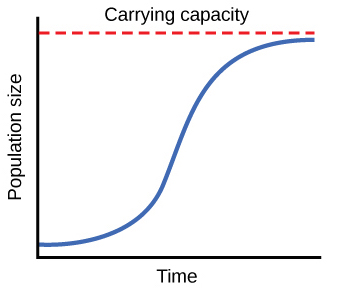
What is the carrying capacity mean?

1

The number of individuals an area can carry

2

the number of births

3

The number of deaths an area has

4

not sure

35

Multiple Choice

Question image

parasites, disease, predators, are examples of what type of limiting factors?

1

density dependent

2

density independent

3

survivorship

4

type 1 curve

36

Multiple Choice

Why don't populations grow indefinitely?

1

limiting factors

2

only biotic factors

3

only abiotic factors

4

none of the above

37

Multiple Choice

Question image

What are survivorship curves?

1

curves that describe the number of survivors over time

2

curves that tell us what the limiting factors are

3

curve that tells us about the carrying capacity

4

a curve

38

Multiple Choice

Emigration is

1

the movement out of an area

2

the movement into an area

3

movement in and out of an area

4

migration

39

Multiple Choice

Question image
Which threat to biodiversity is being displayed?
1

overexploitation

2

invasive species

3

pollution

4

habitat fragmentation

40

Multiple Choice

Question image

What point on the graph represents the carrying capacity?

1

A

2

B

3

C

4

D

41

Multiple Choice

A population is...

1

All members of one species in one area

2

All members of all species that live in one area

3

All of the living and nonliving things in an area

4

None of these

42

Multiple Choice

Question image

What is happening at the 'A' on the graph?

1

the population overshoots above the carrying capacity

2

the population stops growing

3

growth begins to slow down due to limited resources

4

growth is speeding up due to an abundance of resources

43

Multiple Choice

To measure population density, you must divide the number of individuals living in a defined space by the
1

area of the space

2

birth and death rates

3

carrying capacity

4

height of the space

44

Multiple Choice

Nesting birds often space themselves evenly from other nests. This pattern is called
1

clumped dispersion.

2

uniform dispersion.

3

random dispersion

4

scatter dispersion

45

Multiple Choice

Question image
Lichens and mosses that first live in uninhabited areas are examples of
1

secondary species

2

non-native species

3

pioneer species

4

climax species

46

Multiple Choice

Species that could become endangered in the near future are called
1

unlucky

2

extinct

3

endangered

4

threatened

47

Multiple Choice

The sea otter is a(n) ___________ that influences the survival of many other species in its ecosystem.
1

Cute furry creature

2

endangered species

3

keystone species

4

important animal

48

Multiple Choice

Introduced or invasive species are often difficult because:
1

They contribute to habitat fragmentation

2

They do not adapt well to new environments

3

They increase biodiversity

4

They often lack natural predators

49

Multiple Choice

Question image
__________ growth shows growth of a population under environmental constraints (carrying capacity-K) that sets a maximum population size 
1

logistic

2

exponential

3

niche

4

uniform

50

Multiple Choice

The number of females and males of each age contained in a population...

1

limiting factor

2

demography

3

age structure

4

logistic growth

51

Multiple Choice

Question image
Name that population pyramid...
1

Industrialized Country

2

Country with Clean Water

3

Developing Country

4

Logistic Growth

52

Multiple Choice

Question image
Name that population pyramid?
1

Stable Growth

2

Developing Country

3

Exponential Growth

4

Negative Growth

53

Multiple Choice

Question image
Name that population pyramid...
1

Rapid Growth

2

Industrialized Country

3

Declining Growth

4

Stable Growth

54

Multiple Select

Which of the following occurred alongside the Industrial Revolution that led to rapid human population growth? Select all that apply.

1

reliable food supplies

2

improvements in sanitation

3

the Bubonic Plague

4

improvements in health and medicine

55

Multiple Choice

____________ is when an individual joins a different population than what they were originally a part of. 

1

emigration

2

immigration

3

importation

4

negative growth

56

Multiple Choice

Question image

Using the age structure diagrams, Which country has a greater population in the “reproductive” age group?

1

United States

2

Guatemala

57

Multiple Choice

Which of the following describes the distribution of organisms around the watering hole in the Savanna?

1

clumped distribution

2

uniform distribution

3

random distribution

4

territorial distribution

58

Multiple Choice

A human & a Tape Worm: The tape worm gets a place to live in the intestines of the human and food from the human. The human loses weight and nutrients from the tape worm.
1

Mutualism

2

Commensalism

3

Parasitism

59

Multiple Choice

Question image
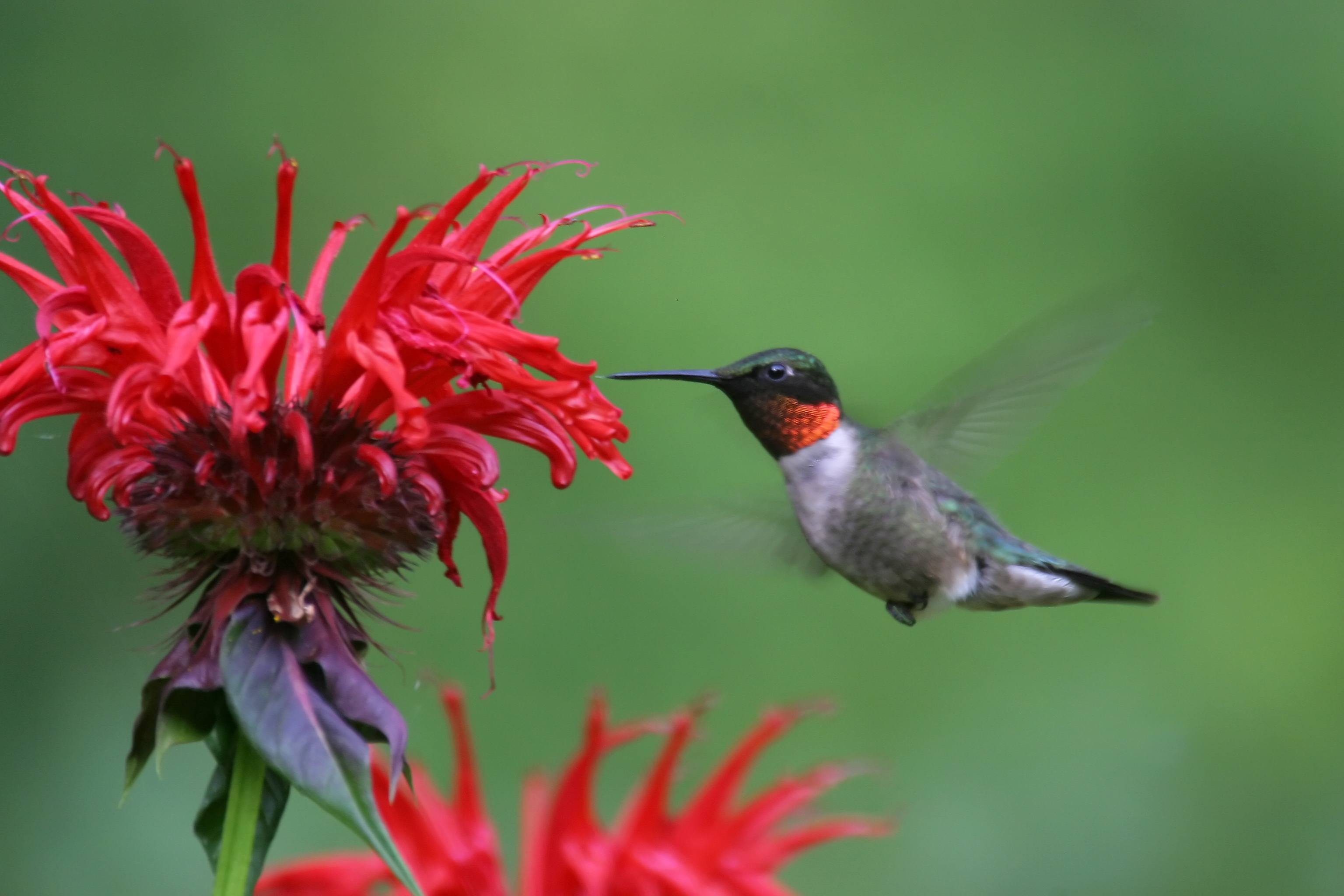
What type of symbiosis?  Hummingbirds feed on nectar from flowers.  The flowers are pollinated by hummingbirds as they move from flower to flower.
1

commensalism

2

mutualism

3

parasitism

4

predation

60

Multiple Choice

Groups of different populations that live in a given area and interact are called a(n)...

1

Community

2

Colony

3

Population

4

Ecosystem

61

Multiple Choice

What is the term for each step in the transfer of energy and matter within a biological community?
1

energy path

2

food web

3

trophic level

4

food pyramid

62

Multiple Choice

Question image
diagram that shows the energy available to each trophic level in an ecosystem; 10% is passed on to upper levels, the rest is lost as heat
1

succession 

2

cellular respiration

3

energy pyramid

4

biochemical cycle

63

Multiple Choice

Study of interactions between organisms and their environment 
1

niche

2

community 

3

ecology

4

ecosystem

64

Multiple Choice

___ states that two species cannot exist together if they compete for the same resources. One will either die out or migrate, or they will adapt to separate resources.
1

Hardy-Weinberg Principle

2

Limiting Nutrient Principle

3

Competitive Exclusion Principle

4

Tolerance Principle

65

Multiple Choice

Question image
Change over time...
1

Evolution

2

Nucleotide 

66

Multiple Choice

Question image
To adjust to a changing environment
1

Mutation

2

Adapt

67

Multiple Choice

The percentage of energy that is transferred from a lower trophic level to the trophic level above it.

1

10

2

1

3

100

4

2

68

Multiple Choice

Where the better adapted organisms survive to pass traits along to offspring.
1

Evolution

2

Natural Selection

3

Extinction

4

Artifical Selection

69

Multiple Choice

Question image
this bee is pollinating the flower. this is an example of 
1

mutualism

2

commensalism

3

parasitism

4

interspecific competition 

70

Multiple Choice

Question image

Which of the following best describes a niche?

1

how many children the organism has

2

the job an organism does in the community

3

where an organism sleeps

4

what types of food the organism eats

71

Multiple Choice

The process when concentrations of a harmful substance increases in organisms at higher trophic levels in a food chain or food web.
1

Biomagnification

2

Predation

3

Extinction

4

Accumulation

72

Multiple Choice

Question image
Identify the process shown in this diagram.
1

Extinction

2

Toxin Accumulation

3

Pollution

4

Biomagnification

73

Multiple Choice

animals or plants that other parts of the ecosystem depend on

1

prey

2

pack

3

keystone species

4

predators

74

Multiple Choice

Question image
Use the diagram to answer the question.
The trout is a source of food for the human and the eagle. When there are more than one organism vying for the same source we call this____?
1

Population

2

Resources

3

Community

4

Competition

75

Multiple Choice

A collection of organisms that make up a community as well as all of the nonliving aspects of the environment.
1

Population

2

Community

3

Habitat

4

Ecosystem

76

Multiple Choice

Question image

What is a keystone species?

1

A species that helps to hold an ecosystem together

2

A species that lives in or around rocks

3

Keys and stones have nothing to do with ecology

4

A keystone isn't a living thing, it's just a stone

77

Multiple Choice

Question image
In the energy pyramid here, how much of the energy in each level gets lost as heat or used by the organism for survival?
1

80%

2

90%

3

10%

4

20%

78

Multiple Choice

The efficiency of energy transfer from a lower trophic level to the next highest level is roughly
1

1%

2

10%

3

100%

4

1000%

79

Multiple Choice

What effect does biodiversity have on a community?
1

It makes destruction by insects impossible. 

2

It makes primary succession more likely.   

3

 It enables species to survive in a desert.

4

It enables the community to withstand changes.

80

Multiple Choice

The differences among a species, like different bird beaks, are called
1

genes.

2

variations.

3

traits.

4

theories.

81

Multiple Choice

Organisms with the most beneficial traits will survive.  This is commonly known as
1

theory of evolution.

2

variations.

3

survival of the fittest.

4

ecosystems.

82

Multiple Choice

Behavioral changes of individuals of a species that allow for better survival.

1

Variation

2

Adaptation

3

Behavior

4

Environment

83

Multiple Choice

Where the better adapted organisms survive to pass traits along to offspring.
1

Evolution

2

Natural Selection

3

Extinction

4

Artifical Selection

84

Multiple Choice

Why are advantageous traits more likely to be passed onto offspring?
1

Because they are more likely to survive and reproduce.

2

Because they come from dominant alleles.

3

Because they come from recessive alleles.

4

Because the trait is an acquired phenotype.

85

Multiple Choice

Do organisms "decide" to evolve and change?
1

Yes, they know they need to change to survive 

2

No, a species changes over time because of natural selection

86

Multiple Choice

Species that are clearly critical to the functioning of an ecosystem are known as

1

biodiversity

2

keystone species

3

main species

4

native species

87

Multiple Choice

A species that is likely to become extinct if protective measures are not taken immediately is known as

1

threatened species

2

endemic species

3

keystone species

4

endangered species

88

Multiple Choice

a species that is not native to a particular region and has no natural predators and little competition

1

consumer species

2

producer species

3

invasive species

4

adapted species

89

Multiple Choice

Succession that occurs in areas that previously didn't support life, such as on rocks or ice

1

tangential succession

2

primary succession

3

secondary succession

4

quaternary succession

90

Multiple Choice

Question image

Why is "A" less biodiverse than "B"?

1

Image "A" is more biodiverse.

2

Image "A" has many corn plants and this makes it have high "rich" biodiversity.

3

Image "A" has a lot more plants than image "B"

4

Even though "A" has a lot of corn plants they are all the same species and makes this a low "poor" biodiverse area.

91

Multiple Choice

Question image
High biodiversity is 
1

having a lot of the same organism.

2

having a few of the same organism.

3

having a lot of variety of different organisms.

4

only having one of each organism. 

92

Multiple Choice

Why is biodiversity important to ecosystems?

1

It helps populations adapt to ecological changes.

2

It increases at each level of the food chain.

93

Multiple Choice

Define genetic diversity

1

variation of genes within a species or population in a given area

2

variety of ecosystems in a given area

3

system made up of all the living and nonliving things in a given area

4

disturbance in the environment conditions that cause genetic changes to occur in organisms

94

Multiple Choice

Define ecosystem diversity

1

variety of ecosystems in a given area

2

variation of genes within a species or population in a given area

3

variety of life in Earth's land, freshwater, and marine ecosystems

4

changes to an ecosystem that affect how the parts of it interact

95

Multiple Choice

Which of these is NOT true about the Endangered Species Act

1

It protects all plants and animals on the endangered species list

2

It is a law that must be obeyed around the world.

3

Anyone who harms species covered by this act can receiver a fine ($)

4

It is enforces by US Fish & Wildlife Service

96

Multiple Choice

the stability of an ecosystem depends on 2 factors

1

natural and human-caused disturbances

2

weather and climate

3

ecosystem resilience and resistance

4

independent and dependent variables

97

Multiple Choice

an ecological hotspot is

1

an area where temperatures reach at least 120 degrees F

2

an area of very high biodiversity

3

an area where almost no species can be found

4

a species that is only found in one part of the world

98

Multiple Choice

A greater a habitat's biodiversity, the greater will be that habitat's -

1

sustainability over time with varying conditions.

2

consumption of energy in the form of sunlight.

3

temperature ranges across the seasons.

4

distance to the nearest water source.

99

Multiple Choice

Why does biodiversity contribute to a habitat's sustainability?

1

The more plants and animals in a habitat, the greater the biomass, which is how habitats store energy.

2

The greater the number of species, the more competition there is for food between predators, which sustains their populations.

3

Changing conditions that harm one species leave other species to survive and perhaps even thrive.

4

Landforms change shape less frequently when there is a greater number of species using the land.

100

Multiple Choice

Which of the following most likely supports the most sustainable ecosystem?

1

The habitat with the greater number of green plants

2

The habitat with the greatest variety of living things

3

The habitat with the warmest average temperature

4

The habitat with the greatest number of consumers

101

Multiple Choice

How is the current decline in biodiversity different from the previous mass extinctions that Earth has experienced?

1

It is happening much more slowly

2

This time it is not really happening

3

It is made worse by an asteroid hitting Earth

4

This is being caused by humans

102

Multiple Choice

Which of the following is NOT a way in which humans are destroying habitats?

1

Gathering rain water to use to water crops

2

Clearing out prairies to grow a single crop

3

Cutting trees to use as toilet paper

4

Building a shopping mall with a large parking lot

103

Multiple Choice

Which of the following is NOT a cause for the current decline in the biodiversity of our ecosystem?

1

over-exploitation of resources

2

planting new forests to replace trees

3

pollution of animal's water sources

4

increasing human population

104

Multiple Choice

What is genetic diversity?

1

the variety of living things in an area

2

the variety of DNA within a species

3

the similarities within a species

4

the similarities among species in an area

105

Multiple Choice

What is species diversity?

1

the different animals in an area

2

the different habitats in an area

3

the different plants in an area

4

the different living things (plants and animals) in an area

106

Multiple Choice

What is an invasive species?

1

An organism that is new to an environment that has positive effects on the environment.

2

An organism that is native to an environment that has negative effects on the environment.

3

An organism that is new to an environment that has negative effects on the environment.

4

An organism that is native to an environment that has positive effects on the environment.

107

Multiple Choice

Which applies to this environmental problem:


The albatross are dying from eating plastic items that look like food.

1

Habitat Loss

2

Invasive Species

3

Pollution

4

Population Growth

5

Overconsumption

108

Multiple Choice

Which applies to this environmental problem:


The zebra mussel is outcompeting native species and causing damage in the Missouri River.

1

Habitat Loss

2

Invasive Species

3

Pollution

4

Population Growth

5

Overconsumption

109

Multiple Choice

Which applies to this environmental problem:


Only 10% of Madagascar's forests remain due to deforestation.

1

Habitat Loss

2

Invasive Species

3

Pollution

4

Population Growth

5

Overconsumption

110

Multiple Choice

Which applies to this environmental problem:


As more people are added to the Earth, more resources are required to meet their needs.

1

Habitat Loss

2

Invasive Species

3

Pollution

4

Population Growth

5

Overconsumption

111

Multiple Choice

Which of the following measures is most likely to help an endangered animal that roams over a large territory?

1

creating an isolated preserve

2

creating wildlife corridors

3

selling hunting licenses

4

building more zoos

112

Multiple Choice

Which climate would you expect to have the highest biodiversity?

1

Hot,Dry

2

Warm,Moist

3

Cold,Moist

4

Cold,Dry

113

Fill in the Blank

Habitat loss is a major reason why species become ____________________, ____________________, or __________________.

114

Multiple Choice

Zoos and aquariums can help increase wildlife populations through

1

captive breeding programs

2

international biodiversity treaties

3

conservation concessions

4

wildlife corridors

115

Multiple Choice

Which of the following is an example of a method for managing whole ecosystems and habitats?

1

captive breeding

2

cloning

3

Species Survival Plans

4

mapping biodiversity hotspots

116

Multiple Choice

A plan to establish an 8000km long strip of land across eight SE Asian countries to rejoin fragments of habitats is an example of

1

wildlife corridor

2

world biodiversity treaty

3

captive breeding program

4

conservation concession

117

Multiple Choice

The Sikhote-Alin Mountains, and the Siberian tigers living on them, are separated from other mountain regions in which the tigers could live. The mountains are an example of a(n)
1

mass extirpation

2

invasive species

3

mass extinction

4

habitat fragment

118

Multiple Choice

The disappearance of a particular population from a given area, but not of the entire species globally, is called 
1

extirpation

2

extinction

3

poaching

4

fragmentation

119

Multiple Choice

By far, the biggest cause of biodiversity loss today is 
1

climate change.

2

overharvesting.

3

habitat change and fragmentation.

4

pollution.

120

Multiple Choice

In the United States, what is the major law that protects biodiversity?
1

Convention on Biological Diversity

2

Endangered Species Act

3

U.S. Fish & Wildlife Service

4

Species Survival Plan

121

Multiple Choice

Which of the following causes Earth's tectonic plates to move?
1

Energy from the Sun

2

Magnetic Pole Reversal

3

Convection currents in the mantle

4

Faults in Mountain Ranges

122

Multiple Choice

Question image
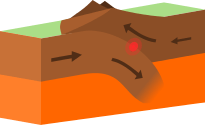
What type of event will occur at this boundary?
1

Earthquake

2

Volcano Eruption

3

Tornado

4

Mountain Building

123

Multiple Choice

Question image
What type of plate boundary is this?
1

Plate

2

Divergent

3

Convergent

4

Transform

124

Multiple Choice

A divergent boundary occurs when plates ....
1

Pull apart

2

Come together

3

Slide past each other

4

subducting

125

Multiple Choice

Which of the following is the name of the ancient supercontinent formed 280 Million Years ago.

1

Pangea

2

Gondwanda

3

Laurasia

4

Neverland

126

Multiple Choice

What geologic feature/event would you most likely to find at a divergent boundary between two pieces of oceanic crust?
1

Rift Valley

2

Mid-Ocean Ridge

3

Island Arc

4

Flat land

127

Multiple Choice

This layer is divided into pieces called tectonic plates.
1

Mesosphere

2

Asthenosphere

3

Mantle

4

Lithosphere

128

Multiple Choice

A giant landmass that existed 200 million years ago
1

Wegener

2

Pangaea

3

Archyopteryx

4

Ammonite

129

Multiple Choice

Which piece of evidence did Wegener use to prove continental drift?
1

The shape of the continents

2

Similar fossils found on separate continents

3

Tree fossils found in odd places

4

All of the above

130

Multiple Choice

Question image
As you travel from the inner core to the crust, how would temperature, pressure and density of the material change?
1

The would all increase

2

The would all decrease.

3

Nothing, the layers are made of the same material throughout

4

Temperature would decrease, but pressure and density would increase

131

Multiple Choice

Question image
The diagram shows what can occur when two continental plates collide.Which characteristic of the Indian Plate explains why it moves under the Eurasian Plate?
1

It is larger.

2

It is denser.

3

It is molten.

4

It is younger.

132

Multiple Choice

Which statement best describes why fossils of the same land-dwelling species have been discovered in both South America and Africa?

1

The organism migrated to two continents

2

The organisms were separated by the formation of new mountain ranges

3

The organisms became extinct due to climate change on these continents

4

These organisms once lived on one large landmass that later split into two continents

133

Multiple Choice

Rocky or rigid outer part of Earth consisting of the brittle crust and the top part of the upper mantle

1

Lithosphere

2

Oceanic Crust

3

Continental Crust

4

Asthenosphere

134

Multiple Choice

Hot fluid or semi-fluid material below or within the earth's crust from which lava and other igneous rock is formed on cooling.

1

Convection Current

2

Lithosphere

3

Core

4

Magma

135

Multiple Choice

In the region where two continental plates collide, what geological feature MOST often forms?

1

an ocean

2

a volcano

3

a river valley

4

a mountain chain

136

Multiple Choice

The theory that the earth is broken into plates and are in motion due to convection currents in the asthenosphere (upper mantle).

1

outer core

2

inner core

3

plate tectonics

4

continental drift

137

Multiple Choice

Process in which two plates collide and the denser plate descends below the other.

1

divergent boundary

2

convergent boundary

3

subduction

4

continental drift

138

Multiple Choice

Question image

What type of plate boundary is shown in the picture?

1

Convergent

2

Divergent

3

Transform

139

Multiple Choice

Question image

What type of plate boundary is shown in the picture?

1

Convergent

2

Divergent

3

Transform

140

Multiple Choice

What landform would you most likely find at a divergent boundary between two pieces of oceanic crust?

1

Rift Valley

2

Mountain

3

Mid-Ocean Ridge

4

Volcano

141

Multiple Choice

What landform would you most likely find at a convergent boundary between two pieces of oceanic crust?

1

Rift Valley

2

Mid-Ocean Ridge

3

Mountain

4

Ocean Trench

142

Multiple Choice

According to Wegener's hypothesis of continental drift,

1

Earth's surface is made up of seven major landmasses

2

The continents were once joined together in a single landmass

3

Earth is slowly cooling and shrinking

4

the continents DO NOT move

143

Multiple Choice

Question image

How was Wegener's theory received by other scientists at the time?

1

They thought it was great

2

They did not accept it

144

Multiple Choice

Question image

Wegener found fossils of ancient ferns on Antarctica, this shows

1

That some ferns can survive temperatures well below freezing

2

That humans put ferns on Antarctica millions of years ago

3

That Antarctica drifted from a warmer climate where plants could grow

4

That fossils can be formed in cold climates

145

Multiple Choice

Question image

Wegener noticed that the Appalachian Mountains and Caledonian Mountains line up and are made of the same rock types. This was a type of ....

1

Fossil Evidence

2

Rock Formation Evidence

3

Climate Evidence

4

Objective Evidence

146

Multiple Choice

Question image

Why was Wegener's hypothesis not accepted?

1

He could not explain what force was moving the continents

2

He was a meteorologists, so no one took him seriously

3

He did not have enough types of fossils to support his theory

4

Because scientists thought Harry Hess' theory was better

147

Multiple Choice

What were 2 kinds of evidence were used to prove that the seafloor spread?

1

rock formations, WWII shipwrecks

2

magnetic seafloor stripes, WWII ship logs

3

magnetic seafloor stripes, age of rocks

148

Multiple Choice

What technology was used during WWII to detect enemy submarines and produce the first map of the seafloor?
1

Sonar

2

Radar

3

GPS

149

Multiple Choice

Process by which new ocean crust forms.

1

Seafloor spreading

2

Continental drift

3

Mid-ocean ridge

4

Rift

150

Multiple Choice

The OLDEST seafloor is located? 
1

Closest to the mid-ocean ridge

2

Farthest from the mid-ocean ridge

151

Multiple Choice

What are Mid-Ocean Ridges?
1

A chain of underwater waterfalls 

2

A chain of underwater volcanos

3

A chain of underwater mountains

4

A chain of underwater rocks

152

Multiple Choice

Why does oceanic crust sink below the continental crust during subduction

1

oceanic crust is less dense

2

oceanic crust is more dense

3

oceanic crust is older

4

oceanic crust is warmer

153

Multiple Choice

Takes place when Earth's magnetic field changes

1

magnetic reversal

2

mid-ocean ridge

3

normal polarity

4

reversed polarity

5

seafloor spreading

154

Multiple Choice

Magnetic bands on the ocean floor are evidence that Earth’s magnetic field changes.

1

TRUE

2

FALSE

155

Multiple Choice

Question image

How many grams of Carbon-14 will remain after 17,100 years- C-14 has a half life 5,730 so 17,100 is about 3 half lives?

1

32 g

2

16 g

3

8 g

4

4 g

156

Multiple Choice

Question image
How do scientists figure out the age of the seafloor?
1

They research it from ancient sea maps that trading vessels would use in the 1700s

2

They use the moon phases and eclipses to calculate the age

3

They use seismographs and the depth as well as location of earthquakes to calculate the age

4

They take drill ships to many locations in the oceans and collect, then date, rock samples. 

157

Multiple Choice

What causes convection currents?
1

weight differences

2

mass differences

3

density and temperature differences

4

rates of change

5

age differences

158

Multiple Choice

What are two (2) examples of hotspots?
1

San Andreas Fault and earthquakes

2

Mid-Atlantic Ridge and resulting subduction

3

Hawaiian Islands and Yellowstone

4

India and Mt. Everest

5

South America and Africa

Question image

How does carbon dioxide return to the atmosphere?

1

Photosynthesis

2

Combustion and Cellular Respiration

3

Consumption

4

Decomposition

Show answer

Auto Play

Slide 1 / 158

MULTIPLE CHOICE