
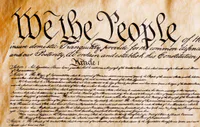
Constitution Day 2

Presentation
•
Social Studies
•
6th - 8th Grade
•
Medium

Jovan Bellecoeur
Used 12+ times
FREE Resource
40 Slides • 36 Questions
1

Review the mini lessons and complete the questions that follow.
US Constitution Review
2
The first federal government order was the Articles of Confederation, it created a very loose alliance of the 13 independent states. It was official in 1783.
The creators were influenced by Magna Carta, English Bill of Rights and followed models of self government from Mayflower Compact.
Many citizens were loyal to their state government, they also feared another strong government (federal).
Under the Article of Confederation the US became a union of states with a weak central government. This was created during the Revolutionary War.
It simply gave the States power and the federal government from gaining to much.
Articles of Confederation- the first constitution of the United States.
3
No President, no national tax, no, no federal court and lack of a strong federal government. Power Resided to the states.
Weaknesses
Congress had power to make war and peace, sign treaties; raise an army and navy; print money, and set up a postal system.
Strength
4
Shays' Revolt leads to a change.
A farmer (Daniel Shays) led a rebellion with 1,200 farmers, because the state of Massachusetts threatened to take his farm because he was unable to pay their high taxes. He claimed that he should not be punished for a problem he did not create.
States realize they need to make some changes to their confederate government.
This lead to the Constitutional Convention of 1787 to revise the A.O.C.
Shays' Rebellion-A revolt that proved how weak the Articles of Confederation was.
5
Multiple Choice
Which of the following DIRECTLY led to the Constitutional Convention of 1787?
Treaty of Paris
Shays' Rebellion
Boston Massacre
French and Indian War
6
Multiple Choice
A weakness of the Articles of Confederation was that MOST governmental power resided in the —
state governments
federal legislature
judicial branch
7
Multiple Choice
They allowed too little power to rest in a federal government and no federal power to levy taxes to pay for the costs of a government.
The above summary describes which document?
Federalist Papers
Articles of Confederation
Declaration of Independence
8
At the Constitutional Convention, proposals were presented for new forms of Government.
Constitutional Convention- A meeting among the original 13 states (minus Rhode Island) in 1787 with the purpose of revising the Articles of Confederation, but instead would result in the U.S. Constitution.
Plan called for representation based on population.
3 branches of government.
Benefits larger states.
Virginia Plan
Plan called for equal representation in each state regardless of population.
Benefits smaller states.
New Jersey Plan
9
Compromise where each slave counted as three-fifths of a person for tax and representation purposes
Three-Fifth Compromise
Compromise between the New Jersey and Virginia Plan that gave the government a bicameral legislature; Senate and House of Representatives
The Great Compromise
10
Multiple Choice
At the Constitutional Convention, the Virginia Plan included a proposal for —
a powerful executive
a one-house legislature
three separate branches of government
thirteen states with separate governments
▲
11
Multiple Choice
Which of the following was the result of the Great Compromise?
two house legislature
the right to bear arms
freedom of speech
slavery
12
Multiple Choice
The Three-Fifths Compromise at the Constitutional Convention concerned which of the following issues?
the establishment of upper and lower legislative bodies
the manner in which bills and amendments would become law
the portion of federal revenues that would come from large and small states
the counting of slaves for purposes of determining representation and taxation
13
Multiple Choice

At the 1787 Constitutional Convention, one major disagreement concerned representation in the new national legislature.
Which terms complete the diagram for numerals I and II?
I. by population, II. equal representation
I. equal representation, II. by population
I. by land area, II. by population
I. by population, II. by land area
14
As a result of the Constitutional Convention, the 7 Principles of Govt. were formed.
Federalism -A system of government where power is shared between the national government and the states. Example= US and TX sharing powers
Limited Government- The principle of government that requires all US citizens, including leaders, to follow the law.
Example= No one is above the law.
Individual Rights- Personal liberties and privileges guaranteed to US citizens; the Bill of Rights.
Example= Protected by Bill of Rights.
Popular Sovereignty- A government in which the people rule. A system in which residents vote to decide an issue.
Example= "We the People"
Republicanism- The belief that government should be based on consent of the people; people exercise their power by voting for political representatives.
Example= Voting
Check & Balances- The ability of each branch of government to exercise checks, or controls over the branches.
Example= President veto a bill, Congress impeach a president, Supreme Court rule a law unconstitutional
Separation of Powers- The division of basic government roles into branches. (Legislative, Executive, Judicial)
Example= Legislative makes laws, Executive carries out the laws, Judicial interprets the laws.
15
Checks and Balances
The Constitution of the United States created three separate
branches of government: the Legislative Branch (Congress), the
Executive Branch (President), and the Judicial Branch (Supreme Court). The Constitution has “checks and balances” to make sure that one branch does not become too powerful and allow each branch to keep the others in line.
Separation of Powers
The powers of the government are balanced among the three
branches. Each branch possesses different powers. For example,
Congress makes laws, sets the budget, and declares war. The
President appoints Supreme Court judges, is the Commander in Chief
of the military, and grants pardons. The Supreme Court interprets
the law and can declare laws unconstitutional.
Checks
Each branch has checks on the other branches to
keep each branch from becoming too powerful.
16


Legislative Branch-Makes Laws, Congress (Bicameral) The Senate (Equal/ 2 perstate) & The House of Representatives (based on population).
Executive Branch- Carry out laws, President, Vice President.
Judicial Branch- Evaluate Laws, Supreme Courts.
Separation of Powers
Checks and Balances
17
Multiple Choice
To ensure against the absolute power of a king, the Framers of the U.S. Constitution included provisions for both houses of Congress to —
establish patent protections
override a veto of a president
add constitutional amendments
make federal court appointments
18
Multiple Choice
The Founding Fathers chose to ensure against a ruler with absolute authority by —
dividing power among 3 branches of government
requiring multiple political parties in each election
guaranteeing the rights of those accused of a crime
creating a civilian-led militia with a right to bear arms
▲
19
Multiple Choice
The first ten amendments of the U.S. Constitution are an example of which constitutional principle?
Republicanism
Individual rights
Checks and balances
Separation of powers
20
Multiple Choice

Which government principle is illustrated in this diagram?
Federalism
Federalism
Republicanism
Separation of powers
21
Constitution was sent to the states for ratification in Sept. 1787 and became a big debate.
Federalist- Supporters of the US constitution
Debate over Ratification

Anti-Federalists- Opponents of the US Constitution
Anti-Federalist were Mason and Henry, they objected to a strong national govt. They were worried State Rights & Individual rights would be controlled by the national government and upper class.
22
The Federalist supported the Constitution and the US needed a strong national government. They argued the Constitution was strong to support the nation with the separation of powers and check and balances.
Federalist- Supporters of the US constitution
Debate over Ratification

Anti-Federalists- Opponents of the US Constitution
Alexander Hamilton, James Madison, and John Jay wrote THE FEDERALIST PAPERS.
Which pointed out the weaknesses in the Articles and argued that the new Constitution would solve these problems and protect the rights of the people.
The Federalist Papers convinced many Americans that ratification of the Constitution was necessary to protect the country.
23
The Bill of Rights .
The Federalist group did not want to add the BOR to the constitution but the states would not ratified the Constitution unless it was added. James Madison wrote 12 for the states to vote on and 10 were adopted. These became known as the Bill of Rights.
Bill of Rights- The first 10 Amendments.
24
Colonial grievances issues addressed.
The Constitution and Bill of Rights addressed many grievances. Some are seen in the chart.
The BOR also protects many of what the framers considered to be "unalienable rights"
Unalienable rights- Natural born rights, "life, liberty and the pursuit of happiness:.

25
The First Amendment
The 1st Amendment provides many of the fundamental freedoms Americans hold dear. Freedom of Speech, Religion, Press, Assembly.
Having these BOR also gives us Civic Duties such as voting, paying taxes and obey the laws.

26
Amending the Constitution
To add an amendment or change the constitution, it has to be voted by both houses of Congress with a 2/3rd vote and then a 3/4th vote by the states. It's known as a living document- To change with the times.

27
Multiple Choice

Why is this type of interaction important in U.S. society?
Free speech allows people to help create a better government.
Due process laws are guaranteed by the Fifth Amendment.
Individual protections are guaranteed by the Fourteenth Amendment.
Freedom of the press helps the government respond to public opinion.
28
Multiple Choice

Which of these is required for amending the United States Constitution?
proposal by two-thirds vote of both houses of Congress, ratified by three-fourths of state legislatures
proposal by two-thirds vote of both houses of Congress, ratified by three-fourths of ratifying conventions in the states
proposal by two-thirds vote of a national convention called by Congress on request of two-thirds of state legislatures, ratified by three-fourths of state legislatures
proposal by two-thirds vote of a national convention called by Congress on request of two-thirds of state legislatures, ratified by three-fourths of ratifying conventions in the states
29
Multiple Choice

Which sentence completes this diagram?
People cannot be forced to be witnesses against themselves.
Cruel and unusual punishment cannot be inflicted.
Warrants cannot be issued unless probable cause is established.
Freedom of the press hel
A defendant cannot be denied a speedy and public trial.
30
Multiple Choice

Which idea correctly replaces the question mark in this diagram?
Due Process
Eminent Domain
Free Speech
Federalism
31
Multiple Choice

Which grievance listed in the Declaration of Independence is addressed by the Third Amendment to the U.S. Constitution?
Restricting trade
Quartering soldiers
Imposing taxes without consent
Federalism
32
Multiple Choice
The Fourth Amendment to the U.S. Constitution specifically addressed the colonists’ grievance that —
they had been forced to house soldiers
they had been subject to trials without a jury
their homes had been searched without warrants
the King had not respected their religious freedom
33
The Compromises & the three branches

34
On the next slide answer the question: What things were added to the new government due to the authors’ experience with the Articles of Confederation?

35
Open Ended
What things were added to the new government due to the authors’ experience with the Articles of Confederation?
36
Poll
Would you rather eat...
beaver tail
ambergris (whale vomit)
oyster ice cream
37
Poll
Would you rather...
be a delegate to the convention
remain oblivious to what was going on
what is a "delegate"?
what does it mean to be "oblivious"?
38
Poll
There was one branch of government under the Articles of Confederation. How many branches are there within the Constitution?
one
two
three
four
there are branches in the Constitution?
39
"A bundle of compromises"

40
Large states vs. Small states forces...

41
The Great Compromise was the name given to the agreement of the Legislative Branch. According to the compromise, Congress would have two houses. The Senate based on equal representation, and the House of Representatives based on the overall state population.

42
Poll
This is your opinion, and only your opinion.
Do you think representation in Congress should be based on...
population
equality
population and equality
I really don't understand how this affects me
43
The North wanted slaves to count for taxes, but not representation
The South wanted slaves to count for representation, but not taxes

44
Southern states wanted to increase their influence/power? How could they do it, and why would Northern states agree?

45

46
The Articles of Confederation did not provide for a chief executive.
Delegates decided that a president was necessary; they disagreed over how to elect.
By popular vote OR...

47

48
Poll
Do you think you would ever want to be president of the United States?
yes
no
maybe
49
Let's explore!
50
ratify- to accept/approve/pass
execute- to carry out
federalism- shared powers between the federal and state gov't
republican- a representative government
propose- to introduce
51

52
Is the LONGEST article and establishes the LEGISLATIVE BRANCH (to legislate is to make or enact laws)

53

54
Multiple Choice
How many senators are in the U.S. Senate?
2
100
50
435
55
Multiple Choice
What is the term for members of the House of Representatives ?
2 years
4 years
6 years
life
56
collect taxes
borrow money & pay debts
rules for citizenship
regulate commerce
coin money
establish post offices

57
give patents for inventions
create lower courts
punish pirates
declare war
make laws that are "NECESSARY and PROPER"

58
59
Poll
In your opinion, should Congress and the President work together?
yes
no
it depends
60
Article II of the Constitution describes the job of the EXECUTIVE BRANCH.
This branch executes, or carries out, laws.

61
Headed by the president; primarily charged with carrying out the government’s day-to-day business.
Describes qualifications, powers, and what happens if...
Explains the Electoral
College

62
serve as Commander and Chief
Maintain a cabinet
Grant pardons
Negotiate treaties with other countries
Appoint ambassadors, Supreme Court justices, cabinet members
Make a state of the union address
Make sure laws are carried out, or executed...
63
64
Multiple Choice
Of the two branches discussed, which is responsible for making the laws?
legislative
executive
judicial
oak
65
Multiple Choice
Of the two branches discussed, which is responsible for declaring war?
legislative
executive
judicial
oak
66
Multiple Choice
Of the two branches discussed, which is responsible for making sure the laws are carried out?
legislative
executive
judicial
oak
67
Multiple Choice
Which branch is the ONLY branch elected directly by the people?
legislative
executive
judicial
68
69
Creates the Supreme Court; deals with United States laws, not state laws.
States what kinds of cases the SC can hear, and guarantees trial by jury for criminal cases
Federal judges are appointed, not elected

70
Fill in the Blanks
The
Type answer...
71
Fill in the Blanks
The
Type answer...
72
Fill in the Blanks
The
Type answer...
73
Multiple Choice
Which of the branches has the most power?
Legislative
Executive
Judicial
They are equal
74
Article IV- States have the power to create and enforce their own laws.
Article V- Discusses how the Constitution can be amended, or changed
Article VI- Establishes FEDERALISM & makes the Constitution "the supreme law of the land"
Article VII- Said the Constitution could not take effect until at least 9 out of the 13 states approved it
75
Poll
Remember the delegates were sent to Philadelphia to REVISE the Articles of Confederation. Imagine if you were an average citizen in 1787, and the delegates came out with an entirely different document. How do you think you would feel?
great, the Articles did not work
ok, these are really smart men
huh, you did what?
upset and shocked
76
Open Ended
The U.S. Constitution, as it was presented, was missing some things according to many citizens. Who or what was not mentioned in the original document?
Review the mini lessons and complete the questions that follow.
US Constitution Review
Show answer
Auto Play
Slide 1 / 76
SLIDE
Similar Resources on Wayground

72 questions
RI 6.6: Author's Purpose and POV_ELA 6 24/25
Presentation
•
6th - 8th Grade
71 questions
Unit 4/5 EOG Review
Presentation
•
6th - 8th Grade
67 questions
Jim Crow Laws & Disenfranchisement
Presentation
•
6th - 8th Grade
70 questions
Module 3, Lesson 2 New England Colonies
Presentation
•
8th Grade
71 questions
D. useful or wasted energy exchanged in physical systems
Presentation
•
KG
72 questions
CHOIR FAREWELL '25
Presentation
•
KG
73 questions
Chapter 2 Acceleration and Extension
Presentation
•
7th Grade
71 questions
Abiotic vs Biotic Lessons
Presentation
•
6th - 8th Grade
Popular Resources on Wayground
21 questions
Continents and Oceans

Quiz
•
6th Grade
20 questions
Parts of Speech
Quiz
•
5th Grade
16 questions
Subject & Predicate
Quiz
•
5th Grade
25 questions
Multiplication Facts
Quiz
•
5th Grade
12 questions
Map Skills
Quiz
•
3rd Grade
22 questions
Continents and Oceans
Quiz
•
5th Grade
15 questions
Rounding Decimals
Quiz
•
5th Grade
20 questions
Brand Labels
Quiz
•
5th - 12th Grade
Discover more resources for Social Studies
10 questions
Exploring the Age of Exploration: Key Events and Figures

Interactive video
•
6th - 10th Grade
12 questions
13 Colonies Geography and Economy
Quiz
•
7th Grade
10 questions
Causes of the American Revolution
Quiz
•
8th Grade
26 questions
SW Asia History
Quiz
•
7th Grade
15 questions
Historical Inquiry Vocab Quiz
Quiz
•
6th - 8th Grade
17 questions
Timelines
Quiz
•
6th Grade
20 questions
US Involvement in the Middle East
Quiz
•
7th Grade
19 questions
Influencing Govt (Interest Groups-Media)
Quiz
•
6th - 8th Grade