Search Header Logo
Semester Review

Semester Review

Assessment

Presentation

Science

8th Grade

Hard

NGSS
MS-ESS1-2, MS-ESS1-3, MS-PS2-4

+25

Standards-aligned

Created by

Katie Reche

FREE Resource

87 Slides • 76 Questions

1

Semester Review

2

3

media

4

media

5

media

6

Multiple Choice

Element or Compound?
H2O
1
Element
2
Compound

7

Multiple Choice

Element or Compound?
As
1
Element
2
Compound

8

Multiple Choice

Element or Compound?
Salt (NaCl)
1
Element
2
Compound

9

Multiple Choice

Which of the following is not a compound?
1
HCl
2
Cl
3
NaCl
4
CO2

10

Multiple Choice

Which of the following represents an element?
1
H2O
2
H2
3
NaCl
4
CaCO3

11

12

Chemical Formulas

  • When you look at a chemical formula, it is very similar to an XYZ formula in Math class.

  • Na2SO4

  • Na2 = 2 Sodium Atoms

  • S = 1 Sulfur Atom (when there is no subscript, it is understood to be 1).

  • O4 = 4 Oxygen Atoms

media

13

Practice with Chemical Formulas: Subscripts

media

Subscripts tell you the number of atoms.

14

Practice with Chemical Formulas: Subscripts

Subscripts always follow the element.

media

15

Practice with Chemical Formulas: Subscripts

If there's no subscript, there's only one atom.

media

16

Multiple Choice

How many atoms of Hydrogen are in H2O

1

1

2

2

3

3

4

more than 3

17

Multiple Choice

Calculate the number of Oxygen atoms in Al(OH)3

1

1

2

2

3

3

4

4

18

Multiple Choice

The ______ are numbers found on the lower right-hand side of an element symbol.

1

Coefficient

2

Exponent

3

Multiplier

4

Subscript

19

Multiple Choice

4CF2Cl2

1

C = 4, F = 4, Cl = 2

2

C = 1, F = 8, Cl = 8

3

C = 4, F = 8, Cl = 8

4

C = 1, F = 4, Cl = 8

20

media

21

Multiple Choice

H2SO4

1

H = 2, S = 4, O = 4

2

H = 2, S = 1, O = 4

3

H = 8, S = 4, O = 4

4

H = 2, SO = 4

22

23

media

24

media

25

media

26

media

27

media

28

Multiple Choice

Ten grams of sugar is placed in a beaker with 100ml of water. Initially, the sugar is at the bottom of the beaker however once gradually heated the sugar disappears. Which statement best explains what type of change occurred?

1

chemical, irreversible change

2

physical, irreversible change

3

chemical, reversible change

4


physical, reversible change

29

Multiple Select

Which of the following are examples of physical changes?

Select TWO correct answers.

1

silver metal turning black when placed in a clear liquid

2

water evaporating out of a boiling pot

3

sugar dissolving into a cup of water

4

bubbles forming when two substances combine in a beaker

5

ash forming from a burning log

30

Multiple Choice

Ms. Clark heated 5 grams of sugar. The sugar first looked shiny, and then it melted and became dark brown. Finally, all that was left was a black, shiny residue. She then heated 5 grams of sand in the same way. The sand’s appearance did not change.

What explains these results?

1

Sand is an element, but sugar is a compound.

2

Heating the sugar caused a chemical change.

3

Heating the sand caused a chemical change.

4

Heat only caused physical changes in both the sand and sugar.

31

Multiple Select

Mrs. Johnson heated 5 grams of sugar. The sugar first looked shiny, then melted and became dark brown. Finally, all that was left was a black, glossy residue. She then heated 5 grams of sand in the same way. There was no change in the appearance of the sand.

What happened to the substances?

Select TWO correct answers.

1

Sand is an element, and sugar is a compound.

2

Heating the sugar caused both a chemical change and a physical change.

3

Heating the sand caused a chemical change.

4

Heat only caused physical changes in both the sand and sugar.

5

Heating the sand caused a physical change.

32

33

media

34

Solute

The substance which is dissolved is called a solute


From the diagram in the previous slide which is solute?

35

Solute

The substance which is dissolved is called a solute


From the diagram in the previous slide which is solute?

36

Solution

  • solution in chemistry is a homogenous mixture of two or more substances.

37

media

38

Solubility

Solubility is the ability of a solid, liquid, or gaseous chemical substance (referred to as the solute) to dissolve in solvent (usually a liquid) and form a solution

39

Factors affecting rate of solubility

rate of solubility - time taken for a substance to completely dissolve in another substance

media

40

Factors affecting rate of solubility

  • Temperature

  • Rate of strirring

  • Size of solute

41

Multiple Choice

Question image

Water is the univeral ____.

1

solute

2

solvent

3

solution

42

Multiple Choice

solute + solvent =

1

solution

2

equation

43

Multiple Choice

Solutes dissolve quicker in _________ water.

1

cold

2

warm

44

Multiple Choice

Solutes dissolve quicker if you stir them.

1

true

2

false

45

Multiple Choice

If a solvent is soluble it means it...

1

can dissolve

2

can't dissolve

46

Multiple Choice

Concentration is determined by the amount of solute present in a solution. How can we make the solution more concentrated?

1

add more solvent

2

Add more solute

3

add more solvent and solute

4

don't add anything

47

Multiple Choice

Question image

When someone mixes sugar with a tea which of the following will allow the sugar to dissolve(mix) quicker?

1

Hot tea

2

Cold tea

3

Adding sugar cube instead of granulated sugar.

4

Adding milk

48

Multiple Choice

Question image

When you add sugar to a cup of coffee you agitate it in order for the sugar to dissolve. Which of the following is another word/term for agitation?

1

concentration

2

heat up

3

shake/stir

4

surface area

49

Multiple Choice

A small amount of NaCl is dissolved in water to make a solution. In this solution

1

water is the precipitate

2

water is the solute

3

NaCl is the solvent

4

NaCl is the solute

50

51

media
media

​The transfer of energy from one particle of matter to another particle of matter.

​​Conduction

The transfer of thermal energy by the movement of a fluid (a gas or a liquid).

​​Convection

​The transfer of energy by electromagnetic waves (light energy waves).

Radiation​

media

52

media

​Heat Transfer Examples

53

Conduction

Energy transfer between particles of matter that touch directly.

  • As heat is added to a material, the particles begin to vibrate more which means kinetic energy increases.

  • Conduction happens through direct touch/contact between objects.​

54

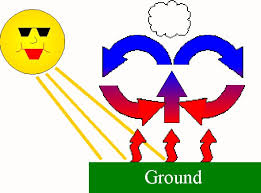
Convection

Heat transfer through movement of fluids.

  • Fluids are materials that can flow, like liquids and gases.

  • The particles at the bottom heat up and become less dense. This causes them to rise and push the colder and denser molecules down.

  • This movement is called a Convection Current​

55

Radiation

Heat transfer by electromagnetic waves.

  • The only form of heat transfer that does not require matter.

  • Heat you can feel but do not always see.

  • This is how we receive heat from the sun since it is able to pass through the vacuum of space where there is not matter present for it to travel through.

56

Multiple Choice

In what direction does heat move?

1

From Cold to Hot

2

To the Left

3

From Hot to Cold

4

To the Right

57

Multiple Choice

What causes a convection current and keeps it going?

1

Hot particles sink, causing the cold particles to rise.

2

Cold particles steal the heat from the hot particles.

3

Hot particles rise, pushing the cold particles down toward the heat source.

4

Convection currents do not move at all.

58

Multiple Choice

Question image

If an insulator is doing it's job well, the temperature of an object over time should...

1

rise slowly

2

lower quickly

3

show very little change

4

rise quickly

59

Multiple Choice

Hot things have ____________ thermal energy than cold things

1

more

2

less

3

same

4

potato

60

Multiple Choice

Question image
Heat transfer in wind.
1
conduction
2
convection
3
radiation

61

Multiple Choice

Question image
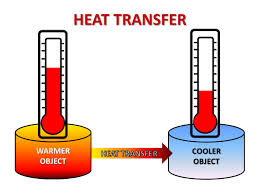
Heat transfers from an area of ____temperature to an area of ___ temperature.
1
high to low
2
low to high
3
high to high
4
It can travel high to low and low to high. 

62

Multiple Choice

Question image
Warm air rises and the cool air sinks demonstrates this type of heat transfer. 
1
conduction
2
convection
3
radiation
4
Insolation 

63

Multiple Choice

What is the transfer of heat by direct contact?
1
conduction
2
convection
3
radiation

64

Multiple Choice

What is a transfer of heat energy by electromagnetic waves through space?

1

conduction

2

convection

3

radiation

65

Multiple Choice

You are stirring a bowl of hot soup with a metal spoon. The spoon starts to feel warmer because of _?_.
1
conduction
2
convection
3
radiation

66

67

The Sun-

  • is the most massive object in our Solar System

  • governs the motion of all other bodies in the system by the force of gravity. 

  • (Bodies of the Solar System remain in their orbital paths due to a balance between gravitational forces and the constant forward motion of the celestial bodies.)

68

Gravity

  • is a force of attraction

  • between

  • two or more masses (objects).

69

Strength of the Gravitational Attraction

  • depends on the mass of the objects involved

  • and on the distance between them.

70

Gravity

Gravitational attraction exhibited by an object increases with increasing mass. If the distance between objects increases, gravitational attraction between the objects decreases.

71

72

media

73

media

74

media

75

media

76

media

77

media

78

media

79

media

80

media

81

media

82

media

83

media

84

media

85

media

86

media

87

media

88

media

89

media

90

media

91

media

92

media

93

media

94

media

95

media

96

media

97

media

98

media

99

Multiple Choice

Which statement is true about the Solar System?


1

The solid planets are much larger than the gas planets.


2

The planets are arranged in order of increasing size.


3

The solid planets are closer to the Sun.


4

The gas planets are closer to the Sun.


100

Multiple Choice

The ___________ is a region of thousands of small bodies that exists outside the orbit of Neptune. Objects in this area consist of "ices'' such as ammonia, water, and methane.


1

Oort Cloud

2

Comets

3

Asteroid Belt

4

Kuiper Belt

101

Multiple Choice

The third region of icy objects, a spherical cloud which starts roughly 300 billion kilometers out, is called ___.


1

The Scattered Disk

2

The Kuiper Cloud

3

The Oort Cloud

4

The Oort Disk

102

Multiple Choice

The 'Kuiper Belt' in space extends roughly from the orbit of the planet ___________.


1

Uranus

2

Pluto

3

Saturn

4

Neptune

103

Multiple Choice

Where is the Oort cloud located?


1

Beyond the Orbit of Pluto

2

Between the Sun and Mercury

3

Between the Asteroid Belt and the Kuiper belt

4

Within the Asteroid Belt

104

Multiple Choice

Analyze the characteristics of an unknown planet below:

  • Rings of ice

  • Revolution 29.5 years

  • Composed mostly of hydrogen and helium

  • Least dense planet, gas giant

Based on the characteristics, what planet is being described?

1

Jupiter

2

Venus

3

Mars

4

Saturn

105

Multiple Choice

Analyze the characteristics of an unknown planet below:

  • blue-green gas giant

  • Rings

  • 27 known moons

  • Revolution 87 years

  • Rotation 17 hours

Based on the characteristics, what planet is being described?

1

Venus

2

Mars

3

Uranus

4

Saturn

106

Multiple Choice

Analyze the characteristics of an unknown planet below:

  • Thick iron core with rocky surface

  • Sulfuric acid clouds

  • Revolution 225 days

  • Rotation 243 days

  • A day is longer than its year

  • CO2 atmosphere traps heat

Based on the characteristics, what planet is being described?

1

Mars

2

Saturn

3

Uranus

4

Venus

107

Multiple Choice

Astronomers discover a new, small, irregularly shaped object in the solar system. The object is orbiting the sun. It is composed of frozen molecules of gasses and other compounds. It is not orbiting a planet. How would the object be classified?


1

Dust

2

Satellite

3

Comet

4

Meteoroid

108

Multiple Choice

Planets vary as they get farther from the Sun. As a rule, the farther a planet’s orbit from the Sun, -

1

the rockier the surface of the planet.


2

the greater the planet’s surface temperature.


3

the greater the planet’s diameter.


4

the longer it takes to orbit the Sun.


109

Multiple Choice

Compared to the Sun, all other stars look like points of light in the night sky because the stars


1

give off much less light than the Sun.


2

give off different colors than the Sun.


3

are much farther away than the Sun.


4

are much smaller than the Sun.

110

Multiple Choice

Which of the following is a true statement about the outer planets?


1

they are gas giants whose orbits are furthest from the sun


2

they are gas giants and are the closest planets to the sun


3

they are gas giants and have terrestrial crust


4

they are gaseous and the smallest planets


111

Multiple Choice

Which of these best describes an asteroid?


1

large, liquid with an atmosphere


2

large, ball of hot gasses


3

small, solid, rocky


4

small, icy


112

Multiple Choice

Over the past few centuries, comets have occasionally been observed in the sky. What is one difference between comets and the Moon?


1

The Moon reflects light from the Sun, while comets generate their own light.


2

Comets collect debris as they travel in space, while the Moon gives off meteoroids.


3

The Moon has a core of ice, while comet cores are solid rock.


4

Comets have large orbits around the Sun, while the Moon orbits Earth.


113

Multiple Choice

Which two words best describe the Sun?


1

star and rocky

2

star and gases

3

planet and rocky

4

planet and gases

114

Multiple Choice

Question image

Leslie draws a picture of the Sun and Earth. Her teacher tells her the size of Earth compared to the Sun is not correct.

How should Leslie change the picture to show the correct sizes of Earth and the Sun in comparison to each other?

1

Increase the size of the Sun so it is twice the size of Earth.


2

Increase the size of Earth so it is twice the size of the Sun.


3

Decrease the size of Earth so it is a tiny dot compared to the Sun.


4

Decrease the size of the Sun so it is a tiny dot compared to Earth.


115

Multiple Choice

A student wants to illustrate the orbits of the planets in the Solar System. He draws several diagrams that show the placement of the Sun (S) and planets. Which diagram is most accurate?


1
2
3
4

116

Multiple Choice

The sun is primarily composed of which elements?


1

hundreds of hot gases


2

helium and oxygen


3

hydrogen and oxygen


4

hydrogen and helium


117

Multiple Choice

Which of the following statements is true about the gravitational attraction between two objects?


1

The less their masses and the farther apart they are, the greater their attraction.


2

The less their mass and the closer they are, the greater their attraction.


3

The greater their masses and the farther apart they are, the greater the attraction.


4

The greater the masses of the object and the closer together they are, the greater the attraction.


118

Multiple Choice

Gravity determines the interactions of the ___________________.


1

planets only


2

moon, planets and sun


3

planets and moon


4

moon and sun


119

Multiple Choice

Which two factors control the influence of gravity on objects?


1

Planetary radius and mass


2

Distribution and location in the solar system


3

Distance and distribution


4

Mass and distance


120

Multiple Choice

Which object in the solar system has the greatest mass and provides the greatest force to keep all objects within the solar system in orbit?


1

Sun

2

Asteroid Belt

3

Oort Cloud

4

Jupiter

121

122

media

Be sure to divide total distance by total time. It does not matter which number is larger.
Use your calculator.

I can divide distance and time to calculate average speed or the instantaneous speed within a graph word problem

123

media

124

media

125

media

126

media

127

media

128

media

129

media

130

media

MOTION GRAPHS

131

media

I can draw a motion graph showing start, stop, and at rest
I can draw a motion graph showing an increase in speed, a decrease in speed, and a constant speed

132

media
media

DISTANCE-TIME GRAPHS
Plotting distance against time can tell you a lot
about motion. Let's look at the axes:

133

media
media

If an object is not moving, a horizontal line is
shown on a distance-time graph.

Time is increasing to the

right, but its

distance does not change.

It is not

moving. We say it is At

Rest.

134

media
media

If an object is moving at a constant speed, it means it
has the same increase in
distance in a given time:

Time is increasing to the right,

and distance is increasing

constantly with time. The object

moves at a constant speed.

Constant speed is shown by

straight lines on a graph.

135

media
media

Lets look at two moving objects:
Both of the lines in the graph show that each object
moved the same distance, but the
steeper dashed line got there before the other one:

A steeper line indicates a larger
distance moved in a given time.
In other words, higher speed.

Both lines are straight, so both

speeds are constant.

136

media
media

Graphs that show acceleration look different from
those that show constant speed.
Time is increasing to the right, and distance

The line on this graph is curving

upwards. This shows an

increase in speed, since the

line is getting steeper:

In other words, in a given time,
the distance the object moves is

change (getting larger). It is

accelerating.

137

media

Summary:

A distance-time graph tells us how far an object

has moved with time.

The steeper the graph, the faster the motion.

A horizontal line means the object is not

changing its position - it is not moving, it is at

rest.

A downward sloping line means the object is

returning to the start.

138

media
media

139

media
media

140

Multiple Choice

Question image
A runner races in the 100 meter dash.  It takes her 10 seconds to finish.  What is her average speed?
1
10 m/s
2
1000 m/s
3
100 seconds
4
10 seconds

141

Multiple Choice

Question image
Total distance divided by total time is
1
average speed
2
constant speed
3
instantaneous speed
4
acceleration

142

Multiple Choice

Question image
Find speed when distance is 142 km and time is 2 hours.
1
71km/hr
2
52km/hr
3
17km/hr
4
90km/hr

143

Multiple Choice

Question image
What does this graph represent?
1
Constant Speed
2
Acceleration
3
Not moving

144

Multiple Choice

Question image
What is the speed of an object that travels 60 meters in 4 seconds?
1
240 m/s
2
15 m/s
3
0.067 m/s
4
15 mph

145

Multiple Choice

While going to school, a student walks an average of 5 km/hr west for 12 blocks.
1
Speed
2
Velocity

146

Multiple Choice

While on a trip, a family travels east from San Antonio to Houston going 70 mph.
1
Speed
2
Velocity

147

Multiple Choice

A car traveling 300 miles in 5 hours is an example of _____. 
1
Speed
2
Velocity
3
Direction

148

Multiple Choice

Distance over Time is the definition of ___. 
1
Speed
2
Velocity
3
Direction

149

Multiple Choice

What is velocity?
1
the quickness of an object
2
the location of an object
3
acceleration
4
speed in a specific direction

150

Multiple Choice

Which graph indicates constant speed?

1
2
3

151

Multiple Choice

Which graph indicates lower speed?

1
2
3

152

Multiple Choice

Question image

Which graph shows that the object is moving fast?

1

A

2

B

3

C

153

Multiple Choice

Question image

This graph shows the movement of an object. When is the most distance covered by the object?

1

between seconds 0 and 1

2

between seconds 1 and 2

3

between seconds 2 and 5

4

between seconds 5 and 6

154

155

​Newton's First Law of Motion

Newton's First Law of Motion states, if the net force on an object is zero, then the motion of the object does not change.

​This means an object at rest stays at rest if it isn't acted on by an outside force. And an object in motion stays in motion unless acted on by an outside force.

media

156

media

157

Multiple Choice

the tendency of an object to resist a change in its motion

1

acceleration

2

inertia

3

mass

4

frame of reference

158

Multiple Choice

Objects with greater _________ also have greater inertia.

1

speed

2

mass

3

temperature

4

friction

159

Multiple Choice

Because of inertia, a resting object will remain at ________.

1

rest

2

a constant speed

3

school

4

inertia 

160

Multiple Choice

Because of inertia, a moving object will keep ________.

1

at rest

2

moving

3

in one spot

4

inertia 

161

Multiple Choice

Newton's 1st Law of Motion is also called the Law of ...

1

Friction

2

Inertia

3

Unbalanced forces

4

Newtons

162

Multiple Choice

An object in motion tends to stay in motion unless an ___ force acts on it.

1

unbalanced

2

balanced

163

Match

Question image

Match these vocabulary terms

To stay the same; to not change

Resistance between two moving objects

A push or a pull

Mass

Gravity

Inertia

Friction

Force

amount of matter

The force that pulls inward

Semester Review

Show answer

Auto Play

Slide 1 / 163

SLIDE